Essential Points
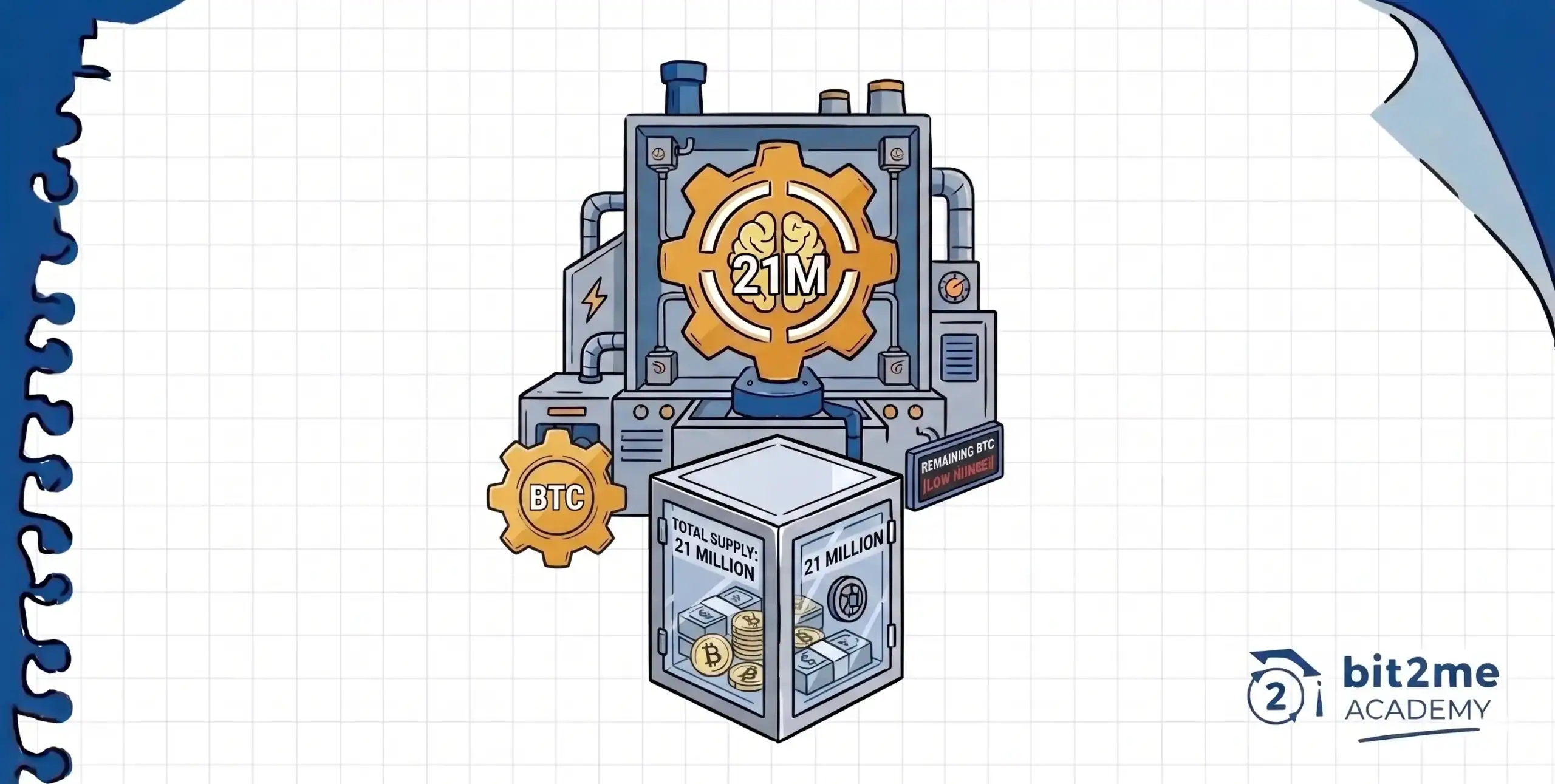
- Final stretch of broadcast: By March 2026, the network had already surpassed 20 million tokens in circulation, leaving just one million units yet to be discovered.
- Extended schedule: Thanks to the halving algorithm, this last million assets will be distributed in a decreasing manner over the next 114 years, ending approximately in the year 2140.
- Real scarcity underestimated: The available supply is significantly lower than the theoretical amount, given that it is estimated that almost 4 million units have been permanently lost due to forgotten passwords or inactive wallets.
- Transition of the mining model: Network security no longer relies on the creation of new tokens, but on a mature transaction fee market, where miners act as auditors of a high-value critical infrastructure.
- Unique inelastic supply: Unlike gold or fiat money, this is the first asset where an increase in demand or price cannot generate more supply, only increasing the difficulty and robustness of the system.
By this point in March 2026, the question is no longer whether this digital asset has value, but rather how much is actually left in the network for those who arrive late. Following the fourth halving in 2024, the ecosystem has mutated.
We are no longer in that era of abundance where miners poured thousands of new units into the market every month; today, scarcity is not an economic theory, it is a technical reality that knocks on the door of exchanges every day.
Looking at the blockchain's real-time counter, the figure is striking: just over 20 million BTC have been mined. This leaves us with a remaining haul of barely one million units yet to be discovered. It seems like a small amount, and it is. However, the way in which those final snippets of code will be released is what defines the most disciplined financial architecture in history.
The Network Clock: Why We Won't Finish Tomorrow
One might think that, with so little time remaining, the process would end in a couple of years. Nothing could be further from the truth. The protocol designed by Satoshi Nakamoto doesn't care about human haste, but rather about blocks and adjustment algorithms. The issuance of each cryptocurrency is programmed to be halved every 210.000 blocks, an event known as the halving.
Currently, the block reward is 3,125 tokens. For the next event in 2028, that number will drop to 1,56. This asymptotic emission curve ensures that the last piece of this digital asset will not be mined until approximately 2140.
Do we really need another Layer 2 to address liquidity in the meantime? Probably not, but the mathematical structure compels us to be patient. The design is such that supply never artificially exceeds demand.
The paradox of lost tokens: Real scarcity
This is where the technical analysis gets interesting. While we say there are almost 20 million units, the reality is much harsher. It's estimated that around 3,7 million tokens are lost forever.
We're talking about hard drives in Welsh landfills, early investors who died without leaving their private keys, and, of course, the famous million units in Satoshi's wallets that haven't moved in over fifteen years. Subtracting these figures, the actual circulating supply that the market can buy and sell is significantly smaller.
Many users prefer the convenience of logging in from their mobile device and seeing a nice balance in an app. But if those apps don't allow you to withdraw the digital asset to a cold wallet, that balance is just a promise. The real scarcity is what you hold in your own hands; the rest is statistical noise in a database.
Mining in 2026: Profitability with low rewards
How is it possible that miners continue to operate their machines if they are receiving fewer and fewer units? The short answer is that the business model has mutated from "extracting raw materials" to "providing critical infrastructure."
In Spain, the image of the enthusiast with three graphics cards in their garage is a romantic anachronism. Today, mining is a game of scale, thermal efficiency, and, above all, energy arbitrage.
The end of subsidies and the reign of commissions
Historically, miners lived off the "block subsidy"—those newly minted coins the network gave away for securing the blockchain. But with the current reward of 3,125 tokens, the margin has narrowed to the point of a bottleneck. Does this mean the end of security? On the contrary. The business today revolves around transaction fees.
With the explosion of data protocols and the tokenization of real-world assets (RWAs) on the main layer, the space within each ten-minute block has become the most expensive real estate on the planet. Miners are no longer simply "coin makers"; they now act as auditors on a high-security financial highway, charging premium tolls for every movement of value. It doesn't matter if the issuance falls as long as the traffic (and the value of what's being transported) keeps growing.
Spain as a laboratory of efficiency
In the national context, the sector has found an unexpected ally in the energy transition. Mining plants in Spain are being strategically located next to wind farms and photovoltaic plants to take advantage of surplus energy. When the electricity grid cannot absorb all the renewable energy produced at midday or on windy nights, the miners step in.
This on-demand consumption allows power plants to remain profitable while the digital asset is mined at near-zero energy cost during those off-peak demand periods. Is it efficient to burn electricity for this? If it's energy that would otherwise be wasted, the answer is a resounding yes. It is, in fact, the most effective grid stabilizer we've ever invented.
The "$600.000 Billion Question" applied to hardware
Just as with the AI bubble we're analyzing this year, mining faces its own infrastructure challenge. The hardware of 2026—state-of-the-art, liquid-cooled ASICs—requires a capital investment (Capex) that only large corporations can afford.
Simply plugging a computer into a wall outlet is no longer enough. Heat flow, Power Purchase Agreements (PPAs), and the lifecycle of chips that become obsolete in just 36 months must now be managed. The protocol's incentive is undeniable: as long as the cryptocurrency's price maintains its upward trend against the euro's devaluation and network fees remain competitive, the system's security will remain impenetrable. Ultimately, the network not only survives scarcity; it thrives on it.

What will happen when the counter reaches zero?
To say that the network will die when the last token is consumed is a superficial reading that ignores how game theory works. The technical answer is a resounding "no." By then (and we're already seeing this in 2026 with the proliferation of execution layers on top of the main network), the transaction volume and value are expected to be so high that the fees alone will keep miners incentivized to protect the system.
Do we really need to create new units to keep computers running? No. If network usage is massive, the fee for writing data to the ledger will be enough to cover security costs. The protocol won't stop; it will simply transition from an inflationary model (where tokens are given away) to a pure service model. Miners will go from being "gold diggers" to being the "guardians of the global infrastructure."
The first inelastic supply in history
You don't need to be a systems engineer to understand that we are looking at the first asset in human history whose supply is absolutely inelastic. Not even gold has this property. Think about it for a second: if the price of gold rises to €5.000 an ounce, mining companies invest in technology to move mountains that were previously unprofitable. More gold appears on the market. Supply responds to price.
With this digital asset, that answer is physically impossible. If the price rises, the only thing that increases is the mining difficulty (the competition between machines), but the rate at which new tokens are issued remains the same: one block every ten minutes, approximately. The code is indifferent to your ambition, the euro's inflation, or geopolitical crises.
Many veteran analysts point out that this characteristic is what makes the asset the "benchmark" of value. While other assets diminish in the face of success, this one consolidates. It's a mathematical anomaly that breaks with centuries of traditional economic theory, which always assumed that everything has a price at which more can be produced. Here, the 21 million limit is the only absolute truth in a sea of bank promises.
More than a number, a guarantee
Knowing how many are left to be mined is an accounting exercise, but understanding why they are limited is an exercise in financial sovereignty. In a world where central banks print money to plug structural holes, this immutable code offers something fiat money cannot: certainty.
It doesn't matter if there are one million or ten million left; what matters is that you, I, and the rest of the world always know exactly how many there will be. That transparency is the true engine of trust in the ecosystem.
 Certificate
Blockchain Course
Basic levelTake this course where we explain blockchain in a clear, simple and concise way so that you have a very clear idea of what this new technology consists of.

 Author