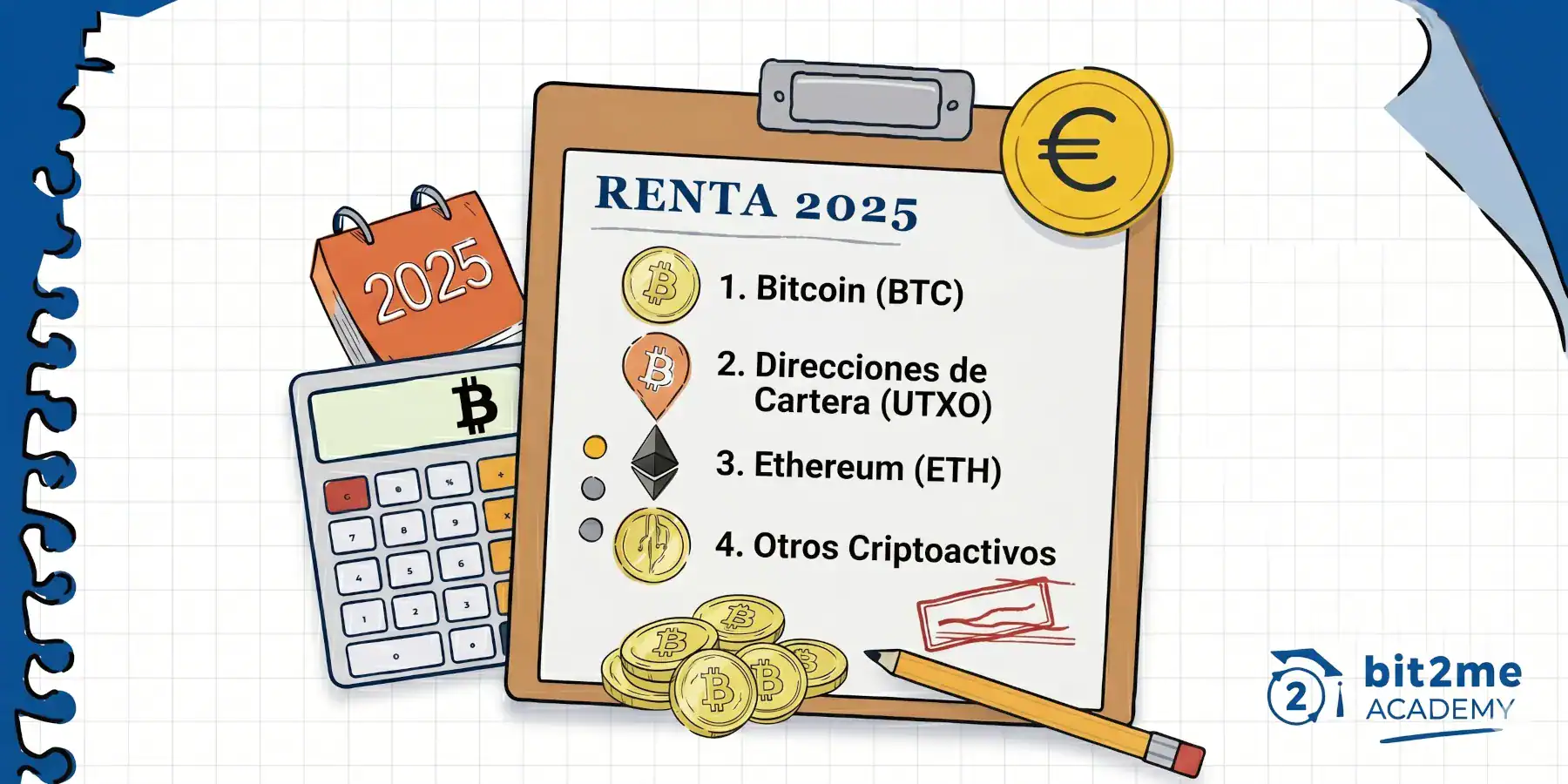
Essential Points
- Selling or exchanging crypto assets produces a capital gain or loss that is taxed under the savings base, even if you never convert the money to euros.
- Savings rates range from 19% to 30% from 2025, and the FIFO method decides which purchase is considered sold first.
- Form 721 must be filed between January and March if your balances abroad exceed €50.000 as of December 31.
- DAC8 expands the information received by the Treasury, but its transposition in Spain remains a pending project for publication in the Official State Gazette (BOE) as of October 2026.
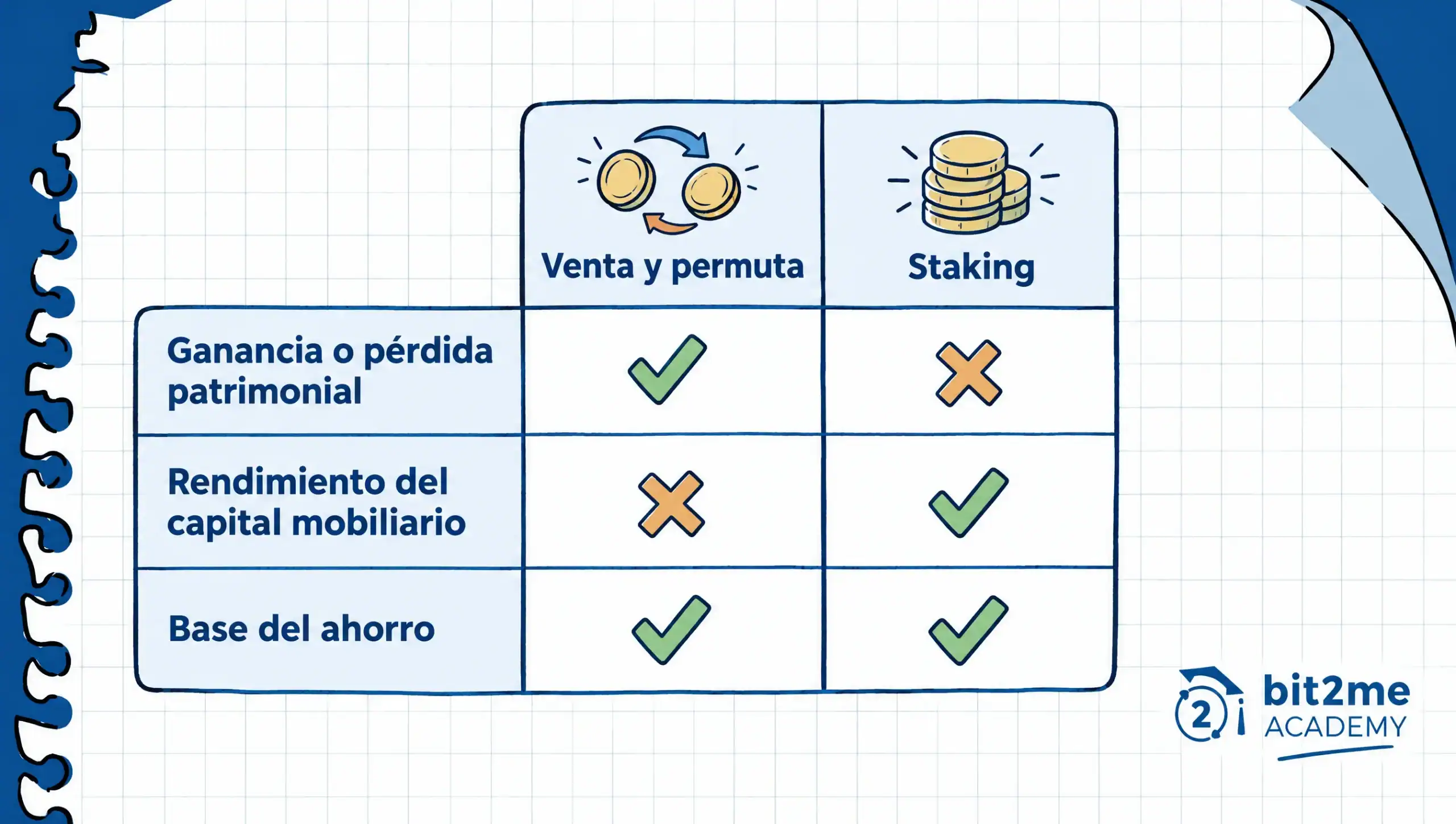
To declare crypto assets on your income tax return, the first step is to identify what you've done with them. Sales and exchanges are declared as capital gains or losses, and staking as investment income, both under the savings income tax base. Even if you don't convert anything to euros, exchanging one crypto asset for another is considered an exchange, according to the Spanish Tax Agency (AEAT).
The Tax Agency has more information than many users realize. The 2026 Annual Tax Control Plan, published in the Official Gazette of March 12, 2026It states that in 2025 the AEAT received data for the entire year on balances and operations with virtual currencies through forms 172, 173 and 721, and that in 2026 it will promote control actions on those who have operated with these assets without declaring their income or capital gains.
The 2025 tax return filing period closed on June 30, 2026, according to the AEATHowever, the underlying rules do not expire with it: the classification of each transaction, the savings brackets, the FIFO method, and the offsetting of losses apply year after year. What changes each year are the dates, the reporting forms, and, with DAC8, the information received by the Tax Agency, so every dated piece of information in this guide includes its source and the date of consultation.
 Certificate

How to declare crypto assets on your tax return depending on each transaction?
The tax treatment depends on what you do with the cryptocurrency, not where you store it. Article 46 of the Personal Income Tax Law Your savings income tax return includes capital gains and losses from transfers, and the sale of a cryptocurrency is one of them. If this is your first tax return, the Academy's introduction on how to declare your cryptocurrencies to the tax authorities organize the basic concepts.
The swap is the operation that usually causes the most surprise. When you exchange one cryptocurrency for another, for example Ethereum for a stablecoin, the Spanish Tax Agency (AEAT) understands that you have transferred the first and takes as the transfer value the higher of the market value of what you give up and the market value of what you receive, according to its regulations. Fact sheet on virtual currencies.
The table summarizes how each transaction is classified and where it is reported. Rows without confirmed criteria are marked as such because we have not been able to find any official source on them, and it is preferable to acknowledge this rather than assume it.
| Operations | Qualification | Base | Box or model | Source (accessed 26-10-2026) |
|---|---|---|---|---|
| Sale in euros | Capital gain or loss | Saving | Virtual currency transmission box (1804, according to the AEAT Assistant) | BOE, article 46 of the Personal Income Tax Law, and AEAT |
| Swap between crypto assets | Capital gain or loss | Saving | Same transmission box (1804) | AEAT, fact sheet on virtual currencies |
| Staking | Return on investment | Saving | Box 0027, according to the Income Tax Report | AEAT, Income Tax Information |
| Airdrops, DeFi and NFTs | No official criteria confirmed | You confirm | You confirm | No official source read |
| Payment for goods or services with crypto assets | No official criteria confirmed | You confirm | You confirm | No official source read |
| Balances held in custody abroad | Informative statement, outside the calculation of the tax | Does not apply | Model 721 | BOE, Order HFP/886/2023 |
For staking, the AEAT Income Tax Information Officer It includes it among the returns on movable capital and not among capital gains. taxation of staking and airdrops details each case, and the Practical guide to tax return boxes It includes the numbering of each form, which changes from one campaign to another.
How much is paid and how is the FIFO method applied?
Savings are taxed in brackets, so each rate applies only to the portion of the base that falls within that bracket. Since January 1, 2025, Law 7/2024 raised the highest rate in the brackets of Articles 66 and 76 of the Personal Income Tax Law, and the total reaches 30% for amounts exceeding €300.000, according to the consolidated text of the Official State Gazette (BOE), updated on October 7, 2026, and consulted on October 26, 2026.
| Liquidable base of savings | State type | Autonomous type (article 76) | Total |
|---|---|---|---|
| Up to € 6.000 | 9,5% | 9,5% | 19% |
| From €6.000 to €50.000 | 10,5% | 10,5% | 21% |
| From €50.000 to €200.000 | 11,5% | 11,5% | 23% |
| From €200.000 to €300.000 | 13,5% | 13,5% | 27% |
| More from 300.000 € | 15% | 15% | 30% |
Before 2025, the final tax bracket was 28%, according to the Spanish Tax Agency (AEAT). The region where you live may have its own regional tax scale, so confirm yours before calculating anything.
To determine your profit or loss on each sale, you need to define which purchase is considered sold. The Spanish Tax Agency (AEAT) indicates that when you transfer only a portion of your homogeneous cryptocurrencies, those you acquired first are considered sold, even if they are held on different exchanges. This is known as FIFO (First In, First Out), and it requires reconstructing the complete transaction history for each cryptocurrency.
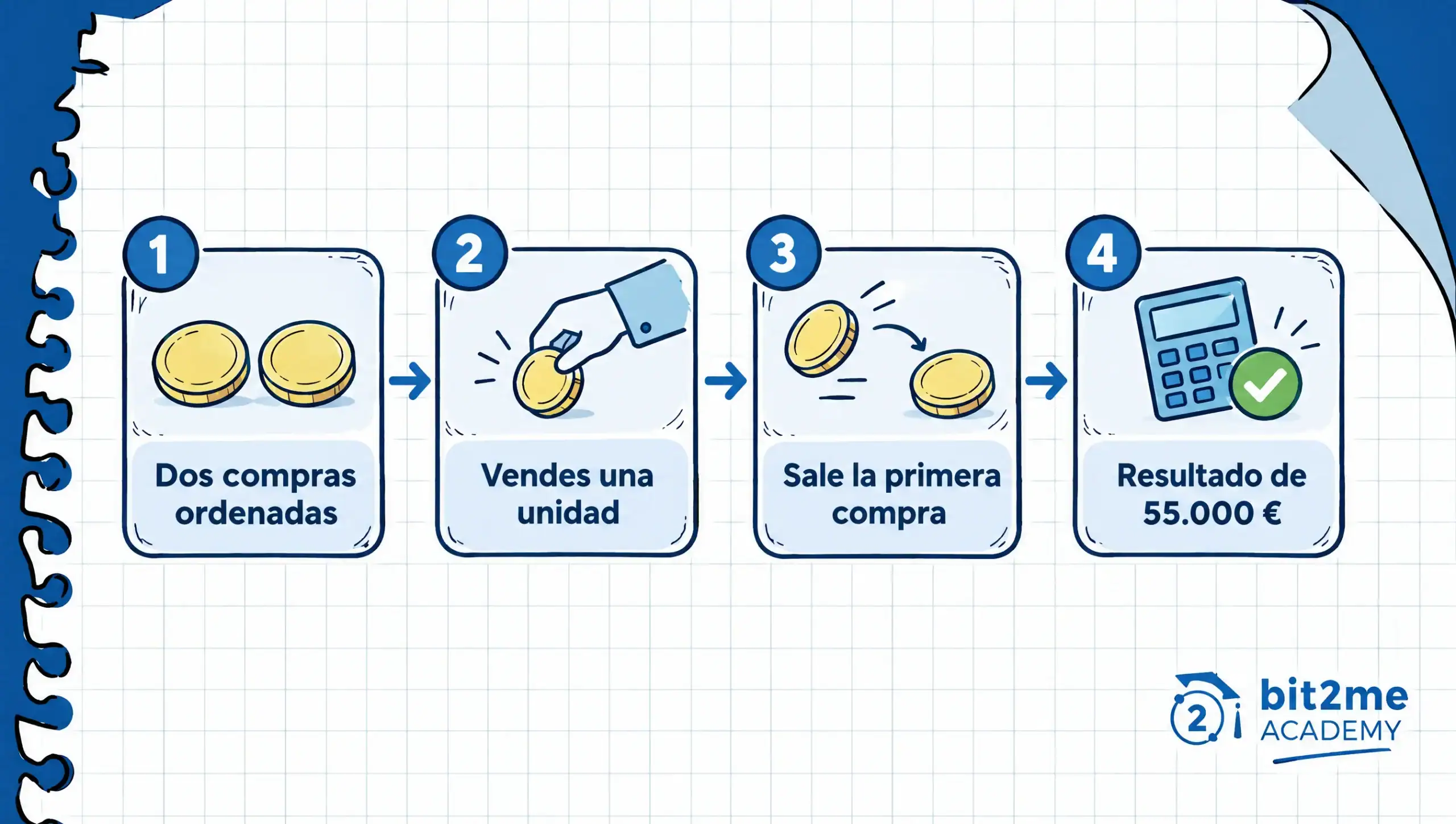
An example using round figures, which are illustrative and not market prices, shows the effect. You buy one unit of a cryptocurrency for €15.000. Months later you buy another for €60.000. Later you sell one unit for €70.000, and the steps are as follows:
- Sort your purchases by date: the first one cost €15.000 and the second one, €60.000.
- Identify the sale: you deliver one unit for €70.000 and the first one you bought is considered sold.
- Subtract its acquisition cost from the transfer value: the result, €55.000, is the capital gain.
- Leave the most expensive unit in your portfolio at its cost, which will be the starting price for your next sale.
Using the FIFO method, the result is €55.000. If you could choose the most expensive purchase, it would only be €10.000, and that difference explains why the method matters: the Spanish Tax Agency (AEAT) sets it as the rule, and it's not up to you.
What losses and expenses can be taken into account when declaring?
Article 35 of the Personal Income Tax Law adds to the acquisition value the expenses and taxes inherent to the purchase, excluding interest, and subtracts from the transfer value those paid by the seller.
That rule is the legal basis for taking into account the platform's buying and selling commissions. Whether a network (gas) commission also counts as an inherent expense is a criterion we haven't been able to verify with the Spanish Tax Agency (AEAT) or the Spanish Directorate General of Traffic (DGT), so it's advisable to confirm this with an advisor.
Losses follow their own course. According to article 49 of the same law, if the capital gains and losses for the year result in a negative balance, this is first offset by the positive balance of the returns on movable capital for the period, up to a limit of 25%, and the remainder in the following four years.
An illustrative example clarifies this. In fiscal year 2025, you lose €5.000 on some trades and gain €2.000 on others. The balance is a net loss of €3.000, which offsets up to 25% of your staking returns for that year, with the remainder available for the following four fiscal years.
| Exercise in loss | Exercises in which compensation can be achieved | Years in which those declarations are submitted |
|---|---|---|
| 2025 | De 2026 a 2029 | De 2027 a 2030 |
| 2026 | De 2027 a 2030 | De 2028 a 2031 |
Distinguishing between the tax year and the year in which the declaration is filed is what causes the most confusion when calculating the deadline, and it is advisable to note each loss with its tax year of origin so as not to let any expire.
If you have traded in Bit2Me, Bit2Me Tax Your account includes at no extra cost a one-year tax report using the FIFO method, in PDF and CSV format, according to the information sheet consulted on October 26, 2026. It only covers transactions carried out in Bit2MeIt does not file the tax return nor is it tax advice, so you have to add the rest yourself.
Does the two-month rule apply to crypto assets?
Article 33.5 of the Personal Income Tax Law prevents the loss on a sale from being deductible if the same asset is repurchased within a certain period: two months for securities admitted to trading on official markets and one year for those not admitted or for other assets. We have not found any official criteria regarding which of these cases applies to crypto assets, or whether they are excluded altogether.
The general rule is explained in the Academy guide on the taxation of shares and the two-month ruleAnd in your case, it's best to confirm it with a consultation with the DGT (Spanish Directorate General of Traffic) or with an advisor.
What are models 172, 173, and 721, and who presents each one?
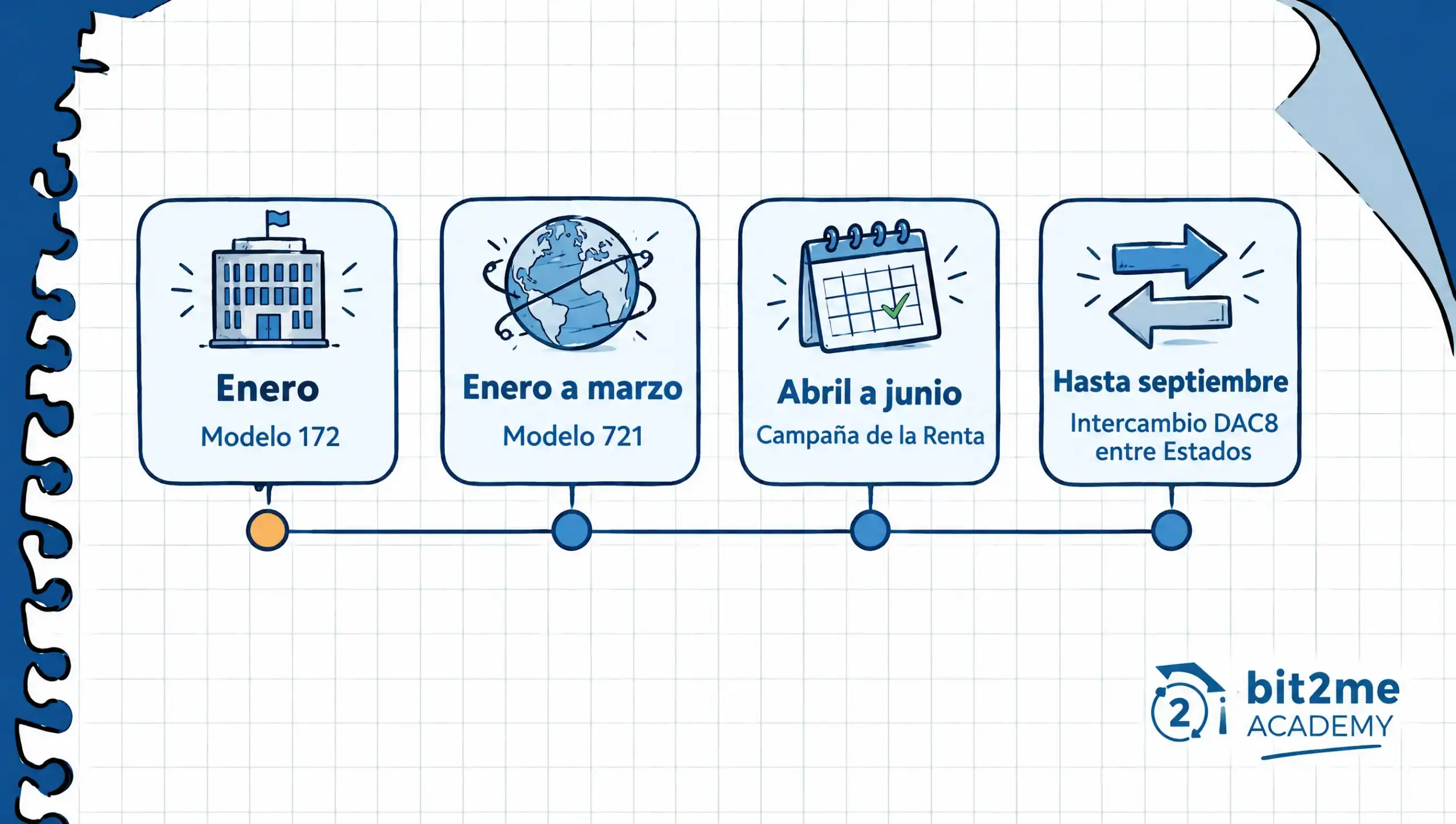
All three are informational returns and are not used to pay any taxes. Forms 172 and 173 were approved with the Order HFP / 887/2023Form 172 reports balances in virtual currencies and form 173 reports transactions, with annual presentation in January of the following year and for the first time in January 2024, for the 2023 fiscal year.
The order refers to Articles 39 bis and 39 ter of the tax management regulations to define who must file them, something we have been unable to verify. The 2026 Control Plan describes the future Form 175 as the declaration for providers of crypto-asset services, which will replace Form 173.
| Córdoba | What it reports | Term | Who | Source (accessed 26-10-2026) |
|---|---|---|---|---|
| 100 (Rent) | Taxpayer income, including income from crypto assets | Annual campaign, from April 8 to June 30, 2026 for the 2025 fiscal year | The taxpayer | AEAT |
| 172 | Balances in virtual currencies | January of the following year | Obligated according to the management regulations | BOE, Order HFP/887/2023 |
| 173 | Transactions with virtual currencies | January of the following year | Obligated according to the management regulations | BOE, Order HFP/887/2023 |
| 721 | Virtual currencies located abroad | From January 1st to March 31st of the following year | Anyone who exceeds the threshold | BOE, Order HFP/886/2023 |
Model 721 is the one that could affect you. It has its own order, the Order HFP / 886/2023, different from that of model 720, and according to the frequently asked questions of the AEATAccording to the information consulted on October 26, 2026, the obligation arises when the combined balance as of December 31 exceeds €50.000.
In subsequent years, it only needs to be filed again if the balance increases by more than €20.000 compared to the last declared amount. The Spanish Tax Agency (AEAT) also excludes coins held in non-custodial wallets from the calculation, although form 721 is for informational purposes only and does not replace the declaration of your transactions in your income tax return.
If you have a company, form 721 and the accounting for crypto assets follow their own rules, which the Academy guide on How to declare cryptocurrencies in companies meets with its official sources.
What changes with the DAC8 in Spain?
The DAC8 is the Directive (EU) 2023/2226, which extends tax cooperation between states to crypto assets. According to the European CommissionIt applies from 1 January 2026, obliges providers to report on the operations of their users and sets the first exchange of data, that of the 2026 financial year, before 30 September 2027.
In Spain, the Government submitted to the Cortes on June 3, 2025 the transposition bill, which modifies, among others, the General Tax Law and the Personal Income Tax Law and replaces the concept of virtual currency with that of crypto asset.
For the models, the draft order Submitted to public hearing on March 10, 2026, it provides for models 042, 172, 175 and 721, and its report places the first application in the year 2026, with presentation from 2027 onwards.
These are all drafts, pending publication in the Official State Gazette (BOE): as of October 26, 2026, we have not located the published law, royal decree, or order. Meanwhile, forms 172, 173, and 721 remain in effect, and the 2026 Control Plan already anticipates that form 175 will replace form 173 once the order is approved.
Current status of the declaration of crypto assets in October 2026
The dates and models for this subject change with each campaign and with each new regulation, so the table reflects the situation as of October 26, 2026, with the source and date of consultation for each piece of data.
| Materia | Situation | Source (accessed 26-10-2026) |
|---|---|---|
| Income tax for the year 2025 | Campaign from April 8 to June 30, 2026, now closed | AEAT |
| Late submission | Without prior notice, a surcharge of 1% plus 1% for each full month of delay, and 15% plus late payment interest after 12 months. | Official State Gazette (BOE), Article 27 of the General Tax Law |
| Income tax for the year 2026 | It is due in 2027; as of October 26, 2026, no calendar was available in the sources consulted. | AEAT, taxpayer calendar |
| Model 721 for the year 2026 | Applications accepted from January 1 to March 31, 2027, with a threshold of €50.000 | BOE, Order HFP/886/2023, and AEAT |
| Models 172 and 173 | Annual presentation in January of the following year | BOE, Order HFP/887/2023 |
| Maximum savings tier | 30% discount on amounts over €300.000, valid from January 1, 2025 | Official State Gazette, Personal Income Tax Law |
| AEAT Control | In 2026, it receives, for the second year, the complete 2025 information on balances and operations | Official State Gazette (BOE), Control Plan 2026 |
| DAC8 | Applicable in the EU from 1 January 2026, with the first exchange before 30 September 2027; in Spain, projects pending publication in the Official State Gazette (BOE). | European Commission and Finance |
Checking directly with the Spanish Tax Agency (AEAT) and the Official State Gazette (BOE) is more reliable than any date in an article, including this one. Filing your 2025 tax return late, whether as a new, supplementary, or corrected return, involves specific procedures that you should confirm with the AEAT. Here, we only mention the surcharge stipulated by law.
What to check before declaring crypto assets in next year's tax return
Declaring crypto assets on next year's tax return will be much easier if you prepare now a complete history of purchases and sales for each cryptocurrency, along with a list of platforms and wallets where you held a balance as of December 31st. Transactions without a confirmed rationale, such as airdrops, DeFi, or NFTs, require separate consultation with a tax advisor.
With DAC8 on the way, the margin for discrepancies is reduced: the 2026 Control Plan already announces Form 175, and we will have to wait for the Official State Gazette (BOE) to publish the order to know from which fiscal year the new forms apply. Until then, the best preparation is an organized and dated record of each transaction.

Frequently asked questions about declaring crypto assets on your income tax return



 Author