- Domain in stablecoins and users: TRON consolidates its position as the leading network for USDT transactions, exceeding 3,4 million daily users thanks to its DPoS consensus model, which guarantees high speed and the lowest fees on the market.
- Convergence with Artificial Intelligence: Through APENFT, the ecosystem integrates advanced models such as GPT-5 and Claude directly into the TronLink wallet, enabling a "pay-per-use" economy with exclusive benefits for token holders.
- Layer 2 (L2) Infrastructure: The metamorphosis of BitTorrent (BTTC) has created a vital bridge of interoperability between TRON, Ethereum, and BNB Chain, facilitating massive decentralized storage and frictionless asset transfers.
- Self-sufficient ecosystem: With the union of STEEM (content), WINkLink (oracles) and HTX DAO (liquidity), TRON ceases to be just a payment network to become a global operating system capable of managing all layers of Web3 in one place.
Since its inception in 2018, the TRON (TRX) network has been consolidated under one non-negotiable premise: Democratize access to a high-performance blockchain architecture with low latency and minimal transaction costs. Thanks to its robust consensus mechanism Delegated Proof of Stake (DPoS), The network has not only increased in efficiency, but has also achieved unprecedented milestones in the industry. According to Recent data from MessariTRON currently maintains a base of over 3,4 million daily active users and exceeds 300 million accounts, positioning itself as the absolute leader in stablecoin trading volume and total value locked (TVL).
However, TRON's potential in 2026 transcends financial metrics. What began as a value transfer network has evolved into a comprehensive and unified ecosystem. Through the integration of cutting-edge solutions such as BitTorrent Chain (Layer 2), the AI-powered economy of APENFT (NFT) with access to GPT-5 models, and the decentralized governance of HTX DAO, TRON stands as the ultimate gateway to Web 3.
In a global landscape where high network fees are often the main barrier to entry, Justin Sun's vision of "decentralize the web", This has materialized today in a platform where scalability and interoperability don't compromise the user experience. This is the preferred infrastructure for those seeking true efficiency, combining decentralized storage, content sovereignty, and massive liquidity in a single global operating system.

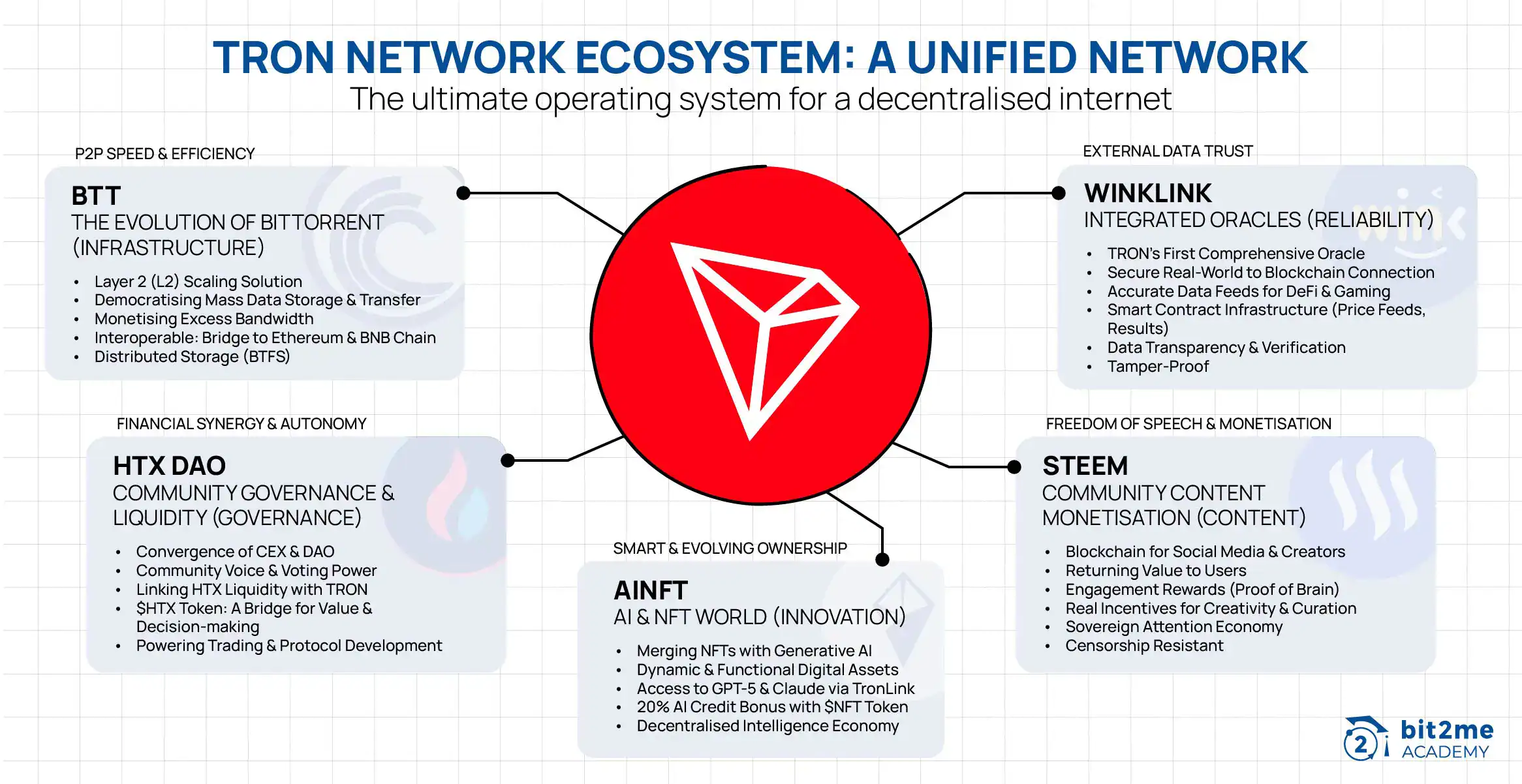
The 5 pillars of TRON
To understand the true scope of the ecosystem or TRON Network, it is necessary to break down the pillars that support its architecture.
BitTorrent (BTT): Storage and Layer 2
And to do that, we'll begin with BitTorrent (BTT)To understand the magnitude of BitTorrent (BTT), it is vital to look beyond its origins. This project, globally recognized for building the largest P2P file-sharing protocol in history, has completed its metamorphosis into a cutting-edge financial infrastructure: a Layer 2 scalability solution for the blockchain.
Currently, BTT operates with a maximum token supply of 990 billion, a figure designed to enable smooth and granular microtransactions within its network. Thanks to this, the project maintains an approximate market capitalization of $332 million (February 2026), solidifying its position as a key player in the top infrastructure asset market.
Democratizing mass storage
The current vision of the BitTorrent Chain (BTTC) focuses on democratizing the storage and transfer of massive amounts of data. This allows users to monetize their excess bandwidth, transforming a previously wasted resource into a value-generating asset.
By deeply integrating with the TRON ecosystem, BTT offers an infrastructure where download speeds and efficient decentralized content distribution are the norm. Of particular interest is that, thanks to its interoperability, BTT not only connects with TRON but also acts as a vital bridge to networks like Ethereum and BNB Chain, enabling assets and information to flow between the world's largest networks at minimal cost.
In this way, the ecosystem eliminates the bottlenecks of traditional networks and directly rewards those who maintain the network through distributed storage (BTFS). All of this is achieved, of course, without losing the P2P and open-source essence that has prevailed in the protocol since its creation in 2001. Thus, BTT is not just a utility token; it is the fuel of a global operating system that rewards collaboration and ensures that the web of the future is owned by its users, not by large centralized servers.
AINFT: Integrating GPT-5 and Claude into the blockchain
At the same time, in the field of the new digital economy and artificial intelligence, there arises AINFT (NFT), a proposal that goes beyond simple collectible digital art.
AINFT's central objective is to merge the immutability of non-fungible tokens with state-of-the-art AI capabilities, allowing digital assets to move from static to dynamic and functional.
For the user, this translates into ownership of smart assets that can evolve, learn, or interact in complex Web3 environments. Of particular interest is that the platform already allows access to advanced models like GPT-5 and Claude directly through the TronLink wallet, eliminating traditional subscription barriers.
Furthermore, the use of the NFT token within this ecosystem grants a 20% bonus in AI credits, incentivizing a "pay-per-use" economy that positions TRON as an innovation hub where digital identity and intellectual property are protected by highly efficient, low-cost smart contracts.
In this way, AINFT not only redefines collecting but also lays the foundation for a decentralized intelligence economy. With a user base already exceeding 410.000 participants, the project demonstrates that the future of NFTs lies not in mere contemplation but in real-world utility and digital sovereignty, empowering each user to own the technology they use to create and communicate in the globalized world.
STEEM: The "Proof of Brain" Revolution
The following proposal is STEEMSTEEM, a platform designed to democratize content, was conceived as a blockchain specifically for social networks and creator communities. However, unlike traditional networks, STEEM operates as a blockchain designed specifically for social networks and creator communities, where ownership and value remain in the hands of the users.
Their vision is to return value to content creators by eliminating corporate intermediaries through a rewards system based on active participation and collective judgment. This is achieved through innovative mechanisms such as... "Proof of Brain" TRON users who interact with STEEM-based platforms can earn real and tangible incentives for their creativity and data curation. Of particular interest to the reader is that this algorithm rewards not only the author but also the reader who discovers and votes on quality content early on, creating a "rewarded curation" system that doesn't exist in Web 2.0.
This model reinforces TRON's goal of building a truly decentralized web where freedom of expression and direct monetization are central. By integrating STEEM, TRON positions itself not only as a financial network but also as a bastion of the attention economy, where every social interaction has the potential to become a digital asset. This allows millions of creators in emerging markets to find in the TRON ecosystem a sovereign, censorship-resistant, and globally connected source of income.
WINK: TRON's reliability network
Of course, a network with a large number of DeFi services, or advanced applications, needs a powerful blockchain oracle system, and the reliability of external data is guaranteed by WINkLink (WIN), the first comprehensive oracle of the TRON ecosystem.
The vision of this project is to securely connect the real world with the blockchain, providing accurate data flows for decentralized finance (DeFi) applications and gaming systems. WINkLink offers developers the necessary infrastructure to create smart contracts that react to external events, such as market prices or sports results, with complete transparency.
This not only improves user confidence in decentralized applications, but also ensures that the entire ecosystem operates with verifiable information and tamper-proof data.
HTX: Community Governance and Liquidity Component
Finally, the governance and liquidity component is provided by HTX (HTX DAO), a project that symbolizes the convergence between centralized exchanges and the autonomy of decentralized organizations.
The goal of HTX DAO is to empower the community to have a say in the management of one of the industry's largest exchange platforms by closely linking HTX liquidity with TRON's infrastructure. Users benefit from a connected financial ecosystem where the HTX token serves as a bridge of value and a decision-making tool, fostering a synergy that enhances both trading and the development of new financial protocols within the network.
Conclusion: Is TRON the operating system of the decentralized Internet?
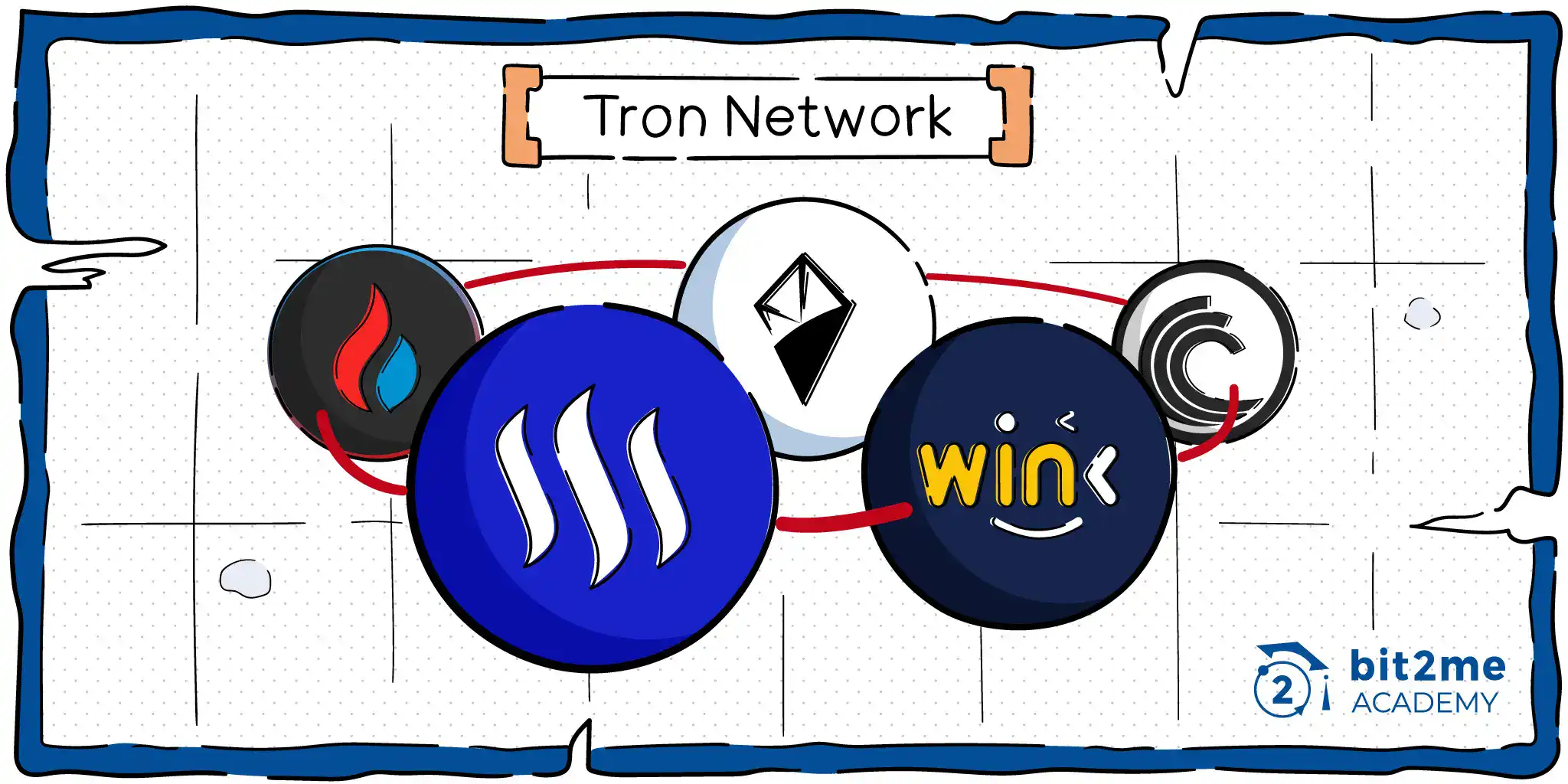
The technical and strategic cohesion of these pillars, BTT for infrastructure, AINFT for innovation, STEEM for content, WINkLink for reliability and HTX for governance, completely redefines TRON's vision by transforming it into a unified, robust and, above all, self-sufficient network.
Unlike other fragmented ecosystems, TRON has designed an architecture where each project acts as an essential cog in the machine. This eliminates reliance on third-party bridges, drastically reducing transaction costs and security risks for the end user.
The "one-stop shop" for decentralization
By integrating these functions under a high-speed, low-fee standard, a "one-stop shop" environment is created. This allows users to seamlessly move between decentralized finance (DeFi), media consumption, and big data storage without compromising the security of the main network.
This circular structure not only attracts developers seeking a ready-to-use environment, but also solidifies TRON as the operating system of the decentralized internet. Its ability to support a transactional load of millions of daily users, while maintaining a cost-effective and deeply integrated experience, positions it as the leading infrastructure for the global adoption of Web3.
 Author