Essential Points
- The Bitcoin whitepaper is 9 pages long and proposes payments between users without a bank or other third party validating each transaction.
- The network orders transactions with timestamps and proof of work, a one-to-one vote per CPU that makes rewriting the history costly.
- Nodes receive new coins and fees, so collaborating with the network offers them more reward than attacking it.
- It's a 2008 design: some figures in the text, such as computer memory, describe that era and not the current network.
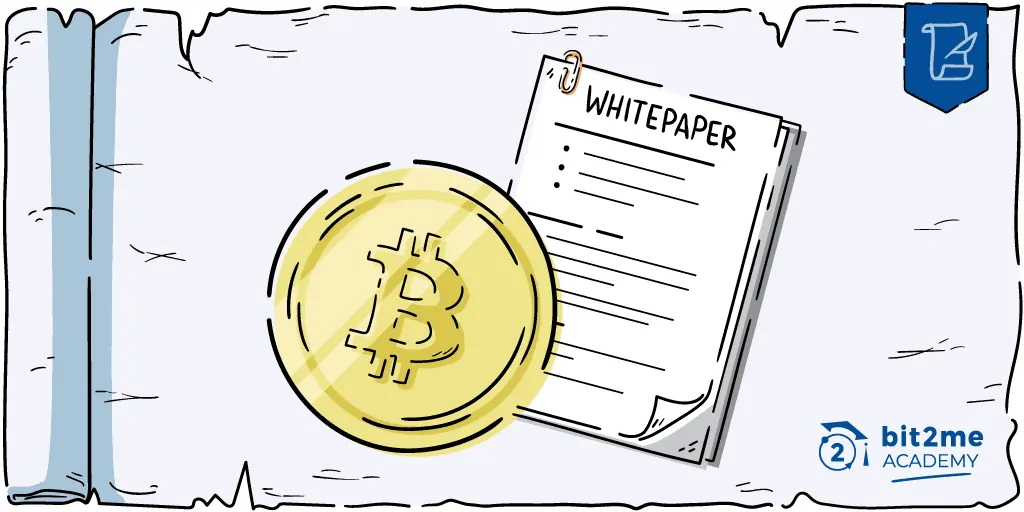
The Bitcoin whitepaper in Spanish is the Spanish version of the 9-page document in which Satoshi Nakamoto described, on October 31, 2008, a peer-to-peer electronic cash system without a trusted third party. He sent it that day to a cryptography mailing list in a message titled "Bitcoin P2P e-cash paper." Eighteen years later, those nine pages remain the best explanation of why Bitcoin exists. Bitcoin and what problem he wanted to solve.
The problem had a name: double-spending, that is, the possibility of spending the same digital currency twice when no one is monitoring the ledger. Until then, the solution involved a bank or issuer validating each payment. Satoshi proposed replacing this with timestamps, proof of work, and a network of nodes, and signed the text with an identity that remains unconfirmed as of October 2026. If you want to know more about the authorship, we'll tell you in [link to article]. Who created Bitcoin?.
The translation below preserves the order and 12 sections of the paper, with links to the concepts that Academy explains separately. You can compare it with the Original Bitcoin paper in English (PDF) and with another Spanish translation hosted on bitcoin.org (PDF)We have corrected typos in accents and meaning without changing the structure of the text.
 Certificate
What problem does the Bitcoin whitepaper in Spanish solve?
Before October 2008, any online payment depended on an institution verifying that the money had not been spent twice. The paper eliminates that intermediary, and this idea runs through the first two sections, the abstract and the introduction, which open the translation with all their nuances.
The text is signed by Satoshi Nakamoto (satoshin@gmx.com, www.bitcoin.org) and is titled "Bitcoin: A Peer-to-Peer Electronic Cash System." The sections appear in their original order, and the links to Academy lead to concepts that the paper assumes are already known, such as the hash or the node.
Abstract of the paper
A purely electronic version of cash would allow online payments to be sent directly, from one entity to another. All this, without having to go through a financial institution. Digital signatures provide part of the solution to the problem, but the main benefits are lost if a trusted third party has to exist to prevent the double-spending. We propose a solution to the problem of double spending using a user-to-user network.
The network timestamps the transactions it enters into a continuous chain of proof-of-work based on hash calculations. Thus, a record is being formed that cannot be changed without recreating the entire proof-of-work. The longest chain not only serves as evidence of the sequence of events, but also ensures that it originated from the cluster with the largest CPU processing load.
As long as most of the CPU processing power is under the control of nodes. who do not cooperate to attack the network. In this way, they will generate the longest chain and give the attackers an advantage. The network itself requires a minimal structure.
Messages are sent under the premise of least effort, and nodes can leave and rejoin the network whenever they like. Always accepting the longest chain of proof of work, as proof of what happened during your absence.
The summary condenses the entire design into a few lines, and it is advisable to keep its ideas in mind before moving on to the introduction, because the rest of the paper develops them one by one and in more detail:
- Digital signatures are not enough if a trusted third party is needed to avoid double spending.
- The network orders transactions in a proof-of-work chain that cannot be rewritten without redoing that work.
- As long as the majority of CPU power is honest, the honest chain is the longest and prevails against attackers.
Introduction
Internet commerce has come to rely exclusively on financial institutions, which serve as trusted third parties, for the processing of electronic payments. While the system works well enough for most transactions, it still suffers from the inherent weaknesses of the trust-based model. Completely non-reversible transactions are not really possible, because financial institutions cannot avoid mediation in disputes.
The cost of intermediation increases transaction costs. This limits the practical minimum transaction size and eliminates the possibility of small, casual transactions, resulting in a higher cost due to this loss and the inability to make irreversible payments for irreversible services. With the possibility of reversal, the need for trust expands. Merchants must take care of their customers, bothering them by requesting more information than would otherwise be necessary.
A certain percentage of fraud is accepted as inevitableThese costs and uncertainties in payments can be avoided if the person uses physical money. But there is no mechanism for making payments through a communication channel without a trusted third party.
What is needed is an electronic payment system that is based on cryptographic proofs rather than trustThis aims to allow both interested parties to transact directly without the need for a trusted third party.
Transactions that are computationally difficult to reverse would protect sellers from fraud. Similarly, routine escrow mechanisms could be easily implemented to protect buyers.
In this work, we propose a solution to the double spending problem using a timestamp server distributed user-to-user to generate a computational proof of the chronological order of transactions. The system is secure as long as the honest nodes collectively control more processing power (CPU) than any group of attacking nodes.
How do you avoid double spending with timestamps and proof of work?
The paper's solution relies on order: if everyone can verify which transaction arrived first, the second one becomes invalid. The following three sections explain how this is achieved without an arbitrator, and each contributes a different piece of the mechanism:
- The chain of digital signatures defines what an electronic currency is and who owns it at any given time.
- The timestamp server sets the order in which each transaction was received.
- The proof of work allows the majority to decide that order without anyone being able to falsify votes.
Transactions
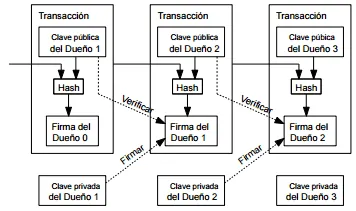
We define an electronic currency as a chain of digital signatures. Each owner transfers the coin to the next by digitally signing a hash of the previous transaction and the next owner's public key, appending both to the end of the coin. A beneficiary can verify the signatures to confirm the ownership chain.
The problem is that the recipient cannot verify whether any of the previous owners double-spent the currency. The common solution is to introduce a reliable central authority, a kind of mint, that would check each transaction for double-spending.
After each transaction, the coin must be returned to the mint to generate new coins. This ensures that only coins generated directly by the mint are trusted to prevent double-spending.
The problem with this solution is that the fate of the entire monetary system depends on the company that manages the mint. With all the transactions having to go through them, just as a bank would act. Therefore, we need to find a way for the beneficiary to know that the previous owners did not sign any previous transaction.
For our purposes, the most recent or earliest transaction is the one that counts. Therefore, we won't consider any subsequent double-spending attempts. The only way to confirm the absence of a transaction is by being aware of all existing transactions.
In the mint model, the mint was aware of all transactions and decided which arrived first. To achieve this without a trusted third party, transactions must be publicly announced [1], and we need a system of participants who agree on a single record of the order in which these transactions were received. The beneficiary needs to know that at the time of each transaction, a majority of nodes agreed on which was received first.
Timestamp server
The server is working to hash a block of data to be dated and publish it widelyas would be done in a newspaper or a Usenet post [2-5]. The timestamp proves that the data obviously must have existed at that time in order to be included within the hash.
Each timestamp includes the previous timestamp in its hash, forming a chain, so each additional timestamp reinforces the previous ones. This timestamp server is the starting point of our proposed solution.
Work test
To implement a timestamp server following a user-to-user scheme, we will need to use a proof-of-work system similar to the Hashcash by Adam Back [6], instead of using a publication in a newspaper or on Usenet.
Proof of work involves exploring a value such that, when calculating a hash, like SHA-256, This starts with a certain number of bits with a value of zero. The average work required will be exponential to the number of bits required. with zero value but which can be verified by running a single hash.
For our timestamp network, we implemented proof of work by incrementing the value of a nonce field, belonging to the block, until a value is found that gives the required number of bits with a value of zero for the hash of the same.
Once the CPU effort has been expended to satisfy the proof of work, the block cannot be changed without redoing all the work. As more blocks are chained after a given one, the work to change a block would involve redoing all the blocks after it.
La work test It also solves the problem of determining how to represent the majority decision. If this majority were based on a vote per IP address, it could be altered by someone capable of assigning many IPs. Proof of Work is essentially “one-CPU-one-vote”The majority decision is represented by the longest chain, which possesses the proof of work with the greatest accumulated effort.
If the majority of CPU power is controlled by honest nodes, the honest chain will grow faster and leave any competing chains behind. To modify a past block, an attacker would have to redo the proof-of-work for that block and all subsequent blocks, and then catch up to and surpass the work of the honest nodes. We will then demonstrate that the probability of a slower attacker catching up to the longest chain decreases exponentially as more subsequent blocks are added.
To compensate for the increased hardware speed and the fluctuating interest in running nodes over time, the difficulty of the proof-of-work is determined by a moving average driven by an average number of blocks per hour. If these are generated very quickly, the difficulty increases.
How does the Bitcoin network work according to the paper?
The net
The paper describes the network with very few rules, and understanding its logic helps in following the six steps on the list, because none of them depend on an authority coordinating them from the outside:
- All nodes receive the same transactions and compete to solve the same proof of work.
- No node acts as an arbiter, since each one accepts a block and works on it.
- The longest chain is the one that counts, so rival branches are abandoned.
According to the paper, the Bitcoin network operates with nodes that group new transactions into blocks, compete to find a proof of work, broadcast the winning block, and accept it by working on it. These six steps are repeated continuously, and the longest chain is always the one that counts. The steps the network executes are as follows:
- New transactions are issued to all nodes.
- Each node collects new transactions in a block.
- Each node works on finding a difficult proof of work for its block.
- When a node finds a proof of work, it issues the block to all nodes.
- The block is accepted by the nodes if all the transactions in the block have been validated and not spent.
- The nodes express their acceptance of the block by working on creating the next block in the chain, using the hash of the accepted block as the previous hash.
The longest string is always considered the correct one. and they begin working on extending it. If two nodes broadcast different versions of the next block simultaneously, some nodes may receive one or the other first. In that case, they work on the first one they receive but keep the other branch in case it becomes longer.
The tie is broken when the next proof of work is found and one branch becomes longer; the nodes that were working on the other branch are subsequently switched to the now longer one.
New transaction emissions don't need to reach all nodes. Once they reach many nodes, they will eventually be included in a block before long.
The block transmission is also tolerant to message loss. If a node does not receive a block, it will ask for it when it receives the next one and realizes that it has lost one.
Why do the nodes mine, and what incentive does the paper foresee?
Incentive
The nodes consume electricity and CPU time, and the paper explains how they are compensated. This payment is the origin of what we now call mining, and you can see how it is applied in practice in [link to relevant section]. How is a bitcoin created?In the text, the incentive is described in three paragraphs.
By convention, the first transaction in a block is a special transaction that generates a new coin owned by the block creator. This adds an incentive for nodes to support the network and provides an initial way to distribute and circulate the coins, since there is no central authority to create them.
This steady addition of a constant amount of new coins is analogous to gold miners spending resources to put it into circulation. In our case, the resources are the CPU time and electricity consumed.
The incentive can also be established using transaction costs. If the output value of a transaction is less than the input, The difference will be a transaction fee that will be added to the incentive value of the block that contains it. Once a predetermined number of coins have entered circulation, the incentive can evolve entirely into transaction fees and be completely free of inflation.
The incentive can also help encourage nodes to remain honest. If a selfish attacker is able to amass more CPU power than all the honest nodes combined, they would have to choose between using it to defraud people by stealing their payments, or using it to generate new coins.
You should find it more profitable to play by the rules, as they will favor you with more coins than combining all the other nodes, rather than undermining the system and the validity of your own wealth.
How do you verify a payment without running a full node?
To allow anyone to verify payments without saving the entire history, the paper shortens the chain and enables lightweight verification. The following three sections divide the work as follows:
- Reclaiming disk space explains how to discard old transactions without breaking the block hash.
- Simplified payment verification shows how to check a payment using only block headers.
- Combining and dividing value describes how an amount is divided among several inputs and outputs.
Claiming Disk Space
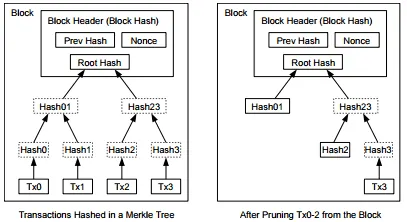
Once the last transaction is buried under enough blocks, the transactions preceding it can be discarded to save disk space. To facilitate this without breaking the block hash, the transactions are checked in a merkle tree [7] [2] [5], with only the root included in the block hash. Old blocks can be compacted by removing branches from the tree. Interior hashes do not need to be saved.
The figures in the following paragraph are from 2008: the paper assumes computers with 2 GB of RAM and an annual growth of 1,2 GB. What remains constant is the size of the header, because the documentation for bitcoin.org developers, consulted in October 2026, sets the block headers at 80 bytes, just as Satoshi calculated.
The header of a block without transactions will be about 80 bytes. If we assume that each block is generated every 10 minutes, 80 bytes 6 24 * 365 = 4.2MB per year.
With computers generally selling with 2GB of RAM in 2008, and Moore's Law predicting a current growth of 1.2GB per year, storage should not be a problem even if block headers need to remain in memory.
Simplified Payment Verification
It is possible to verify payments without running a full network node. A user only needs to keep a copy of the block headers of the longest chain of the proof-of-work, which can be obtained by searching the network nodes until convinced that they have the longest chain, and getting the branch of the Merkle tree that links the transaction to the block in which it was dated. Although you cannot verify the transaction yourself, by linking to it somewhere in the chain, you can see that it has been accepted by some node on the network, so blocks added afterwards would further confirm this acceptance by the network.
As such, the verification is reliable as long as honest nodes control the network, but it becomes more vulnerable if the network is dominated by an attacker. While the network nodes can verify transactions themselves, the simplified method can be fooled by transactions fabricated by an attacker if that attacker gains control of the network.
One strategy to protect yourself is to accept alerts from network nodes when they detect an invalid block, asking the user to download the entire block and the alerted transactions to confirm the inconsistency. Businesses that frequently receive payments will want to run their own nodes for more independent security and faster verification.
If you want to see for yourself what that complete node recommended to businesses in the paper looks like, Academy has the guide for it. Set up a Bitcoin node in less than 10 minutes.
Combining and Dividing Value
While it would be possible to manipulate individual coins, it would be difficult to manage making separate transactions for every cent of a transfer. To allow value to be divided and combined, transactions contain multiple inputs and outputs.
There will usually be either a single input, from a larger previous transaction, or multiple inputs combining smaller amounts, and at least two outputs: one for payment, and one to return the change, if any, back to the issuer.
It must be taken into account that this system is fanned out, so that a transaction can depend on several transactions, And these, in turn, can depend on many more, which is perfectly fine. There's never a need to extract a single, complete copy of the transaction history.
How is privacy protected in Bitcoin?
Privacy policy
This section resolves a design tension: transactions must be public so that everyone can order them, but that doesn't require payments to reveal who makes them, and the paper achieves this in the following way:
- The transactions are public, so everyone can order and verify them.
- Public keys are not named, so a payment does not point to a specific person.
- A new key pair per transaction prevents linking different payments to the same owner.
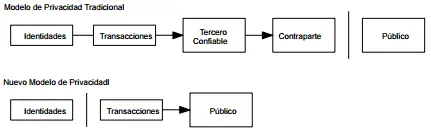
The traditional banking model achieves its level of privacy by limiting access to information to the parties involved and a trusted third party. The requirement to publicly announce all transactions contradicts this method, but privacy can still be maintained by breaking up the flow of information elsewhere. keeping public keys anonymousIt's publicly visible that someone is sending a certain amount of money to another person, but there's no information linking the transaction to a specific individual. This is similar to the level of information displayed on stock exchanges, where the timing and size of individual transactions—the "tape"—are public, but the identities of the parties involved are not revealed.
As an additional firewall, A new key pair must be used for each transaction, so that they cannot be linked to a common owner. Some types of association with multi-ticket transactions are unavoidable, which can reveal that their tickets belong to the same owner. The risk would be that if the owner of a key is revealed, then the linker could reveal other transactions that belonged to it.
The public key that the paper asks to be renewed in each transaction is what we now know as a Bitcoin address. If you want to see how it's generated and how it's used, we explain it in [link to explanation]. What is a Bitcoin address?.
What is the probability that an attacker will reach the honest chain?
The paper concludes with a mathematical proof: it calculates how many blocks a recipient of a payment must wait before considering it final. The calculations follow the approach of an attacker attempting to outmaneuver the legitimate blockchain, and each formula is presented as an image with its corresponding text.
Calculations
We consider the scenario in which an attacker attempts to generate an alternate chain faster than the legitimate one. Even if this were successful, it would not open the system to arbitrary changes, such as creating value out of thin air or taking money that never belonged to the attacker.
Nodes would not accept an invalid transaction as paymentAnd honest nodes will never accept a block containing them. An attacker might try to change only their own transactions to reclaim money they've recently spent.
The race between an honest chain and an attacker's chain is characterized as a Random Binomial Path. The success event is the honest chain extending in an additional block and increasing its advantage by +1, and the failure event being the attacking chain extending in one block reducing the distance by -1.
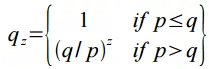
The probability that an attacker can catch up to us, starting from a given deficit, is analogous to the Gambler's Ruin problem. Suppose a player with unlimited credit starts in deficit and plays a potentially infinite number of attempts to try to reach a break-even point. We can calculate the probability that they would reach the break-even point, or that they would catch up to the honest chain, as follows [8]:
- p = probability that an honest node finds the next block.
- q = probability that the attacker will find the next block.
- qz = probability that the attacker will reach from z blocks back.
In text, the formula says that qz is 1 when p ≤ q, that is, when the attacker has at least the same power as the honest network and always ends up reaching it, and that it is (q/p)^z when p > q, with z as the distance in blocks.
Given our hypothesis that p > q, the probability drops exponentially, while the number of blocks the attacker must reach increases. With the odds stacked against him, if he doesn't make a lucky play early on, his chances become extremely slim as he falls behind.
Now, let's consider how long the recipient of a new transaction needs to wait before being sufficiently certain that the issuer cannot change it. We assume the issuer is an attacker who wants to make the payee believe they were paid for a while, then switch the transaction to pay themselves back, after some time has passed. The beneficiary will be alerted when this happens, but the sender hopes that it is too late.
The recipient generates a new key pair and delivers the public key to the sender shortly after signing. This prevents the sender from preparing a blockchain ahead of time and working on it continuously until they are fortunate enough to get far enough ahead to execute the transaction. Once the transaction is sent, the dishonest sender secretly begins working on a parallel chain containing an alternate version of their transaction.
The recipient waits for the transaction to be added to a block and for z blocks to have been linked after the transaction. He won't need to know the exact amount of progress the attacker has made, but assuming the honest blocks took the expected average per block, the attacker's potential progress will be a Poisson distribution with an expected value of:
In text, the expected value is lambda = z·(q/p), where z represents the blocks the recipient expects. To obtain the probability that the attacker can still reach us now, we multiply the Poisson density by the amount of progress they could have made by the probability that they could reach that point:
In text, the summation covers all values of k from 0 to infinity and multiplies the Poisson density (lambda^k · e^-lambda / k!) by (q/p)^(zk) when k ≤ z and by 1 when k > z. We rearrange to avoid summing the infinite tail of the distribution…
In text, the result is 1 minus the sum, from k = 0 to z, of the Poisson density multiplied by (1 – (q/p)^(zk)), a finite expression that is calculated with a loop. We convert to C code…
#include
double AttackerSuccessProbability(double q, int z)
We run some results, and we can see that the probability falls exponentially with z. With q=0.1, the probability drops from 0.2045873 with one block to 0.0009137 with five, and with q=0.3, 25 blocks are needed to fall below 0.001, as shown in the following two tables.
| q = 0.1 | P |
|---|---|
| z = 0 | 1.0000000 |
| z = 1 | 0.2045873 |
| z = 2 | 0.0509779 |
| z = 3 | 0.0131722 |
| z = 4 | 0.0034552 |
| z = 5 | 0.0009137 |
| z = 6 | 0.0002428 |
| z = 7 | 0.0000647 |
| z = 8 | 0.0000173 |
| z = 9 | 0.0000046 |
| z = 10 | 0.0000012 |
| q = 0.3 | P |
|---|---|
| z = 0 | 1.0000000 |
| z = 5 | 0.1773523 |
| z = 10 | 0.0416605 |
| z = 15 | 0.0101008 |
| z = 20 | 0.0024804 |
| z = 25 | 0.0006132 |
| z = 30 | 0.0001522 |
| z = 35 | 0.0000379 |
| z = 40 | 0.0000095 |
| z = 45 | 0.0000024 |
| z = 50 | 0.0000006 |
We solve for P less than 0.1%... The following table reads like this: with q=0.10, five blocks are enough to go below P < 0.001, and the more power the attacker has, the more blocks the payee has to wait for, up to 340 with q=0.45.
| q | z minimum for P < 0.001 |
|---|---|
| q = 0.10 | z = 5 |
| q = 0.15 | z = 8 |
| q = 0.20 | z = 11 |
| q = 0.25 | z = 15 |
| q = 0.30 | z = 24 |
| q = 0.35 | z = 41 |
| q = 0.40 | z = 89 |
| q = 0.45 | z = 340 |
Satoshi's conclusions about cryptographic proofs instead of trust
We have proposed a system of electronic transactions that does not depend on trust. We start with the usual framework of coins made based on the use of digital signatures, which provides strong control of ownership, but which is incomplete if there is no way to prevent double spending.
To solve this, we propose a peer-to-peer network that uses proof-of-work to record a public transaction history and that quickly becomes computationally unsolvable for an attacker who wants to change it, if honest nodes control the majority of the CPU power.
A robust network due to its unstructured simplicity. Nodes can all work simultaneously with minimal coordination. They don't need to be identified, as messages aren't routed to any particular destination and only need to be delivered on a best-effort basis. Nodes can leave and rejoin the network at will, accepting the proof-of-work chain as evidence of what transpired during their absence. They vote using their CPU power, expressing their acceptance of valid blocks by extending them and rejecting invalid blocks by refusing to work on them. Any necessary rules or incentives can be enforced through this consensus mechanism.
Highlighted
- [1] W. Dai, "b-money," https://www.weidai.com/bmoney.txt, 1998.
- [2] H. Massias, XS Avila, and J.-J. Quisquater, "Design of a secure timestamping service with minimal trust requirements," In 20th Symposium on Information Theory in the Benelux, May 1999.
- [3] S. Haber, WS Stornetta, "How to time-stamp a digital document," In Journal of Cryptology, vol 3, no 2, pages 99-111, 1991.
- [4] D. Bayer, S. Haber, WS Stornetta, "Improving the efficiency and reliability of digital time-stamping," In Sequences II: Methods in Communication, Security and Computer Science, pages 329-334, 1993.
- [5] S. Haber, WS Stornetta, "Secure names for bit-strings," In Proceedings of the 4th ACM Conference on Computer and Communications Security, pages 28-35, April 1997.
- [6] A. Back, "Hashcash: a denial of service counter-measure," http://www.hashcash.org/papers/hashcash.pdf, 2002.
- [7] RC Merkle, "Protocols for public key cryptosystems," In Proc. 1980 Symposium on Security and Privacy, IEEE Computer Society, pages 122-133, April 1980.
- [8] W. Feller, "An introduction to probability theory and its applications," 1957.
From the 2008 white paper to the network we use in 2026
Reading the Bitcoin whitepaper in Spanish reveals how much of that original design remains relevant: each section of the paper now has a named concept. The table below links each problem Satoshi solved with its modern term and the corresponding Academy article for further exploration.
| Section of the paper | Problem it solves | Modern concept | Academy article |
|---|---|---|---|
| Timestamp server | Establish the order of transactions | Blockchain linked by hashes | What is a hash |
| Work test | Voting without identities, one CPU one vote | Mining with proof of work | What is Proof of Work? |
| Incentive | Motivate nodes to remain honest | Block rewards and fees | How is a bitcoin created? |
| Simplified Payment Verification | Verify payments without saving the entire chain | Light nodes and Merkle tree | What is a Merkle tree? |
| Privacy policy | Separate transactions from identities | Public keys and addresses | What is a Bitcoin address? |
If after reading the paper you want to see how the network Satoshi described behaves today, you can consult the Bitcoin price today en Bit2MeA market statistic that changes every minute and should be viewed without giving it more weight than it deserves. And if later you decide buy Bitcoin at Bit2Me, find out about the risks beforehand: its value is very volatile and you can lose the entire amount you acquire.

Frequently Asked Questions about the Bitcoin Whitepaper


 Author