Javier Pastor and Jesús Lorente, from CLCrypto, they tell us How to declare cryptocurrencies in companies to the Treasury during an interesting Webinar such as «Use of cryptocurrencies in companies», in order to know basic aspects to take into account to adapt our companies and their operations to the cryptocurrency sector.
It starts at Bit2Me Jump into the world of cryptocurrencies with a head start. Sign up easily and get €15 FREE on your first purchase with this link. Don't wait any longer to join the crypto revolution! Join Now
Use of cryptocurrencies in your company
To begin with, Jesús Lorente says that “More and more companies are investing in crypto, either by keeping them directly as part of their investments, or they are directly generating tokens or crypto services, or finally because they are charging/paying for their services in cryptocurrencies.” Making a clear allusion to the increasing adoption of cryptocurrencies not only on a personal level, but also on a business and institutional level. As a financial technology, cryptocurrencies have a significant impact on the way we conduct business and financial operations, not only locally and regionally, but also internationally.
However, Lorente makes a call for attention to the proper management of these assets: “We must be cautious when operating with wallets/purses. If a wallet is personal, we should not mix balances with those of the company, since this will negatively affect the traceability of our balances for the Treasury. And it is here where we begin to navigate through the set of basic points for the proper use and management of cryptocurrencies in companies.
Vision of ICAC as a regulatory body
First of all, Jeśus Lorente points out that the accounting of cryptocurrencies must follow what is indicated by the ICAC (Institute of Accounting and Auditing). Thus, he tells us that an ICAC consultation carried out in 2014 says that cryptocurrencies can be accounted for as "Intangible Assets" or "Stocks". The latter provided that the company is engaged in the purchase and sale of the digital asset, while if the company only invests, only the former should be used.
It also highlights that, in another consultation with the ICAC, but this time carried out in 2019, light was shed on how to account for cryptocurrencies in the event that a company issues its own tokens. In this case, ICAC clarifies that they must be accounted for as "Stock«, because they are destined to become financial availability when they are bought and sold.
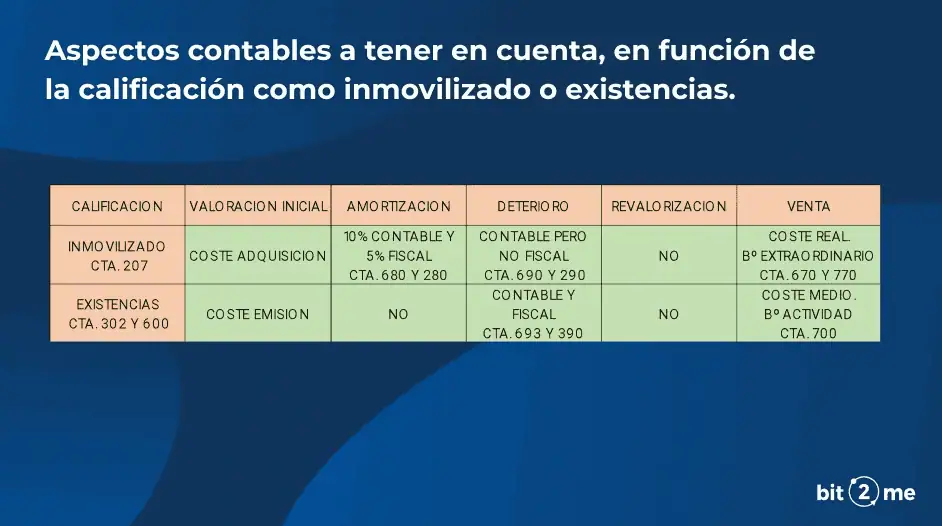
With all this clarified, we can make the following classification for the accounting aspects of cryptocurrencies in our companies:
Analyzing the classification
The previous classification table presented by Jesús Lorente can offer us a lot of clarity on the accounting and tax management of our cryptocurrencies in companies, so let's analyze each of its parts carefully:
Classification
When we acquire cryptocurrencies and record them as "Immobilized", their accounting must be done in Account 207. If, on the contrary, we are recording "Stocks", these must be recorded in Accounts 302 and 600.
Initial assessment
In this case, when we buy cryptocurrencies as a form of investment and record them as “Immobilized in Account 207”, we must record said purchase using the acquisition cost. For example, if we buy 1 BTC at €20.000 and immobilize it, we must use the acquisition cost in accounting.
If, on the contrary, we are a company that is issuing a token, we must use the Issuance Cost of that token. But here you have to be especially careful: the Issuance Cost is not the cost or value of the token when we sell it to the market, but all the cost related to the issuance of said token. This includes the R&D for the token, salaries, infrastructure and any costs that have been related to the issuance of said token.
Amortization
In this case, if we are working with Fixed Assets, we can amortize our investment with 10% accounting and 5% tax, using Accounts 680 and 280. However, in stocks these cannot be amortized.
This is a unique feature of cryptocurrency accounting, especially when we talk about Fixed Assets, since although cryptocurrencies do not deteriorate over time, we can make use of said element to amortize our investment over time.
Deterioration
Remember that impairment is the analysis of the current value of an asset with respect to its initial acquisition value. For example, we were able to acquire a property for 1 million euros, but after a while, due to deterioration, the value of the property can drop to 600 euros. This reduction in value is the deterioration of the property itself and can be accounted for.
In the case of the acquisition of cryptocurrencies in companies, the impairment for immobilized assets is accounting, but not fiscal, using accounts 690 and 290. Thus, for example, if we buy BTC at €60.000, but at the time of filing taxes, this BTC is now worth €20.000, we can account for the loss at the end of our financial year, but we cannot deduct taxes unless the holding of said BTC is sold.
This is not applicable when we talk about Stocks.
Revaluation
In this case, both for Fixed Assets and Inventories, the revaluation is not posted.
Venta
In this case, in the event that we sell Fixed Assets, we must take into account the actual cost of the asset and the profit is recorded as Extraordinary in accounts 670 and 770. On the other hand, if we sell inventories, we must record the average cost of the asset and their profits are posted to account 700.
Download here the webinar of Jesús Lorente and Javier Pastor

Declare to the Treasury: Form 721 at the business level
«The 721 model directly affects companies», says Jesus Lorente. As companies and individuals we must see how many cryptocurrencies we have outside of Spain and declare their stocks. However, the model makes clear some moments where its presentation is not mandatory:
- When holdings are less than 50.000 euros.
- In the case of legal persons and companies, the presentation of the 721 is not necessary, if said stocks are duly identified (both in tokens, quantity and location) and declared in the business accounting.
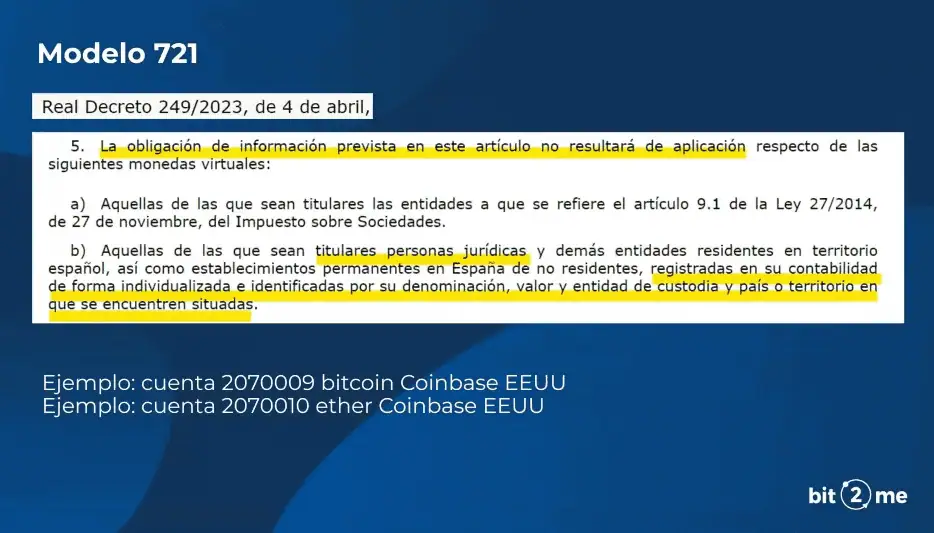
In any case, due to the novelty of Model 721, it is to be expected that many questions will arrive regarding the proper use and presentation of the model, information that will be useful for us to present the information correctly to the Treasury.
company taxes
In this case, Jesús Lorente clarifies that "In a society the same tax is always paid: 25%". However, in natural persons this changes depending on the activity. The following box shows the tax percentages:
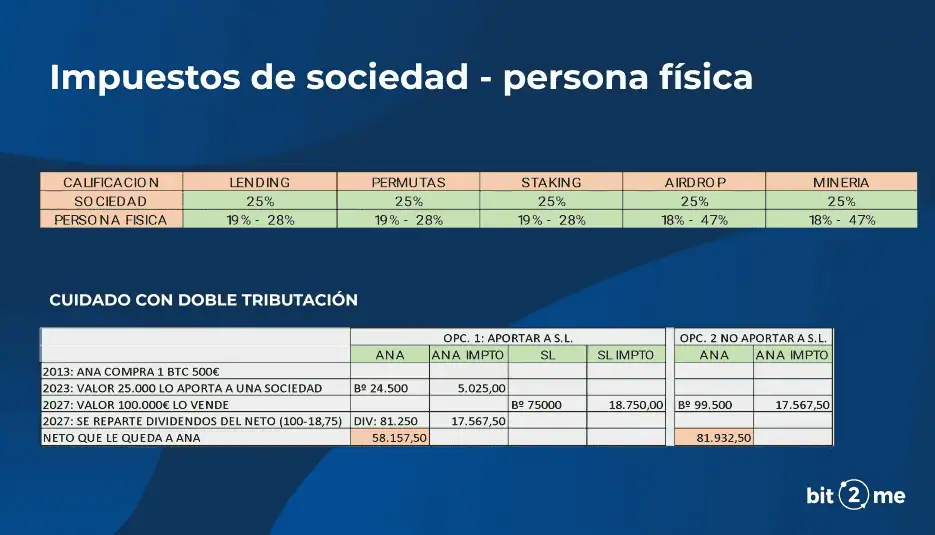
In any case, we must avoid double taxation, as shown in the example, since we could have losses for it.
Employee pay using cryptocurrency
“Paying employees with cryptocurrencies is legal”says Jesus Lorente. However, it must be taken into account that it cannot be higher than 30%, since it is considered a payment in kind, so it is limited to this percentage by law.
Payment in cryptocurrencies can be positive for both companies and workers. On the one hand, the company expands the range of job opportunities that it can capture both locally and internationally, while employees can receive an asset that can be revalued over time, being an important savings asset for their financial stability.
In the event that the payment is made by means of a service invoice, the company can pay 100% of it, as long as there are no other legal provisions that prevent this type of exchange, both by the company (in Spain) and the service company (in Spain or another country).
Present and future regulation
Regulations for the crypto sector are coming and adjusting to them is essential for companies. On the one hand, the regulations and recommendations issued by the ICAC and the Treasury are essential for companies to be able to handle accounting and tax payments corresponding to cryptocurrencies legally and safely. Added to this is the arrival of MiCA and similar regulations in the rest of the world.
The truth is that the regulations will be an element present in the ecosystem, and the companies that are within the crypto sector must follow them in order to avoid fines or legal/fiscal processes that may affect the good operation of the company.
Undoubtedly, a set of data and information that can serve us very well to carry out a good management and control of our cryptocurrencies in business spaces.


 Author