Essential Points
- Tax Automation: Bit2Me Tax eliminates human error by consolidating thousands of transactions into a single report compliant with Spanish tax regulations.
- Identification of Taxable Events: The system automatically distinguishes between swaps, sales to fiat and staking returns, assigning each its corresponding tax treatment in the IRPF.
- Time Optimization: Native integration with the exchange allows you to obtain a profit and loss balance in seconds, avoiding the manual FIFO calculation method, which is prone to errors.
- Guaranteed Legal ComplianceThe content acts as a bridge between the technological complexity of blockchain and the administrative requirements of Model 100 and the new Model 721.
If you still think the tax authorities don't know what you're doing with your digital assets, you're operating with outdated information. It's 2026, and the Spanish Tax Agency has deployed an arsenal of tools that have transformed the "gray area" into a brightly lit showcase. That's why declaring crypto assets on your 2025 tax return is no longer an option for those who want peace of mind; it's a technical obligation that requires surgical precision.
Do you really need to report every single transaction? If you've traded on exchanges or moved funds between protocols, the short answer is yes. But let's not just scratch the surface and examine what you should actually be doing.
Taxable events: The myth of "I only declare if I withdraw money from the bank"
First, keep in mind that many investors make the critical mistake of thinking that as long as they don't convert their tokens to euros, there are no taxes. Wrong. In Spain, any exchange is a taxable event. If you swapped Ethereum for a stablecoin to "protect" yourself from volatility, you've just generated a capital gain (or loss). And in that case, the tax authorities consider that you've sold one asset to buy another.
It doesn't matter if the funds never touched your BBVA or Santander account. The network's traceability is public, and exchanges with a presence in Europe have already done their homework by submitting your data through the corresponding reporting mechanisms. But in addition to swaps, you should also monitor returns on investment income: those small incomes generated by staking or lendingIn 2025, these will be added to the taxable savings base as if they were the interest from a traditional bank deposit, and you will also have to declare them.
Tax brackets and rates
However, the taxation of digital assets in Spain is not flat. It is structured in brackets that tax higher incomes more heavily. For the 2025 tax return, the applicable rates for savings income are as follows:
- Up to €6.000: 19%
- Between €6.000 and €50.000: 21%
- Between €50.000 and €200.000: 23%
- Between €200.000 and €300.000: 27%
- Over €300.000: 28% (or even 30% depending on the autonomous community and last-minute adjustments).
Does that seem like a lot? Perhaps. But what really hurts isn't the percentage, but the incorrect calculation of the base.
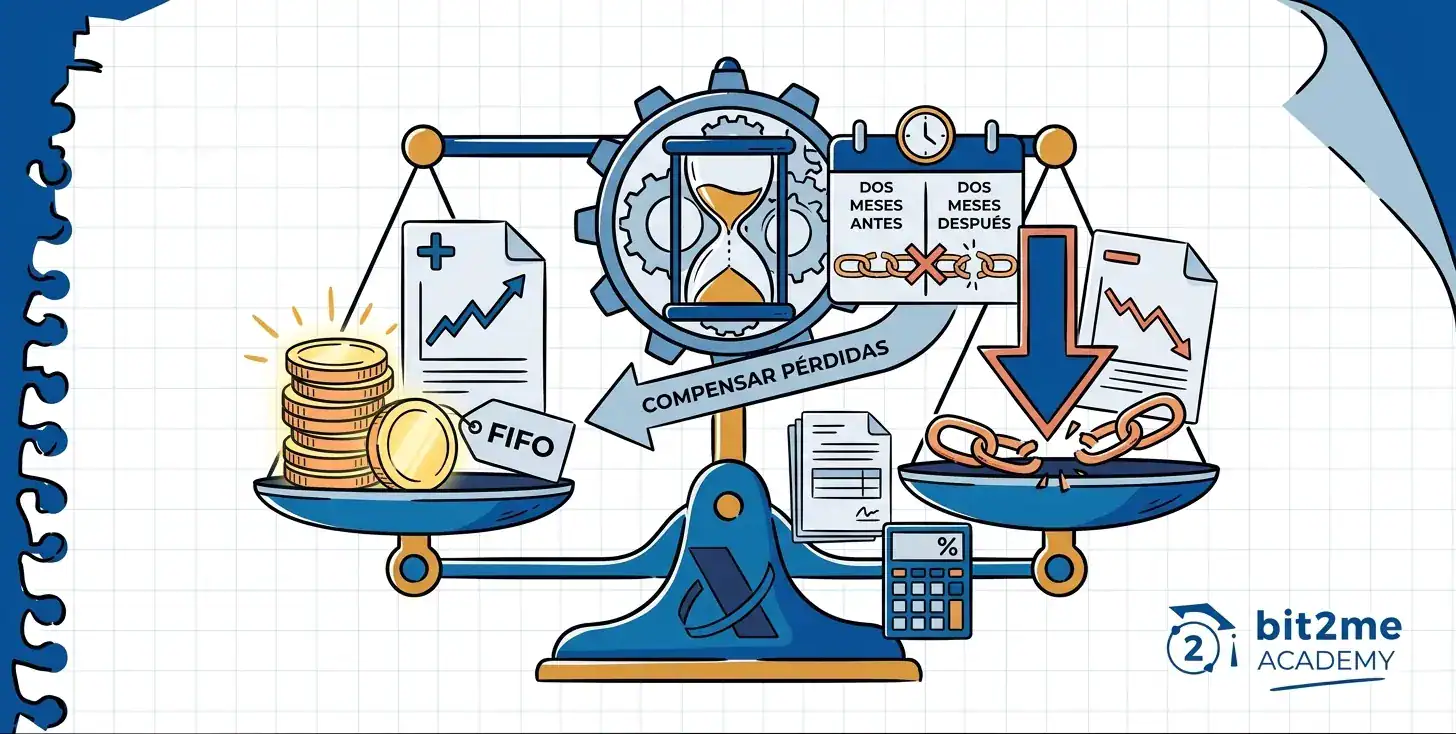
This is where the FIFO (First-In, First-Out) method comes into play. The tax authorities require that, when selling or exchanging, you consider the first tokens sold to be the first ones you bought. If you bought Bitcoin for €15.000 and now have €60.000 worth, and you sell a fraction of it today, the acquisition cost you must use is €15.000, which significantly increases your accounting profit.

Models 172, 173 and the dreaded 721
To ensure total control, the Government implemented a triad of information models that are already fully operational:
- Model 172 and 173: You don't fill these out yourself; the custody platforms located in Spain do. They report on your balances and transactions. If you use a Spanish exchange, assume that the Spanish Tax Agency already has a draft of your transactions before you even turn on your computer.
- Model 721: This is your responsibility. If you have more than €50.000 in crypto assets on platforms outside of Spain (such as Binance, Kraken, or cold wallets if considered external custody), you must report it. This isn't a tax form, but a reporting form. However, the penalty for failing to do so is high enough that you don't want to take the risk.
Models 172, 173 and the dreaded 721
For a crypto enthusiast in 2026, understanding this triad isn't just a matter of compliance, but of financial survival. The Spanish Tax Agency has moved from simply "inviting you to file a tax return" to proactive monitoring. Here's a breakdown of why these new models have changed the game in Spain.
Models 172 and 173: The end of anonymity on local platforms
These are automatic templates within the system. They don't require you to lift a finger, but they are what feed the tax data that appears in your draft tax return.
- Model 172 (Balances)Cryptocurrency platforms based in Spain report to the Spanish Tax Agency the balance of each cryptocurrency you hold as of December 31st. This includes the value in euros, the number of tokens, and the asset type. If you hold 0,5 BTC on a Spanish platform, the Tax Agency already knows its exact value at year-end.
- Model 173 (Operations)This is where traceability becomes complete. The platforms detail every purchase, sale, exchange, or transfer you've made: date, amount, type of transaction, and the parties involved.
What's the real risk? That the tax authorities have already calculated your profit before you even start doing the math. If your data in Form 100 (your income tax return) doesn't match what's reported in these forms, the system will automatically trigger an alert and you'll receive a notification.
Model 721: The magnifying glass on foreigners and cold wallets
While the previous ones are automatic, 721 is manual and mandatory for the user. It is the direct successor to the old Model 720, but designed specifically for the digital asset ecosystem.
The €50.000 threshold
You don't have to declare every penny. The obligation arises when the sum of all your assets on platforms located outside of Spain exceeds €50.000 as of December 31st.
But be careful with the valuation. The market value in euros at the end of the year is used. If your portfolio was worth €40.000 in November but a last-minute rally raises it to €52.000 on New Year's Eve, you are required to report it.
What about cold wallets (Ledger, Trezor)?
This is the most controversial and technical point. The regulations link the declaration to "custody".
If your private keys are on a foreign platform (Binance, Coinbase, Kraken), Form 721 is definitely mandatory.
If you use a cold wallet and you hold the keys yourself, the technical interpretation in 2026 is that, since there is no external entity holding them, there would be no obligation to report via form 721. However, the Spanish Tax Agency (Hacienda) closely monitors movements from these wallets to exchanges. If tokens "appear" out of nowhere on an exchange to be sold, you will have to demonstrate the traceability of that original purchase.
Administrative sanctions
Failing to file Form 721, or filing it with false or incomplete information, is playing with fire. The penalties have been adjusted to be proportionate but severe:
- Lack of presentation: Fixed fines for each piece of data or set of data that should have been included.
- Minimum penalty: Forgetting this model can result in fines starting at several hundred euros, even if there was no intention to hide funds.
How to optimize your tax return? Don't give away a single euro.
Since the system is rigid, your only defense is organization. Many investors assume that the taxman's cut is inevitable, but they forget that the law allows you to adjust your taxable income if you know where to look. It's not about tax engineering, but about applying common accounting sense.
The real impact of commissions and gas fees
Did you know you can deduct purchase and sale fees? They're not a minor expense. Every time you pay a gas fee on the Ethereum network for interacting with a smart contract, or an execution fee on an exchange, that amount is added to the acquisition value or subtracted from the transfer value.
If you make hundreds of transactions a year, these small amounts can add up to thousands of euros in legitimate deductions. In a congested network environment where a single transaction can cost €20 or €30, ignoring these expenses is, quite literally, giving money away to the state. Make sure your records include the cost of the asset plus the commission paid; only then will you be taxed on the actual net profit.
The "tax shield" for capital losses
If the market hasn't performed well for you and you've incurred capital losses, you can offset them. In 2026, given the volatility we've experienced, you'll likely have positions with losses. Don't ignore them. You have up to four years to use those losses and reduce your tax bill in future years.
Here's how it works: if you've lost €5.000 this year but gained €2.000 in other transactions, your balance is negative and you don't pay any tax. But the remaining €3.000 stays in your "tax reserve" to offset gains until 2030. Furthermore, the regulations allow you to offset capital losses with income from movable capital (such as staking) up to a limit of 25%. Don't consider that capital lost; from an accounting perspective, it's an asset that reduces your tax liability.
Automation: The end of manual Excel thanks to Bit2Me Tax
Trying to calculate the FIFO of a thousand trading transactions in Excel is a surefire invitation to an anxiety attack and, almost certainly, a tax audit. The moment you make a mistake in a single cell, the domino effect ruins the traceability of your entire portfolio.
In 2026, the professional thing to do is to use tools like Bit2Me Tax. The complexity of decentralized finance and the multiple cross-chain bridges make manual tracking impractical for humans. These systems connect via APIs to your wallets and exchanges to capture the complete history and perform the heavy lifting:
- Identify which token entered first to apply FIFO correctly.
- Separate what is a swap (capital gain) from what is staking or airdrops (capital return).
- Generate a PDF report ready for your manager or for you to fill in the boxes of Model 100 yourself.
The technology that brought us here—with its decentralization and complex protocols—is the same technology that, through tax consolidation algorithms, should save us from bureaucracy. In this sector, delegating calculations to a machine is not a luxury; it is a basic measure of legal certainty.
FAQ: Frequently Asked Questions about Income Tax 2025



 Author