Essential Points
- Distributed Ledger: Blockchain eliminates the need for intermediaries (banks, notaries) by distributing an identical copy of the record among thousands of computers globally.
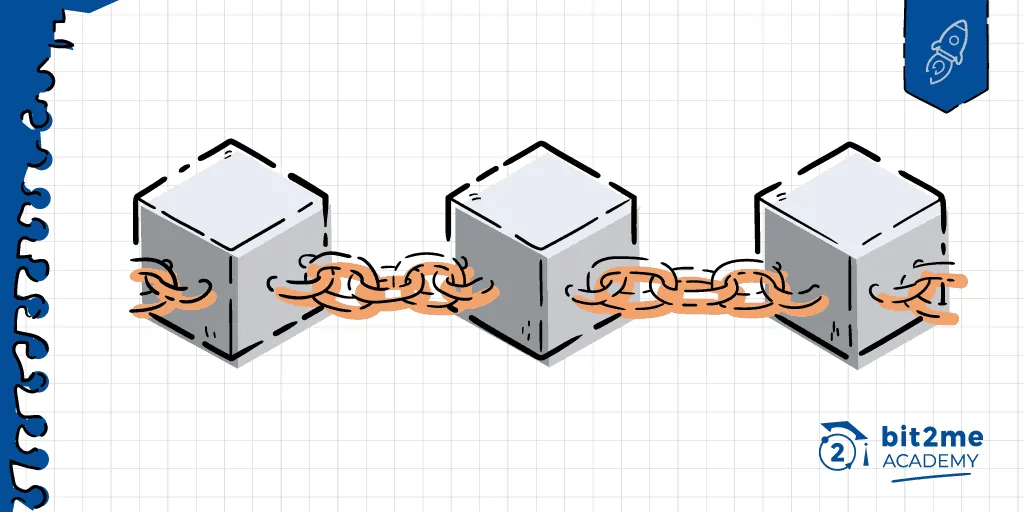
- Cryptographic security: Each block contains the digital fingerprint (hash) of the previous one, which guarantees that any attempt to alter it will break the chain and be rejected by the consensus.
- Consensus Mechanism: The validity of the data does not depend on an entity, but on mathematical algorithms that ensure that all participants agree on the veracity of the information.
- Total immutability: Once data is validated and added to the chain, it becomes permanent and irreversible, offering an unprecedented level of security in the digital environment.
The blockchain (or chain of blocks in Spanish), is a technology that allows you to create a distributed ledger in a computer network without the need for a central server or database. Updating and managing this accounting book can only be done in consensus with all the parts that make up the network.
For this reason, the computing power of all nodes. of the network is used not only to enter information, but also to protect it against unauthorized modification. As a consequence, the blockchain allows very high levels of security to be achieved compared to other technologies.

 Certificate
Main Cryptocurrencies Course
Basic levelBit2Me Academy We bring you a new course where you will learn everything you need to know about the most important cryptocurrencies that exist today.
How does blockchain technology work?
For blockchain technology to work, it is first necessary to create specific software for it. This software allows computers to create the network that will make the blockchain work in a distributed way. As in the case of software Bitcoin and other crypto assets. Generally, this software is open source and protected by licenses of FOSS. This implies that they are public, transparent and can be used, reviewed and contributed by anyone.
Not having database or localized server, a blockchain-type network is attributed the characteristic of being a distributed network. This means that the information is replicated in all the computers in the world that are connected to the same blockchain. In the event that more than 50% of the computers that make up that blockchain network are not from the same person or company, we can say that the network is decentralized. With this, we can say that it does not have a "centre of emission, control or power".
In essence, a blockchain network is just a database that allows reading and writing new records, although without being able to modify anything that exists in it. All the records that are saved in it are linked to each other with a very advanced mathematics. Making it impossible to include something that is not consistent with the rest of the included records.
How is a blockchain built?
However, the construction and operation of the blockchain depends on a series of elements that we will examine below:
Blocks
Un block is a set of confirmed transactions and additional information that has been included in the chain of blocks. Each block that is part of the chain (except the genesis block, which starts the chain) is made up of:
- An alphanumeric code that links to the previous block
- The “package” of transactions it includes (whose number is determined by different factors)
- Another alphanumeric code that will link to the next block.
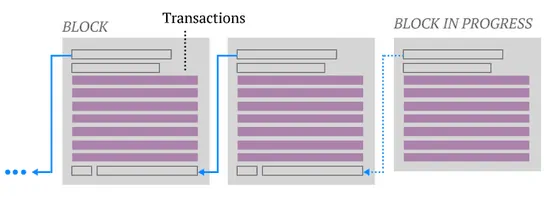
The block in progress tries to find out with calculations the third point that we have indicated. A code that follows certain rules to be valid and can only be obtained by testing non-stop. But how are these blocks generated? Well this is the work of the next element to examine.
Miners
Miners are dedicated specialized computers or equipment that provide computational power (or miner) to the bitcoin network. This power is used to verify the transactions carried out. Every time someone completes a block they receive a reward in the form of bitcoins and / or for each transaction that is made.
Nodes
A node is a computer/chip connected to the Bitcoin network using a software that stores and distributes a real-time updated copy of the blockchain. Every time a block is confirmed and added to the chain communicates to all nodes and this is added to the copy that each one stores.
One of the biggest curiosities that the Bitcoin protocol has is that each unit is not a file as such, which is sent as if it were a movie or song, in the style of a P2P protocol such as BitTorrent. Actually, a record of the change of ownership of a certain amount of bitcoins is produced in the blockchain. The most common node software on the Bitcoin network is Bitcoin Core.
Of course, all crypto assets follow this three-part structure, each part with its own particularities. But this simple way of working It guarantees the maximum security granted by the blockchain.
Usefulness of blockchain technology
Blockchain utilities are many. In fact, it is already being implemented in multiple sectors in a technological race that will forever change essential aspects of our individual and collective lives.
Just as the Internet revolutionized the way of creating, transmitting and consuming information, with blockchain technology we are at the door of what is called Internet of value or Internet of money.
Blockchain technology is essential in the creation of crypto assets. These can be used to transfer value between people around the world. Plus digitize property of everything that has value (whether tangible or intangible) allows us, among other things, to create immutable property records and digital assets that can be transferred between people without having to require a trusted intermediary as up to now (banks, notaries…).
Conclusion
At this point we can say that blockchain technology is one of the most powerful tools we have today. Its capabilities and utilities are barely being explored. However, technology has proven its suitability in different uses, radically transforming the way we do things.
Exploring and further developing this technology will bring us to a point where we can more interconnect the world. all this, without jeopardizing our privacy and the security of our systems and data. Thanks to this, we can say that blockchain technology takes us to the next technological evolutionary step.
FAQ – How does Blockchain work?



 Author