Essential Points
- With a crypto card you can spend your app balance at any physical or online store that accepts cards, without the merchant touching a single crypto asset.
- Everything happens through an automatic conversion: your crypto balance is transformed into euros the moment you confirm the payment on the card reader.
- It solves the problem of having digital assets "stored" without being able to use them for your morning coffee or grocery shopping.
- Convenience has an important nuance: paying by card is not the same as sending crypto directly to another person, and it's important to understand when each option is more suitable.
More and more people are discovering that their cryptocurrencies don't have to stay stored in an app waiting for their value to change: they can also be spent at the supermarket, in a coffee shop, or in an online store, much like traditional money. This possibility, driven by cards linked to a balance of digital assets that are converted into euros at the time of payment, has gone from being a technological novelty to a tool that many users already incorporate into their daily routine. The most frequently asked question among those approaching this area for the first time is simple: can you really pay with cryptocurrencies like regular money, in any physical or online store?
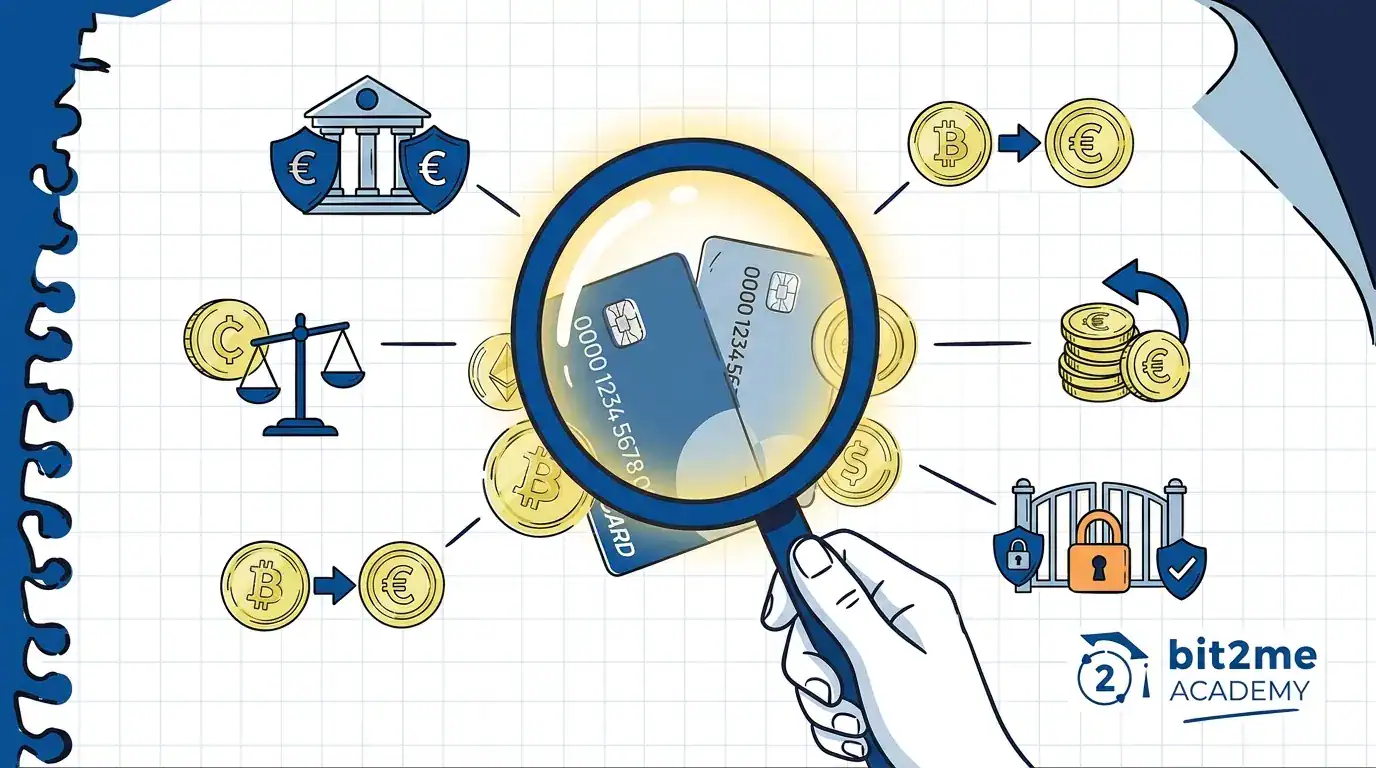
In this article, you'll find a clear explanation of how automatic cryptocurrency-to-euro conversion works when you swipe your card, which merchants accept it, and the exact steps involved in the payment process. We'll also review the differences between this and sending cryptocurrencies directly from wallet to wallet, the real-world advantages and limitations, and the security precautions you should take before using your card at the supermarket checkout or online.
What exactly does paying with a crypto card mean today?
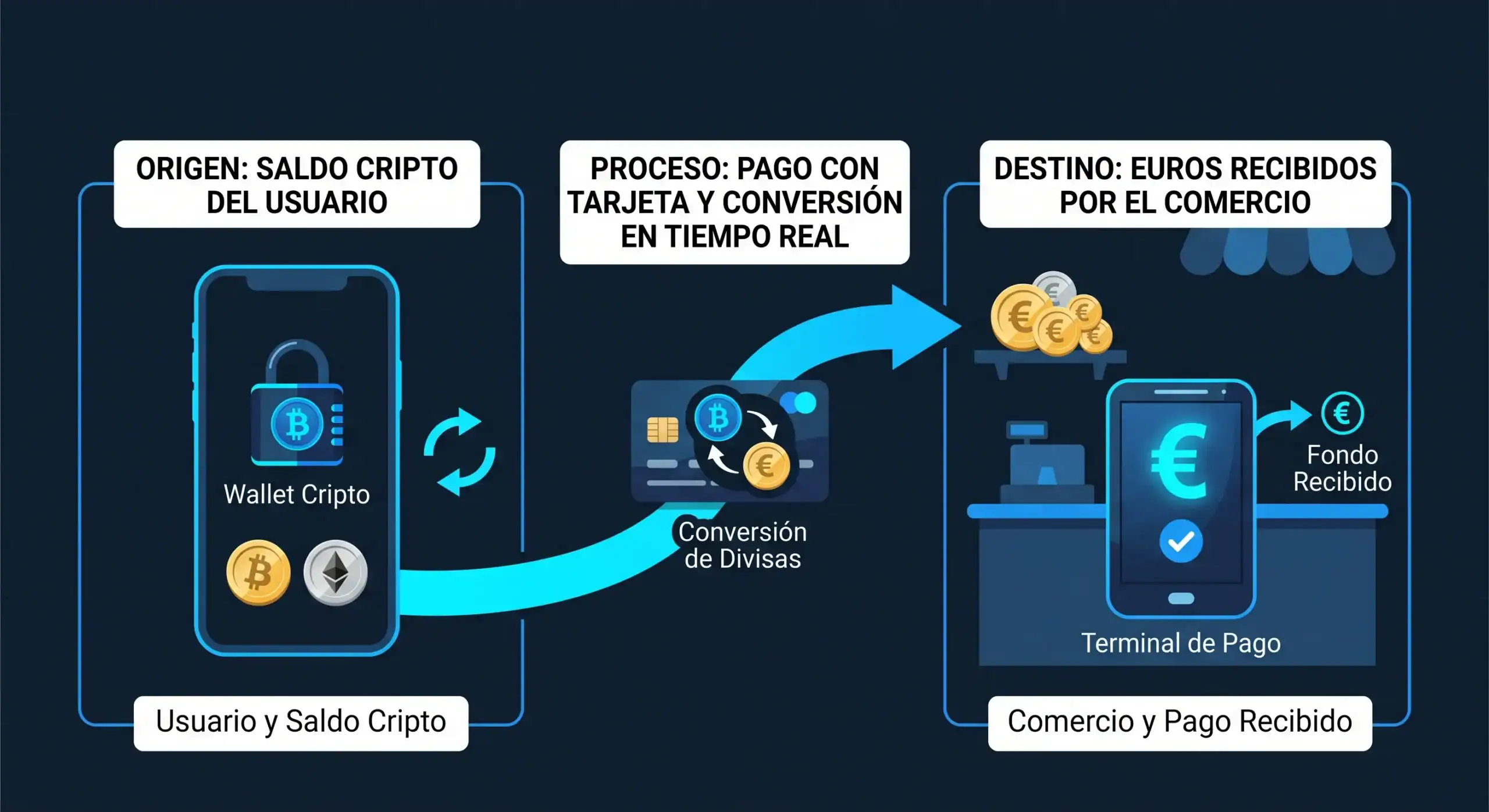
When we talk about paying with a crypto card, we're not saying that the merchant receives Bitcoin, Ether, or any other digital asset directly into their account. What happens is different and, in fact, much simpler to understand: the user keeps their purchased crypto assets in an app, and a physical or virtual card linked to that app allows them to use the value of that balance as if it were conventional money at the point of sale.
The merchant never sees or handles crypto at any point in the transaction. They receive euros, exactly as if the customer had paid with a traditional debit card linked to a bank account. That's why someone can, for example, pay for their weekly shopping with Bitcoin without the supermarket having to adapt its payment system in any way. This separation between what the user has (cryptocurrencies) and what the merchant receives (euros) is the key to understanding why this payment method works virtually everywhere card payments are accepted.
How does the automatic conversion of crypto to euros work when paying?
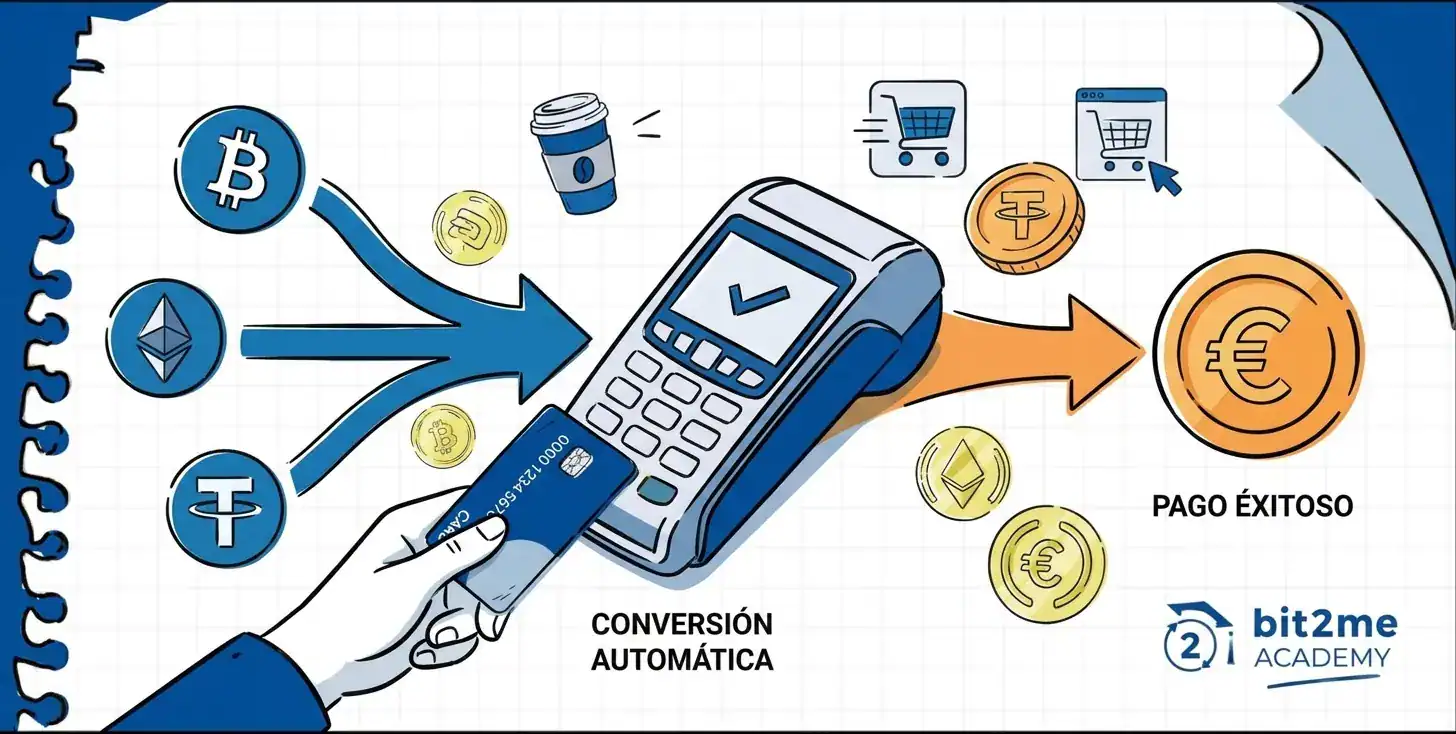
The technical mechanism behind a crypto card is simpler than it first appears. The moment the card is swiped or inserted into the card reader, the system takes the exact amount requested by the merchant in euros and calculates the equivalent amount in cryptocurrency based on the current exchange rate. This amount is then deducted from the user's balance in the app, while the merchant receives the full amount in euros through the usual payment methods.
The entire process happens in seconds and is transparent to the user, who only sees the payment confirmed on their screen. The conversion rate applied to each transaction, as well as any associated fees, can be viewed at any time within the application itself, as this information varies and it's advisable to review it before each frequent use of the card. This mechanism is the same whether the available balance is in Bitcoin or another supported cryptocurrency, and it's what allows, in practice, paying with Bitcoin at any terminal without the merchant noticing any difference compared to a conventional card payment.
It's important to understand that this conversion isn't a purchase or sale that the user manually decides on at that moment: it's automatic and occurs as part of the payment itself. The digital asset is converted into euros solely to complete that specific transaction, and the rest of the balance in the app remains intact within the user's existing asset portfolio.
Which stores can you pay at with your crypto card
One of the most common questions among those trying this form of payment for the first time is whether it only works in stores "specializing" in crypto. The answer is no: since it's a physical or virtual card linked to international card networks already used by the vast majority of businesses, you can pay at any establishment that accepts cards, without that business needing to know anything about digital assets.
This includes both physical stores with card terminals and online stores that accept card payments at checkout. The user experience is indistinguishable from that of any other debit card: you simply tap or insert the physical card into the terminal, or enter the virtual card details on the website's payment gateway. There are no additional steps, special screens, or added friction compared to a traditional payment method.
- Supermarkets, restaurants and local shops with physical card payment terminals.
- Online stores that accept card payments during the purchase process.
- Subscriptions and digital services that are charged on a recurring basis by card.
- Cash withdrawals at compatible ATMs, when the card allows it.
This broad coverage is precisely what differentiates a crypto card from other forms of spending on digital assets, and it is also the reason why many users consider it the most practical bridge between their crypto asset portfolio and their daily consumer life.
How to pay with cryptocurrencies step by step using your crypto card?
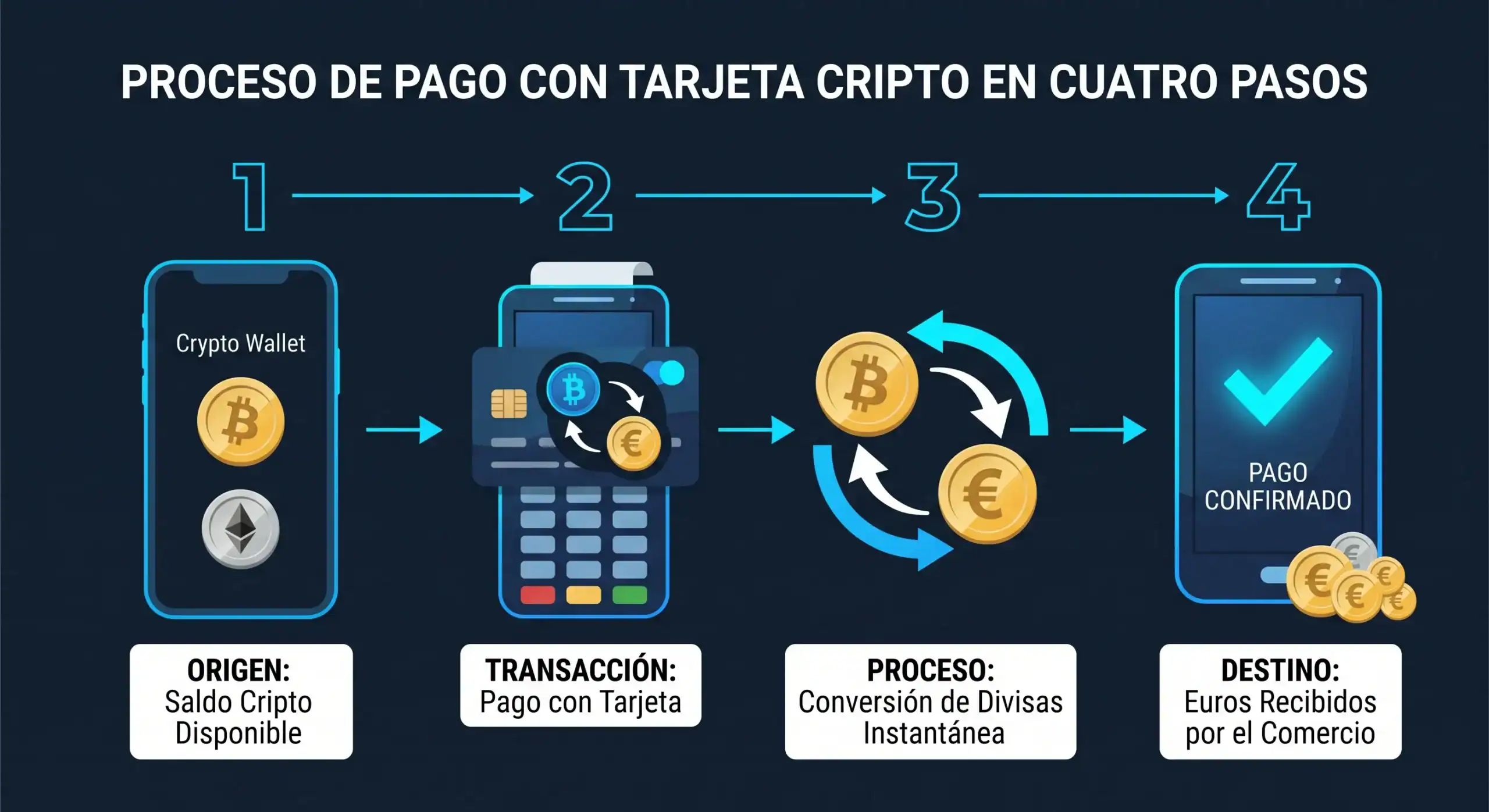
The payment process with a crypto card always follows the same sequence, regardless of the merchant or the cryptocurrency used as the source of the balance. Understanding these steps helps dispel the sense of complexity that many people unnecessarily associate with anything related to digital assets.
- Have a balance in crypto assets in the app. Before any payment, the user needs to have purchased or received crypto assets and have sufficient funds in their account on the application associated with the card.
- Swipe or insert the card into the card reader like any other card. At the time of payment, the physical card is used in the usual way (contactless, chip or strip) or the virtual card details are entered if the purchase is online.
- Automatic conversion of crypto to euros at the time of payment. The system instantly converts the required amount of the chosen crypto asset to euros, according to the exchange rate at that precise moment.
- Payment confirmation. The merchant receives confirmation that the payment has been completed in euros, and the user sees the corresponding charge reflected in their crypto asset balance in their app.
Paying with a crypto card versus paying directly with peer-to-peer crypto assets
There's another way to spend cryptocurrencies that doesn't involve a card: direct wallet-to-wallet transfers, known as peer-to-peer payments. This involves no automatic conversion or card reader; instead, it's a transaction on the blockchain itself that the recipient must accept in the same cryptocurrency being sent.
The difference between paying with cryptocurrencies by card and doing so directly, peer-to-peer, is substantial in practical terms. With card payments, the merchant never needs a wallet or to accept crypto; they simply receive euros, as explained earlier. In peer-to-peer payments, however, the recipient must have a wallet compatible with that specific cryptocurrency and be prepared to accept the volatility of holding it, as well as wait for the network to confirm the transaction, which can take anywhere from seconds to several minutes depending on network congestion and the chosen transaction fee.
This explains why card payments have become the preferred option for everyday purchases: supermarkets, restaurants, subscriptions, or online shopping. Peer-to-peer payments, on the other hand, still make sense in very different contexts, such as sending funds to another person who also trades cryptocurrencies, participating in certain decentralized services, or moving assets between their own platforms. Neither method is inherently better; each addresses a different need.
Practical advantages and limitations of daily life
Adopting a crypto card as your regular payment method has clear benefits, but also limitations that you should be aware of before relying on it completely. Understanding both sides helps you decide when it's appropriate to use it and when it's not.
Among the advantages most highlighted by users who already incorporate it into their routine are the following:
- Virtually universal acceptance, just like any conventional debit card.
- There is no need to manually sell crypto assets before spending: the conversion happens at the time of payment.
- The remaining balance in the app continues to be part of the user's crypto asset portfolio, without the need for additional operations.
- It works the same in physical and online stores, with no extra steps compared to a traditional card.
If you're interested in incorporating this form of spending into your daily life, you can order a Card from the app and start using your cryptocurrency balance at any merchant that accepts cards.
However, there are also limitations inherent in the real-world user experience. The available balance depends on the cryptocurrency's exchange rate at the time of payment, so the amount deducted in crypto can vary from day to day for the same euro purchase. Furthermore, each transaction involves a conversion subject to the platform's current terms and conditions, and not all cryptocurrencies supported by the app may be available as a source of funds for the card at all times.
 Certificate

Security when paying with cryptocurrencies
The security of a crypto card relies on two distinct layers that should be understood. First, there's the security of the card itself as a physical or virtual payment method, which follows the same protection standards as any bank card: blocking via the app, configurable limits, and real-time notifications for every transaction. Second, there's the security of the cryptocurrency balance backed by that card, which depends on best practices such as enabling two-factor authentication (2FA) and never sharing account login credentials with third parties.
Within the European Union's regulatory framework, the MiCA (Markets in Crypto-Assets) regulation establishes a harmonized framework for cryptocurrency service providers, bringing a level of oversight that was previously lacking in much of the sector. This does not eliminate the risk associated with cryptocurrency volatility, nor does it make the card a risk-free product; it simply means that the entities involved operate under verifiable regulatory requirements. If you ever have doubts about a transaction, reviewing your transaction history in the app and temporarily blocking your card are the two quickest and most effective actions available to any user.
Paying with a crypto card regularly doesn't require advanced technical knowledge, but it does require a basic level of digital security awareness, just like with any bank card you use every day. Keeping your phone secure, regularly reviewing your transactions, and enabling app alerts are simple habits that virtually eliminate any everyday operational risks.
The convenience of paying with cryptocurrencies at the checkout of any store, physical or online, no longer depends on special infrastructure or adapted businesses: it depends on a card and a conversion that happens in seconds. Anyone wanting to delve deeper into how these cards work, their features, and why they have become a central element in connecting crypto assets with everyday spending can consult the main guide on the Card. Bit2Mewhich serves as the central reference for this content cluster. If, after reading all this, you're convinced by the idea of having your crypto assets available for real-world spending, the next natural step is to order Card and see how it works with your own balance.

Frequently asked questions about payments with cryptocurrencies



 Author