Essential Points
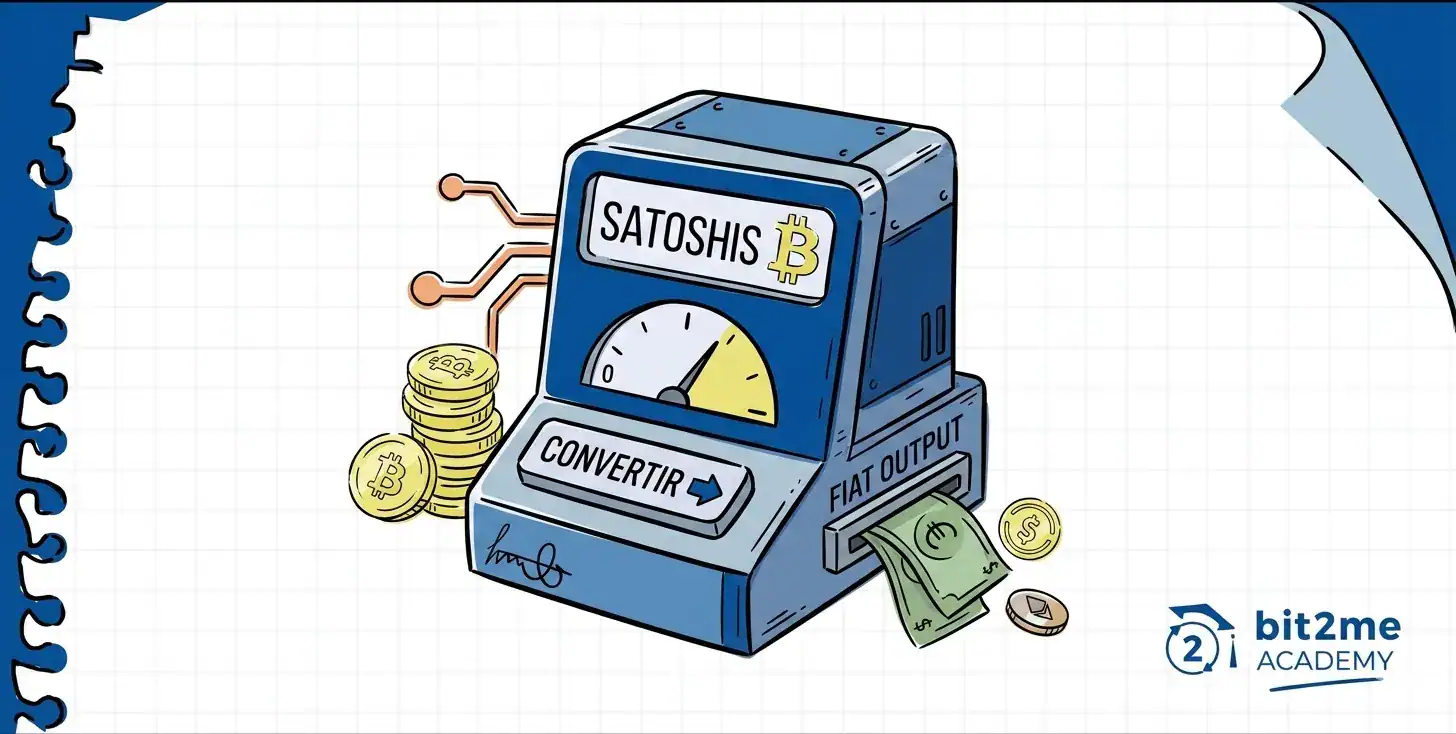
- Definition of satoshi: The "satoshi" is the smallest and indivisible unit of Bitcoin; one Bitcoin is exactly equal to 100 million Satoshis, a fixed ratio engraved in its code.
- Conversion calculation: To find out the value in fiat currency (euros or dollars), multiply the amount of BTC by the current market price; if starting from Satoshis, first divide by 100 million.
- Importance of precision: Due to extreme volatility and the handling of many decimal places, it is vital to use web tools that update the price in real time via websockets to avoid costly human errors.
- Psychological and technical advantage: Counting in Satoshis (e.g., 50.000) instead of Bitcoin decimals (e.g., 0,0005) makes it easier to read, reduces confusion with leading zeros, and is the standard unit for small transactions.
Managing Bitcoin (BTC) requires more than just a pretty app on your phone; it demands understanding what's behind the numbers flashing on the screen. If you've ever tried to mentally convert Bitcoin to Euros (or dollars) while the market fluctuates 3% in ten minutes, you know that accuracy isn't a luxury, but a necessity to avoid losing money along the way.
The smallest unit: Why do we talk about Satoshis?
First, you should know that you don't need to buy a whole token to participate in the ecosystem. In fact, most users trade fractions. A Satoshi is the smallest unit on the network and is equivalent to one hundred millionth of a whole asset. Does that seem like a small amount? Ask anyone who held a million of them back in 2015.
The relationship is fixed and mathematical: 1 BTC = 100.000.000 Satoshis. This figure is fixed, hardcoded into the protocol. When you use a web tool to perform the calculation, the algorithm applies a simple rule of three based on the real-time market price, but understanding the underlying arithmetic gives you real control over your funds.
 Certificate

How to manually calculate the value of your tokens?
Imagine you have 0.0045 BTC and want to know how many euros you have in your pocket. The process is straightforward. You only need the current price of the asset (the spot price) and a basic calculator.
- Direct multiplication: BTC amount × Asset price = Fiat currency value.
- Practical example: If the price is €95.000 and you have 0.0045 BTC, the operation is 0.0045 * 95.000 = €427,50.
What if you have Satoshis? This is where many people get confused with the zeros. To convert from Satoshis to the base unit, divide by one hundred million. If you have 500.000 Satoshis, the calculation is 500.000 / 100.000.000 = 0,005 BTC. Once you have that decimal, repeat the multiplication step.
It's pure arithmetic logic that any computer can solve in milliseconds, but you should master it to avoid major errors when sending transactions.
Web tools: Speed versus mental calculation
Doing these calculations manually is fine for learning, but in day-to-day operations we prioritize efficiency. Web conversion tools have evolved to offer aggregated data from multiple sources, preventing an API failure in a single node from giving you an unrealistic price.
These platforms allow you to switch between Bitcoin, Satoshis, Euros, and Dollars with a single click. Their biggest advantage? Eliminating human error when moving the decimal point. A single extra or missing zero in a conversion can mean the difference between a fine dinner and a quick coffee at the airport. By using an optimized interface, you ensure that the value you see is the one you will actually pay or receive.
But to make things easier for you, we've created a tool that does this in just a couple of clicks:
Price Converter
Volatility and the time factor
The price you're calculating right now will probably be wrong in sixty seconds. Cryptocurrency markets never close. That's why, when converting Bitcoin to Euros, the tool needs to be updated via WebSockets to reflect the latest market tick.
If you're going to make a significant transaction, don't rely on a screenshot from five minutes ago. The math is precise, but the values of the variables are constantly changing. The key is to use tools that allow you to "freeze" the price for a few moments so that your calculations reflect the reality of your wallet.
FAQ: Satoshi to dollar or euro converter



 Author