Essential Points
- Node Infrastructure: Development begins with the choice between running your own node (maximum sovereignty) or using third-party APIs (faster deployment), directly impacting the app's security.
- Simulation Environments: The use of Testnet and Regtest is mandatory; they allow you to run transactions without real value, and are critical for debugging before moving to Mainnet.
- Abstraction through Libraries: Developing on Bitcoin does not require programming from scratch; mature libraries handle address creation, transaction signing, and complex script calculations.
- Key Security: The architectural design must prioritize private key management (custody vs. non-custody), as this is the most critical point of failure in any crypto application.
Writing code for a Bitcoin application isn't the challenge many people imagine. If you have basic programming knowledge, the syntax won't hold you back. The real hurdle appears when you try to fit the puzzle pieces together. Understand what each component does and how they communicate with each other. Once you grasp that architecture, you can have a working prototype in an afternoon's work.
This text is not a "copy and paste" tutorial. Our intention is to provide you with a mind map of the elements that make up a robust digital asset and how they interact. Before opening your code editor, make sure you understand the fundamentals of networking. If you don't know what a network is, then... unspent output (UTXO)You're going to have problems before you even start.
The design mindset: Separate to conquer
We need to think in terms of independent blocks. Forget monolithic structures. On one hand, there's your business logic (your application), and on the other, there's the Bitcoin network. They are distinct worlds that need a reliable bridge to communicate.
How do we connect these two worlds? You have two main paths:
- The sovereignty path: You install and manage your own node.
- The third-party route: You use other people's infrastructure through service providers.
In both scenarios, communication is handled through an API. Some developers prefer the agility of RESTful interfaces, while others opt for the robustness—sometimes somewhat clunky—of JSON-RPC. Fortunately, the open-source community has provided us with libraries that package these calls and save us the dirty work.
The path of the own node
For this analysis, we'll take the more demanding route: managing our own node. Is it more complex? Yes. Is it worth it? Absolutely. Running your own instance grants you complete autonomy and allows you to audit what happens on the network without asking anyone's permission. It's the only way to truly understand how crypto assets are validated in real time.
Building this infrastructure forces you to manage the chain's storage and understand request latency. It's not just software; it's pure infrastructure. If you delegate this part to a third party to save a few euros on servers, you're missing the point of building in this ecosystem. Do you want to be just another programmer, or do you want to master the protocol? The answer will determine how you design your architecture.

Anatomy of a node: The three pillars
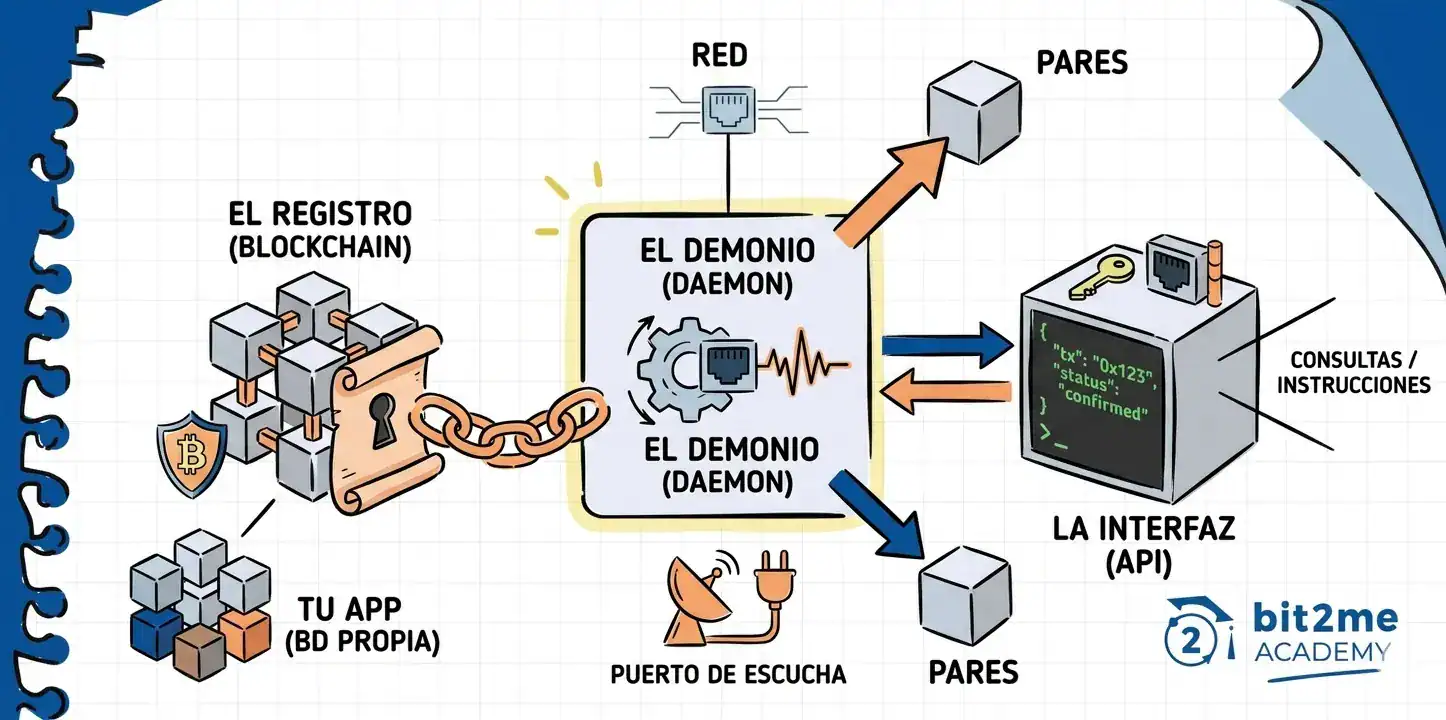
A node is not a monolithic block of software, but an ecosystem composed of three pieces that must fit together precisely:
- The Daemon: It's the heart of the beast. It stays connected to other peers via sockets, creating the P2P network where events are constantly exchanged. If this process stops, you're out of the game.
- The ledger (Blockchain): The local database where all events are recorded. A common mistake is thinking your application should write directly here. Wrong. Your app will have its own database for its internal logic; the node is only your immutable source of truth.
- The interface (API): The translator that converts the raw protocol data into readable JSON responses. You can protect this access or leave it open, although in 2026, leaving such an API exposed without security is asking for serious trouble.
You can run a node on virtually any system, whether Unix or Windows. The listening port allows bidirectional communication: you receive real-time network updates and, at the same time, send instructions to the node to perform actions.
Looking to set up something similar to a private block explorer? There's no need to reinvent the wheel. Open-source tools like the Insight ecosystem, though veteran, continue to demonstrate that setting up a RESTful interface on a node's infrastructure is a matter of minutes if you know which commands to run in the terminal.
The spread and the myth of processing
Injecting a payment into the network is a surprisingly linear process. Once the backend prepares the transaction, it's pushed to the node via the JSON-RPC API. From there, your node advertises it to its peers, who then advertise it to theirs, and so on until the network is flooded.
Here, performance depends on the quality of your connections. If your node is well-matched with low-latency neighbors, your transactions will be lightning fast. If you're connected to slow or poorly configured nodes, your transaction will be stuck in mempool limbo longer than you'd like.
The offline workflow
There's a concept that novice developers often overlook: the network doesn't need to know what you're doing until the last second.
- The addresses are generated offline.
- Transactions are constructed and signed without touching the internet.
- The node only comes into play when you need to check the previous status of an asset or when you already have the data package ready to send.
To manage this, we typically separate the backend into two libraries. One handles the hands-on communication with the node, while the other focuses on pure cryptography: creating keys and signing transactions. It's a clean architecture that minimizes security risks.
Scaling up to an Exchange
If you're planning to build something on the scale of an exchange, the model doesn't change, it just multiplies. We're not talking about a single server, but rather load-balanced infrastructure and node clusters for each cryptocurrency you decide to list. Redundancy isn't a luxury; it's the lifeline of your business. If a node becomes outdated or fails, the system must seamlessly switch to the next available node for the user.
Trench warfare tips for beginners
If it's your first time, don't overload your personal computer by downloading hundreds of gigabytes of data. Rent an inexpensive virtual server—you can find options for just over €5 a month—and use it as a testing ground. The network speed of a data center will allow you to sync your string in a fraction of the time it would take at home.
Once configured, you can develop your application locally and simply point the API to your remote server's IP address. For those coming from NodeJS, libraries like Bitcore or BitcoinJS remain the gold standard, depending on whether you're looking for a complete solution or just need to handle the offline logic.
Ultimately, building on Bitcoin is like playing with building blocks: the complexity lies not in the block itself, but in the skyscraper you are able to imagine with them.
Do you know which programming language you're going to use for your first implementation?
Architecture: Beyond "Hello World"
If we strip the software down, we're left with the same old structure: a backend, its own database, and a frontend. The trick lies in how you manage network asynchronicity.
- The Backend as conductor of the orchestra: Your server shouldn't be stuck waiting for Bitcoin. It should be able to process user requests and, in the background, query the node using RPC or WebSocket calls.
- Your database is sovereign: The Bitcoin node stores the network history, but your database stores your user's history. Don't confuse these concepts. In your local database, you record that "John" has X tokens, but you only confirm this when the node approves it from the P2P network.
- The interface (Frontend): This is where we serve up the information in a simplified way. The user doesn't want to see an unreadable hexadecimal hash; they want to see a green checkmark that says "Transaction confirmed."
The flow of interaction with the node
The backend interacts with the network in two main ways:
- Active (Pull) Mode: Your application asks, "Has the payment arrived at this address yet?" The node responds with the current status of the mempool or the confirmed block.
- Passive Mode (Push/Listen): You configure the node to "shout" whenever it detects a relevant event (such as a new block or an incoming transaction). Your backend listens for this shout and automatically updates the database.
Do you really need your own API?
Many people wonder whether they should expose an intermediary API. If you're building a mobile application or a modern website (SPA), the answer is a resounding yes. You don't want your mobile device trying to communicate directly with the Bitcoin node due to security and latency concerns.
Your API acts as a security filter: it validates the user's session, checks permissions, and then, only if everything is correct, translates that request into an order for the node. It's a necessary layer of protection to prevent anyone from trying to flood your node with junk requests.
At the end of the day, developing on Bitcoin in 2026 is an exercise in state management. The node gives you the reality of the network, and your database gives you the reality of your business. The success of your app depends on how well you synchronize both worlds seamlessly for the user.
Have you already decided whether your application will be a query tool or will it allow users to actively send crypto assets?
We put pieces together: Application + Bitcoin Node
At this point, theory becomes real architecture. A block explorer is, essentially, an optimized mirror of what happens on the network. If you try to query each piece of data directly from the node when a user loads your website, the experience will be terrible: the node is excellent at validating, but it's a pretty mediocre query manager.
This is where the magic of timing comes into play.
The data flow: From node to screen
For your browser to run smoothly, the backend needs to work tirelessly in the background. It's not about waiting for someone to visit your website, but about being constantly "attached" to the node.
- Real-time indexing: Your backend subscribes to events from the node (usually via ZMQ or WebSockets). As soon as the node detects a new block or transaction in the mempool, it "passes the message" to your server.
- Information processing: The backend receives a block of raw data, often in hexadecimal. Its job is to break that down, identify which addresses have participated, calculate the fees, and structure it logically.
- Database Persistence: You store that processed result in a high-performance database (like PostgreSQL or even something more specialized for time series). Why? Because searching for a transaction from three years ago on the node's disk is slow, but searching for it in a database you've indexed is instantaneous.
- Power consumption from the front: When a user enters a hash into their mobile or computer's search bar, your frontend doesn't bother the node. It queries your database, which responds in milliseconds.
Why bother duplicating the data?
You might think that having the information on the node and in your database is redundant. It is, but it's a necessary redundancy. An explorer needs to display statistics: how many cryptocurrencies have been moved today, what the average fees are, or which addresses are the most active. The Bitcoin node doesn't have a "give me the top 10 addresses with the highest balance" button; your database can tell you that if you've been saving the balances block by block.
The challenge of reorganizations (Reorgs)
This is where you see who's a seasoned analyst and who's an amateur. Sometimes, the network discards a block that just appeared (a chain reorganization). Your backend needs to be smart enough to detect that the node has rolled back and correct your local database. If you don't, your browser will show phantom transactions that never actually happened.
Building this infrastructure gives you complete control over your data. You're no longer dependent on external APIs that can go down or start charging exorbitant fees. You have your own private, fast, and sovereign token search engine.
FAQ – Developing Bitcoin Applications



 Author