Essential Points
- Hybrid infrastructure for greater speed: Paying directly on a cryptocurrency network (on-chain) is slow for a supermarket. The safest and most practical option today is to use intermediary cards that instantly convert your assets into fiat currency, avoiding unnecessary waits at the checkout.
- Superior technical safety compared to plastic: Cryptocurrencies use digital signatures that are far more robust than the magnetic stripe or chip of traditional cards. While a conventional card can be cloned, a crypto transaction relies on a private key that never leaves your mobile device.
- The human factor as the weak link: Technology is a "steel safe," but security fails if the user has poor digital hygiene. Using simple passwords like "1234," connecting to public Wi-Fi networks at the supermarket, or not enabling biometrics are the real risks, not the protocol itself.
- Financial stability through stablecoins: Using volatile assets like Bitcoin to buy food is risky, as its value can change while you're filling your cart. To protect your budget, the sensible option is to use stablecoins (cryptocurrencies pegged to the value of the euro or dollar), ensuring that the price on the shelf is what you actually pay.
- Privacy exposed versus cash: Unlike physical money, which is anonymous, every cryptocurrency payment leaves an immutable trace on a public network. Even if your name doesn't appear, any analyst can track your spending habits by linking your wallet address to your real identity.
If you've ever felt a slight shiver when holding your debit card near a card reader that looks like it's survived the world wars, you're not alone. Financial security is, by definition, a matter of trust.
However, when we apply that scenario to the realm of digital assets, the doubt not only persists but multiplies. Can we really trust that buying a dozen eggs and a pack of milk won't end in a crypto disaster?
But the reality is that paying with cryptocurrencies at the corner supermarket has gone from being a fantasy for "geeks" to a real option. However, as with any technology that tries to displace the established system, the answer to whether it's secure isn't a simple yes or no. Instead, it depends fundamentally on the infrastructure you're using and how much you're willing to relinquish in terms of custody.

The architecture behind the transaction: What happens when you bring your mobile phone close?
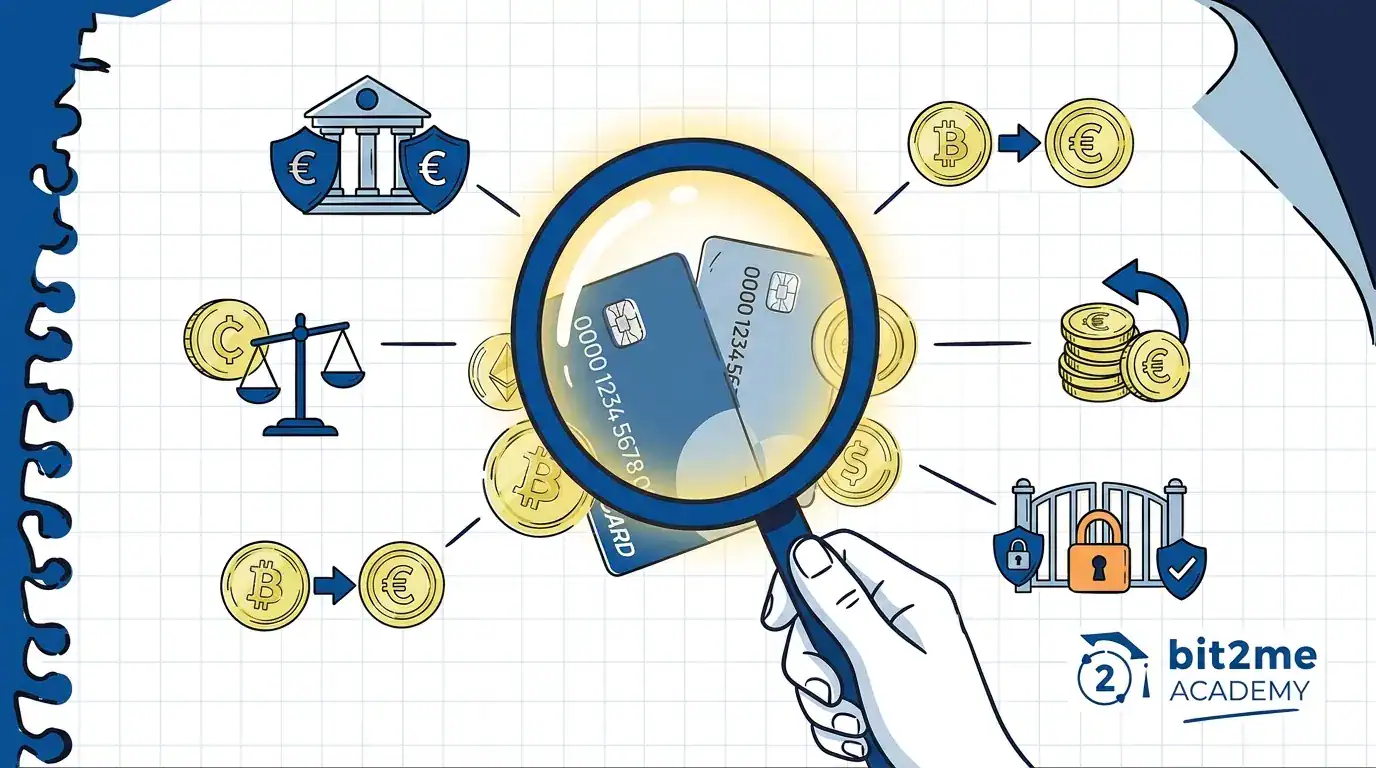
If you want to understand whether your money is safe between the dairy aisle and the checkout, you first need to look under the hood. It's not the same to send a transaction directly to the network (what we call on-chain trading) as it is to swipe a debit card linked to your cryptocurrency balance. They're completely different worlds.
Let's be realistic: seeing a "We Accept Bitcoin" sign in a neighborhood supermarket is still as rare as seeing a unicorn. The vast majority of businesses don't want to know anything about the technical complexities of blockchain; they just want euros. But that reality is slowly changing, especially in countries where the national currency is highly volatile, and in other cases, because interest in new payment methods is leading to their acceptance.
Therefore, when you bring your mobile phone close to the terminal, an intermediary comes into play (like Bit2Me or Bitpanda). This actor acts as an invisible bridge: Liquidate your tokens and deliver fiat currency to the merchant in the millisecond it takes the card reader to beep.
Is this system "pure" from a decentralization standpoint? Not at all. You're delegating custody. But, let's be honest, it's the only viable way to avoid risking network congestion. Ethereum I left you standing in front of an impatient cashier and a queue of customers who started giving you uncomfortable looks.
In this scenario, the risk of hacking doesn't lie in the global network infrastructure, but in the fragility of your own digital security. If your application isn't secure or if you use your home computer without taking proper precautions, the weak link will always be you, not the protocol.
At the end of the day, this intermediary layer offers a layer of operational security that the main network still cannot guarantee for buying a loaf of bread: the certainty that the payment will not be left in limbo while your ice cream melts on the conveyor belt.
Is it safe to pay with digital assets? Debunking the fear of hacking
There are still those who think that paying for a loaf of bread with cryptocurrencies is like carrying a neon sign inviting a movie hacker to empty your account from a laptop on the other side of the world.
This is a widespread but misguided idea. If we analyze the technical architecture, the cryptographic signature required to authorize a payment with digital assets is, by definition, infinitely more robust than the EMV chip in that plastic card you've been using for years.
Let's be clear: credit cards are outdated technology that's been patched up. They can be cloned, their numbers intercepted on dubious payment gateways, or "wiped" using brute-force attacks. In contrast, a token transaction requires a private key that, if you do things right, never leaves the secure enclave of your mobile phone. There's no number to copy, no magnetic stripe to read.
Does this mean you're invulnerable? Not at all. But the problem isn't the protocol itself, but rather the "digital hygiene" of the person using the device. If you use a predictable PIN (like the classic 1234) or you're too lazy to set up biometrics, don't blame the technology for your lack of judgment. The protocol is a steel safe; leaving the door open is your decision.
In this ecosystem, security is not a product that a bank sells you; it is a habit that you cultivate yourself every time you decide not to use the supermarket's open wifi to manage your assets.
Volatility: The risk no one talks about in the fruit section
We can get lost in debates about cybersecurity protocols for hours, but financial security is a completely different beast. Imagine paying for your weekly groceries with a volatile digital asset.
As you walk from the supermarket to your car, the value of that token plummets 10% due to an unfortunate tweet or a sudden move by Wall Street whales. Was the transaction secure? Technically, the bits reached their destination, but your wealth evaporated along the way. You lost purchasing power while loading the bags into the trunk.
Therefore, the use of stablecoins (Those tokens pegged to the euro or the dollar) have ceased to be an option and have become the only sensible path if you don't want to play Russian roulette with your monthly budget. No one in their right mind wants to be the star of a sequel to the famous Bitcoin pizza anecdote, paying for a steak today with what, in three years, could have been the budget for a high-end laptop.
Security in the supermarket isn't just about preventing your passwords from being stolen; it's about having the certainty that the price you see on the shelf is the price you actually end up paying at the end of the day. In this area, stablecoins not only win hands down, but they are the only infrastructure that allows this ecosystem to be more than just an experiment for speculators. What good is an ultra-secure network if your purchasing power depends on the whims of a market that never sleeps? Exactly: it's useless.
Privacy vs. Surveillance: The Purchase Receipt Dilemma
This is where the official narrative falls apart, and those of us who have been around the block for years raise an eyebrow. Paying in cash is the last bastion of analog freedom: the cashier doesn't care if you buy three boxes of donuts or broccoli; your bank simply doesn't receive the information. However, when you pay with digital assets, you're signing an immutable record on a public network. You're essentially shouting your consumption habits into the digital void.
Don't be fooled by the word "anonymity." It's true that your name and surname aren't on the blockchain, but your wallet address is, exposed for eternity. If an overzealous forensic analyst or tax agency manages to link that alphanumeric address to your identity (something ridiculously easy if you use a bank exit ramp), your entire financial life is laid bare.
Do we really need the whole world, or a credit scoring algorithm, to know how much we spend on toilet paper or sleeping pills? True security is inseparable from privacy.
In this area, cryptocurrencies still have a challenge to overcome: proving they can offer a robust shield of anonymity without becoming a playground for fraud. Until that happens, every supermarket payment is a trail of breadcrumbs that anyone with enough computing power can follow all the way to your front door.
Hygiene protocols to avoid unpleasant surprises at the checkout
If you're going to take the plunge and start using your tokens to fill the fridge, forget about any weird experiments. Here are three golden rules we apply before turning on the computer or leaving the house:
- Use a card with institutional backing: If the card issuer is not licensed to operate in Spain, run away.
- Spending limits: Don't link your main wallet (where you keep your long-term savings) to your everyday card. Keep a "spending wallet" with just enough for the week.
- Always use two-factor authentication (2FA): If your app doesn't ask for your fingerprint or a dynamic code to authorize payment, delete that app immediately.
Conclusion: Are we prepared?
Paying with digital assets at the supermarket is, technically speaking, as safe as swiping a conventional credit card; I would even venture to say that it surpasses it if we consider the robustness of end-to-end encryption and the absence of obsolete magnetic strips.
But let's not kid ourselves: absolute security in this sector is a pipe dream if the user is unaware of which network they are operating on or if they intend to fill their fridge with tokens that fluctuate more violently than the price of gasoline during the peak of the August holiday exodus.
Are we witnessing the future of payments? Undoubtedly. But it's a future that demands maturity. We must stop viewing our crypto assets as video game coins and begin managing them with the same instinctive caution we use to watch our wallets on a crowded subway car.
Technology has already done its part by offering us an almost impenetrable infrastructure; now it's up to you to decide whether you're going to be the master of your finances or simply a spectator waiting for a third party to fix major mistakes.
In the end, the real "revolution" is not the code, but the habit of the person who uses it.
FAQ: Frequently Asked Questions about Payments with Digital Assets



 Author