Essential Points
- The Bogleheads portfolio and the Permanent Portfolio are two asset allocation recipes with decades of track record, designed to not depend on accurately predicting the economic cycle.
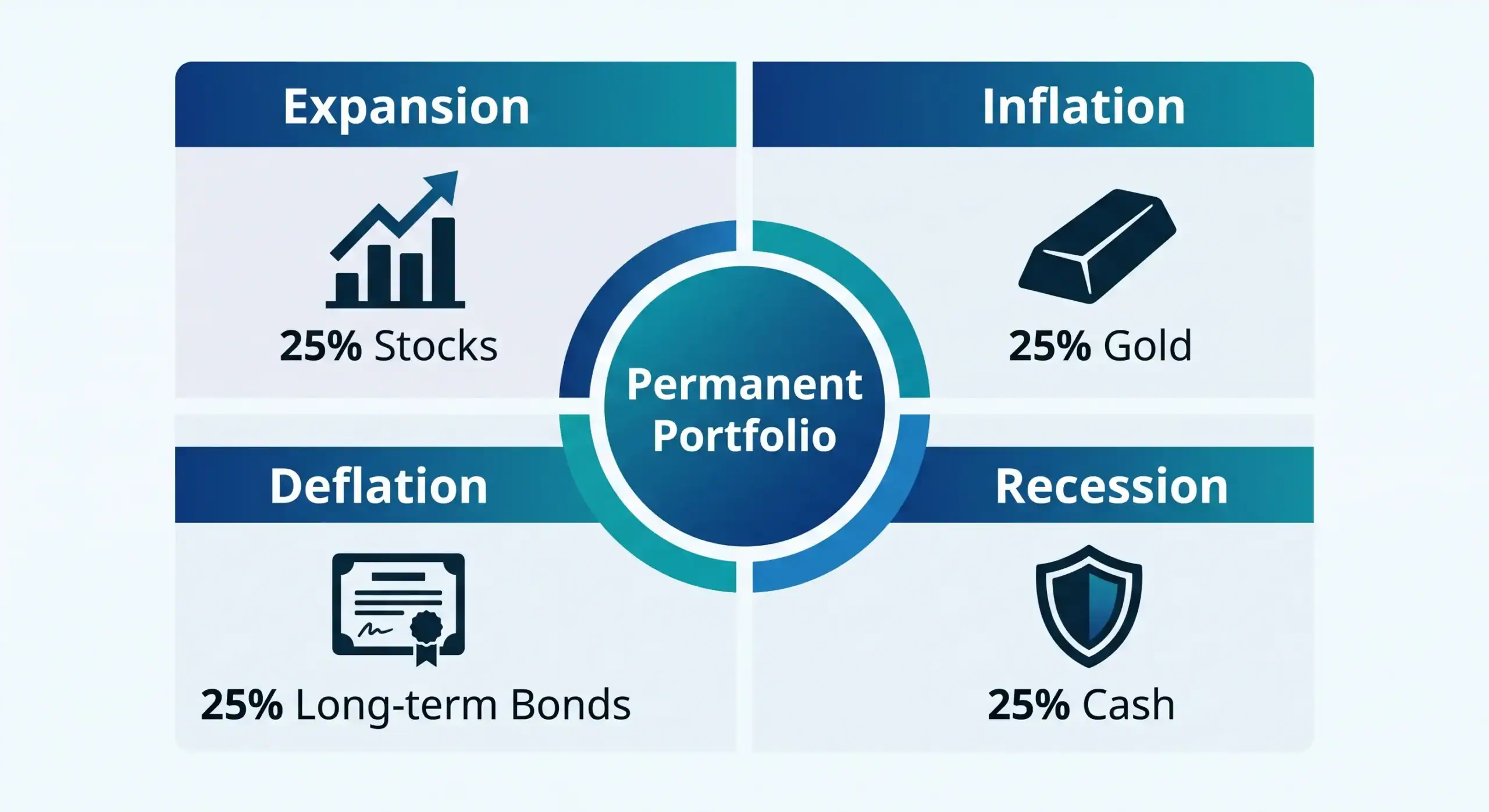
- The first one divides your contribution into two or three low-cost index funds; the second one divides the capital 25% between stocks, long bonds, gold and cash.
- Both are suitable for long-term investing with a simple portfolio to maintain, without analyzing companies or trying to predict what comes next.
- Choosing between one and the other depends on how much volatility you are willing to accept in exchange for higher expected returns, not on which is "better" in absolute terms.
There are investment strategies named after their creators, backed by decades of proven track records. The Bogleheads portfolio, inspired by John Bogle, and the Permanent Portfolio, designed by Harry Browne, are probably the two best-known named asset allocation strategies in long-term passive investing. If you've had your money sitting idle in the bank for a while, or invested in actively managed funds without a clear understanding of the fees you're paying, it's very likely you've come across one of these strategies sooner or later.
They both share the same underlying convictionNobody—not you, not a professional manager, not the central bank of the day—can reliably and consistently predict what the market will do next year. Where they differ is in how they respond to that uncertainty. Bogle opted to own the entire market at the lowest possible cost; Browne, to spread capital among assets that react differently depending on the economic climate. In this article, we review both philosophies and how they are implemented today. Bit2Me Invest, its tax and legal nuances in Spain, and above all what strategy best suits which type of buyer, so that you can make the decision based on your own criteria.
Bogleheads Portfolio: The John Bogle Method
Who was John Bogle and what did he change in the world of investing?
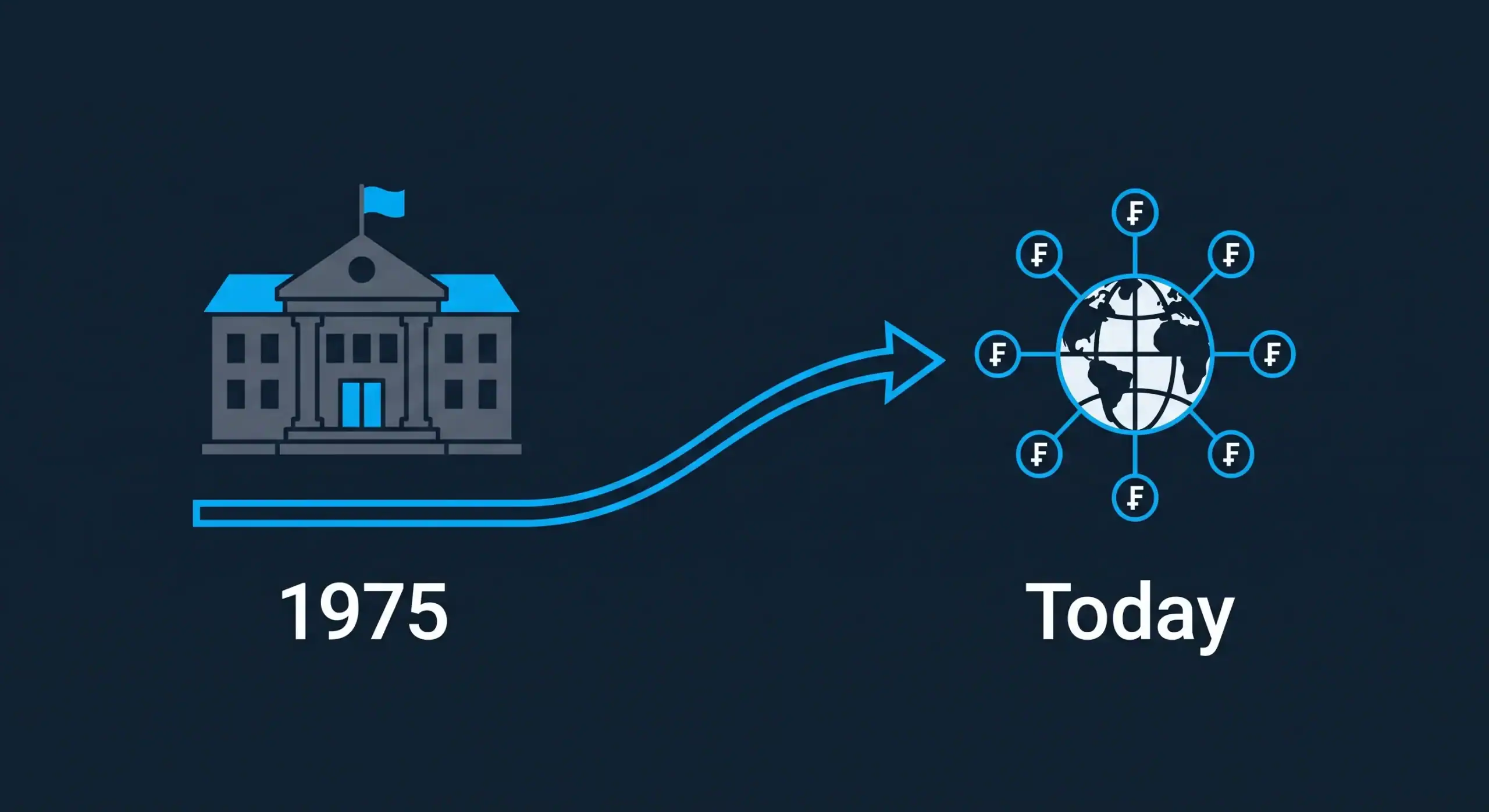
John Bogle founded The Vanguard Group In 1975, and a year later, he launched the first index fund available to individual investors, replicating the S&P 500. In an industry that thrived on convincing people that an expert manager was needed to make money in the stock market, he proposed just the opposite: instead of trying to beat the market—and paying professional managers to achieve this—it was enough to replicate it at the lowest possible cost, because much of active management fails to outperform its benchmark index once fees are deducted.
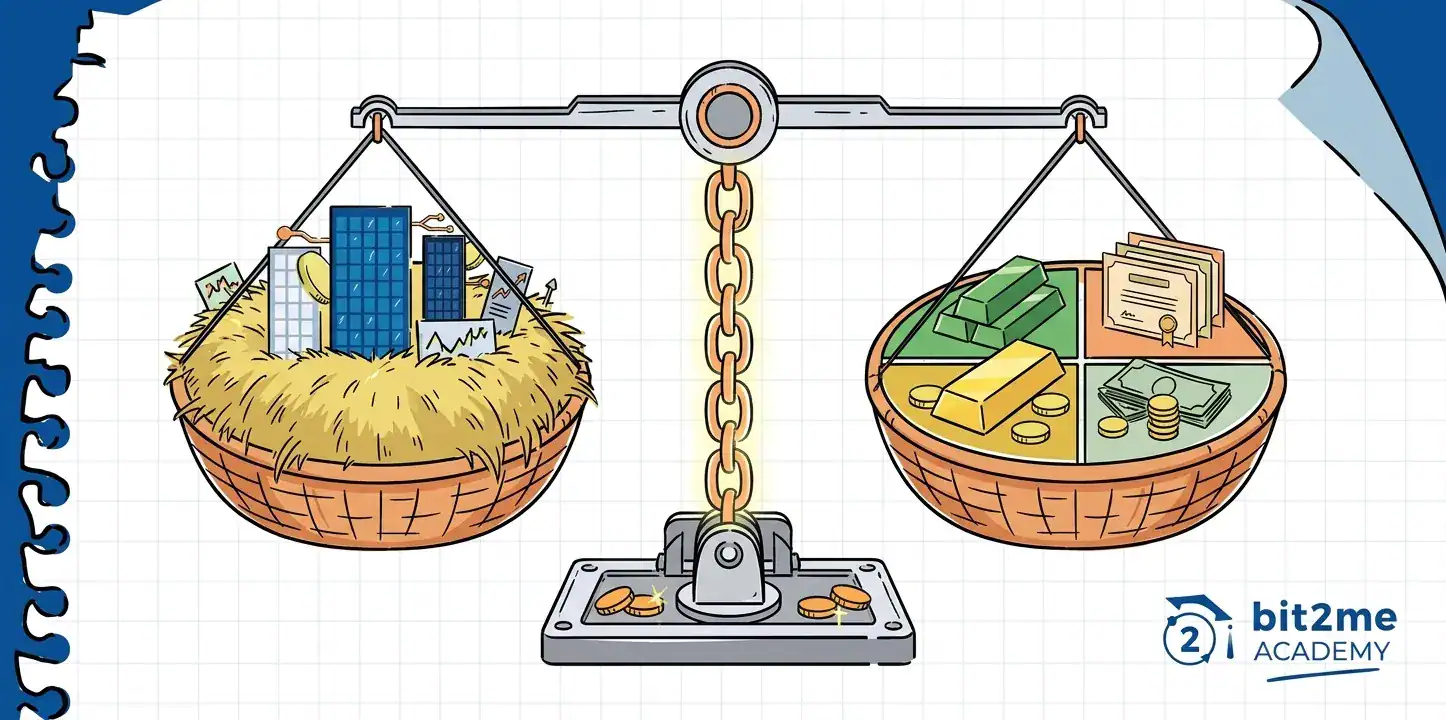
Bogle summarized his philosophy with a phrase that has become a classic in index investing: “Don’t look for a needle in a haystack, buy the whole haystack.” His legacy continues to this day.Index funds and low-cost ETFs are now one of the most widespread forms of investment in the world, and around their ideas a global community of individual investors known as Bogleheads was born.
The Bogleheads principles: the philosophy behind the portfolio
The Bogleheads portfolio is not a specific product, but the practical application of a handful of principles that have proven their strength for decades.
- Start as soon as possible and be consistent. Timing in the market matters more than hitting the perfect entry point; contributing regularly allows you to average out your purchase price instead of trying to guess when to buy cheap.
- Diversify globally. Global funds such as those that replicate the MSCI World or the FTSE All-World provide exposure to thousands of companies spread across dozens of countries.
- Keep costs low. The Bogleheads community's general guideline is to look for funds with a TER below 0,2%.
- Don't do market timing. Consistently predicting market movements is virtually impossible, even for professionals.
- Adjust the risk to your time horizon. More equities when you're young; more fixed income as you get closer to the time when you'll need that money.
- Simplify. A portfolio of two or three well-chosen funds is usually sufficient; added complexity does not improve profitability, it only adds cost and more chances of error.
These six principles are especially relevant in Spain, where the average cost of actively managed funds has traditionally been higher than that of their indexed equivalents. Every extra percentage point of TER you pay is a point that stops working for you in the long run.
The three-fund portfolio: the portfolio of three funds
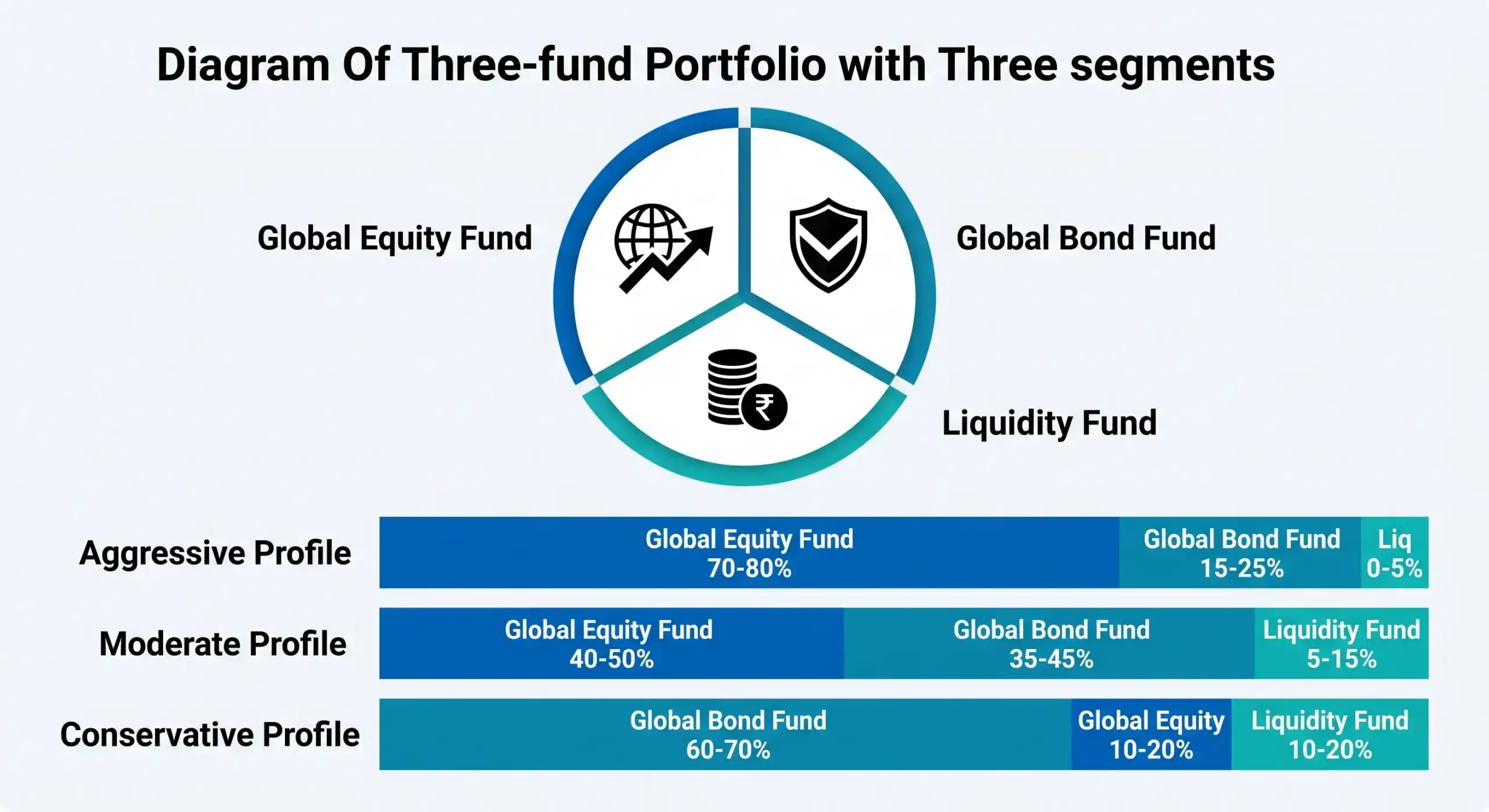
The three-fund portfolio is the most popular implementation of the Bogleheads philosophy, and its appeal lies in how little you need to build it: a global equity fund —based for example on the MSCI World or the FTSE All-World—, a global fixed income fund that provides stability, and optionally, a money market fund as a liquidity reserve.
The ratio between equities and fixed income depends on your risk profile and investment horizon. As a guideline: an aggressive profile with a horizon of more than 20 years could manage around 90% equities and 10% fixed income; a moderate profile with 10-15 years, between 70% and 80% equities; and a conservative profile with less than 10 years, a more balanced allocation, close to 50-50.
Why are three funds—or even two—enough? Because that combination already provides exposure to tens of thousands of assets worldwide, and adding a fourth or fifth fund almost never significantly improves diversification: what it usually does is complicate monitoring and rebalancing.
How to adapt the Bogleheads portfolio to the Spanish investor?
The Bogleheads philosophy originated in the United States, but it adapts well to the Spanish fiscal and regulatory context, with several nuances that are worth knowing before building your own portfolio.
The first is the tax advantages of funds compared to ETFsIn Spain, unlisted investment funds allow transfers between funds without taxation until final redemption, according to Article 94 of the Personal Income Tax Law (LIRPF), while ETFs are taxed as if they were shares upon each sale. This makes index funds the preferable option over equivalent ETFs for a Spanish Boglehead seeking tax efficiency, although both can be used within the same investment philosophy.
The second nuance is the home biasSome investors add a small additional weighting of European equities to their global portfolio to reduce exposure to exchange rates—global funds are usually highly concentrated in dollars—and benefit from more favorable dividend withholdings within the European Union, although it is advisable to maintain this moderate bias.
The third nuance has to do with the accumulation funds versus distribution fundsAccumulation funds, which reinvest dividends instead of distributing them, are more tax-efficient because they defer the tax event until the sale, and are usually the most advisable option for a long-term Bogleheads portfolio. Finally, it's worth knowing about the most used indices for the global componentThe MSCI World covers developed countries, with about 1.500 companies, and is the usual reference among European Bogleheads, while the FTSE All-World adds emerging markets, with about 4.000 companies, in exchange for slightly more exposure to that risk.
Step by step: Build your Bogleheads portfolio with Bit2Me Invest
Bit2Me Invest gives you access to a catalog of hundreds of investment funds from international asset managers, with clean share classes and no retrocessions—a cost approach that naturally aligns with the Bogleheads philosophy. Here's how you can start building your own portfolio of three funds:
- Accede to Bit2Me Investigate and complete the risk profiling questionnaire. This suitability test is mandatory under MiFID II regulations and helps you understand what type of assets fit your situation and risk tolerance.
- Choose the funds that will make up your portfolio. A global equity fund, a fixed income fund and, if you want, a money market fund for liquidity, following the logic of the three-fund portfolio.
- Make your contributions regularly. Setting aside a fixed amount each month to invest is the most direct application of the first Bogleheads principle.
- Avoid touching your wallet during times of volatility. Having defined your allocation in advance—and why you chose it—is your best defense against impulsive decisions when the market moves strongly.
The advantage of building your Bogleheads portfolio in Bit2Me Invest is about having, within the same ecosystem where you already manage your crypto assets, access to low-cost index funds and the tax efficiency of transferring between funds in Spain, without needing to open an account in a traditional bank.
 Certificate
Permanent Portfolio: The Harry Browne Method
Why Harry Browne created a portfolio that doesn't need to predict the future
Harry Browne, an American financial advisor and popularizer, experienced firsthand the stagflation of the late 1970s: runaway inflation, stagnant growth, and an oil crisis that destabilized global markets. In 1981, after realizing that no one around him had been able to anticipate that scenario, he published the initial ideas for what would become the Permanent Portfolio. This experience led him to a premise that is still supported by much of the academic evidence today—the SPIVA (S&P Indices Versus Active) reports have shown for years that active management rarely beats its benchmark index consistently—: instead of trying to predict the economic scenario, one should build a portfolio that performs reasonably well across all scenarios.
Herein lies the nuance that distinguishes the Permanent Portfolio from conventional diversification: instead of spreading money across asset classes with a moderate growth scenario in mind, Browne diversified by macroeconomic scenario, identifying four possible environments—expansion, inflation, deflation, and recession—and allocating an asset to each. In 1999 he published Fail-Safe Investing, the book where he sets the weights and the rebalancing rule that are still used as a reference today.
The four economic scenarios and the asset it protects in each one
The driving force behind the Permanent Portfolio is not any single asset, but the low correlation between the four.
Historically, stocks and long-term bonds have shown a low correlation, and in recessionary phases it has even become negative; gold, in turn, has tended to decorrelated with equities in times of acute financial crisis, although the exact degree varies depending on the period.
This lack of correlation—not the individual returns of each asset—is what underpins the logic of the entire strategy: at any given point in the cycle, there are usually one or two assets performing well, and years in which all four decline simultaneously are, according to historical evidence, rare. The most frequently cited example is 2008: while global equities experienced one of their worst declines in decades, long-term bonds and gold mitigated much of the impact.
How to implement the Permanent Portfolio with ETFs
Putting logic into practice involves choosing an instrument for each leg, with low costs and faithful replication of the underlying asset as a common criterion.
For shares (25%)The most coherent option is an ETF indexed to a broad global index such as the MSCI World or the MSCI ACWI, since one tracking the S&P 500 introduces a bias towards the United States that Browne did not consider. long-term bonds (25%)The key is duration: the longer the bond, the greater the price sensitivity to interest rates and the potential benefit from deflation, although it is also the most volatile component when rates rise sharply, as happened in 2022. gold (25%)It's important not to confuse an ETC (Exchange Traded Commodity) backed by physical gold with futures or mining stocks, which have a different risk profile; for tax purposes, it's taxed as a capital gain, not as investment income. liquidity (25%)A high-credit-quality money market fund or short-term Treasury bills are the usual options, designed to preserve capital rather than maximize returns.
The selection criteria are similar across all four legs: low TER —ideally below 0,25%—, physical replication, high trading volume and UCITS domicile, always confirming the specific availability of each instrument in the catalog.
Historical performance and comparison with the S&P 500
Analyzed over long periods, the Permanent Portfolio has tended to show moderate annual returns, lower than those of an equity-concentrated index like the S&P 500, but with significantly lower historical volatility and much less pronounced peak declines during major market crises. This combination—lower returns, but also much less risk—is precisely the trade-off that Browne consciously designed.
In prolonged bull markets, such as the one experienced by global stock markets between 2009 and 2021, the Permanent Portfolio has tended to underperform a 100% equity index. Those who choose this strategy consciously accept this opportunity cost in exchange for a more stable trajectory during downturns. 2022 was probably its most demanding test in recent decades: soaring inflation and rising interest rates simultaneously impacted both equities and long-term bonds, while gold performed more reliably. It is precisely this honest assessment that reinforces the analysis: no portfolio, however well-designed, is immune to all possible scenarios.
For whom does the Permanent Portfolio make sense?
The profile that best suits this strategy typically has a long-term investment horizon, at least ten years, prioritizes preserving capital and minimizing shocks over maximizing returns, and has a conservative or moderate risk profile with a preference for a "set it and forget it" approach. Conversely, it's probably not the best option if you're young, have a very long-term investment horizon and a high risk tolerance, prioritize maximizing returns in bull markets, or are a trader who bases their strategy on market timing. The Permanent Portfolio doesn't eliminate risk; it redistributes it across the four scenarios, and there are rare periods when all four decline simultaneously.
How to Build Your Permanent Portfolio in Bit2Me Invest and the rebalancing rule?
Through Bit2Me With Invest, you can access the instruments that make up this strategy from a single platform. It's important to be clear here: the Permanent Portfolio is not a product of Bit2Me Invest, but a strategy that you can implement yourself with the available tools.
- Accede to Bit2Me Invest and complete the onboarding process, which includes the suitability test required by MiFID II.
- Select the instruments that correspond to each leg of the portfolio from the available catalog.
- Configure the weights of your initial contribution: 25% in each of the four blocks.
- Establish Browne's rebalancing rule: adjust when any asset exceeds 35% or falls below 15% of your total portfolio.
- Review your portfolio every six months or annually, and avoid making changes if the pesos remain within that range.
Bogleheads vs Permanent Wallet: Which one suits you?
At this point, you probably already have an idea of which of the two you're leaning towards. Both strategies share the same commitment to simplicity and the same skepticism towards market timing, but they are based on different logics: Bogleheads aim to own the entire market at the lowest cost; the Permanent Portfolio allocates capital among assets that react differently to the economic cycle. The following table summarizes the key differences to help you decide.
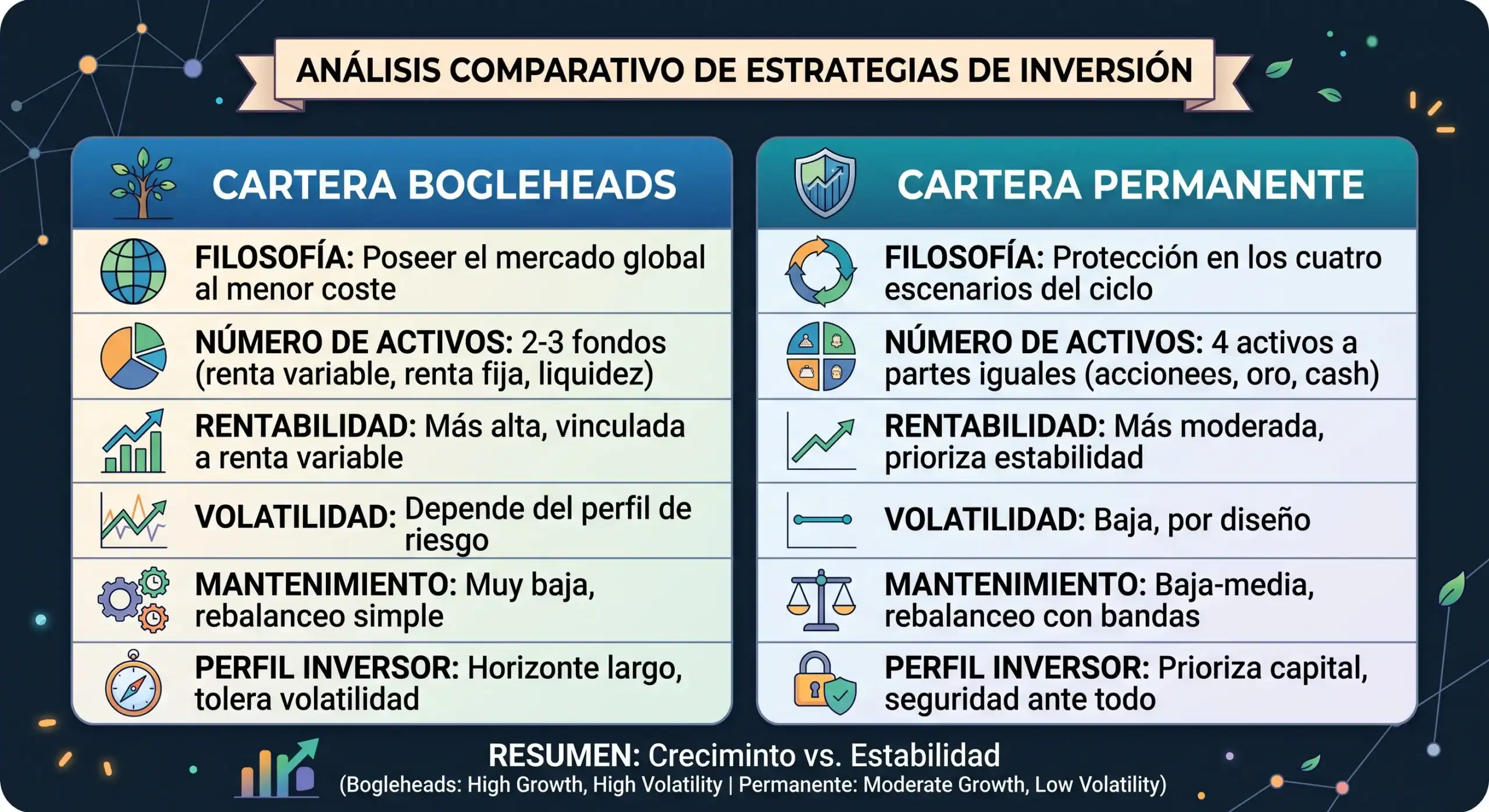
In practice, the question isn't which is superior, but rather what kind of risk you prefer to take. If your investment horizon spans several decades, you have a high tolerance for volatility, and you want to maximize capital growth, the Bogleheads three-fund portfolio is usually a better fit. If you prioritize stability above all else or prefer peace of mind when the market is volatile, the Permanent Portfolio is designed precisely for that. There's nothing preventing you from combining elements of both if your profile warrants it: some investors allocate most of their capital to a three-fund portfolio and set aside a smaller portion as a buffer, following the logic of the four scenarios.
Those seeking variations on this philosophy often encounter Ray Dalio's All-Weather Portfolio, which applies a Risk Parity concept with a greater emphasis on fixed income, or Lazy Portfolios like David Swensen's Yale Portfolio. All share the same core principles: few holdings, minimal rebalancing, and low costs, with different nuances regarding the weight given to each asset class.
Neither John Bogle nor Harry Browne invented patience, but both demonstrated that it can be made into a replicable method: Bogle democratized access to markets by stripping investing of the veneer of complexity that many managers were keen to maintain, and Browne showed that you don't need to accurately predict the economic cycle to protect your wealth. Today, Bit2Me Invest brings both philosophies closer to the Spanish investor, without inaccessible minimums or endless processes, within the same ecosystem where you already manage your crypto assets.

Frequently Asked Questions about the Bogleheads Portfolio and the Permanent Portfolio



 Author