Essential Points
- Every purchase is a tax sale: For the tax authorities, paying with your crypto card isn't a simple expense, but rather a "barter." Technically, you're selling a fraction of your tokens to buy a product, and you must pay taxes on the difference between the price you paid for those tokens and the value of what you're acquiring today.
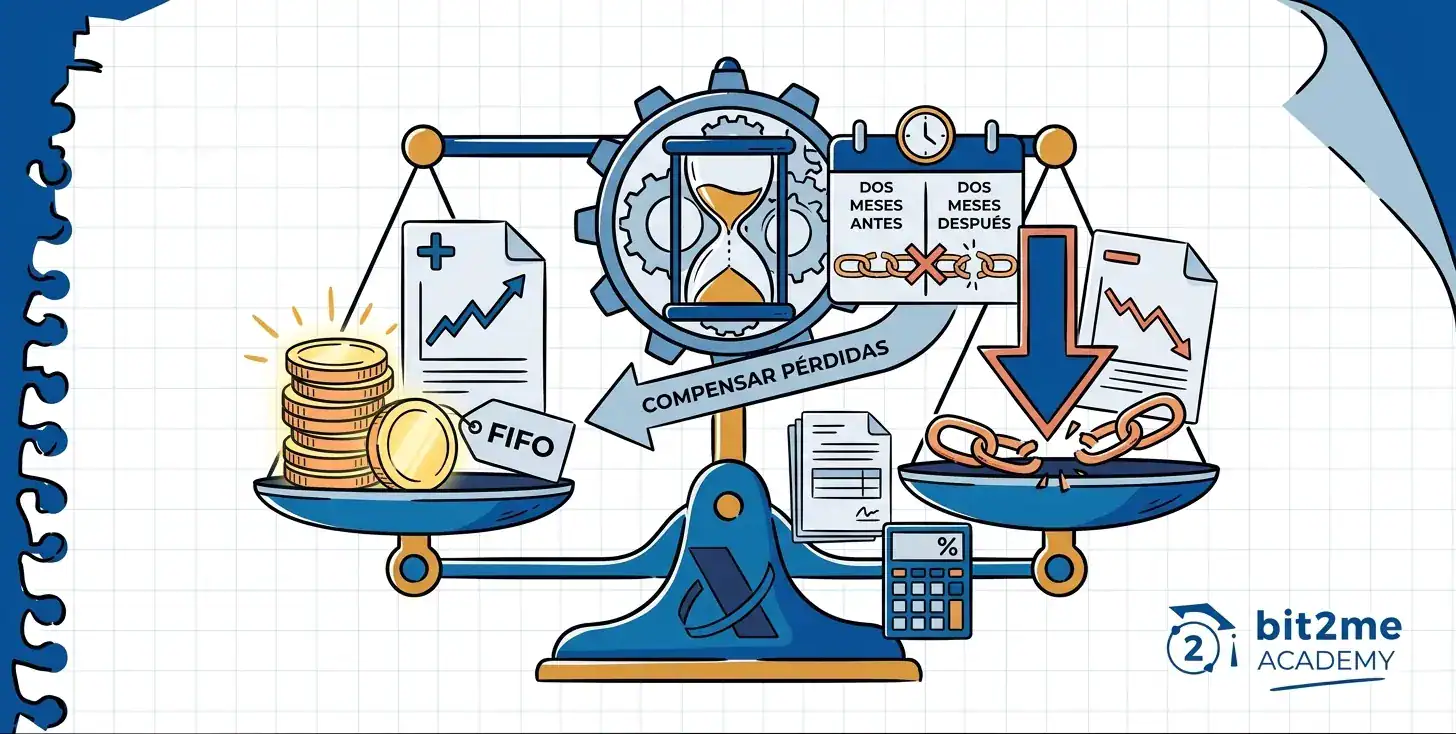
- The impact of the FIFO method: In Spain, the "first in, first out" principle applies. If you use your card today, it's considered that you're spending the oldest tokens you purchased. If you bought them cheaply years ago, the capital gain (and the tax payable) will be much higher.
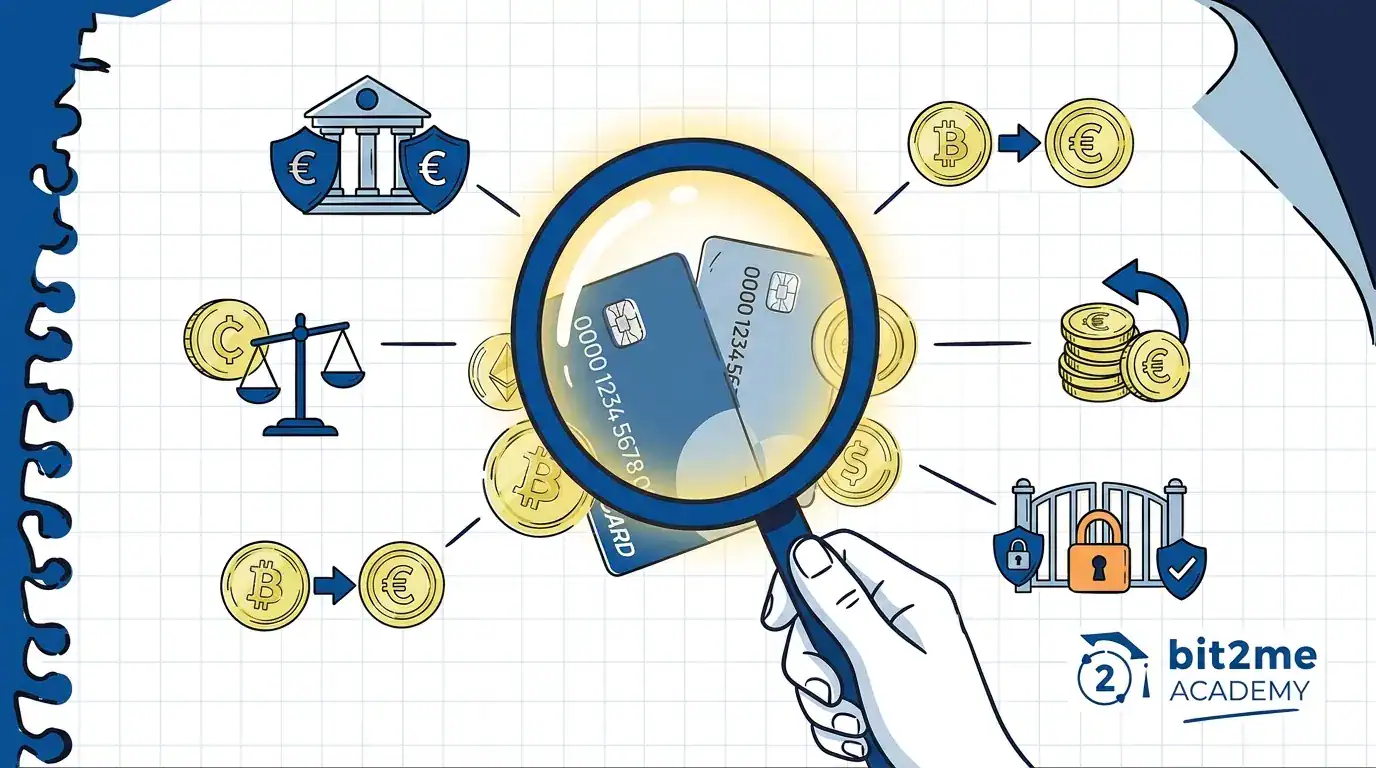
- Total surveillance by the AEAT: Anonymity is over. Thanks to the MiCA regulations and the data exchange (DAC8), the Spanish Tax Agency receives automatic information from credit card exchanges. Their algorithms cross-reference your card expenses with your declared income to detect discrepancies instantly.
- Cashback is not a gift: The rewards you receive for your purchases are taxed as capital gains from the moment they arrive in your account. If those tokens increase in value and you spend them later, you generate a second taxable transaction.
- Sections and loss compensation: Profits are taxed as savings income (between 19% and 28%). The advantage is that you can use losses from other crypto investments to offset gains from your everyday purchases and reduce your tax liability.
If you paid for your coffee this morning with your debit card linked to a token platform, you have technically just carried out a transaction that the tax authorities want to know the details of.
The romanticism of the early years, when digital assets moved under the radar, is over. Today, the Tax Agency not only has eyes everywhere thanks to the full implementation of MiCA, Instead, it has algorithms that cross-reference your expenses with your income almost instantly.
Does this mean you should stop using your card? Not at all. But the convenience of carrying your crypto assets on your mobile phone comes at a price: the responsibility of understanding that every "beep" on the card reader is a tax event.

The fiscal anatomy of card payments
Many users mistakenly believe that as long as they don't withdraw money to their traditional bank account, there are no taxes to pay. This is a huge error. The moment you swipe your card through a merchant's terminal, what we legally call an exchange occurs. You are handing over a digital asset in exchange for a good or service.
For the tax authorities, in that precise microsecond, you've sold a fraction of your tokens. The calculation is devilish if you don't have the right tools: you have to subtract the acquisition value (what that token cost you months or years ago) from the transfer value (the price of the product you're buying).
The difference is your net worth gain or loss. Do you really want to calculate this every time you buy a loaf of bread? Probably not, but your platform should be doing it for you behind the hood.
 Certificate

The FIFO Method Puzzle
This is where things get serious. In Spain, the criterion for calculating these profits is the FIFO (First-In, First-Out)In other words, the first assets you bought are the first ones you sell when using the card.
Imagine you bought a fraction of a cryptocurrency in 2022 at a ridiculously low price and continued accumulating it in 2024 and 2025. If you use your card today to buy a €1.500 computer, the tax authorities will consider that you are spending those cheap tokens from 2022.
The result is a huge unrealized capital gain that suddenly appears on your tax return. You're not spending "current money," you're liquidating your investment history, and that can be very costly if you don't plan which assets are linked to your card.
Reporting obligations: The trail of Model 721
Forget the old idea that what happens on the exchange stays on the exchange. Transparency isn't an option; it's the system's default setting. With the DAC8 directive fully operational and automatic data exchange mechanisms running at full speed, most digital asset service providers operating in Europe are completely transparent about your balances and every transaction you make with your card.
Do you have a credit card issued by a foreign entity but live in Spain? Then you'll have to deal with Form 721. For some, it's a safeguard; for others, their worst bureaucratic nightmare. If your total assets on that platform exceed €50.000 at the end of the year, notification is mandatory. But don't be confused: Just because your balance is less than that amount doesn't give you carte blanche to remain silent. The fact that you are not required to submit this information form does not eliminate your obligation to pay income tax on each individual payment.
The tax authorities have stopped playing guessing games. They no longer sit around waiting for you to proactively and kindly tell them what you've done with your tokens. Now, their strategy is much more pragmatic: they simply cross-reference your tax return with the gigabytes of data that exchanges have already uploaded to their servers. If what you say doesn't perfectly match what they already know, the algorithm will trigger a request for information before you even realize it. Do you really want to risk it over the VAT on a few online purchases? In the current scenario, traceability is absolute, and anonymity in spending is simply a myth from another decade.
The Cashback and Rewards Maze
Do you get 2% back in tokens on every purchase? Those loyalty programs we love so much (and that digital asset platforms use like candy outside a school) hide a tax labyrinth that often catches many people off guard. In 2026, cashback has gone from being a "gift" to a major accounting headache.
The general rule is simple: every time you receive those reward tokens, you're experiencing a capital gain at market value. If you're credited with €10 in tokens today for buying a phone, those €10 automatically become your acquisition value for the future. But this is where the system turns perverse. If those tokens increase in value and, three months later, you use them to pay for dinner, you've just triggered a second transfer. It's an endless loop of micro-transactions that makes manual management simply utopian for anyone who doesn't have tax software permanently attached to their skin.
In specialized forums and among financial content creators, we prefer to debate whether these rewards should be classified as investment income, similar to interest on a current account. However, the Spanish Tax Agency isn't interested in such nuanced arguments in 2026: its stance is unequivocal. Any increase in your net worth that doesn't stem from a prior transfer is included in the capital gains tax base for savings.
Does it really make sense for the government to pursue every penny of profit from a cashback on bread purchases? From an administrative efficiency standpoint, it's absurd. But from the perspective of full traceability, it's the perfect tool to force you to declare your earnings. If you accept the token, you accept the trail. In the end, what seems like an incentive to save a little on your daily expenses turns out to be a first-class ticket to an automated audit if you don't keep meticulous records of every penny the exchange "gives you." In this sector, we should already know this: if the product is free (or you get money back for using it), the real cost is usually hidden in the next draft tax return.
Tax brackets and taxable base for savings in 2026
It's not all a bureaucratic obstacle course. At the end of the day, the use of your digital asset cards is included in the savings tax base, an ecosystem that, although its rates have increased in 2026, remains more predictable than the general personal income tax scale.
Currently, we're operating within a range of 19% to 28%. Does it hurt? Yes, but at least the rules of the game are clear: you pay for what you earn, not for the total volume of what you spend.
| Net Profit Graduation (Savings Basis) | Applicable Tax Rate |
| Up to € 6.000 | 19 % |
| Between €6.000,01 and €50.000 | 21 % |
| Between €50.000,01 and €200.000 | 23 % |
| Between €200.000,01 and €300.000 | 27 % |
| More from 300.000 € | 28 % |
What's truly interesting (and what separates an amateur user from one who knows what they're doing) is income offsetting. If your token market investments have hit a rough patch this year and you've closed trades at a loss, those losses are pure gold for your tax return. You can use them to offset the profits you make every time you swipe your card.
In practice, it's a way to "subsidize" your everyday purchases through taxes: if your losses offset your spending gains, the tax burden of your daily expenses could be reduced to zero. However, this isn't done by guesswork; it requires meticulous accounting and a data dump that leaves no room for misinterpretation by the tax inspector.
Risks of Big Data at the Spanish Tax Agency (AEAT): The algorithm never sleeps
At this point, some people still naively wonder: “Is an alarm really going to go off in Madrid because I paid for a taxi with my tokens?” The short answer is a resounding yes. The long answer is that the Tax Agency no longer needs a human inspector checking your invoices; its Big Data infrastructure and predictive analytics are sufficient.
The Spanish Tax Agency has perfected data intelligence systems that would put Silicon Valley to shame. These algorithms massively cross-reference expenses processed by Visa or Mastercard networks linked to cryptocurrencies with your declared income. If your lifestyle (your dinners, your trips, that new car) is financed with a digital asset card that doesn't appear on your tax returns, the system automatically detects the cash flow discrepancy.
The net has tightened so much that the risk of penalty for trying to conceal these small transactions far outweighs any theoretical savings from not declaring them. In the current system, a minimal penalty for "data omission" or "filing incomplete returns" is infinitely more painful than paying that 19% tax on a couple of dinners out. This isn't an administration looking for errors; it's one that processes data, and against massive amounts of data, the individual user playing hide-and-seek is bound to lose.

FAQ: Taxation of crypto cards



 Author