Essential Points
- Security through Physical Isolation: The main value proposition lies in the fact that the private keys never leave the physical chip (Secure Element), neutralizing phishing attacks or remote malware.
- Self-Custody Management: The use of these devices gives the user total control (financial sovereignty), eliminating the counterparty risk associated with third-party exchanges or custodians.
- Multi-asset Interoperability: Modern hardware wallets allow you to manage hundreds of blockchains and tokens (ERC-20, BEP-20) from a single, unified, and secure interface.
- Resilience in the face of loss: Thanks to the BIP39 standard, access to funds is recoverable using a seed of 12 to 24 words, regardless of the physical integrity of the device.
If your private keys have ever touched a computer with an internet connection, you're already vulnerable. It doesn't matter how many antivirus programs you have installed. Hardware wallets aren't just a gadget for tech enthusiasts; they're the only real physical barrier between your digital assets and any remote attacker.
These devices operate on a principle of total isolation. By generating and storing keys in a secure environment (Secure Element), they ensure that transaction signing occurs within the device. The outside world never sees your seed phrase. Why delegate this responsibility to a third party when you can have complete control in the palm of your hand?
The market has evolved dramatically. We're no longer limited to classic USB; now we're dealing with devices with high-resolution touchscreens, encrypted Bluetooth connectivity, and native compatibility with dozens of Layer 2 networksModels like the Trezor Safe 5 or the Ledger Stax series have set the standard in usability without sacrificing an iota of technical robustness.
Even so, hardware alone can't work miracles. It's useless to have the best protected token if you then jot down the 24 recovery words in a digital notepad or save them as a photo on your phone. Security is a chain, and you are almost always the weakest link.
To get the most out of this technology, I suggest following a golden rule: always verify the destination address on the device screen, not on your computer monitor. Viruses that modify the clipboard are commonplace. Keep your firmware updated, use an additional passphrase if your assets warrant it, and above all, understand that in this ecosystem, financial sovereignty comes with absolute responsibility.
What are Hardware Wallets?
If there's one thing we've learned in recent years, it's that any bit connected to the network is a vulnerable bit. Hardware wallets cut this problem off at the root by operating as watertight wallets, without direct contact with the tangled web of the internet. By falling into the category of cold wallets, their function is simple but vital: to keep crypto assets safe from remote attacks that no antivirus on the market could stop.
These are not just ordinary USB flash drives. These devices are genuine. Hardware Security Modules (HSM) Miniaturized. Their internal architecture is designed so that private key generation occurs in an isolated execution environment. What does this mean in practice? That the keys die where they are created. They never cross the connection port to your computer or mobile device; only the digital signature necessary to validate the transaction is sent.
The level of physical protection is equally robust. Many of these devices have intrusion detection circuits that, in the event of an attempted tampering in a laboratory, perform a preventative memory wipe. This electronic "suicide" ensures that, even if a third party has the device in their possession, your tokens remain inaccessible. It's a layer of defense that transforms the hardware into a virtually impregnable digital safe.
Despite this robustness, the user experience doesn't suffer. Most current models use USB-C connections or encrypted wireless protocols that allow you to manage your wallets with surprising agility. At the end of the day, a hardware wallet is the ultimate tool for those who understand that, in the world of digital assets, convenience should never compromise security. Would you really leave your savings in a system that could be hacked while you sleep? Probably a resounding no.
Functions of hardware wallets
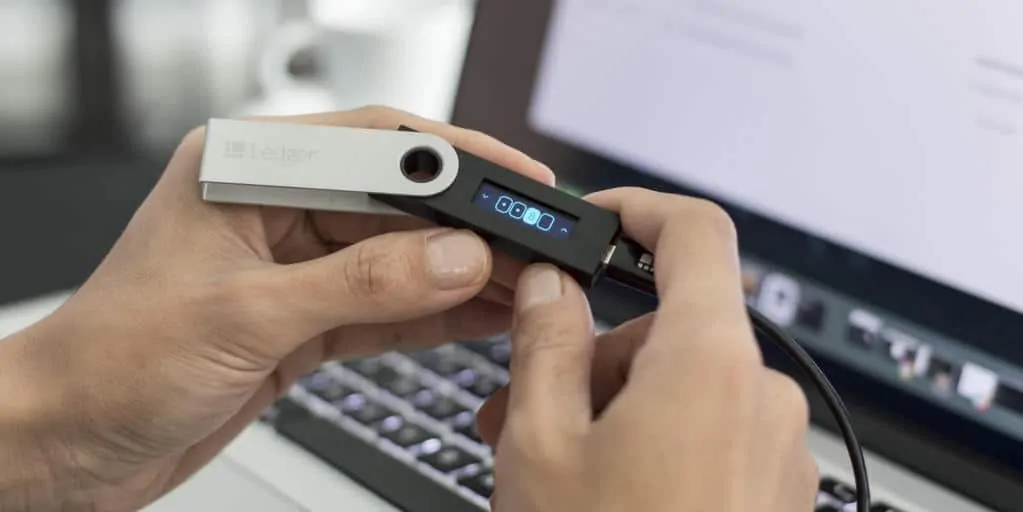
Despite the complexity of the ecosystem, a hardware wallet operates under a strict functional minimalism: generating private keys and signing data. It may seem like little, but it's what keeps your crypto assets safe from prying eyes. By delegating these tasks to a dedicated environment, we guarantee that the private key never touches the computer's operating system, not even for a fraction of a second. If the key is unknown, it can't be stolen. It's that simple.
The integrated screen isn't just for show; it's your last line of defense. Why is it so important? Because attackers can manipulate what you see in your browser or mobile app, but they can't alter what the device's secure chip displays. Before authorizing any transaction, you must verify that the transaction details match on both devices. If there's a discrepancy, someone is trying to steal your tokens, and the device has just saved your money.
Although these devices are compact and highly portable, their management requires a software interface on a computer or smartphone. This application acts as a bridge, sending the unsigned transaction to the device and receiving the digital signature back. Once the transaction is complete and the cable or wireless connection is disconnected, the device shuts down. No trace remains; there are no background processes or open backdoors.
The validation process occurs exclusively within the hardware's silicon. By signing within this electronic bunker, we ensure that even a malware-infested computer is unable to compromise the integrity of your digital assets. Is it annoying to have to press physical buttons for each submission? Perhaps. But in an environment where a single wrong click can empty an account in milliseconds, that small amount of friction is the best investment in peace of mind you can make.

Characteristics of hardware wallets
- immune to virus and malware attacks which can infect the device and steal private keys. Therefore, they allow for the secure and efficient storage of large amounts of crypto assets.
- Absolute control over private keys, and therefore, of funds, is owned by the user. So that Trust in third parties is not required for the handling of keys and the management of crypto assets.; as it happens with online wallets or hot wallets.
- private keys are generated randomly and without patterns through a Random Number Generator (RNG).
- Hardware wallets usually have limited media, with which they seek to maximize security.
- The software of the hardware wallets are open source mostly. This allows the user and the community to validate how they operate and verify the security processes they implement.
- Similarly, hardware wallets allow to add extra layers of security. For example, PIN settings of your choice or 2-factor authentication (2FA). These methods prevent a third party from using the device if it is lost or stolen.
- Keys are generated and maintained within the same hardware device. They never go out to the computer. So they are kept safe and protected.
- compatible with most operating systems availables.
- have a seed that allows to restore the keys and recover the funds.
- The acquisition of hardware wallets requires a small investment. There are devices that range from €50 to €200 or more. However, considering that its acquisition is intended to protect large sums of money, it really is a small investment, don't you think?

Recommendations for use for hardware wallets
- When configuring a hardware wallet for the first time it is recommended make a written backup of the seed or keywords. Since several of them show the seed only once.
- The seed backing should be kept in a safe and protected place. since if damage or loss occurs, it will be impossible to restore a wallet and recover its funds.
- The seed endorsements they should never be done inside the computer or other device without being encrypted and encrypted first. Since these devices are prone to hacking and cyber theft.
- If you are going to buy a hardware wallet, be sure to buy it from its official suppliers and not from markets or third parties. Well, there are many possibilities of hacking, theft and scams if the necessary precautions are not taken.
Examples of hardware wallets
Trezor
To talk about Trezor is to talk about the very foundation of personal custody. They were the first to understand that the security of our crypto assets couldn't depend on a black box. Their reputation isn't the result of marketing, but of an open-source philosophy that allows any expert to dissect their firmware to ensure there are no hidden tricks or loopholes.
In 2026, while the veteran Model One and Model T remain functional devices, the Trezor Safe series takes center stage. These new models have resolved one of the brand's long-standing debates by including a security chip (Secure Element) that, unlike the competition, is auditable. This means you enjoy superior physical resistance against data extraction attacks without sacrificing complete transparency.
Setup remains a digital hygiene ritual: the device generates a recovery seed (your "master key") in a completely offline environment. As a deterministic (HD) wallet, you can manage an unlimited number of addresses for your tokens from a single backup. The entire signing process occurs on the device's silicon; your computer acts only as a blind messenger that never actually handles the private keys.
Forget the old limitations: today Trezor supports thousands of assets, including XRP, Solana, and major Ethereum scaling networks. Whether you use the Safe 3's USB-C port or the Safe 7's touchscreen and Bluetooth for convenience, the Trezor Suite interface makes managing your wealth as intuitive as using a banking app—but with the difference that you are the bank. Would you really settle for less?

Ledger
Ledger has maintained its leading position not only through its robustness but also by understanding that security starts with visual appeal. While the iconic Ledger Nano S Plus and Nano X remain reliable tools, the current standard is set by the Ledger Stax and Ledger Flex models. These devices have replaced tiny screens with e-ink panels that allow you to read every detail of the transaction before signing. Why settle for deciphering minuscule characters when you can clearly see the address to which you're sending your crypto assets?
The magic happens under the hood, thanks to its proprietary operating system, BOLOS, integrated into a bank-grade security chip. Unlike other manufacturers, Ledger isolates each application from each network individually. If one app for a specific token were to fail, the rest of your assets would remain protected. It's a level of risk compartmentalization that few can match.
Today, saying they support a thousand assets is a huge understatement; through Ledger Live, you can manage thousands of digital assets across more than 50 different networks natively. The interface has become a complete financial hub where you can buy, sell, or stake without your private keys ever touching your computer or mobile device. Everything is validated on the device, which still adheres to the golden rule: three failed PIN attempts and the device is automatically formatted to prevent physical tampering.
One vital technical detail that has evolved is the seed. We're no longer just talking about 24 words on a piece of paper. Ledger now offers optional recovery protocols for the more cautious, although purists still prefer complete offline control. With prices ranging from €79 for the entry-level models to nearly €280 for the premium models with wireless charging, the question isn't whether Ledger is expensive, but whether you're willing to risk your tokens to save the cost of a dinner out. My answer is clear.
Bit2Me Wallet, a secure wallet for your cryptocurrencies
Let's be honest: carrying a hardware wallet around your neck to pay for a coffee in downtown Madrid isn't practical. It's like carrying a safe under your arm to buy bread. In today's ecosystem, the key to success lies in compartmentalization. While your hardware wallet safeguards the bulk of your crypto assets long-term, you need a streamlined tool that allows you to operate in the real world seamlessly.
This is where it comes in Bit2Me Wallet. We don't intend to replace your cold storage; we want to be your best ally. We've designed our platform with institutional-level security in mind, but with the immediacy you demand every day. Need to send tokens to a friend or make a quick purchase at your favorite store? With our interface, you can do it in just a couple of taps on your mobile device, with the peace of mind that your main funds remain safely stored offline.
True power emerges when you combine both worlds. By using Bit2Me As your central hub, you create a professional workflow: you maintain complete control over your physical device and use our infrastructure for daily operations, asset trading, and performance management. It is, quite simply, the most robust team you can assemble to manage your wealth in 2026.
Are you really going to keep missing out on opportunities because you don't have your assets readily available when the market moves? You can set up your wallet for free and start trading in less than 20 seconds. It's time to take control of your finances with the leading platform in Spain.
FAQ – What are Hardware Wallets?



 Author