Essential Points
- The first known bitcoin to dollar exchange was on 12-10-2009: 5.050 BTC for $5,02, according to its seller.
- Mt. Gox, active since 18-7-2010, acknowledged in 2014 the loss of about 850.000 BTC and continues to return funds until 2027.
- Every major hack, from Coincheck to Bybit and Binance in October 2026, has put the spotlight on custody.
- Today, exchanges operate in the EU under MiCA, which has been fully in force since 1-7-2026 after the end of the transition period.
Binance estimated that an attacker withdrew $6.300 billion from its hot wallets on October 29, 2026, which, if confirmed, would be the largest cryptocurrency theft on record, far surpassing the one suffered by Bybit in 2025. The figure may change as the investigation continues, but it illustrates the progress made since 2009, when Martti Malmi sold 5.050 bitcoin for $5,02 and no one was yet talking about markets.
The history of Bitcoin exchanges is a series of problems only partially solved. First, a price had to be put on a currency that started out worth zero, as the article on [reference to Bitcoin exchange] explains. How much is a bitcoin worth?And today you can consult the Bitcoin price today without leaving Bit2MeThen came Mt. Gox with the first robberies, and finally the regulators.
In the European Union, the MiCA regulation already establishes who can offer these services, and the transitional period in Spain ended on July 1, 2026, according to the CNMVUnderstanding how we got here helps you critically interpret every platform announcement, every hacking statistic, and every promise about custody, because almost everything being discussed today has already happened before under a different name and on a different scale.
 Certificate
What is a Bitcoin exchange and what types are there?
Anyone wanting to exchange Bitcoin for euros, dollars, or another cryptocurrency needs a platform to connect them with the other party, and that's what an exchange is. Its function is to allow the conversion of digital assets into fiat money and return, something that in 2009 required a direct agreement between two people.
Within this category, it's useful to distinguish between two uses. Buying and selling platforms exchange fiat currency for cryptocurrencies at a fixed price, while trading platforms offer a console for real-time trading, with an order book and technical price analysis tools.
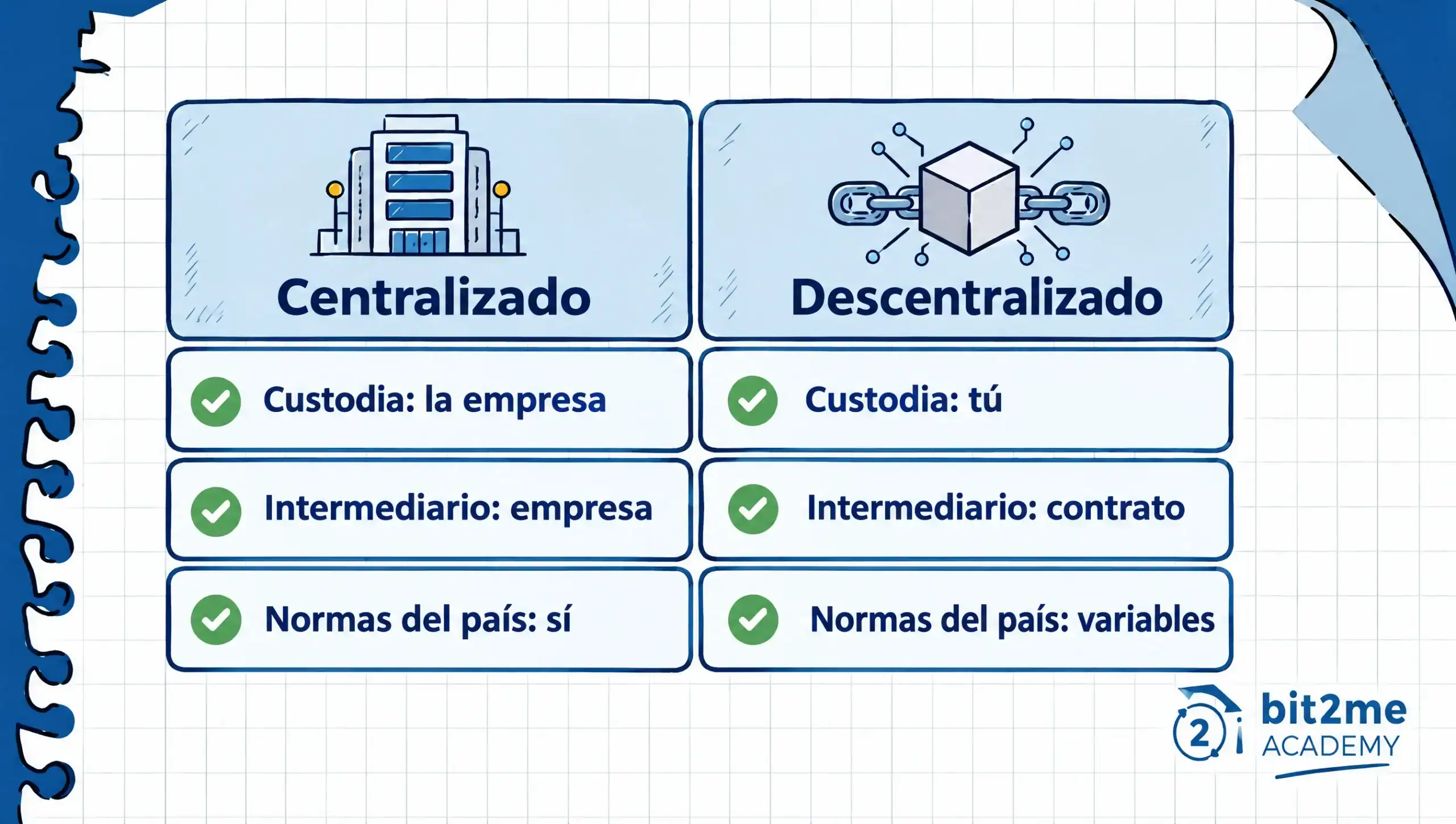
The other distinction is who holds the funds, and much of what follows depends on this. In a centralized exchange, a company manages your funds, applies the rules of its jurisdiction, and intervenes in every transaction. In a decentralized exchange (DEX) The changes are executed by smart contracts on a blockchain and you keep the keys to your wallet, although you assume responsibility for usage errors and failures of the contract itself.
From the first exchange rate to the 10.000 bitcoin pizza
The first acknowledged transaction between two people occurred on January 12, 2009, when Satoshi Nakamoto sent bitcoin to Hal Finney, according to Bitcoin wiki timelineIn those months everything was about tests and donations, and the few operations that took place lacked a market price.
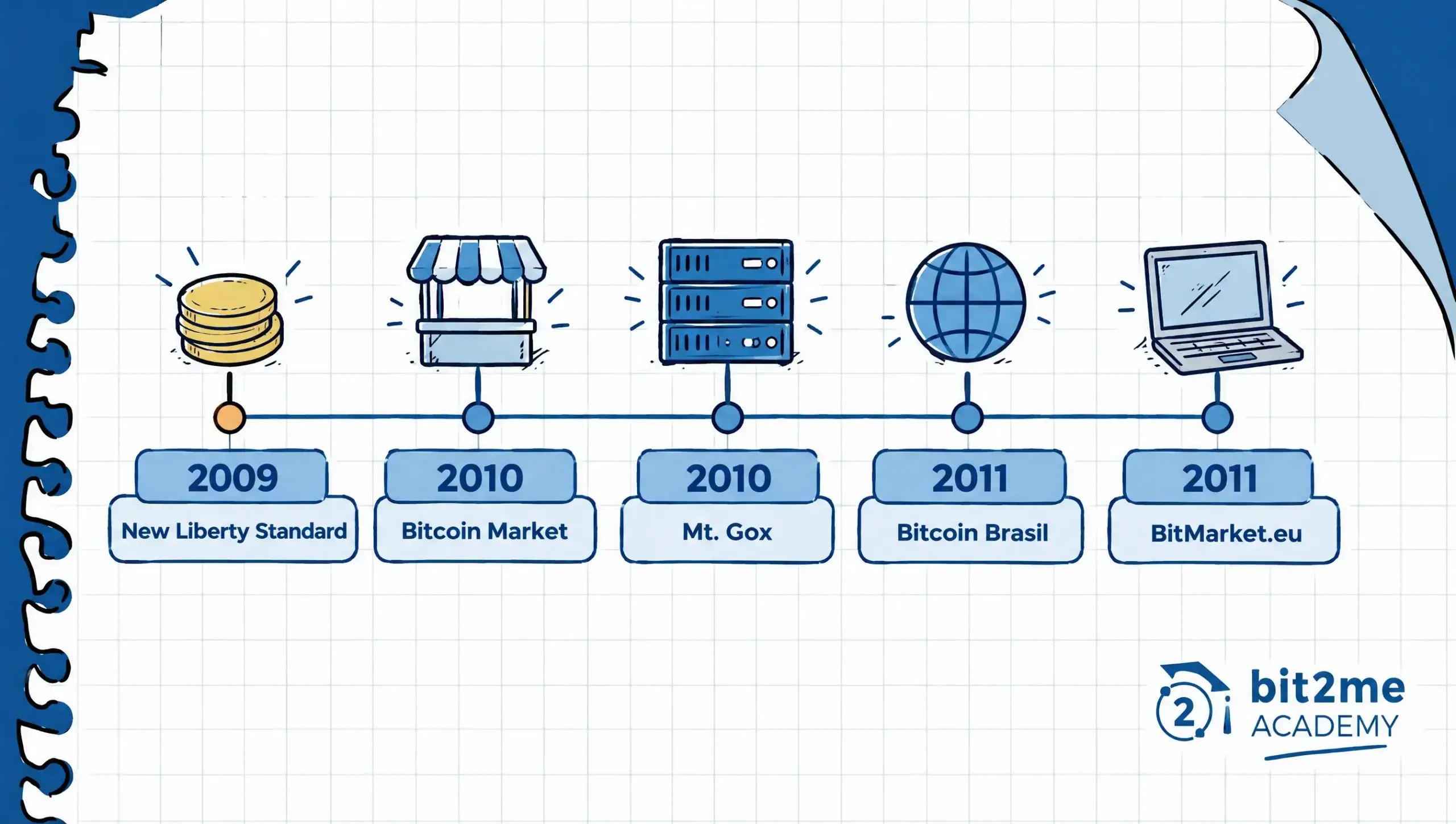
That changed on October 5, 2009, when New Liberty Standard published the first known price. According to the same timeline, $1 was then equivalent to 1.309,03 BTC. A week later, on October 12, Martti Malmi sold 5.050 BTC to that service for $5,02. PayPal, an operation considered the first exchange of bitcoin for fiat currency.
It came out at just over 1.000 BTC per dollar, a price slightly higher than the New Liberty Standard quote, and marked the beginning of the relationship between Bitcoin, exchanges and market prices.
Even so, for more than a year Bitcoin remained without a usable value in commerce. Laszlo Hanyecz offered 10.000 BTC on Bitcointalk for a couple of pizzas, and the purchase was completed on May 22, 2010, according to the Bitcoin wiki, a date that is remembered today as the Bitcoin Pizza Day.
Bitcoin Market and Mt. Gox, the first markets of 2010
The user dwdollar, from BitcointalkHe launched Bitcoin Market, a peer-to-peer trading platform that began operating on March 17, 2010, and accepted PayPal, according to the Bitcoin wikiPayPal stopped supporting the site on June 4, 2011 due to the cases of fraud that had occurred.
A brief message on Bitcointalk from July 18, 2010 Mt. Gox was introduced, featuring the latest price, high and low of the last 24 hours, volume, and best bid and ask prices. Jed McCaleb created the platform, and in March 2011, it was acquired by Mark Karpeles, which led it to its collapse.
In the spring of 2011, platforms also appeared that supported currencies other than the dollar. Bitcoin Brasil was announced on March 31 to operate with Brazilian reais, according to the Bitcoin wiki, and BitMarket.eu He did it on April 5th to exchange bitcoin for euros.
Today, that change is offered by authorized cryptocurrency service providers under MiCA, and if you want to take the plunge, you can buy Bitcoin at Bit2MeThe value of Bitcoin can change rapidly, so it's advisable to read the risks in the legal disclaimer on this page before making any decisions.
The first thefts, from the Mt. Gox hack to the 2014 crash
Mt. Gox suffered its first major breach on June 19, 2011, when an attacker used an auditor's credentials, obtained from a compromised computer, to mint bitcoin in their name and sell it at any price. The nominal price fell to one cent before recovering, according to the Bitcoin wiki.
Other small exchanges suffered a similar fate. Bitomat, from Poland, announced on July 31, 2011, that it had lost all its data and was bought by Mt. Gox on August 11, while Bitcoinica suffered thefts in March and May 2012, with more than 43.000 BTC lost in the first instance, according to the same wiki (Bitcoin ATM, Bitcoinica).
The final blow came in February 2014, when Mt. Gox filed for bankruptcy protection in Japan and admitted in its filing to the disappearance of approximately 850.000 bitcoins. Some of those bitcoins later resurfaced in an older storage facility, and you can read more about the case in the article on What is Mt. Gox?.
The biggest exchange hacks since 2016
After Mt. Gox, the pattern repeated itself with increasingly larger figures. The table lists the largest cases with the figure provided by each source, which varies depending on the asset's price at the time of the count and, in the most recent cases, may still be changing.
| Date | Consumer Relations Platform | Lost | Cause indicated | Outcome |
|---|---|---|---|---|
| August 2016 | Bitfinex | 119.756 BTC (about $72 million then) | Unauthorized withdrawals | Lichtenstein, sentenced to 5 years in November 2024 |
| January 2018 | Coincheck | 523 million XEM (approximately $534 million according to initial reports) | Unique signature hot wallet | Replacement to customers by the company |
| May 2019 | Binance | 7.000 BTC (about $40 million) | API keys and 2FA codes obtained by the attacker | Covered with the SAFU bottom |
| March 2022 | Ronin (Axie Infinity) | 173.600 ETH and $25,5 million in USDC (more than $600 million) | Five out of nine committed validators | Attributed to Lazarus by the US |
| October 2022 | BNB Chain Bridge | 2 million BNB created (about $570 million) | Bridge failure, with falsified evidence | Network shut down and approximately 2,07 million BNBs burned |
| November 2022 | FTX | About $477 million according to Elliptic ($370 to $400 million in other estimates) | Without attributing it, after declaring bankruptcy | Unidentified author |
| November 2023 | Poloniex | More than $100 million | Hot wallets | Figures between $114 and $126 million according to the count |
| February 2025 | Bybit | About 401.000 ETH ($1.400 to $1.500 M) | Multi-signature compromised by the Safe interface | Attributed by the FBI to TraderTraitor, part of Lazarus |
| October 2026 | Binance | Approximately $6.300 billion according to Binance ($5.900 billion according to Chainalysis) | Open investigation | Binance says it will replenish balances |
The Bitfinex case had a drawn-out ending. Ilya Lichtenstein pleaded guilty in August 2023 to conspiracy to launder stolen bitcoin. His five-year sentence was handed down in November 2024, but he didn't serve the full term because he was released from prison early. His partner, Heather Morgan, received an 18-month sentence.
Bybit refutes the notion that thefts always originate from poorly secured wallets. On February 21, 2025, approximately 401.000 ETH were drained from multi-signature wallets after the Safe interface used by signatories was compromised, making it the largest theft from an exchange at the time. Arkham also estimates the 2020 LuBian theft, which no one has claimed responsibility for, at $3.500 billion.
Ronin and BNB Chain have a different cause, because they weren't traditional exchanges but rather bridges connecting blockchains. On Ronin, the attacker controlled five of the nine validators, and on BNB Chain, he created 2 million BNB by exploiting a vulnerability that falsified proofs. The validators then shut down the network, and this shutdown limited the damage, although at least $100 million flowed to other chains.
What changed in custody after each robbery?
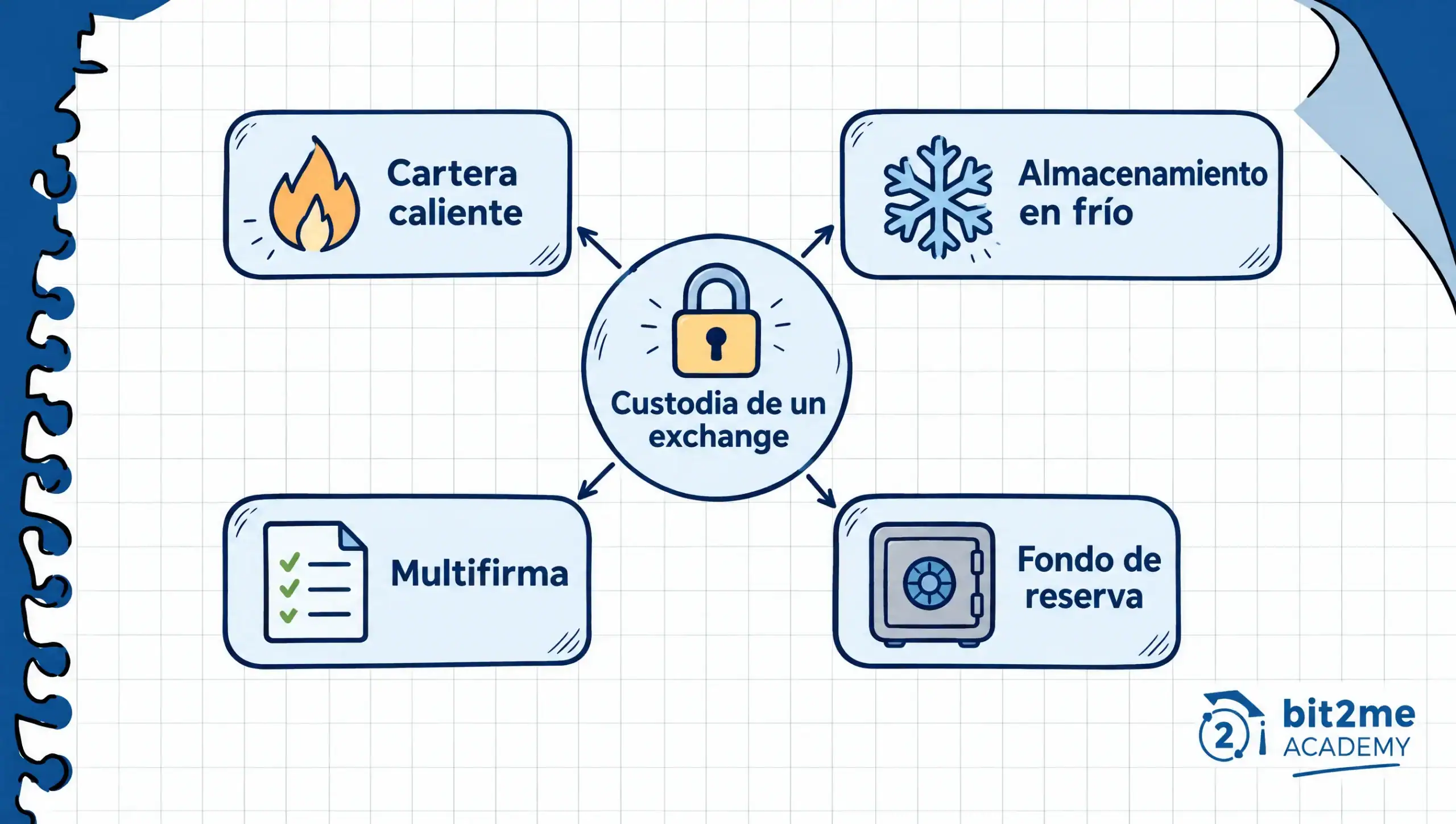
The Coincheck theft highlighted the vulnerability of storing large sums of money in online wallets: 523 million NEM were held in a single-signature hot wallet. Since then, the standard practice has been to keep only a small portion in hot wallets and the rest in cold storage.
Other lessons emerged with each case. In 2019, Binance covered the 7.000 BTC stolen with its SAFU reserve fund, and in 2022, Ronin went from 9 to 17 validators after losing control of five of them. Bybit added a nuance: multi-signature authentication is insufficient if the attacker manipulates the interface used by the administrators to sign. At FTX, administrator John Ray stated that private keys were stored unencrypted.
None of these measures eliminate the risk, as the October 2026 attack on Binance demonstrates. To compare platforms, it's helpful to know What makes an exchange more reliable? and review their custody policies before leaving funds with them.
How are Bitcoin exchanges regulated today?
In the European Union, the MiCA regulation has been in effect since December 30, 2024, and the transition period in Spain ended on July 1, 2026, according to the CNMVFrom that date, only crypto asset service providers authorized by the CNMV or another EU authority can operate in Spain, and the CNMV itself maintains its register.
In the United States, the course changed in 2025. The SEC dismissed its lawsuits against Coinbase in February, against Kraken in March, and against Binance in May, and on July 18, the GENIUS Act for stablecoins was signed.
Japan tightened its oversight after the Coincheck theft in 2018. The financial agency inspected the platform, which subsequently removed three anonymity-focused cryptocurrencies from its catalog. Regulations vary from country to country, and what is valid in Spain may not be valid in another jurisdiction, so it's always advisable to check the rules governing a platform before using it.
Current state of Bitcoin exchanges in October 2026
Mt. Gox administrator Nobuaki Kobayashi, with the approval of the Tokyo court, extended the refund deadline from October 31, 2026, to October 31, 2027, and Arkham places approximately 34.388 BTC in wallets identified as belonging to Mt. Gox, both figures as of October 20, 2026. Arkham's figure is an estimate, so it should be compared with the administrator's official announcements.
The investigation into the Binance attack remains open as of October 30, 2026. The company attributes initial access to a compromised DevOps engineer's laptop, states that it has not seen any leak of private keys, and says it has set aside $6.340 billion to replenish balances, while TRM Labs attributes the attack with high confidence to the North Korean group TraderTraitor.
| Consumer Relations Platform | Last milestone verified | Date |
|---|---|---|
| Bitstamp: | Robinhood closes the acquisition for $200 million; it was announced in June 2024. | 2 June, 2025 |
| LocalBitcoins | It announces its closure and gives 12 months to withdraw funds | February 9th 2023 |
| Kraken: | Jesse Powell steps down as CEO and is succeeded by Dave Ripley | September 2022 |
| Kraken: | It freezes its initial public offering plan | March 2026 |
| OKX: | Its subsidiary Aux Cayes pleads guilty and pays more than $500 million | February 24th 2025 |
| Binance | Changpeng Zhao receives US pardon; Richard Teng is listed as co-CEO | 23th October 2025 |
Each row includes its date because this sector changes rapidly. Before relying on any data in this section, check the CNMV registry and the communications from each platform, which will always be more reliable than an article, including this one.
What does the history of Bitcoin exchanges leave behind?
From New Liberty Standard to MiCA, the common thread is custody. Each stage solved one problem—price, liquidity, local currencies, or authorization—and left another open: who holds the funds and what happens when that fails. The history of Bitcoin exchanges shows that no technical improvement can replace the vigilance of those who entrust their assets to them.
We'll have to wait until the Binance investigation is complete and Mt. Gox finishes paying out, presumably in 2027, to know if the industry has truly learned from its past. In the meantime, understanding what went wrong at each stage gives you the perspective to ask better questions of any platform.

Frequently asked questions about the history of Bitcoin exchanges



 Author