Essential Points
- HODL is holding cryptocurrencies without selling them; staking locks them up to validate a proof-of-stake network in exchange for variable rewards.
- Staking rewards are variable, no one can promise them, and they are paid in the asset itself, so their value in euros depends on the price.
- Staking adds risks that HODL does not: penalties, exit queues, and dependence on a provider if you do not control the keys.
- Providing liquidity to a decentralized exchange is not staking: its risks are different, such as impermanent loss.
HODL vs. staking is one of the first decisions faced by anyone who already owns cryptocurrencies and doesn't know what to do with them while they hold them. HODL involves keeping them without selling them, while staking locks them in a proof-of-stake network to help validate transactions in exchange for variable rewards. Neither option guarantees a specific outcome: the price can fall in both cases, and staking adds its own inherent risks that HODL doesn't.
The difference affects when you can move your cryptocurrencies and who holds your keys, and that's why it matters as much as any other figure. The European MiCA regulation has been in effect since December 30, 2024, and the CNMV reminds users in its page about the regulation of crypto assets that crypto asset service providers must be authorized by it or another competent EU authority, a fact that matters when staking is managed by a third party.
Understanding these differences before making a decision helps you avoid common surprises, such as discovering that your cryptocurrencies take a long time to be released when you want to move them, or that a provider is holding onto the keys you thought you had. This allows you to assess whether holding, staking, or combining both options is right for you, without anyone promising you a specific outcome.
 Certificate
What is HODL and what is staking?
HODL is the term the crypto community uses to describe the decision to hold cryptocurrencies without selling them for months or years, especially with BitcoinIt does not require any specific network or any lock-up: your cryptocurrencies remain in a wallet, yours or a provider's, and you receive nothing from the protocol for holding them, so the only thing that changes over time is their market price.
Staking is locking up cryptocurrencies on a proof-of-stake (PoS) network to validate transactions, and on Ethereum it involves activating a validator, according to the documentation from ethereum.org Accessed October 26, 2026. The complete mechanism is explained in the Academy guide on What is cryptocurrency staking?.
It's important to distinguish between staking and mining, as they are often confused. According to ethereum.org, Ethereum transitioned from proof-of-work to proof-of-stake in September 2022, and in this model, there's no need to expend energy on calculations: the protocol chooses validators based on the capital they have locked, not their computing power. In the delegated variant, the DPoS (Delegated Proof of Stake)You choose who you support with your cryptocurrencies without being a validator.
Proof of Authority (PoA) also doesn't work by locking up coins. The ethereum.org documentation describes it as a reputation-based algorithm, where signers are chosen based on their reputation and not through a staking-based mechanism, so it's not a form of staking despite the similar name.
What are the differences between HODL and staking?
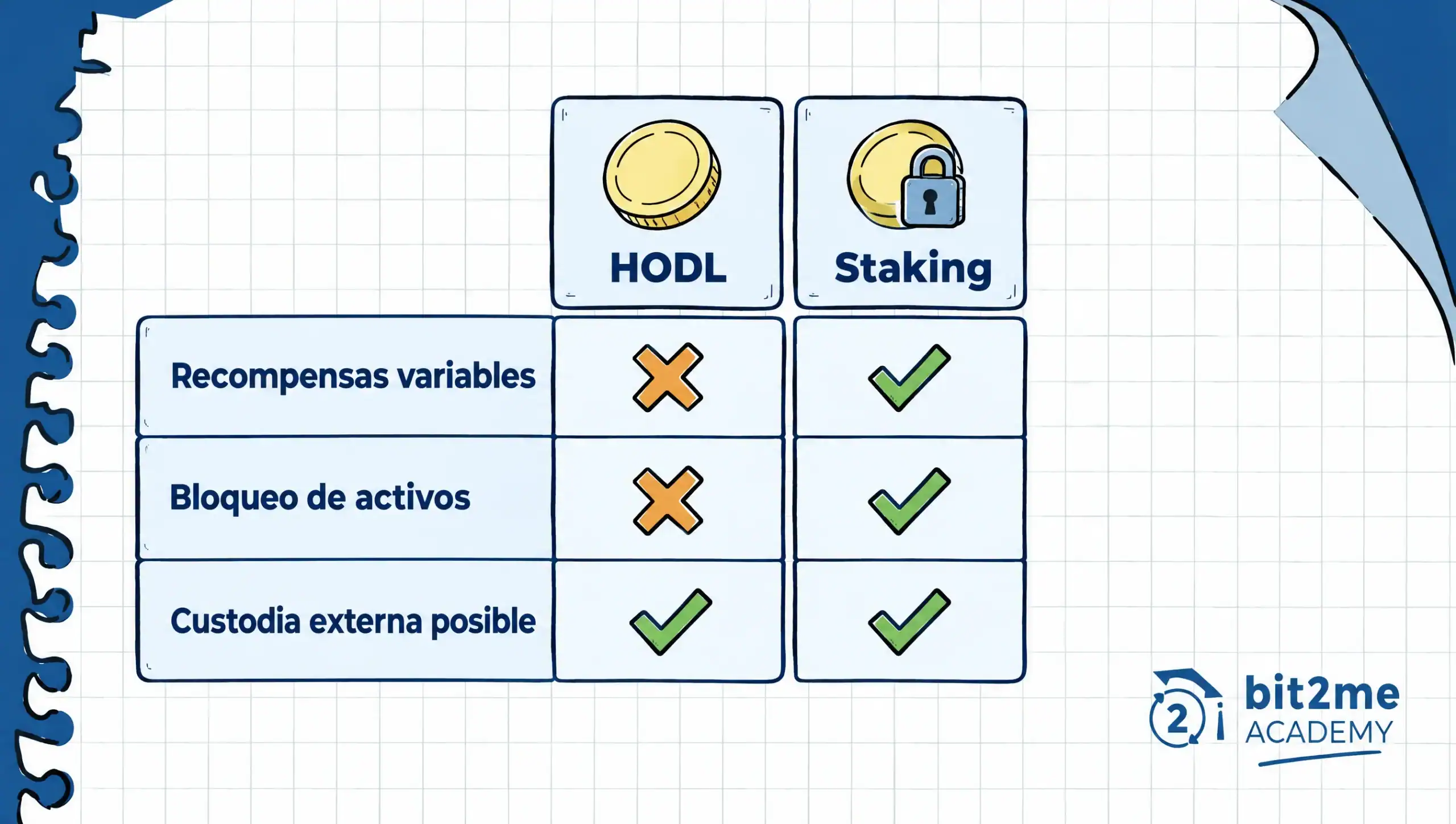
The fundamental difference lies in what happens to your cryptocurrencies while you hold them. With HODL, only the price changes, which can go up or down. With staking, you lock them up to participate in validation and receive variable rewards, which in Ethereum are paid in the asset itself, so their value in euros depends on the price.
The table summarizes the differences that most influence the decision, each with its source and the date of consultation. It does not include reward figures, as these vary by network and provider, and any past percentages are not indicative of what you will receive.
| Criterion | HODL | Staking | Source (consultation) |
|---|---|---|---|
| What you receive | Only the price variation, up or down | Variable protocol rewards, plus price variation | ethereum.org/staking (26-10-2026) |
| management | You can sell whenever you decide, depending on where you store your cryptocurrencies. | It depends on the network and the provider: outbound queues and possible blocking issues. | Withdrawals on ethereum.org (26-10-2026) |
| Term | No minimum: you decide. | Entry can take anywhere from hours to weeks, and exit follows a similar queue, according to the network. | ethereum.org/staking (26-10-2026) |
| Custody | You choose: your own wallet or a provider's wallet | Home staking with your keys, delegated with assigned signing keys, or exchange with self-custody | ethereum.org/staking (26-10-2026) |
| Own risks | Price drop and loss or theft of keys | The same, plus penalties for misconduct and counterparty risk. | ethereum.org/staking (26-10-2026) |
| Regulation in the EU | If you use a provider to operate or safeguard, it must be authorized. | If a provider offers staking, it must be authorized. | CNMV (26-10-2026) |
This comparison dismantles two ideas from the classic approach to this debate. One is that staking is always a short-term strategy, because the timeframe depends on the network and the provider, and can be as long as that of a HODL. The other is that HODL doesn't require decisions, since it also forces you to choose where you store your cryptocurrencies and who controls the keys.
How does staking work from lock to exit?
On Ethereum, activating your own validator requires at least 32 ETH, according to ethereum.org, and the protocol queues new validators before they can begin validating. This wait to join can range from hours to weeks because it depends on how many participants try to join simultaneously, and leaving follows a similar queue with a rate limit.
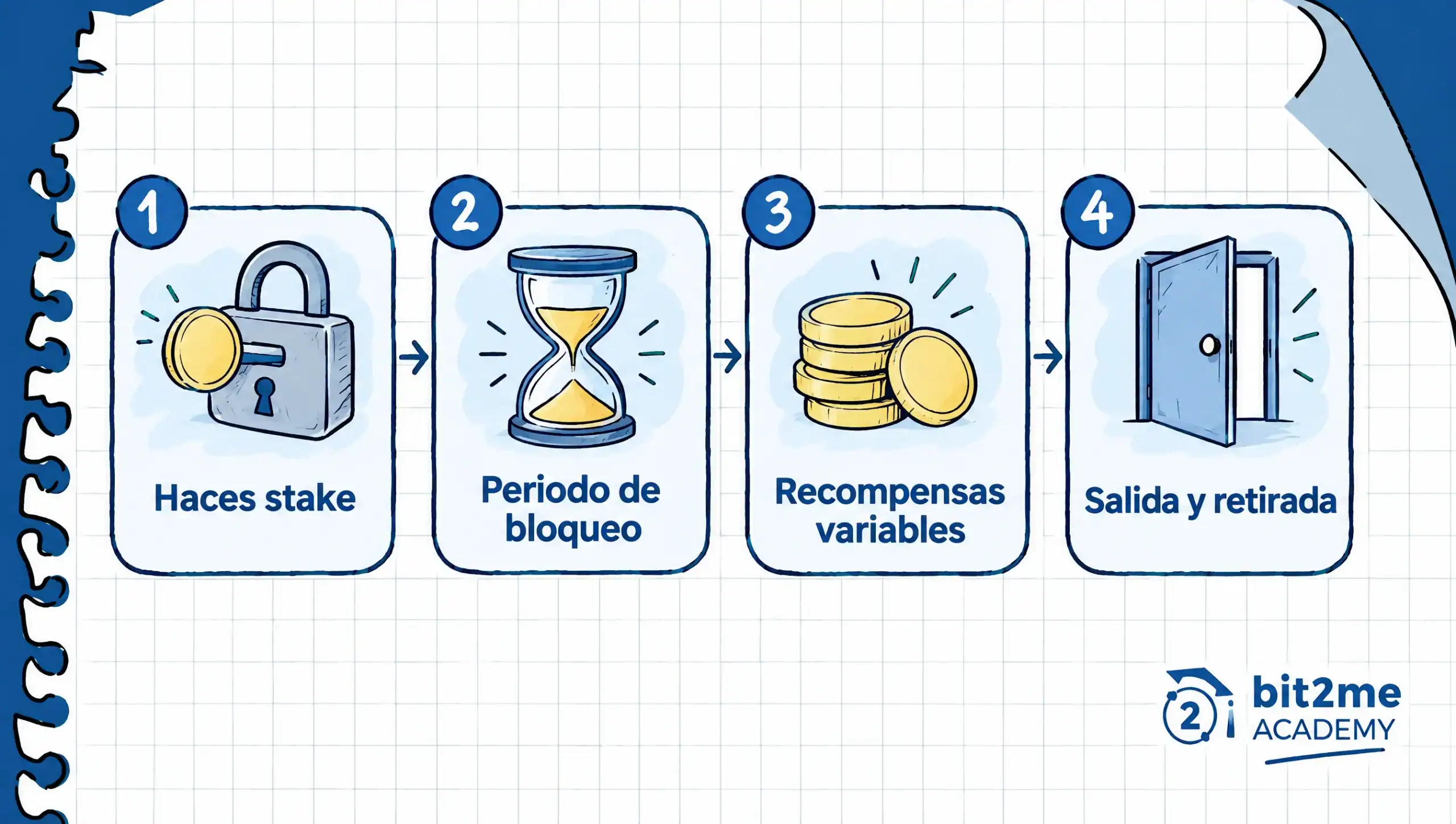
The process has four phases that should be distinguished, because each one has its own risk and its own timeframe, and the following list orders them from when you lock your cryptocurrencies until you recover them:
- You stake: you lock up an amount of cryptocurrency, either with your own validator, by delegating to an operator, or through a provider.
- Lock-in period: Your cryptocurrencies participate in the network and you cannot use them freely while the participation lasts.
- Variable rewards: the protocol pays for successful validation, and the amount changes with the network, the number of participants, and the asset price.
- Exit and withdrawal: You request to exit, wait your turn in the queue, and withdraw your principal and rewards when processed.
The rewards you receive depend on the staking model you choose. With home staking, according to ethereum.org, the protocol pays you the full rewards directly, while with delegated staking you receive the protocol's rewards minus a monthly fee for running the node. In pooled staking, the rewards go to the validators in the pool, not directly to you, and each pooling method distributes them differently.
Once inside, ethereum.org indicates that you can withdraw your rewards and principal, although the withdrawal time varies depending on how many others are withdrawing. This means that staking isn't inherently a short-term or long-term commitment: the protocol establishes a queue, and the provider can add its own timeframes.
What are the risks of staking compared to HODLing?
Staking adds risks to those already associated with holding cryptocurrencies, and the best way to understand these risks is to compare them one by one. The table summarizes five of these risks, including the source and date of each data point, clearly indicating which risks are common to HODL holdings and which are specific to staking.
| Risk | What does it mean | Data and source (consultation) |
|---|---|---|
| Price | The rewards do not necessarily compensate for a drop in the asset's price; HODL suffers the same. | Page Bit2Me Earn It indicates that rewards are variable and depend on the network, demand, and volatility (26-10-2026) |
| slashing | Penalty that destroys part of the stake of a misbehaving validator | ethereum.org indicates that a massive slashing event can destroy 100% of a validator's stake (26-10-2026) |
| Unlocking period | Variable-length exit queue and potential provider blockages | ethereum.org It indicates that the exit takes a variable amount of time depending on how many people leave at once (26-10-2026) |
| Counterparty | Dependence on an operator or exchange that holds your cryptocurrencies in custody | ethereum.org Adds to delegated staking the provider's counterparty risk (26-10-2026) |
| Variability of rewards | The APY, the estimated annual rate that includes compounded rewards, changes with the market. | Bit2Me Earn warns that past APY does not guarantee what will happen next (26-10-2026) |
Price risk deserves clarification, as it's the most underestimated risk. Holding or staking a cryptocurrency whose price falls reduces the value of your position in both cases, and staking rewards are paid in the same asset, so they don't act as a fixed buffer. Therefore, it's advisable to determine in advance how much you could lose without significantly impacting your financial situation.
Slashing is the most specific risk of staking. According to ethereum.org, signing two conflicting blocks destroys a portion of the validator's stake, and going offline only costs small amounts of ETH. Those who delegate to an operator depend on that operator's reliability, which is why choosing the right provider is so important.
Custody and keys: who controls your cryptocurrencies in each option
In HODL, custody depends on where you store your cryptocurrencies. You can keep them in your own wallet, where you control the keys, or leave them with a provider who holds them in custody for you. hardware wallets They are a common way to keep keys offline, but that decision is yours and doesn't change the price risk.
There are several variations of staking, and none is the only possible one. According to ethereum.org, each method distributes ownership of the signing and withdrawal keys differently, and this distribution indicates how much control you retain over your cryptocurrencies.
- Home staking: you keep the signing and withdrawal keys, and you maintain the node.
- Delegated staking: you usually keep the withdrawal keys and give the signing keys to an operator.
- Pooled staking or liquid staking: you receive a token that represents your position, and the pool's contracts and operators control the validators.
- Exchange: the exchange holds your ETH.
This corrects the idea that staking can only be done with a hot wallet. In Ethereum home staking, the signing key resides on a node with internet access, but according to the ethereum.org's guide to solo staking Ultimate control of your funds always rests with the withdrawal address. There isn't a general rule for other networks that we can provide here.
Academy's guides on Ethereum staking y liquid staking They detail these variations. If a platform manages the staking for you, you depend on its security and terms, something you should also review with any provider that holds your cryptocurrencies, even if you only HODL.
Is staking the same as providing liquidity to a decentralized exchange?
It isn't, and the classic HODL vs. staking debate conflates both concepts when discussing Uniswap. Providing liquidity involves putting two cryptocurrencies into a decentralized exchange's pool for others to trade, in exchange for a portion of the fees. No proof-of-stake network is protected, so it's not staking.
Según un study published on arXiv by Hafner and Dietl in 2024Liquidity providers supply these assets in exchange for a fee, and small price changes can lead to losses. This is the impermanent loss: the difference between the value of your position in the pool and the value of holding those assets out.
These risks are compounded by those of smart contracts. According to the Ethereum.org documentation on decentralized financeEthereum products, like any software, can suffer errors and attacks, but that source doesn't quantify the risk of a specific exchange. The Academy guide on farming versus staking Compare both mechanisms.
Current state of staking in Spain and the EU in October 2026
The framework is MiCA, the European regulation on crypto-assets. According to the CNMV (Spanish National Securities Market Commission), it came into effect on December 30, 2024, and the transition period in Spain ended on July 1, 2026.
Therefore, as of October 26, 2026, crypto asset service providers must be authorized by the CNMV or another competent EU authority, and the CNMV indicates that you can check this in the ESMA and CNMV registers.
| Date | Done | Source |
|---|---|---|
| December 30th 2024 | MiCA comes into effect | CNMV |
| July 1, 2026 | The transition period in Spain ends | CNMV |
| 26th October 2026 | The output of an Ethereum validator follows a queue of variable duration. | ethereum.org |
| 26th October 2026 | Bit2Me Earn reports variable APY and that it is not covered by MiCA deposit protection. | Bit2Me Earn |
Page Bit2Me Earn As of October 26, 2026, the service offers variable APY and flexible withdrawal on most assets, and advises that it is not a bank deposit and is not covered by MiCA deposit protection.
The same page indicates a 12-month freeze on a specific product, the B2M Farming Pool, and warns that you could lose some or all of your funds. If you use a staking platform, first check that it is authorized: Earn's rewards are variable and not covered by a deposit guarantee, and registration with the CNMV (Spanish National Securities Market Commission) is more reliable than any information in an article, including this one.
The HODL vs staking debate depending on your time horizon and risk tolerance
HODL vs. staking doesn't have a single answer, because it depends on things only you know: how long you can be without your cryptocurrencies, how much custody you're willing to assume, and what losses you can tolerate. Before deciding, it's advisable to answer three questions honestly and in writing, without being swayed by past percentages:
- Could you need those cryptocurrencies before an exit queue or provider lock ends?
- Do you prefer to safeguard the keys yourself or trust an authorized provider and assume their counterparty risk?
- How much value could you lose, in both options, without your situation changing?
Taxation is another deciding factor, and its treatment depends on your specific situation and current regulations. This article doesn't go into detail because we haven't been able to verify it with official sources, so consult the Tax Agency or a tax advisor before deciding. If, after considering these options, you want to explore staking with a regulated provider, Bit2Me Earn It is an option, with variable rewards that no one can promise and that are not covered by a deposit guarantee.
To continue reading, you can compare specific options in the cryptocurrency guide with stakingSee a practical example in the guide of Secret Network staking or review the HODL side in the Academy analysis of cryptocurrencies to hold long-termNone of those readings are recommendations, and all call for the same skepticism.

Frequently asked questions about HODL and staking



 Author