Essential Points
- A new bitcoin is created as payment to the miner who finds a valid block, something that happens approximately every ten minutes.
- Since the halving in April 2024, the payment is 3,125 BTC per block, and it will drop to 1,5625 BTC around 2028.
- The proof-of-work and difficulty adjustment every 2.016 blocks make any attempt to manipulate the chain more expensive.
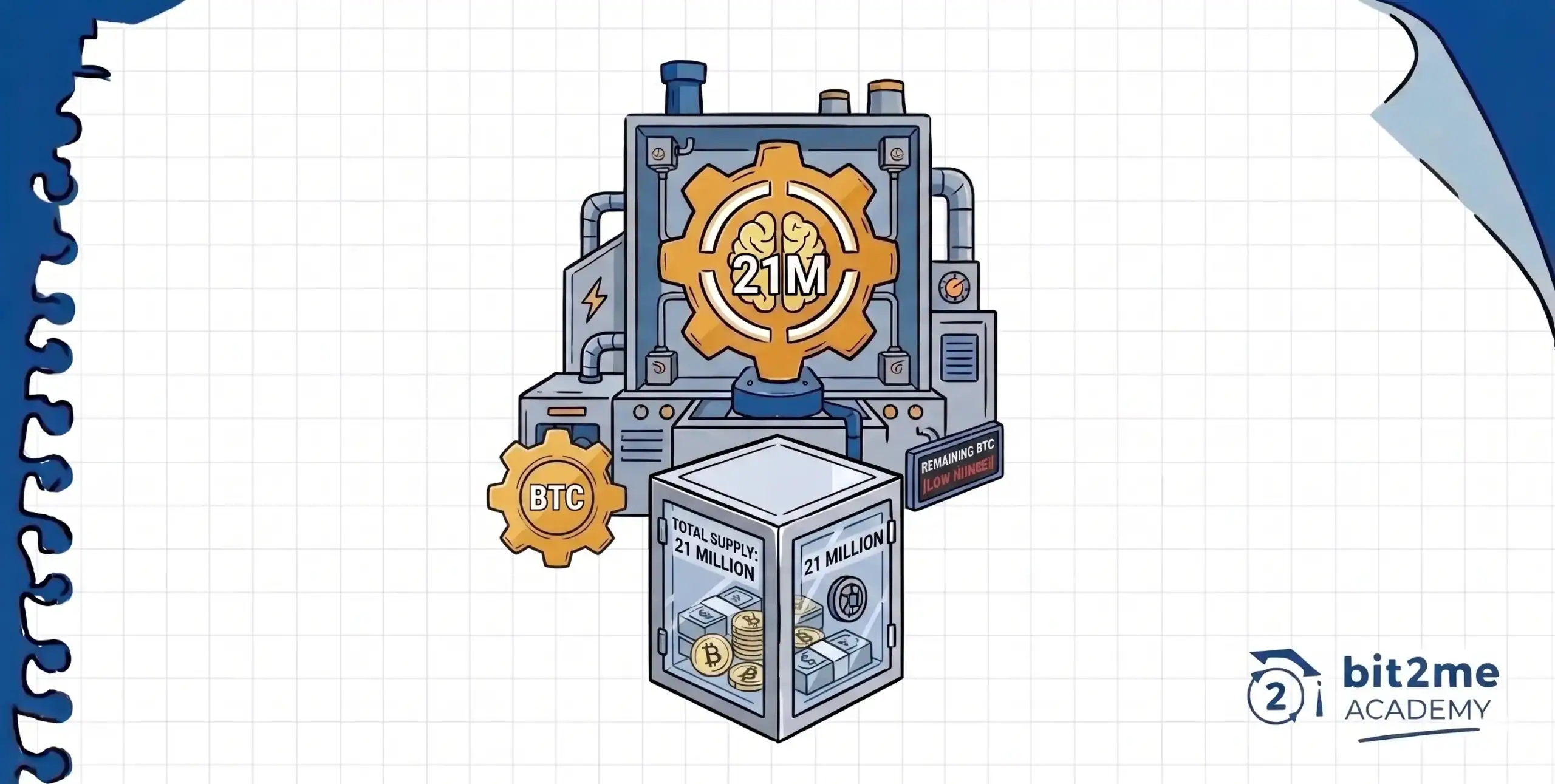
- The limit is 21 million units and the last one will be issued around 2140, when only the commissions will remain.
Every ten minutes or so, the Bitcoin network does something no central bank or corporation can do by decree: create new units of its digital currency, without anyone printing or issuing them. Today it distributes 3,125 BTC for each block added to its chain, a figure that was fixed at the halving on April 20, 2024. bitcoin.organd nobody decides manually who gets to collect it.
To understand how a bitcoin is created or generated, we need to look at a specific miner, the first one to find a valid block and broadcast it. Their reward arrives in a special transaction, the coinbase, and the protocol rules limit it. If more than the allowed amount is granted, the network rejects the block.
Behind this mechanism are three components that should be separated. The blockchain stores the history in an orderly fashion, the proof-of-work makes adding new pages to that history costly, and the issuance schedule limits the total to 21 million units. Each component has its own arithmetic, and together they explain why the process is predictable and, at the same time, very difficult to manipulate at will—something that should be clear before reading any figures about scarcity.
 Certificate
Blockchain, the base in the construction of Bitcoin
The Bitcoin blockchain is a public ledger of transactions organized into interconnected blocks, copies of which exist on thousands of computers that do not need to trust each other. Each block includes the hash of the previous one, so changing an old block requires recreating all subsequent blocks. This structure, described by Satoshi Nakamoto at the whitepaper of the project, it is the support on which the new units appear.
The system is open source and runs on a peer-to-peer (p2p) network de nodes.These are computers that receive transactions, verify that they comply with the rules, and pass them on to their neighbors. Anyone can start a node without asking permission, and therefore no single actor controls who participates.
Bitcoin combines three things at once: software, a protocol, and a digital currency that doesn't exist in the physical world. The software is what the nodes run, the protocol sets the rules (including how much can be created and when), and the currency is the ledger of balances that results from applying those rules. To learn more about its origins, you can read What is Bitcoin and how does it work?.
Since each node maintains its own copy of the chain, there is no central server to attack or administrator able to edit balances at will. For a transaction or block to be accepted, the independent nodes simply need to verify separately that they comply with the same rules.
When a bitcoin is said to be "created," the protocol recognizes a new balance in favor of whoever has added a valid block to the chain of blocksThat amount did not exist in any record before, and afterwards it is noted in the history shared by all nodes.
Process of generating a bitcoin unit
Bitcoin mining is the process by which mining nodes compete to add a new block to the chain and collect the reward set by the protocol. Unlike fiat moneywhich a central bank can print when it deems appropriate; new bitcoin units only appear as payment for that work, and no government or company decides how many or when.
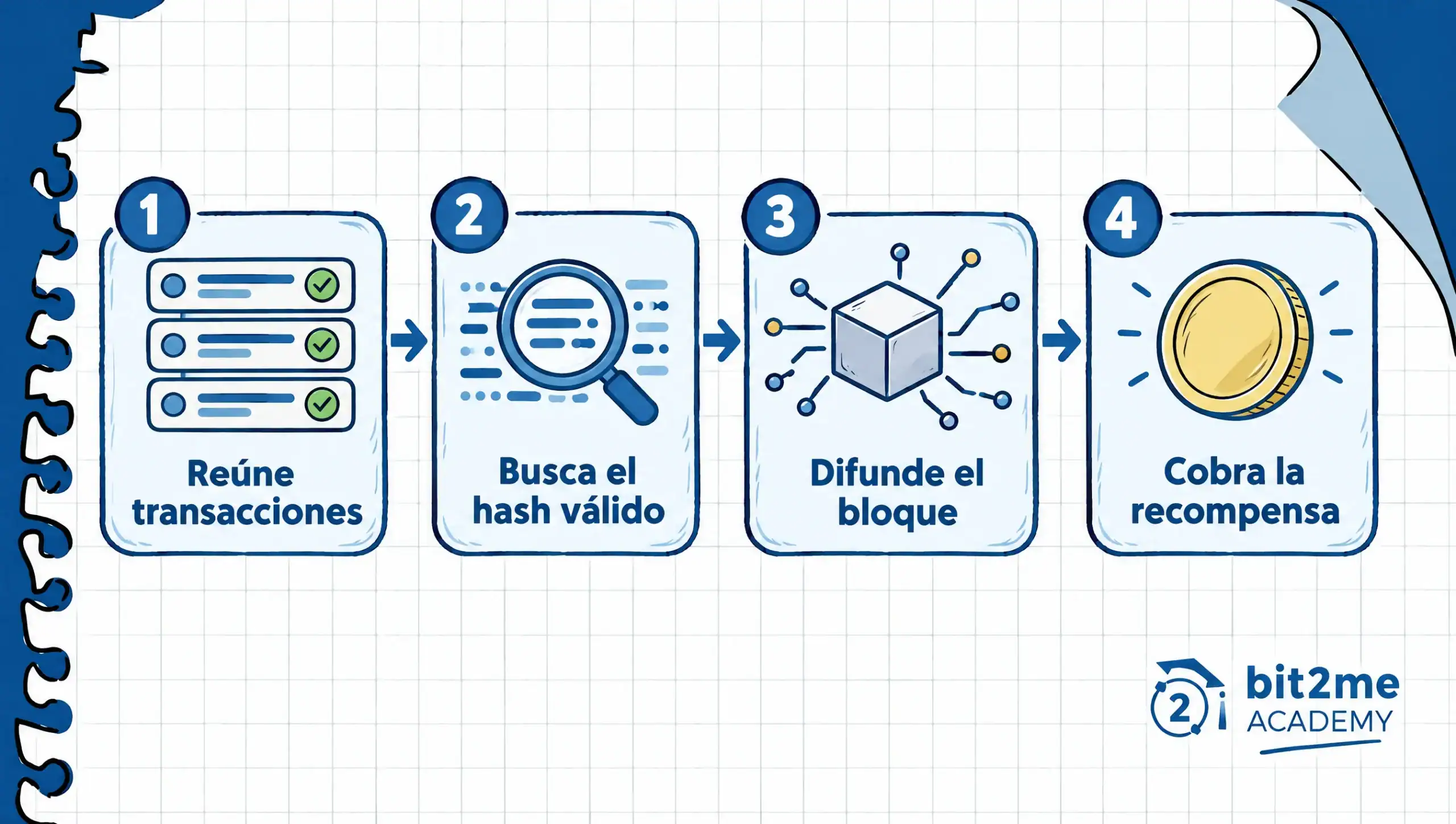
The process begins when users send transactions and these wait in the mempoolA waiting room is where each node stores unconfirmed transactions. A miner chooses which transactions to include, checks the digital signatures of each, and groups them into a candidate block, to which they add a special transaction that awards them the reward.
Miners don't work solely for the reward. When the inputs of a transaction exceed its outputs, the difference is a fee that goes to the person who creates the block, which is why they almost always fill their blocks with transactions from other users in addition to their own.
With the candidate mounted, the miner looks for a hash valid for the block header. This search involves repeating a calculation millions of times until a result below the target set by the network is found. The first one to achieve this publishes their block, and the other nodes immediately verify that it complies with the rules before adding it to their copy of the chain.
The special transaction is called coinbase transaction And it's the only point in the protocol where new units are created. It doesn't use any previous output: it awards the miner the block reward, plus the fees of the transactions they've included. Article about block rewards It explains how that payment is calculated.
What happens if two miners find a block almost simultaneously? The developer documentation calls this a temporary fork: each node accepts the first block it sees, and when a miner builds on one of the two, that side gains strength. Nodes eventually follow the chain with the most proof-of-work, and the block on the losing side is discarded.
The newly created coins also cannot be spent instantly. According to the Bitcoin developer documentationA Coinbase exit waits at least 100 blocks before moving, which is about 16 or 17 hours. This rule prevents someone from spending a block reward that might later be discarded by the network.
How is a bitcoin created or generated, and why is it expensive to counterfeit?
Proof of work is the mechanism that forces the expenditure of real computing power to propose a block, making it more expensive to forge the chain than to respect its rules. In the Proof of Work (PoW)Any node can verify a block instantly, whereas creating it requires millions of attempts.
What the miner calculates over and over is the block header, which measures only 80 bytes according to the Reference documentation from developer.bitcoin.orgThis header includes six fields: the version, the hash of the previous block, the Merkle root (a unique summary of all transactions in the block), the time, the difficulty target, and the nonce.
The Merkle root deserves special mention. It is obtained by pairing transaction identifiers and repeatedly hashing them until only one remains, and it serves to verify that a transaction is in a block without downloading the entire block. Therefore, changing a single transaction changes the header and forces the process to be redone.
The function that converts any set of data into a fixed-size string is SHA-256This is the method used by Bitcoin mining. Its result changes completely if even a single bit of the input is modified, so there's no shortcut to getting closer to a valid hash; you just have to try different values until one fits.
It's like rolling a die with many faces: each attempt has the same small probability of succeeding, and no one can predict which one will. Winning doesn't depend on the miner's skill, but on how many attempts per second they manage to make and the luck of succeeding before the other participants.
That's where the nuncioThis is a 4-byte field in the header that miners change to obtain new hashes without waiting for more transactions. With just over 4.000 billion possible values, a powerful machine quickly exhausts it and modifies other header or coinbase data to continue testing.
The nonce does not regulate the difficulty, and it is important not to confuse them. mining difficulty The target that the hash must exceed is set, and the network readjusts it every 2.016 blocks by comparing the real time with the ideal of two weeks, according to the same documentation.
If the boulder problems are solved faster than expected, the difficulty level increases, and if they are solved slower, it decreases, to maintain a pace of about ten minutes per problem. This automatic adjustment is what keeps the broadcast schedule stable.
All this work has a real cost in electricity and equipment, and that cost is precisely what underpins the reliability of the history. An accepted block represents actual computing power expended, not just a statement from the proposer.
The system has a clear purpose: to make it as difficult as possible for someone to rewrite the history. To change an old block, an attacker would have to redo its proof of work and that of all subsequent blocks, competing against the rest of the network simultaneously. The more work accumulated on top of a transaction, the more expensive it becomes to undo it.
Overview of the generation process
The Bitcoin issuance rate is the number of new units the protocol creates per unit of time, and it remains stable even if the number of miners changes. If more mining rigs are added, blocks tend to be mined sooner than the expected ten minutes, and in the next adjustment, the network raises the bar.
Mining is becoming increasingly competitive: more miners are raising the difficulty, demanding more computing power and higher electricity costs to maintain the same probability of finding a block. Therefore, anyone wanting to participate needs specialized equipment and access to electricity, and must accept that their costs will change with the difficulty.
Today, industrial-scale Bitcoin mining is done with ASICcircuits designed solely for calculating SHA-256. FPGA and GPU These were historic stages. Over time, specialized teams displaced the rest.
It's important to distinguish between mining and owning bitcoins. Creating new units requires specific hardware and electricity consumption, but simply holding, storing, or sending bitcoins only requires a wallet. These are two different activities with very different costs, risks, and required expertise, and most users only engage in the latter.
What is the halving and how much does the reward decrease?
The halving is the reduction of the block reward by half, which the protocol applies automatically every 210.000 blocks, approximately every four years. Satoshi Nakamoto set this schedule in the original design, so the issuance decreases in stages and gradually approaches the cap of 21 million units without anyone having to trigger the change.
In practice, each halving reduces by half the rate at which new units appear without changing the average time between blocks. Miners still find a block approximately every ten minutes, but each find has a smaller impact on the total emission than the previous one.
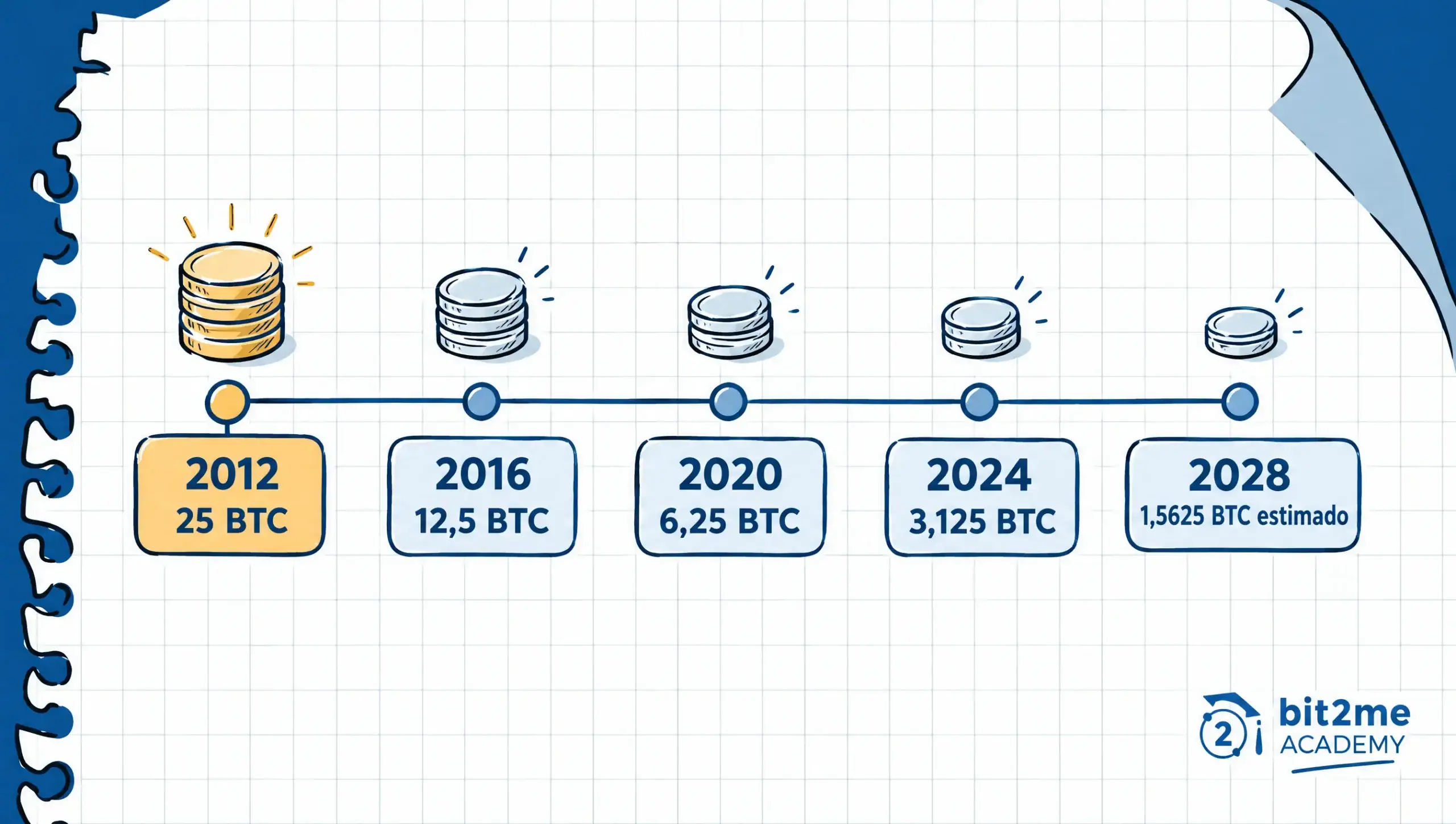
The following table lists the four halvings that have occurred and the next one expected, with data from bitcoin.orgThe reward is not a fixed amount: it drops from 25 to 12,5, 6,25 and 3,125 BTC, and the date of the fifth halving is only an estimate, because the time between blocks varies.
| Halving | Date | Block | Reward after the halving |
|---|---|---|---|
| First | November 28th 2012 | 210.000 | 25 BTC |
| Second | July 9, 2016 | 420.000 | 12,5 BTC |
| Third | May 11th 2020 | 630.000 | 6,25 BTC |
| Fourth | April 20th 2024 | 840.000 | 3,125 BTC |
| Fifth (estimated) | 2028 | 1.050.000 | 1,5625 BTC |
The numbers align with that schedule. If a block is released every ten minutes, that's about 144 per day, and with 3,125 BTC each, that's about 450 BTC issued daily, or nearly 164.000 per year. The first batch of 210.000 blocks issued 10,5 million units at 50 BTC per block, half the total, and each subsequent batch issues half as much as the previous one.
This timeline has a practical consequence: the further it progresses, the less the reward matters and the more the fees become important. Around 2140, when the protocol stops issuing new units, miners' pay will depend solely on the fees users pay to include their transactions in a block. These fees already form part of what miners earn, although their proportion fluctuates with network congestion.
Current state of Bitcoin issuance
As of October 2026, the reward remains at 3,125 BTC per block, the amount set by the fourth halving, and the protocol issues around 450 BTC per day, compared to 900 BTC per day prior to April 2024 (figure from March 2026).
The mined supply surpassed 20 million BTC in March 2026, with block 939.999 mined by the Foundry USA pool, representing approximately 95% of the cap. At that time, less than one million bitcoins remained to be issued, and this final batch will be distributed over approximately 114 years, until around 2140.
The next halving is scheduled for 2028, at block 1.050.000, and will lower the reward to 1,5625 BTC, a date that bitcoin.org presents as an estimate. If you want to see how it's trading today, you can check the Bitcoin price todaywhich is continuously updated. These figures change with each block, so it's advisable to check them with a block explorer before quoting them.
A release schedule that sells out by design.
Understanding how a bitcoin is created or generated helps to put into perspective the claims about its scarcity. The total amount is limited by the protocol, issuance decreases at known intervals, and the rest of the network verifies each block, so no single miner can alter the schedule on their own. These rules are public and anyone can verify them.
What remains open is how network security will be financed when the reward approaches zero. Fees will have to support miners for more than a century, and their weight will depend on actual network usage at any given time. We'll have to wait and see how this relationship evolves as the next halvings approach.

Frequently asked questions about how a bitcoin is created



 Author