Essential Points
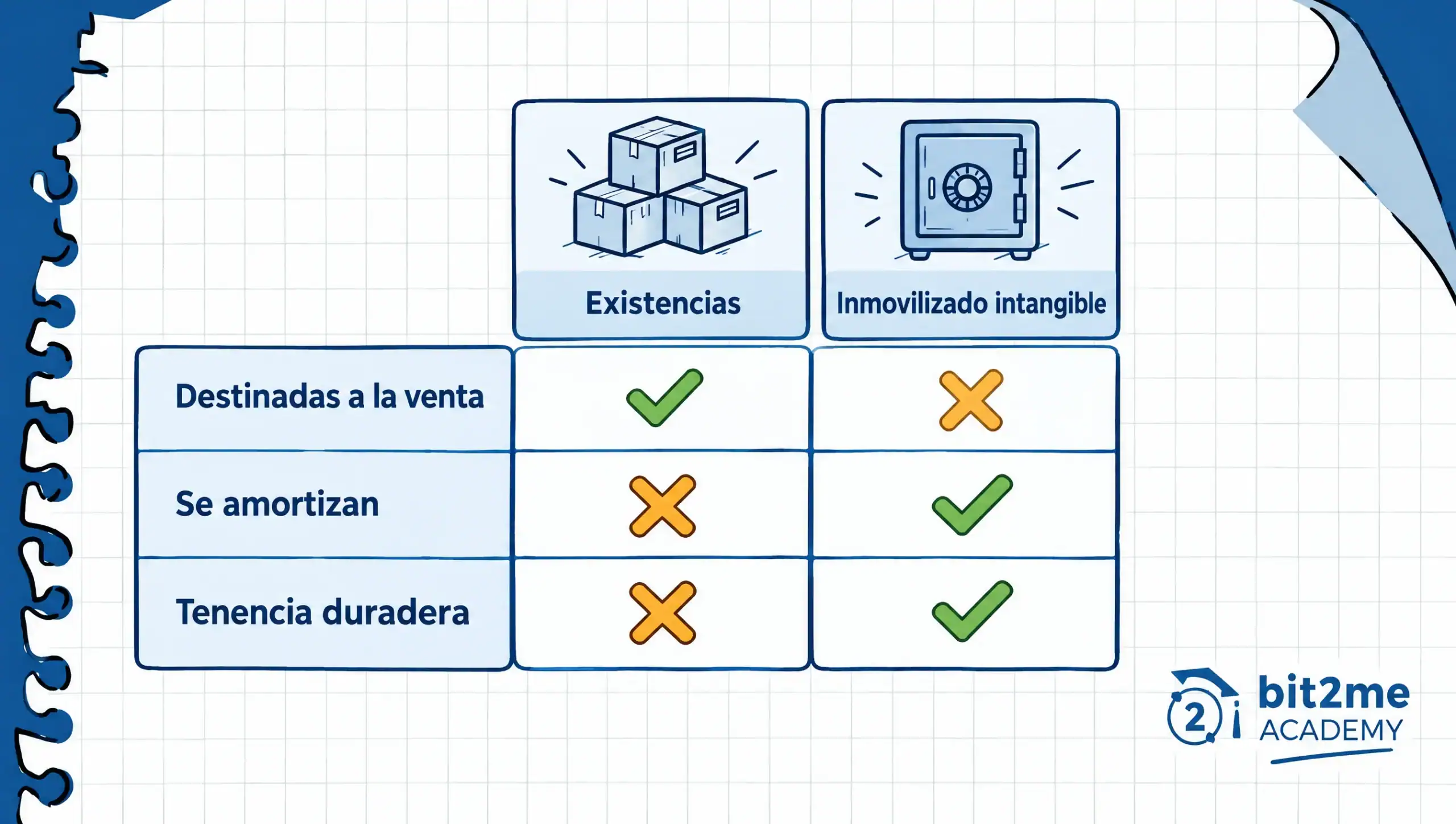
- A company treats cryptocurrencies as inventory if it intends to sell them on a regular basis and as intangible assets if it holds them.
- Without an estimated useful life, the PGC sets ten years of accounting amortization and the AEAT allows a maximum of 5% per year in the tax.
- Form 721 is not required for foreign balances up to 50.000 euros or if the company registers its currencies individually.
- The reduced rates in 2026, the transposition of DAC8 and the accounting criteria may change, so it is advisable to confirm them with an advisor.
A company that holds bitcoin in its treasury, issues its own token, or charges for a service in cryptocurrencies immediately faces two questions: what is this asset for accounting purposes, and what must it report to the tax authorities? When declaring cryptocurrencies in companies, it's advisable to separate these two aspects, because the accounting classification and the reporting obligation are governed by different rules and criteria that have changed since [the company's inception]. Bit2Me Academy summarized, in August 2023, the CLCripto webinar on which this guide is based.
The ICAC, the Institute of Accounting and Auditing, concluded in the BOICAC 120 December 2019 Virtual currencies are considered inventory when a company holds them for sale as part of its ordinary business activities. From a tax perspective, the Tax Agency It sets the combined balance abroad at 50.000 euros, from which form 721 must be submitted, and excludes companies that record their currencies individually in their accounts.
Javier Pastor and Jesús Lorente, from CLCryptoThey reviewed it in the webinar «Use of cryptocurrencies in companies» These and other points, from depreciation to employee compensation, are addressed. Their ideas are attributed to them and compared with the regulations in force as of October 26, 2026, because the rates, Form 721, and European regulations have changed.
 Certificate

How to declare cryptocurrencies in companies according to the Spanish framework?
Jesús Lorente described three situations in which a company comes into contact with crypto assets: some companies hold them on their balance sheet, others issue their own tokens or services, and still others collect or make payments with them. Each approach changes the accounting and tax treatment, so the first task is to identify which one describes the company, something that the Academy guide on What is a cryptocurrency? It helps to determine if the concept is new.
One of his warnings is directly reflected in the regulation. According to the speaker, mixing the balances of a personal wallet with those of a company harms traceability for tax purposes. Order HFP / 886/2023The regulation of model 721 excludes currencies that a legal entity records individually in its accounting, with their denomination and value and with the custodian entity and the country.
For those considering holding crypto assets in their balance sheet, Academy's guide on corporate treasury in cryptocurrenciesPublished on August 26, 2026, it covers custody and internal controls. Bit2Me also brings together in its webinar page for companies sessions on taxation, accounting and regulation.
Inventory or intangible assets?
The criterion depends on the use the company gives to the asset. BOICAC 120The regulation dated December 2019 states that virtual currencies are considered inventory if they are intended to be converted into financial assets through sale as an ordinary activity, and refers to the accounting and valuation standard 10 of the PGC, the General Accounting Plan.
When the company holds them for no other purpose, the criterion is based on the IFRS IC agenda decision, which applies IAS 2 to cryptocurrencies held for ordinary sale and IAS 38 to the others.
The ICAC includes in a accounting plan development document These cryptocurrencies are then treated as intangible assets valued at cost, although their useful life is unclear. Lorente summarized the distinction in the same terms.
The table organizes the differences presented by Lorente, which the General Accounting Plan (PGC) or the Spanish Tax Agency (AEAT) allow to be verified. Concepts for which no official source has been located are listed as the rapporteur's opinion.
| Concept | Stock | Intangible assets | Source |
|---|---|---|---|
| when it applies | Destination for sale as a regular business | Possession without that destination | BOICAC 120December 2019 |
| Initial assessment | Purchase price or production cost | Acquisition cost, according to Lorente | PGC, rule 10. and the speaker's opinion |
| Accounting amortization | They don't pay for themselves, according to Lorente | Ten years if the useful life cannot be reliably estimated | PGC, rule 5. |
| Tax amortization | According to Lorente, it is not appropriate. | Maximum of 5% per year if useful life is not estimated | AEAT Companies Manual, 2021 edition |
| Deterioration | Correction if the net realizable value falls below the cost | Annual review of indicators; accounting-related, but not tax-deductible | PGC y Article 13.2 of the LIS |
| Revaluation | It is not counted | It is not counted | Speaker's opinion |
| Venta | Weighted average cost and sales result | Cost of the asset and gain/loss on disposal of fixed assets | PGC and the speaker's opinion |
An illustrative example, using hypothetical amounts that are not market prices, helps to see the effect. A digital asset recorded at €20.000 as an intangible asset with no estimated useful life would be amortized for accounting purposes at a rate of €2.000 per year for ten years. If its recoverable value were to fall to €12.000, the accounting impairment of €8.000 would not reduce the tax while the asset remains on the balance sheet.
For tokens issued by the company itself, Lorente emphasized that the issuance cost is not the token's sale price, but rather the entire cost of creating it, including R&D, salaries, and infrastructure. In the income statement, the Spanish General Accounting Plan (PGC) groups the gains from the disposal of fixed assets in accounts 670 and 770, not in an "extraordinary" item.
The Spanish General Accounting Plan (PGC) also warns that its chart of accounts is a guide or reference, not a binding numbering system. No specific account for crypto assets is listed in the official sources consulted; therefore, each company defines the sub-accounts it uses in consultation with its advisor.
Does a company have to file form 721?
The obligation arises from Order HFP/886/2023, of July 26which approved the information statement on virtual currencies located abroad. Lorente stated that the model directly affects companies, and this is true insofar as a company holds crypto assets outside of Spain and does not fall under an exclusion.
According to AEATAccording to the ruling consulted on October 26, 2026, there is no obligation to report when the total balances held abroad as of December 31, valued in euros, do not exceed €50.000. If this limit is exceeded, all currencies must be reported. The filing period runs from January 1 to March 31 of the year following the year to which the information refers.
The exclusions applicable to a resident company are summarized in three conditions, each sufficient on its own according to the Order and the AEAT, and it is advisable to check them in this order before deciding whether to submit the form:
- Joint balances abroad as of December 31 that do not exceed 50.000 euros.
- Currencies of resident legal entities individually recorded in the accounting records, with their name, value, custodian entity and country or territory.
- Coins held by the entities referred to in Article 9.1 of the Law 27/2014 on Corporate Income Tax.
Following the first declaration, the AEAT indicates in its page about the submission deadline It only needs to be resubmitted if the balance increases by more than €20.000 compared to the last declaration or if ownership is extinguished. Following this deadline, the 2026 tax return, if applicable, would be filed between January 1 and March 31, 2027.
Lorente stated the second condition in other words: the company is excluded if its inventory is identified by tokens, quantity, and location and is recorded in the accounting records. This aligns with the standard, although the Spanish Tax Agency (AEAT) adds the value and custody requirements. The model has already been used in campaigns since 2024 and its record at the AEAT headquarters It outlines the current procedure.

Corporate tax and double taxation of cryptocurrencies
The statement in the webinar that a company always pays 25% described the general rate, and since Law 7/2024, exceptions have been made. For periods beginning in 2026, the AEAT includes the forty-fourth transitional provision of the 27 / 2014, which sets reduced rates for micro-enterprises and small-sized entities.
| Entity type | Type in 2026 | Source |
|---|---|---|
| General scheme | 25% | AEAT, tax rate |
| Micro-enterprise (turnover less than 1 million euros) | 19% up to 50.000 euros of taxable base and 21% on the rest | AEAT, forty-fourth transitional provision of the LIS |
| Small-sized entity | 23% | AEAT, forty-fourth transitional provision of the LIS |
The webinar also compared corporate tax rates with those for individuals, which depend on income type. That comparison used 2023 percentages that are not reproduced here, and an individual's tax return is detailed in the Academy guide on [topic missing]. How to declare your cryptocurrencies to the tax authorities.
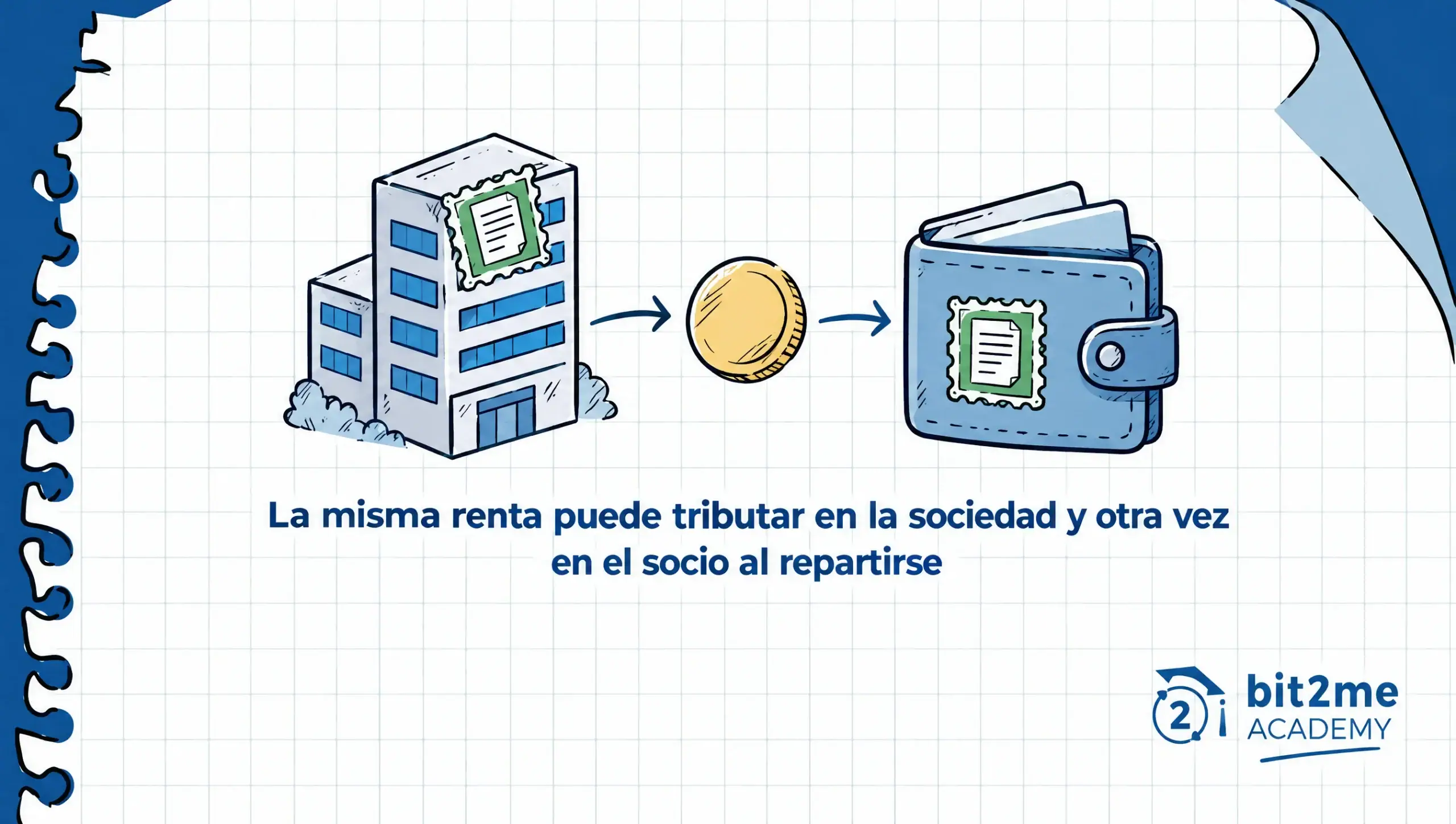
Double taxation was another topic covered in the webinar, which emphasized the importance of avoiding it because it can lead to losses. The scheme is simple: income can be taxed by the company under Corporate Income Tax and then taxed again by the individual who receives the distribution. The numerical example from the original presentation has been omitted because it relied on 2023 tax rates, and the image only summarizes the mechanism.
Can employees be paid in cryptocurrencies?
Paying part of the salary in cryptocurrencies, which Lorente treated as in-kind compensation, has a legal limit. Article 26.1 the Workers' Statute It prevents in-kind wages from exceeding 30% of the worker's salary earnings or from reducing the full cash amount of the minimum interprofessional wage.
Digital assets are volatile and their value can fall between the time they are agreed upon and the time they are used, so the worker assumes that risk and the agreement should be reviewed with a labor advisor.
For the company, expanding the range of profiles it can hire, within or outside of Spain, is an organizational advantage that the speaker pointed out, although it does not replace cost or risk analysis.
The official sources consulted do not provide any information on the criteria of the Directorate General of Taxes or the Social Security Administration regarding how these payments are treated for income tax and social security contributions. Until this is confirmed with an advisor, it is prudent not to treat them as equivalent to a payment in kind involving other goods.
Current state of cryptocurrency taxation and accounting in companies in October 2026
The regulations affecting a society with crypto assets depend on several administrations and change frequently, so the table reflects the situation as of October 26, 2026, with the source and date of consultation for each piece of data.
| Materia | Situation | Source |
|---|---|---|
| Corporate tax | General rate of 25%, with 19% and 21% for micro-enterprises and 23% for small-sized entities in 2026 | AEAT, accessed on 26-10-2026 |
| Model 721 | Threshold of 50.000 euros, new presentation with an increase of more than 20.000 euros and deadline from January 1 to March 31 | AEAT, accessed on 26-10-2026 |
| DAC8 | Bill submitted to Parliament on June 3, 2025; no confirmed publication in the Official State Gazette (BOE) | Treasury |
| Mica | Applicable from 30 December 2024; Spanish transition period closed on 1 July 2026 | CNMV, accessed on 26-10-2026 |
| Accounting criteria | BOICAC 120 December 2019 on stocks | ICAC |
DAC8 is the European directive on administrative cooperation, the Directive (EU) 2023/2226, which reinforces the information that crypto asset providers communicate to tax authorities about the operations of their users, whether residents or not in Spain.
The Government approved the transposition bill on June 3, 2025, and Tax Control Plan 2026 It anticipates a new model 175 and the expansion of models 172, 173 and 721. As of October 26, 2026, it has not been possible to confirm that the law, the royal decree and the order of models have been published.
For a company, MiCA has a practical consequence. According to the CNMV (Spanish National Securities Market Commission), from July 1, 2026, only cryptocurrency service providers authorized by the CNMV or another European authority can operate in Spain. Therefore, it is advisable to check the authorization of the entity that holds the company's cryptocurrency assets in its registry. The text of the Regulation (EU) 2023 / 1114 It is in EUR-Lex.
Direct consultation with the Spanish Tax Agency (AEAT), the Official State Gazette (BOE), and the ICAC remains more reliable than any date or data appearing in an article, including this one. No new accounting standard on crypto assets subsequent to BOICAC 120 appears in the consulted sources, although the absence of results does not prove its non-existence.
What to review with an advisor before declaring cryptocurrencies in companies
Declaring cryptocurrencies in business is a multi-layered decision, and the webinar summary offers a useful insight: accounting classification, individualized registration, and custody determine almost everything else. When these three elements are clear, the filing of Form 721, the corporate tax rate, and the treatment of impairment become much less uncertain.
Before the next Form 721 filing window, it's worth reviewing with your advisor how cryptocurrencies are currently being recorded, whether there are any foreign balances above the threshold, and how DAC8 will progress. If you're also considering paying part of your salary in cryptocurrencies, it's advisable to consult your payroll advisor and remember that their value can decrease.

Frequently asked questions about cryptocurrency accounting and reporting in businesses



 Author