Essential Points
- Digital Sovereignty: Bitcoin's security lies in the custody of the private keys. If you don't own the keys, you don't own the coins (Not your keys, not your coins).
- Storage Hierarchy: Using hardware wallets (like Ledger or Trezor) is the gold standard, as they keep your keys off any internet-connected device.
- Cyber Hygiene: The weakest link is the human. It is imperative to avoid phishing and never digitize (photos or files in the cloud) the seed phrase.
- Multi-layer security: Implementing Multisig (Multisignature) or using a Passphrase (25th word) adds a layer of physical protection against theft or coercion.
Safeguarding your bitcoins is a task that, despite what urban myths might suggest, is quite simple. The internet is, by design, one of the most hostile financial systems for thieves. However, as with any technological tool, absolute security is impossible if the user lets their guard down.
We are not questioning the robustness of the protocol; we are pointing directly to the weakest link: the human factor. The lack of digital hygiene and the neglect of basic best practices have allowed thefts of this digital asset to reach astronomical figures, far exceeding 40.000 billion euros in accumulated losses, from 2009 to 2026.Are you going to be the next one to become part of that statistic because of laziness? Better safe than sorry.
Looking back, the biggest "hits" in this brief but intense history haven't been coding errors. They've always been human errors at critical points where massive amounts of tokens were concentrated. Anyone who's been in the industry for years knows full well that most of these disasters could have been avoided with a little common sense and some training.
The myth of hacking the network
It's vital to understand that, as of today, there isn't even a theoretically viable way to break the cryptographic security that underpins Bitcoin. Its architecture is significantly superior to that of any traditional financial system. In fact, if someone were to manage to compromise its foundations, the collapse of the network would be the least of our problems.
Before this cryptocurrency fell, we would see the cryptography that protects commercial aviation, military communications, and global banking. The entire system that underpins modern civilization would collapse. That's why, when we talk about protecting your assets, we mean protecting yourself from your own negligence, not from a technological failure.
Therefore, if you are looking for a platform that understands this responsibility, Bit2Me It has established itself as a benchmark for those wishing to operate, standing out for its focus on safety and regulatory compliance. Bit2Me It offers a robust environment to manage your tokens without unnecessary complications from your mobile phone or computer.
Want to delve deeper into history's most notorious disasters? We've prepared a detailed analysis of the most impactful digital asset thefts so you can learn from others' mistakes:

Custody strategy: How to protect your digital assets in 2026
The best way to protect your crypto assets is to anticipate problems. It's pointless to lament when your account balance reaches zero because you blindly trusted an exchange. If you leave your funds in the hands of third parties, you simply own nothing more than an accounting entry on someone else's server.
Is the digital environment secure? Nothing is 100%. Just like with physical money, everything online can be compromised by a well-executed attack, no matter how robust the security infrastructure may seem.
If you follow these guidelines, you will make the attackers' task so difficult that they will probably prefer to look for a more careless victim.
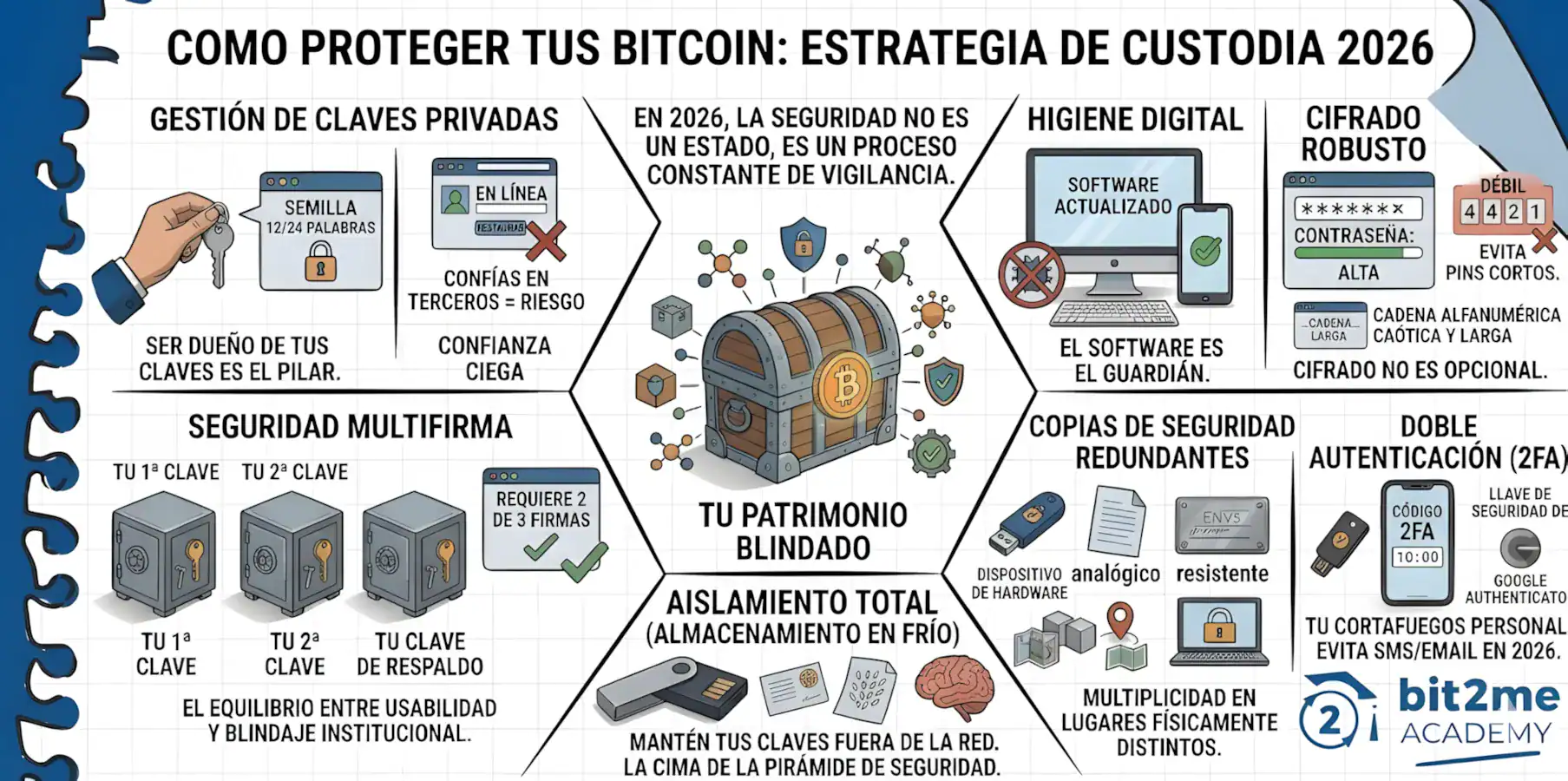
Manage your own private keys
This principle is the cornerstone of the entire ecosystem. It's the foundation, but we often ignore it out of sheer laziness. Owning your keys is the only real way to protect your tokens.
You must be extremely cautious with any online service. Whether it's a cloud wallet, an exchange, or a lending platform, if you don't have control over the seed phrase, you're taking an unnecessary risk. Be systematically suspicious. It's the healthiest approach you can take in this industry.
Carefully analyze the reputation of any service before sending a single satoshi from your computer. Remember that platforms with impeccable reputations have fallen in the past, victims of massive hacks or internal mismanagement. The moment you delegate custody of your assets, they are no longer under your direct control.
Spend as little time as possible with your funds in the hands of third parties. Also, keep a close eye on phishing attempts, which in 2026 are more sophisticated than ever thanks to generative artificial intelligence. Always check URLs and don't click on suspicious links you receive on your mobile device. Security isn't a state, but a constant process of vigilance.
Digital hygiene: Up-to-date software or assets at risk
Another crucial aspect of this system is the health of your devices. Using a cryptocurrency usually requires software to act as an intermediary (the wallet). Whether you're using a state-of-the-art computer or your mobile phone, if the code is outdated, you're vulnerable.
The software is the guardian of your private keysTherefore, any application you install must be malware-free. Do you use a web wallet? Be careful. Your operating system may appear clean, but a malicious browser extension could be injecting code to siphon your funds without your knowledge.
If you prefer installable programs, the risk changes but doesn't disappear. An outdated wallet is an open door to known vulnerabilities. Even worse: you could have downloaded a compromised version or have another app on your device that, after an automatic update, becomes a Trojan designed to steal your keys. By 2026, supply chain attacks will be commonplace; don't trust anything that isn't verified.
Encryption is not optional; it's your last line of defense.
Almost every modern wallet application automatically generates your keys. The problem isn't usually in the generation process, but in how they're stored. By default, many programs save this data in internal files which, if not protected, are exposed in plain text. If an attacker gains access to that file, your tokens are gone in seconds.
Wallets that implement robust security standards offer encryption of this file with a password or PIN. This adds an extra layer of protection: even if someone steals your key file, they will need your key to decrypt it. Essentially, the private key is mathematically transformed and becomes unusable without the correct password.
- The danger of short PINs: On a mobile phone, a four-digit PIN is a bad joke. An attacker can crack it by brute force in a matter of minutes using automated scripts. And they'll do it silently, without you receiving any notification.
- Strong passwords: If your wallet allows it, avoid simple numbers. Use complex passphrases. If the software lets you choose the seed phrase or private key directly, go for a long and complex alphanumeric string. Using "123456" or family names is, quite simply, giving away your assets.
To manage this password chaos, tools like KeePassXC or trusted password managers (e.g., BitWarden) are powerful allies, provided you know what you're doing. A smart technique is to fragment your security: store the encryption password in a manager and keep a physical paper copy in a secure location. However, if you lose access to the manager and don't have a backup, forget about your funds. For the more technically inclined, there's always manual encryption using [method/method]. OpenSSLHowever, if you're dealing with figures that would keep you up at night if you lost them, it's best to jump straight to hardware solutions, which we'll discuss later.
The second factor: Your personal firewall
Are you one of those who prefers to delegate safekeeping to a web service despite the risks? If so, the least you should do is activate a second level of protection.
Two-factor authentication (2FA) is an identity verification process that adds a necessary layer of security. At this point, using long passwords is no longer enough. The majority of digital asset thefts occur through sophisticated phishing, persistent malware, or network interception attacks, not through brute-force server attacks.
If an attacker obtains your password but doesn't have access to your second key, your tokens will remain safe. It's a physical and temporary barrier that usually takes several forms:
- Authentication Apps: Tools like Google Authenticator or Authy generate codes that expire every 30 or 60 seconds. Without that code, the password is worthless.
- Physical keys (Yubikey): It's the most robust option. It requires you to connect a physical device to your computer or bring it close to your mobile phone via NFC to authorize entry.
- SMS and Email: These methods are outdated and vulnerable to SIM swapping. By 2026, you should avoid them if your service offers more secure options.
However, keep in mind that 2FA doesn't protect you if the website is hacked internally. The golden rule still applies: don't store your savings on online platforms. If it's not your password, it's not your money.
Backups: The life insurance for your assets
If you manage your own wallet, backups are mandatory. But having just one isn't enough; you need redundancy in physically separate locations.
Today, most of us use HD (Hierarchical Deterministic) wallets. The advantage is enormous: you only need to back up a single "seed" (a string of 12 or 24 words). With that seed, you can recover all your crypto assets and transaction history on any new device. If your wallet isn't HD, you would have to create a backup after every transaction, which is impractical with today's technology.
Where should I store the backups?
- Digital physical media: Encrypted USB drives or SD cards should always be kept offline. But be careful; these storage devices need to be checked regularly. The NAND flash memory can be affected by ambient radiation, which is always present worldwide, or by other forms of degradation, so you should check them regularly to make sure everything is working properly.
- Analog backup: Write the seed on paper or engrave it on stainless steel to withstand fires or floods.
Don't underestimate this step. James Howells' story is the perfect reminder of what can go wrong. Due to a household blunder (accidentally throwing away a hard drive in 2013), this Welshman ended up losing 7.500 BTC. Despite his desperate attempts to locate the drive in the landfill, his fortune remains buried under tons of garbage.
Shared security: The power of multi-signature
If you're looking for a real balance between usability and institutional-grade protection, the multi-signature addresses They are the answer. Unlike a standard address linked to a single key, these require multiple keys to authorize a transaction before nodes validate it on the network.
Imagine the classic scene of a safe that only opens if two people turn their keys simultaneously. If one of them has their key stolen, the attacker can't do anything; the safe remains locked. In the digital asset ecosystem, this translates into configurable schemes like "2 of 3": you generate three keys, but you only need two to move your tokens.
- Strategic configuration: You can have one key on your computer, another on your mobile phone, and a third one printed on paper in a safe.
- Resilience to theft: If a criminal hacks your phone, they won't be able to steal anything because they lack the second signature.
- Recovery from losses: If you lose your mobile phone, you still have your computer password and physical backup to move your funds to a new, secure address.
Although historically these addresses began with the number 3, with the adoption of followed y tap rootThe formats have evolved toward greater efficiency and privacy. To manage this, open-source tools like Electrum or Sparrow Wallet remain solid choices for those who prefer free software over proprietary solutions. If you're interested in the mathematics behind this process, researching the Shamir Scheme will give you a fascinating perspective on how to securely fragment secrets.
Total isolation: Keep your keys off the network
The premise is unbeatable: if your private keys never touch the internet, no one can steal them remotely. This concept, known as cold storage, is the pinnacle of security for protecting your crypto assets.
There are three main ways to implement this isolation:
- Hardware Wallets: These are physical devices designed exclusively for signing transactions without the private key ever leaving the chip. They connect to your computer via USB or Bluetooth, but the signing process takes place in a sealed environment. Although they represent a financial investment, by 2026 they will be the most sensible option for any serious asset manager.
- Paper Wallets (Paper): This involves printing the seed or key on physical media. It's effective, but dangerous if the computer you used to generate the key was infected at the time. Furthermore, paper is fragile; a fire or flood could wipe out your savings in seconds if you don't use steel plates.
- Brain Wallets (Memory): Memorizing a seed phrase of 12 or 24 words is the most discreet method, but also the riskiest. The human brain is prone to forgetting and distorting memories under stress. Would you really entrust your financial future to your ability to recall 24 random words ten years from now? I wouldn't risk it.
For more advanced users, there's the option of offline or air-gapped transactions. This involves using a computer that has never been connected to the internet to sign transactions, transferring the data via USB or QR codes. It's a laborious and manual process, but it offers a nearly impenetrable layer of security. Remember that all these techniques can be combined: you can have a multi-signature address where one key is on a hardware device and another is encrypted offline.
Think about your will
We do not want to be fatalistic, but it is important to consider all possibilities. Too much security without a plan B can be dangerous. In the event of a fatal event, the bitcoins you have stored over a lifetime may be completely lost. inaccessible even for your family members, because the place where you keep these private keys (and the passwords to decrypt the keys if you have encrypted them) is so private that nobody, apart from you, knows it.
This is a controversial point, because those same people in whom you leave your trust as a plan B could be the one who steals you.
In this case it may be a good idea to use the multi-signature wallet where you can create a configuration of copies of keys stored in safes or places that will be inherited after your death.
One of the great revolutions in this line is the Smart Contracts, which will be able to send your bitcoin to whoever you decide once you die.
Like everything in this life, single failure points are always bad when it comes to security. Think about it also when storing your private keys, but be careful not to neglect these other storage points.
How complicated!
Possibly, at this moment, you have in your mind something like: “Is it really that complicated? Do I have to have all this in my head to have bitcoin?
It all depends on how seriously you want to take the security of your bitcoins. Possibly the more bitcoin you want, the more security.
Our recommendation is to start from the simplest. If you are going to store a couple of hundred euros, do not complicate yourself as much: use a lightweight HD wallet on your computer (Electrum) or mobile phone (Mycelium or Copay). Back up the seed, encrypt it if you like, and save it well. Finally protect the wallet with a pin or password. With this you have something fairly safe, as long as you do not have the infected device, and it is a simple process that takes no more than 3 minutes to complete.
As an addition, and if you do not mind spending money, you can use a hardware device to store the keys (for example Trezor).
If you are going to store larger quantities, we recommend you create a cold wallet through a 2 of 3 multi-signature address (for example with Copay). If the amount to be stored is going to be very large, put two of the keys encrypted and printed on paper, safely and separately from each other. Do not use copay on the same computer to obtain the 3 keys, you must use for example: a tablet, a smartphone and a computer. Finally you eliminate the purse of two of the devices and only leave one in which it is most comfortable for you, for example the smartphone, to see the balance and even have the address at hand to send you funds, but you can never operate without one of the two other keys that you can load on time on another device.
I have been robbed, what do I do?
Remember that the movements of money in Bitcoin are irreversible, if they steal you, you cannot call any central authority to cancel the shipment and return you. Not the same Satoshi Nakamoto can do this.
Now, Bitcoin is not anonymous, it is a pseudonym, and the most important transparent and all movements are reflected, that is: they can be traced.
If your bitcoins have been stolen, you should contact the Police, specifically the Logical Security department (or its counterpart in your country), who is the one who specializes in these aspects.
It is true that it is a complex and slow task, and in very few cases the Police have managed to recover the bitcoins, but in recent months (and increasingly) international authorities in several dozen countries are already organizing themselves in the tracking and resolution of this type of case developing specific tools for the analysis of The blockchain.
Conclusion
Although the technology of Bitcoin is safe in itself and the main online wallets have improved a lot when it comes to security, you will never be 100% safe from the bad arts of hackers, thieves and friends of outsiders in general.
And it is that money, today, is not protected with weapons and security cameras, it is protected with mathematics.
As usual, common sense is also a good advisor when it comes to protecting your bitcoins.
Of course, the level of paranoia must always be commensurate with the amount of money to be handled and will depend on each one. Remember that in Bitcoin your bank is you, you take care of your security and you can define your own protocols.
Along with it and these 7 recommendations (some combinable), you will greatly limit the room for maneuver of anyone interested in getting your bitcoins.
FAQ – How to protect your bitcoins: find out how here


 Author