Essential Points
- Resource Efficiency: Lightweight wallets eliminate the barrier to entry into the crypto ecosystem by enabling operation on mobile devices with limited storage.
- SPV Mechanics: The key technology is Simplified Payment Verification, which allows light clients to confirm the validity of transactions by querying only a fraction of the blockchain.
- Privacy Commitment: Although highly functional, the use of lightweight wallets can expose metadata to the full nodes that query it, a critical factor for advanced users.
- Interoperability: They represent the necessary bridge for mass adoption, facilitating instant payments and asset management without proprietary server infrastructure.
If you're looking to manage your crypto assets efficiently without straining your computer's hard drive, lightweight wallets are the logical solution. Not everyone has the time or resources to maintain a full node, and let's be honest: nobody wants to wait days for a blockchain that's already terabytes in size to sync. These tools allow you to operate with technical reliability while avoiding the burden of downloading the entire network history.
The trick lies in delegation. These wallets connect to an external full node, a machine that actually carries the weight of the entire network database. By downloading only a tiny fraction of the data, synchronization is almost instantaneous. It's the difference between carrying your entire library and just the index of the book you want to read. For a mobile device, where storage space is at a premium, this architecture isn't just an option; it's a necessity.
The mechanics of SPV and the confidence factor
This system relies on the Simplified Payment Verification (SPV)Thanks to this protocol, the wallet only downloads the block headers. Can the wallet verify a transaction on its own? No. This is where you need to get involved: You are relying on other nodes in the network to tell the truth about the validity of the movements. It's a toll we pay in exchange for portability, although for most home users, the risk is acceptable compared to the convenience gained.
Despite this dependence on third parties, there is a red line that will not be crossed: the custodyYour private keys never leave your device. The external node may try to deceive you about your balance or track your transactions, but it will never be able to touch your funds. The security lies in the fact that the node only acts as a mail carrier delivering information; it doesn't have the key to your safe.
However, don't let your guard down. If the node you connect to is malicious, your privacy is at risk. On networks like BitcoinIn a world where anonymity is a persistent myth, a corrupted node can link your IP address to your token addresses. The funds are safe, yes, but your financial data might not be. Is this the price we're willing to pay for immediacy? Possibly, but it's wise to identify the vulnerabilities before the rain starts.

Characteristics of Lightweight Wallets or light purses
Choosing a lightweight wallet means understanding that we don't always need to carry the burden of the entire infrastructure to move our capital. Unlike full nodes, these wallets give us complete ownership of our private keys without forcing us to manage terabytes of data. It's essentially the smartest way to carry your crypto assets in your pocket without putting a strain on your phone.
How do they operate without the complete chain?
The magic behind these tools lies in their connection to external servers. By interacting with nodes that maintain a complete copy of the network, your device only processes the strictly necessary information. This eliminates the tedious synchronization waits we saw years ago; here, setup is almost instantaneous. We gain speed and free up storage space, which, on portable devices, remains a precious resource.
To achieve this efficiency, the system uses Simplified Payment Verification (SPV). Since your wallet cannot confirm a transaction on its own due to a lack of complete transaction history, it delegates this query to other nodes in the network. Does this mean we are defenseless? Far from it.
The security behind Merkle's root
The wallet doesn't simply "believe" what the external node tells it. It uses the Merkle root of the block where your transaction is located. This cryptographic identifier confirms that the transaction has been validated by the miners (or validators, depending on the protocol) and effectively included in the blockchain.
- Technical superiority: By managing the keys yourselves, these clients are infinitely more secure than any web wallet or exchange platform.
- Reliability: SPV technology is a robust standard that balances agility with mathematical certainty.
- Versatility: Although there are versions for computers, its natural habitat is the smartphone, allowing any user to operate as a lightweight node from a free application.
However, always make sure to download these tools from their official websites. In an environment where digital assets are the primary target of phishing attacks, the first layer of security isn't the code, but your common sense when installing software. Is it worth sacrificing some privacy for this speed? For everyday use, the answer is usually a resounding yes.
Recommendations for use for lightweight wallets
If you're involved in mining, remove the rewards from your radar of lightweight wallets. It might seem convenient to receive your earnings directly on your phone, but it's a rookie mistake. Mining rewards are often broken down into numerous microtransactions. (UTXOs) a lightweight client doesn't handle well. Trying to move those funds later can overload the application or generate unexpected fees. For this, a full node on a robust computer is better.
Risk management and digital health
Let's not kid ourselves: these wallets are for everyday use. Think of them as your pocket wallet, not a bank vault.
- Moderate amounts: Because they are permanently linked to the internet, the risk of exposure is higher. Keep your main capital in a safe place and only invest in the low-cost cryptocurrency what you plan to spend or move in the short term.
- System hygiene: It doesn't matter how encrypted your seed phrase is if your device has a Trojan monitoring every screen tap. Keep your operating system free of junk and pirated software; the security of your tokens starts with an up-to-date antivirus.
- official sources: Never, under any circumstances, download a wallet from an advertising link or a Telegram message. Go directly to the developer's official website. In 2026, app "cloning" attacks are so sophisticated that you could be installing a perfect imitation designed to drain your balance in seconds.
Finally, if you opt for browser versions or online interfaces, always verify the security certificate and the URL. A single changed character in the address bar can be the difference between successful management and financial disaster. Is it tedious to double-check everything? Perhaps. But in this industry, laziness is the fastest way to run out of money.
Some examples of lightweight wallets
Among the category of wallets that operate with thin clients, the most popular is Electrum. However, there are many others that use this feature and do not require downloading the entire blockchain. Therefore, they also work faster, more efficiently, safer and with less storage space. Let's see which are the most used.
Desktop
Electrum
As we have already seen, Electrum It is a desktop wallet that has separate clients for major cryptocurrencies like Bitcoin, Litecoin, and Dash. Each of these can be downloaded from official websites. Electrum uses the SPV to verify transactions. For this, the SPV client only downloads the block headers and requests a Merkle tree inclusion test. This purse can be synchronized with other hardware such as Trezor or Ledger.

Smartphone options
Choosing where to store your tokens isn't a decision to be taken lightly. As networks have evolved, some pioneers have given way to applications that better manage privacy and multichain capabilities. Here are the most robust options for your mobile device or computer.
BlueWallet (Reference in Bitcoin)
BlueWallet It has established itself as the preferred choice for those seeking power without complications. It's an open-source wallet that uses SPV to deliver blazing-fast speed. What makes it stand out today is its native integration with the Lightning Network and its ability to connect to your own node if you decide to make the technical leap. You can link it with hardware devices like Trezor or Jade, keeping your private keys always under your physical control.
Blockstream Green
If security is your obsession, Blockstream Green It's your tool. Green stands out for its multi-signature model, which adds an extra layer of protection without compromising the agility of a thin client. It's compatible with Liquid NetworkThis allows for more private and faster cryptocurrency transfers. Its clean interface is designed to provide a seamless user experience on both Android and iOS, and it also allows for full integration with its own custody hardware.
Edge Wallet (Multichain Versatility)
Unlike the previous ones, Edge It's the Swiss Army knife for those diversifying their portfolio across different crypto assets. It remains true to its deterministic architecture, where a single seed generates an infinite number of addresses hierarchically. What truly makes it valuable in 2026 is its internal exchange engine, which allows users to move from one token to another, or even from fiat currency to digital assets, without leaving the application. All of this while maintaining the "not your keys, not your funds" philosophy.
Phoenix (Lightning's Standard)
We cannot talk about lightness in 2026 without mentioning PhoenixIt's a lightweight client that redefines what it means to use Bitcoin on a daily basis. Although technically a simplified layer two node, it operates on a "set it and use" principle. It handles all channel management automatically, enabling instant payments with ridiculously low fees. It's probably the most human and least intimidating way to interact with the network without sacrificing self-custody.
Bit2Me Wallet: The convergence between agility and operational depth
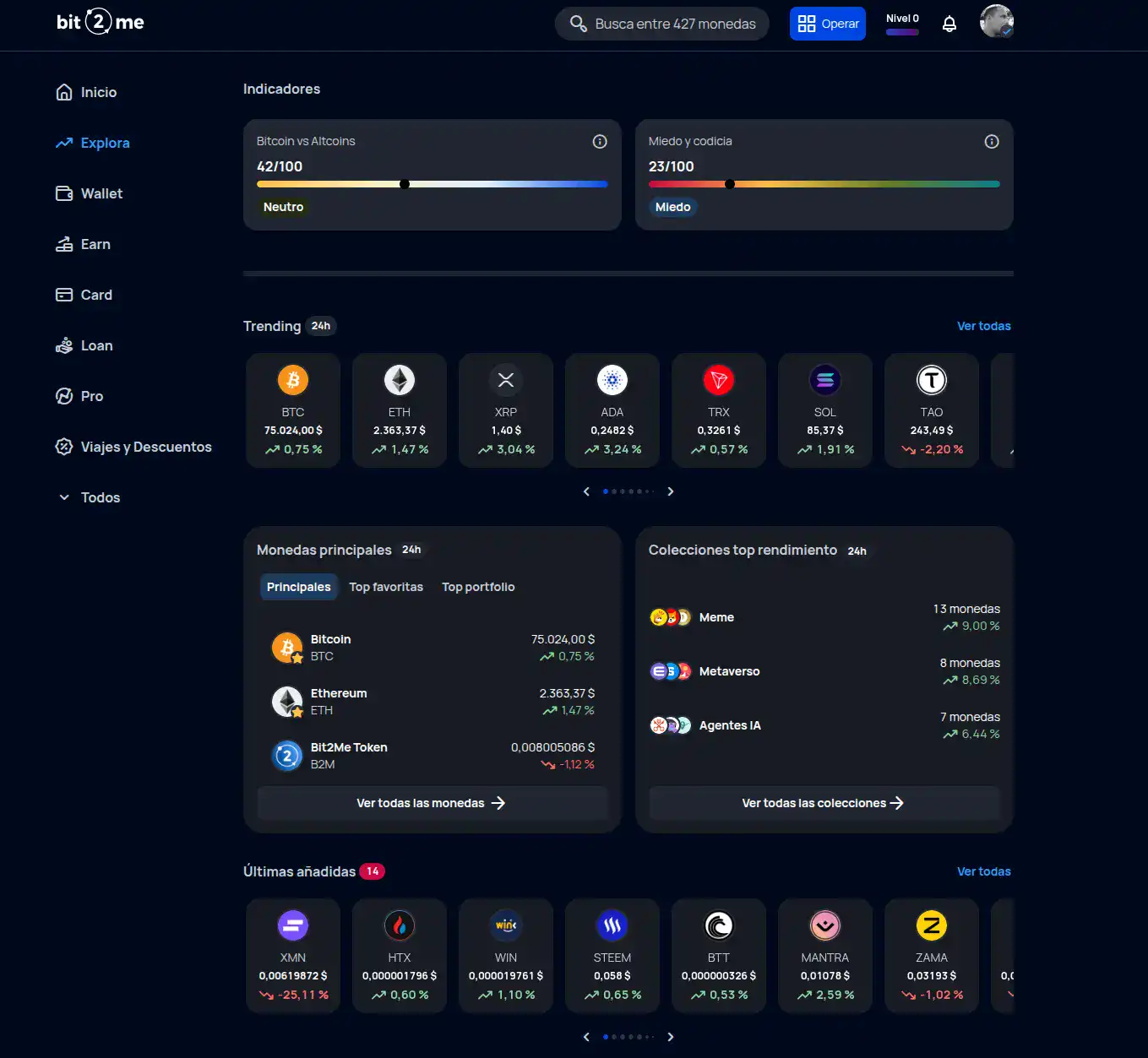
While lightweight wallets have marked a milestone in mobility, Bit2Me Wallet raises the bar by offering an infrastructure that combines security, simplicity, and astonishing execution speed. We're not just talking about storing your tokens, but about having a financial suite designed so that the user doesn't waste a single second on cumbersome processes.
A seamless ecosystem
What truly sets this option apart is its integration capabilities. You don't need to switch between different applications to manage your assets:
- Multi-asset and Multi-currency: Supports a vast number of crypto assets and traditional currencies, allowing your portfolio to be as diverse as your investment strategy requires.
- Instant Swap: Forget waiting for endless external confirmations. You can seamlessly swap between different tokens, maintaining immediate liquidity.
- Synchronization with Bit2Me Trade: For those who need to take it a step further, the connection to the professional trading platform is direct. It's the perfect bridge between saving and market trading.
Universal access to capital
How do we convert "real world" money into digital assets? Bit2Me They've solved this bottleneck with a flexibility few can match. You can top up your wallet via bank transfer or with the speed of a credit or debit card.
In short, if you're looking for a tool that not only protects your funds but also enhances your flexibility, this is the option that best understands the current pace of blockchain technology. Why settle for a simple wallet when you can have an entire ecosystem at your disposal?


 Author