Essential Points
- The largest cryptocurrency thefts target third-party platforms, keys, and contracts, not a proven flaw in the Bitcoin network.
- Mt. Gox (2014) and Bitfinex (2016) opened the list; Bybit (2025) and Binance (2026) brought the figures into billions of dollars.
- The value of a robbery changes depending on the valuation date, so each figure in this guide includes its date and criteria.
- The practical lesson is simple: distribute your funds, protect your keys, and check what you sign before approving it.
Bitcoin and cryptocurrency thefts are no longer just anecdotes from the early years of the industry. Chainalysis, a blockchain analytics firm, tallied more than $3.400 billion stolen between January and early December 2025, with the Bybit attack alone accounting for approximately $1.500 billion of that figure, according to their data. report on robberies in 2025That record didn't last long, because on October 29, 2026, more than $6.000 billion left Binance wallets, according to the FBI alert published two days later.
Behind each figure lies a different way funds were lost: a platform with exposed keys, a smart contract with a coding error, or a person tricked into signing something they didn't understand. The cases that have most impacted the industry, from Mt. Gox in 2014 to Binance in 2026, share little more than their scale, and the same theft can be worth vastly different amounts depending on the date it's calculated. Therefore, each amount listed here includes its date and valuation criteria.
Understanding them has practical benefits for you, because almost all of them exploit a weakness that also exists on a smaller scale. The value of crypto assets can change rapidly, so the figures you see are a snapshot of a specific date, not a forecast.
 Certificate

How are Bitcoin and other cryptocurrencies stolen?
To steal cryptocurrency, it's not necessary to break Bitcoin's cryptography, and the cases in this guide demonstrate this, because the weak point is almost always in the network's surroundings. TRM Labs, another on-chain analytics firm, calculated in its report for the first half of 2026 that infrastructure and operational commitments accounted for around 15% of incidents, but around 76% of the money lost.
A hot wallet is a wallet that remains online and is used by a platform to process withdrawals, making it an attractive target, while a cold wallet stores its keys offline. You can learn more about the difference in Academy's guide on What are hot wallets? and in the cold wallets.
The major cryptocurrency thefts in this guide fall into four attack patterns, and several of these are often combined in a single incident, so it's important to distinguish them one by one:
- Private keys: These are obtained directly from a server or a person and allow legitimate transactions to be signed within the system.
- Infrastructure: The server, node, or signature system that a platform uses to authorize withdrawals is compromised.
- Smart contracts: exploiting a bug in a protocol's code to make someone pay the wrong person.
- Social engineering: a person is tricked with a job offer, a link or a download into giving access.
In the realm of personal wallets, Chainalysis recorded approximately 158.000 compromises in 2025, affecting around 80.000 victims and totaling $713 million, a figure lower than the previous year. Large-scale platform thefts account for a much larger share of the total: the three largest in 2025 represented 69% of service losses. To distinguish a code flaw from a scam, it helps to understand what a coding flaw is. double-spending, an attack that none of these cases required.

What are the biggest Bitcoin and cryptocurrency thefts in history?
The table orders nine cases by date and separates two pieces of data that are often mixed up: the amount taken, in units of the asset, and the value of that amount according to the source. The valuation criteria change from case to case because each source chose a different time, and this difference can multiply or divide the figure.
| Case | Date of theft | Asset and amount | Dollar value and criteria | Source |
|---|---|---|---|---|
| Mt. Gox | Announced on February 28, 2014 | Approximately 750.000 BTC from clients and approximately 100.000 BTC of our own; approximately 200.000 BTC reappeared in March 2014 | No dollar value: the company only gave amounts | Mt. Gox Press Releases |
| Bitfinex | August 2016 | 119.754 BTC | More than 4.500 billion in February 2022, the date of the arrests, not the date of the robbery | U.S. Department of Justice |
| Coincheck | January 26, 2018 | NEM | 58.000 billion yen, the amount at the time according to the Japanese regulator; no conversion to dollars | FSA of Japan |
| Binance (2019) | May 7th 2019 | 7.000 BTC | About 40 million, at the price of that day according to the platform itself | Binance press release from May 2019 |
| Ronin | March 23th 2022 | Cryptoassets on Ethereum | About 620 million, value at the time of notification (March 29, 2022) according to the FBI | FBI |
| Bybit | February 21th 2025 | Ether | About 1.500 billion, the current value according to the FBI | FBI |
| KelpDAO | April 18th 2026 | 116.500 rsETH | About 292 million, at the price at that time according to Chainalysis | Chainalysis |
| Bitget | 24 September 2026 | Multiple assets across seven networks | 351,6 million according to TRM Labs (platform figure) and 387 million according to Chainalysis | TRM Labs |
| Binance (2026) | 29th October 2026 | 18.270 BTC and other assets across ten networks | More than $6.000 billion according to the FBI; $6.360 billion according to TRM Labs, which values each transfer at the current price; about $6.400 billion according to Chainalysis | FBI |
The dollar figures are a convention and not an exact loss, because the price of Bitcoin and other assets changes every day. If you want to compare a certain amount of BTC to its current value, you can consult the Bitcoin price in Bit2MeThe last two rows are recent and are still being updated, so take them as estimates as of November 1, 2026.
What happened in the exchange robberies, from Mt. Gox to Binance in 2019?
Mt. Gox and bankruptcy
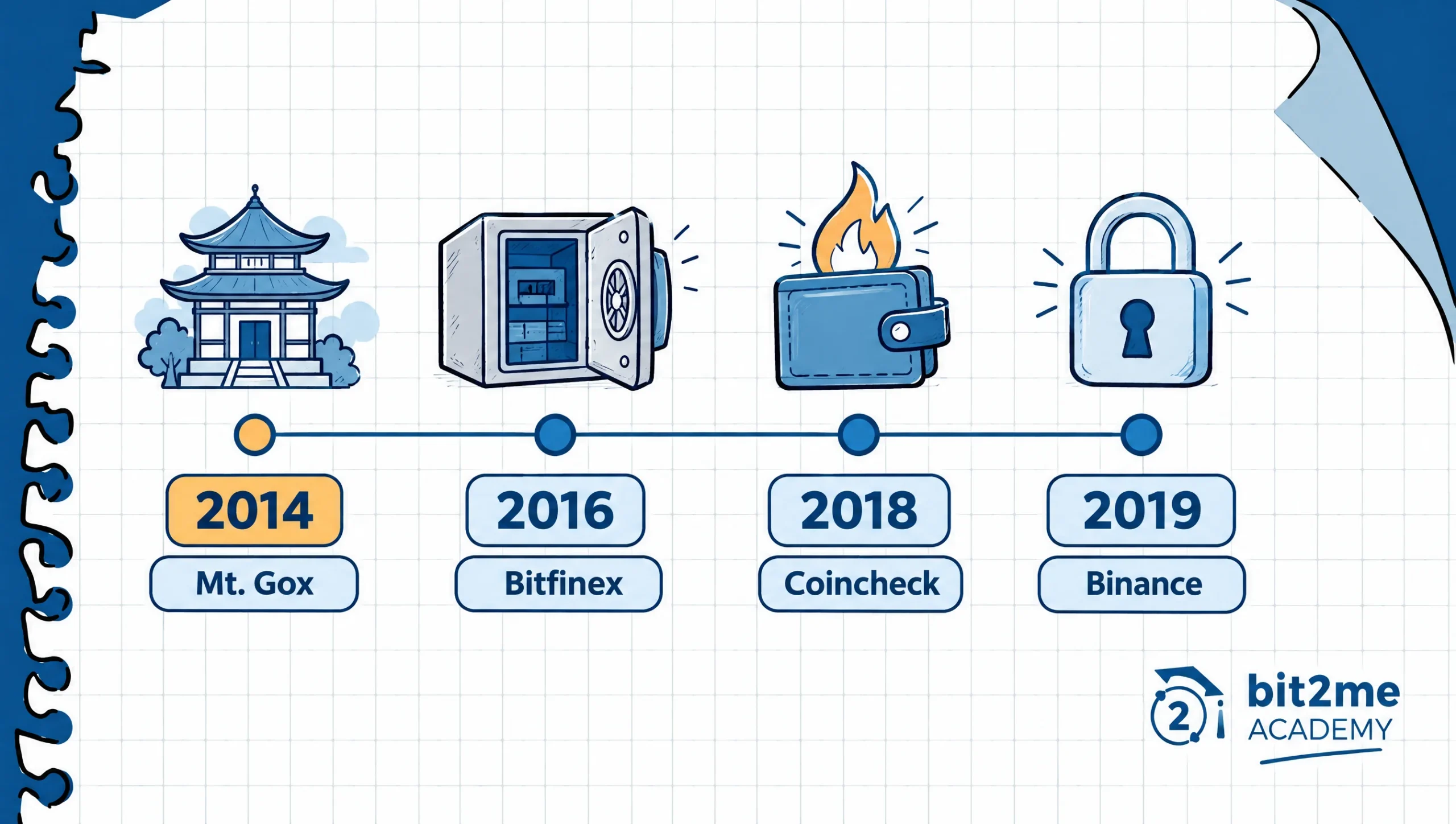
Mt. Gox, a Tokyo-based exchange platform, announced on February 28, 2014, that approximately 750.000 bitcoins belonging to its customers and about 100.000 of its own had gone missing, acknowledging that it could not confirm the exact figure. On March 20, 2014, it reported that it had found approximately 200.000 BTC in an old wallet it believed to be empty, according to its official announcementsYou have the case summary in the Academy guide on What is Mt. Gox?.
The company then suggested that the bitcoins might have been moved by exploiting a flaw in the Bitcoin system, and the Tokyo District Court opened bankruptcy proceedings on April 24, 2014. Since then, an administrator has been managing the return to creditors, a process that remains open as of November 2026.
Bitfinex and the laundering of stolen money
In August 2016, 119.754 bitcoins left Bitfinex through more than 2.000 fraudulent transactions, according to the U.S. Department of JusticeThe agency valued that amount at more than $4.500 billion when it announced the arrests in February 2022. Agents seized more than 94.000 BTC, valued at more than $3.600 billion at the time of the seizure.
The two defendants pleaded guilty on August 3, 2023, to conspiracy to launder money, and one of them, Ilya Lichtenstein, was sentenced in November 2024 to five years in prison.
Coincheck and the regulator's orders
On January 26, 2018, Coincheck suffered an unauthorized access that drained NEM by about 58.000 billion yen and affected about 260.000 people, according to the balance sheet of the Japanese financial agencyThat agency ordered improvements to the platform, and the order of March 8, 2018, pointed to serious management and internal control problems.
Binance and its SAFU fund
On May 7, 2019, Binance reported that attackers had withdrawn 7.000 BTC from its Bitcoin hot wallet, which held around 2% of its bitcoins, after obtaining API keys and two-step verification codes from several users.
The platform said it would cover the loss with its SAFU fund and that no customer funds would be affected, and its chief executive put the figure the next day at about $40 million.
How did robberies change with The DAO, Ronin, and Bybit?
The DAO and the fork
On Ethereum, the first major blow came on June 17, 2016, when an attacker exploited a recursive call vulnerability in The DAO, a fund governed by smart contracts, and began draining its ether into a child contract, according to the Ethereum Foundation notice.
The community proposed a software fork, and on July 20, 2016, the foundation announced that it had been completed, with around 85% of the miners on the new chain and some 12 million ETH moved to a recovery contract to return them to token holders.
The decision split the network: the chain that did not adopt the change remained active and is now known as Ethereum Classic, according to the Ethereum historyTo understand this dilemma, you can review What is a DAO?because the case showed that an immutable code and a community that decides to correct it do not always go hand in hand.
The robbery at Axie Infinity
Network bridges, like the one that affected the Ronin network, concentrate a lot of value in a few points, making them a highly sought-after target, because a single failure can release large amounts of funds locked in the originating network. You can see how they work in the Academy guide on What is a crypto bridge?.
The FBI confirmed on April 14, 2022, that Lazarus Group and APT38, North Korean cyber actors, were responsible for the theft of $620 million in Ethereum reported on March 29, 2022, and the US Treasury places the theft on March 23, within the attack on Axie Infinity.
Bybit and the FBI attribution
The largest theft up to 2026 was the Bybit heist: on February 26, 2025, the FBI attributed the theft of approximately $1.500 billion to North Korea, operating under the codename TraderTraitor. The theft occurred around February 21. According to the FBI, some of the stolen funds were converted into Bitcoin and other assets distributed across thousands of addresses.
Current state of cryptocurrency thefts in November 2026
Accumulated losses in 2025 and 2026
The balance of Bitcoin and cryptocurrency thefts as of November 1, 2026, is the worst on record: TRM Labs calculated on October 30 that the year's thefts and attacks total $8.700 billion, the highest figure in its series, and that most of it corresponds to the Binance case.
In the first half of 2026, incidents reached a record number of 207, but losses totaled $972 million, down from $2.300 billion in the first half of 2025.
KelpDAO and Drift, April 2026
On April 18, 2026, 116.500 rsETH, about $292 million, left the KelpDAO bridge after a message between chains was forged, and Chainalysis points out that it was not a smart contract failure but an attack on the infrastructure that verifies messages.
The contract pause halted a second attempt to steal approximately $95 million, and Arbitrum's security council froze over 30.000 ETH from the attacker's subsequent funds. In April, Drift Protocol was also the victim of a $285 million theft, according to TRM Labs.
Bitget and the two published figures
On September 24, 2026, BitGet detected unauthorized transfers from its hot and tempered wallets, totaling $351,6 million according to TRM Labs and $387 million according to Chainalysis. The platform stated that its private keys were not stolen and that its user protection fund covered the loss.
Binance and the FBI alert from October
On October 29, 2026, funds began to leave Binance wallets on various networks, and the FBI published two days later that more than $6.000 billion had been stolen and that North Korea was responsible, under the name TraderTraitor.
Chainalysis puts the total at around $6.400 billion and estimates that approximately $2.800 billion was frozen as of October 30th, while TRM Labs counts 18.270 BTC among the stolen assets. The investigation remains open, and the figures change daily.
Mt. Gox, payment terms
Finally, the administrator of Mt. Gox extended the deadline for payments to creditors, which was previously set to end on October 31, 2026, to October 16, 2026, according to the official website of the processSome figures in this section may have changed by the time you read it, so please consult the linked sources.
What Bitcoin thefts teach us about protecting your funds
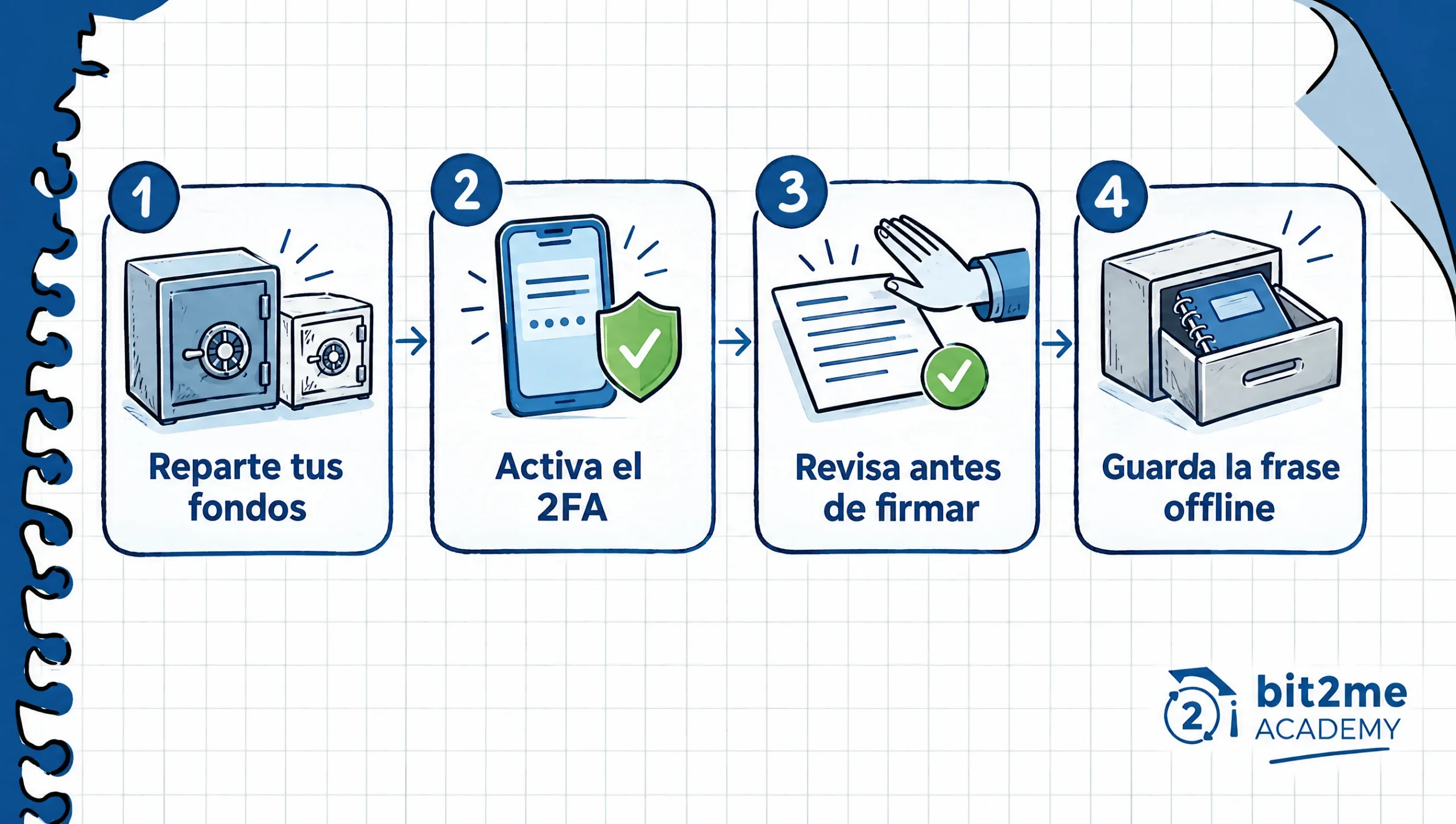
The Bitcoin and cryptocurrency thefts in this guide all share a common thread: the failure lay in a single point—a hot wallet, a signature system, a bridge, or a deceived individual. This doesn't guarantee you'll be immune if you use a platform, but it does offer a practical guideline: avoid relying on a single site and carefully review what you authorize. No single measure eliminates all risk, but the following steps reduce the exposure of your funds to both third-party errors and your own.
- Spread your funds: don't leave everything on a single platform or wallet, and decide how much you need to have on hand and how much you can store offline, for example in a hardware wallet.
- Activate 2FA, two-factor authentication, with an app or a physical key, and don't share it or store it with your password.
- Review before signing: check the address, the network, and what you are authorizing, and be wary of job offers, downloads, or links that ask you to install something or connect your wallet.
- Save the phrase offline: the seed phrase It gives access to your funds, so write it down on paper, don't photograph it, and don't give it to anyone.
If you use a platform, it's helpful to understand what happens to your funds in each model, and Academy's guide on this topic is useful. Custodial and non-custodial wallets It explains it. If you decide to buy Bitcoin later, you can buy Bitcoin at Bit2Me and apply these measures from day one, keeping in mind that the value of crypto assets can rise or fall rapidly and that you may not recover your investment. To recognize the most common scams, also review the guide from How to identify and avoid cryptocurrency scams.

Frequently asked questions about Bitcoin and cryptocurrency theft



 Author