Essential Points
- BitAxe is an open-source ASIC miner, with ESP-Miner firmware, which you manage via Wi-Fi from your browser.
- Each model uses a different Bitmain chip, and the official repository only provides hashrate figures for some of them.
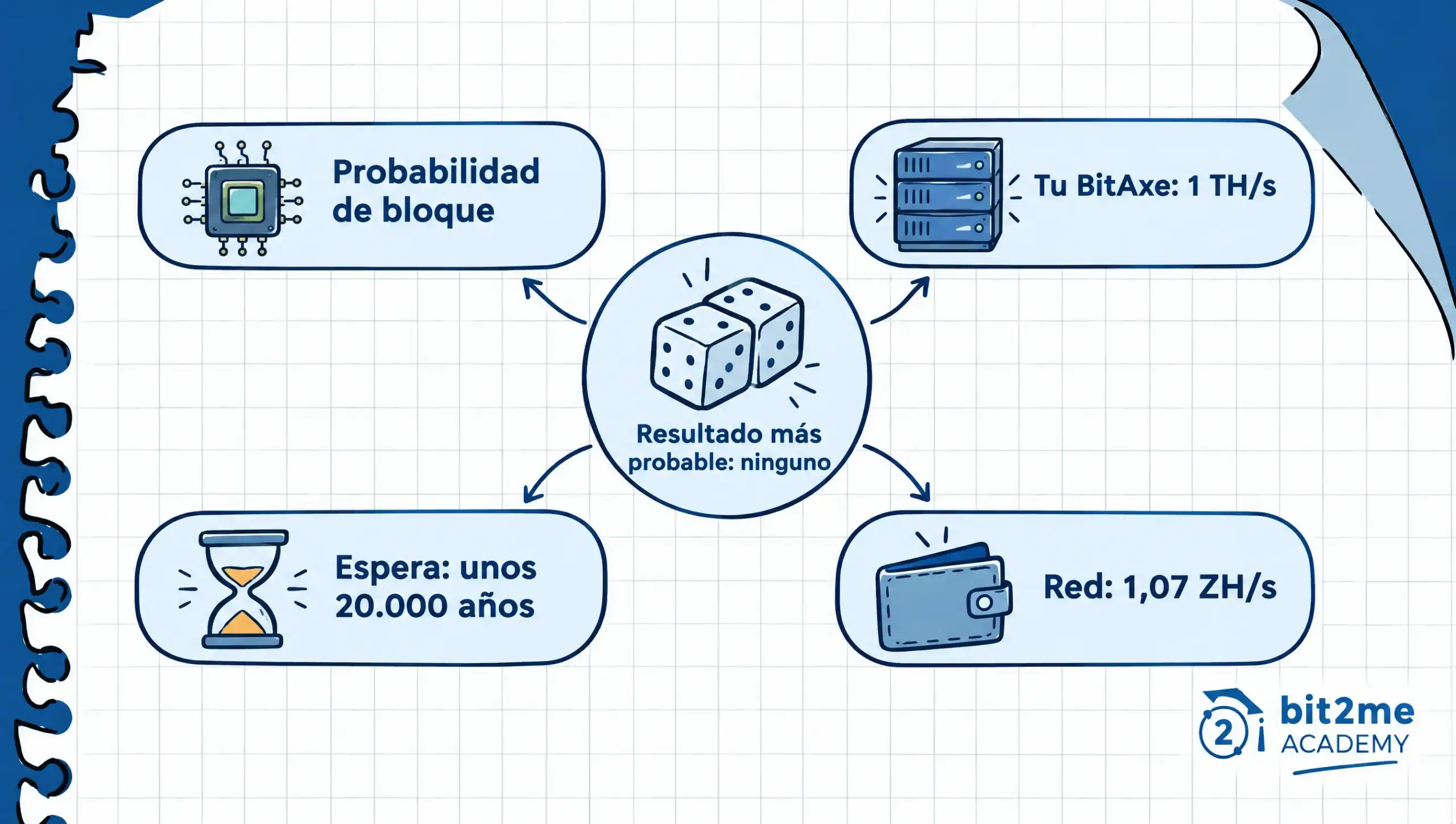
- With 1 TH/s versus 1,07 ZH/s of network, you would expect about 20.000 years on average per block (estimate).
- The consumption is low, but you're unlikely to receive any reward: it's a learning tool, not a source of income.
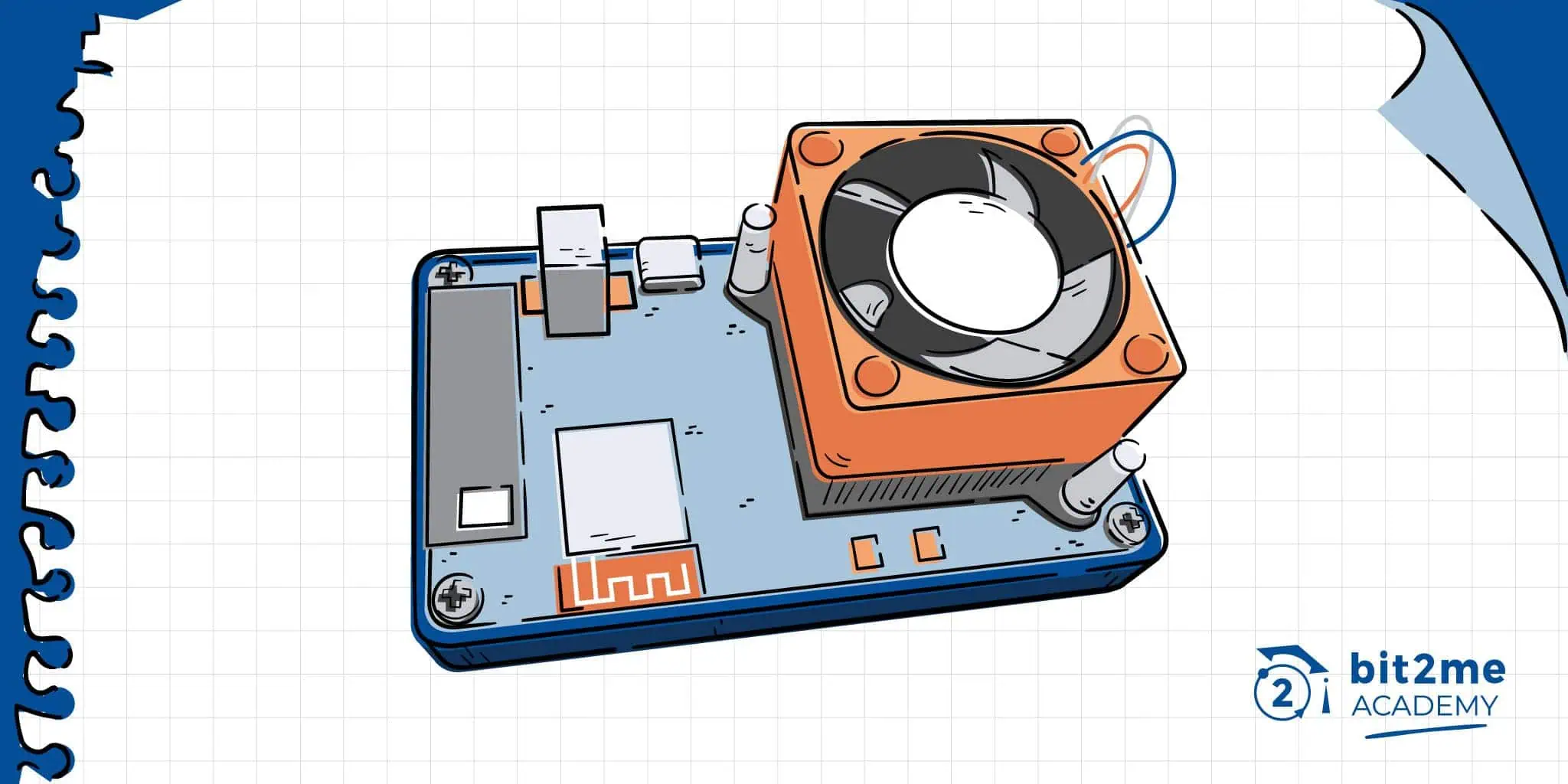
BitAxe is an open-source ASIC miner that connects via Wi-Fi and calculates Bitcoin hashes using a Bitmain chip and ESP-Miner firmware. It allows you to mine Bitcoin at home, but there are two distinct questions. The first is whether it works, and the answer is yes; the second is whether it's financially worthwhile, and the answer is almost certainly no.
The numbers explain why. As of October 31, 2026, the Bitcoin network had a hashrate of around 1,07 ZH/s, according to the public data from blockchain.comA home rig with a throughput of 1 TH/s, a round figure close to what the official repository estimates for the Gamma model, contributes slightly less than one billionth of that total. At that rate, the average wait to find a single block is about 20.000 years, a calculation based on the hashrate for that date, detailed below.
So, what's the point of a BitAxe? To understand mining firsthand and manage open-source, auditable hardware. The fundamental question is whether you're looking for financial gain or technical independence, and here are the figures to help you decide, without any income promises and with the risks clearly laid out, so you can compare the cost of the equipment with what it can offer in return.
 Certificate
What is BitAxe and what is it used for?
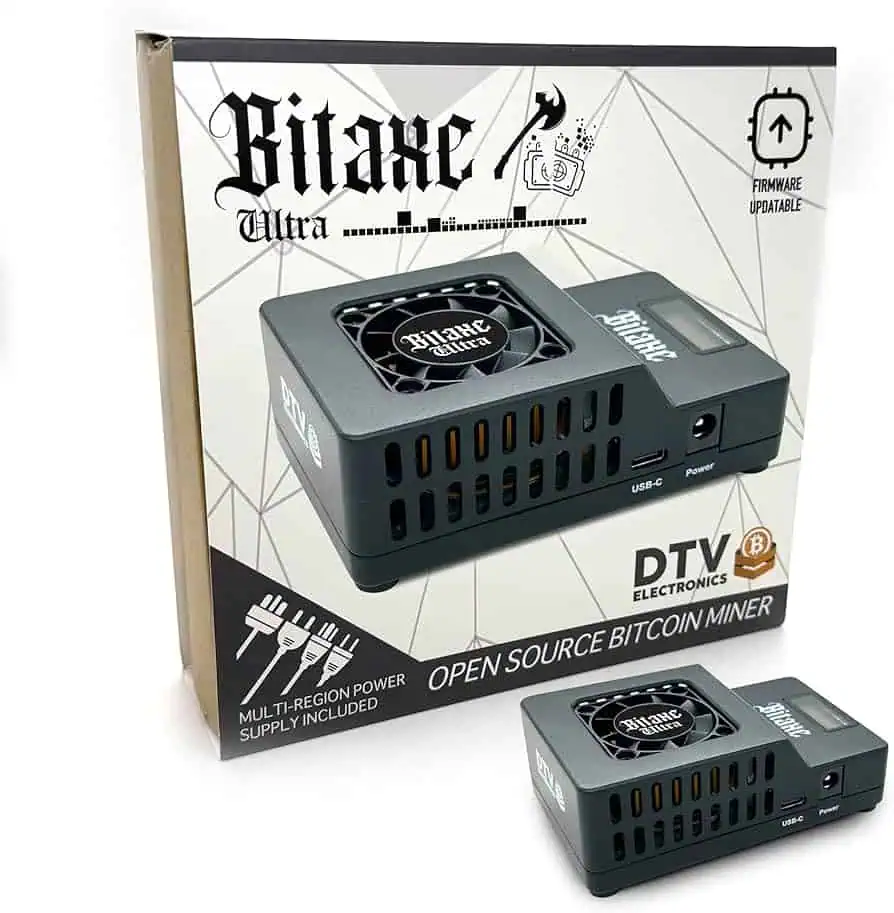
BitAxe is a Bitcoin mining project with open-source hardware and firmware, designed so that anyone can build or buy a small miner and understand how it works. The ESP-Miner firmware is released under the GPL-3.0 license and its web interface is called AxeOS, while the Ultra board design is distributed under the CERN-OHL-S-2.0 license, according to the official repositories. ESP-Miner and Bitaxe.
The heart of the board is a chip ASICA BM1366 is a circuit designed to repeat a single operation, which in Bitcoin is the calculation of the SHA-256 hash. This approach makes it much more efficient than a CPU or a graphics card, which is why the latter are no longer competitive for Bitcoin mining. The Ultra model uses the BM1366 chip, and Bitmain claims an efficiency of 0,021 J/GH for it.
It's important to clarify that figure: it's provided by the chip manufacturer, and BitAxe's own repository indicates this, so it's not a measurement of the equipment running on your shelf.
The practical use of a BitAxe is educational: you see how a team sends its results to a pool and how far apart home miners are from industrial mining. If you're looking for an overview, the guide on What is bitcoin mining? It gives you the context.
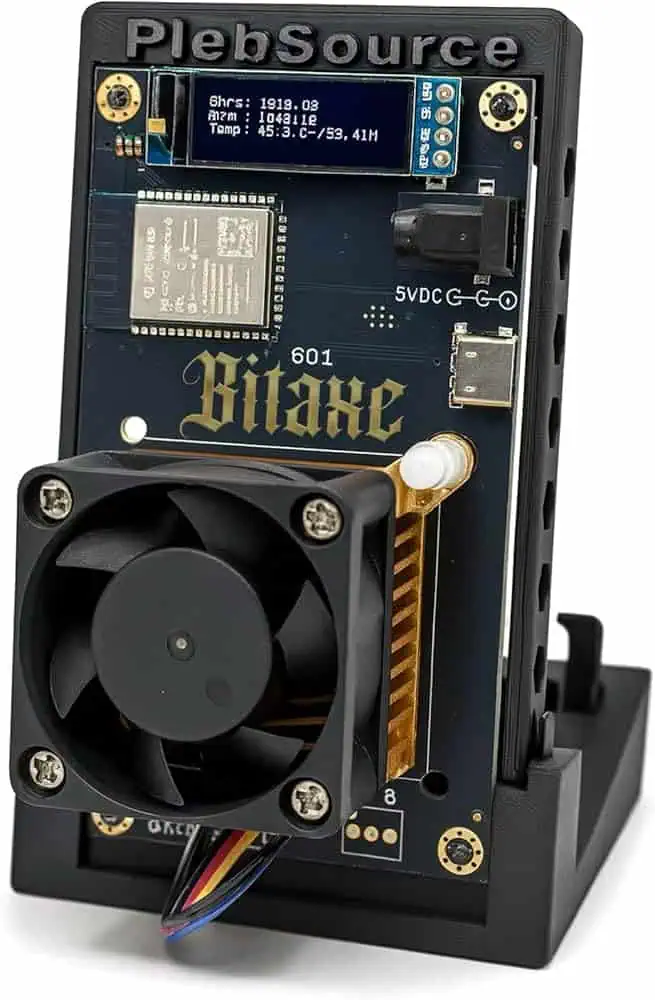
What BitAxe models are available and what does the official documentation say?
Today there are several BitAxe models, each using a different chip. The table lists the five models listed on bitaxe.org, along with the original chip and the hashrate and power requirements indicated in each repository as of October 31, 2026. Where the repository does not provide a value, the table indicates it instead of filling it in.
| Córdoba | ASIC chip (original equipment) | Hashrate according to the official repository | Food according to the official repository |
|---|---|---|---|
| Max | BM1397 (Antminer S17) | Over 400 GH/s with cgminer on a separate computer | 5V, more than 15W |
| Ultra | BM1366 (Antminer S19 XP) | It does not indicate a figure. | 5V; the main repository says it needs 15W and recommends a 25W (5V and 5A) power supply |
| Supra | BM1368 (Antminer S21) | It does not indicate a figure. | 5V, power supply of more than 15W |
| Gamma | BM1370 (Antminer S21 Pro) | Approximately 1,2 TH/s, according to README's own estimate | 5 V, at least 4 A (20 W); often 25 to 30 W are required |
| UltraHex | Six BM1366 | It does not indicate a figure. | It does not indicate a figure. |
The figures come from bitaxe.org/hardware and from the repositories Bitaxe, Max, Supra y Gamma, consulted on October 31, 2026. Two details prevent misunderstandings when reading the table. The 1,2 TH/s figure for Gamma is an estimate that the README calculates by distributing the nominal 234 TH/s of the Antminer S21 Pro among its 195 chips, not a measured result, and the 400 GH/s for Max corresponds to usage with cgminer from another computer.
The power column also refers to the power supply you need, not the actual consumption, which depends on the frequency and voltage you configure on the equipment and which you will have to measure with a wattmeter if you want an exact figure.
The list of official repositories also includes the Gamma Turbo, a dual-chip BM1370 version, and a website of verified vendors. If you see a hashrate or wattage figure advertised that doesn't appear in your model's documentation, treat it as third-party information and verify it before relying on it.
How does a BitAxe work?
A BitAxe combines two components: an ESP32-S3 microcontroller, which runs the firmware and manages the Wi-Fi connection, and one or more ASIC chips that perform the heavy lifting of calculating hashes. The firmware connects to a mining server using the Stratum protocol, receives a working template, distributes it to the chip, and returns the solutions it finds.
ESP-Miner supports Stratum V1 and Stratum V2. The latter is the latest version of the protocol, encrypts traffic, and, according to its specification, allows the miner to build their own block templates and choose which transactions to include instead of leaving it up to the pool. This is an interesting development for those interested in decentralization, although it requires a pool or server that also supports it.
A common misconception needs to be clarified. A BitAxe does not validate network transactions on its own: that is done by a... full nodeAnd it's the pool or your own node that builds the block template on which the miner works. That's why it's more appropriate to talk about a miner and not a mining node, because they are different functions.
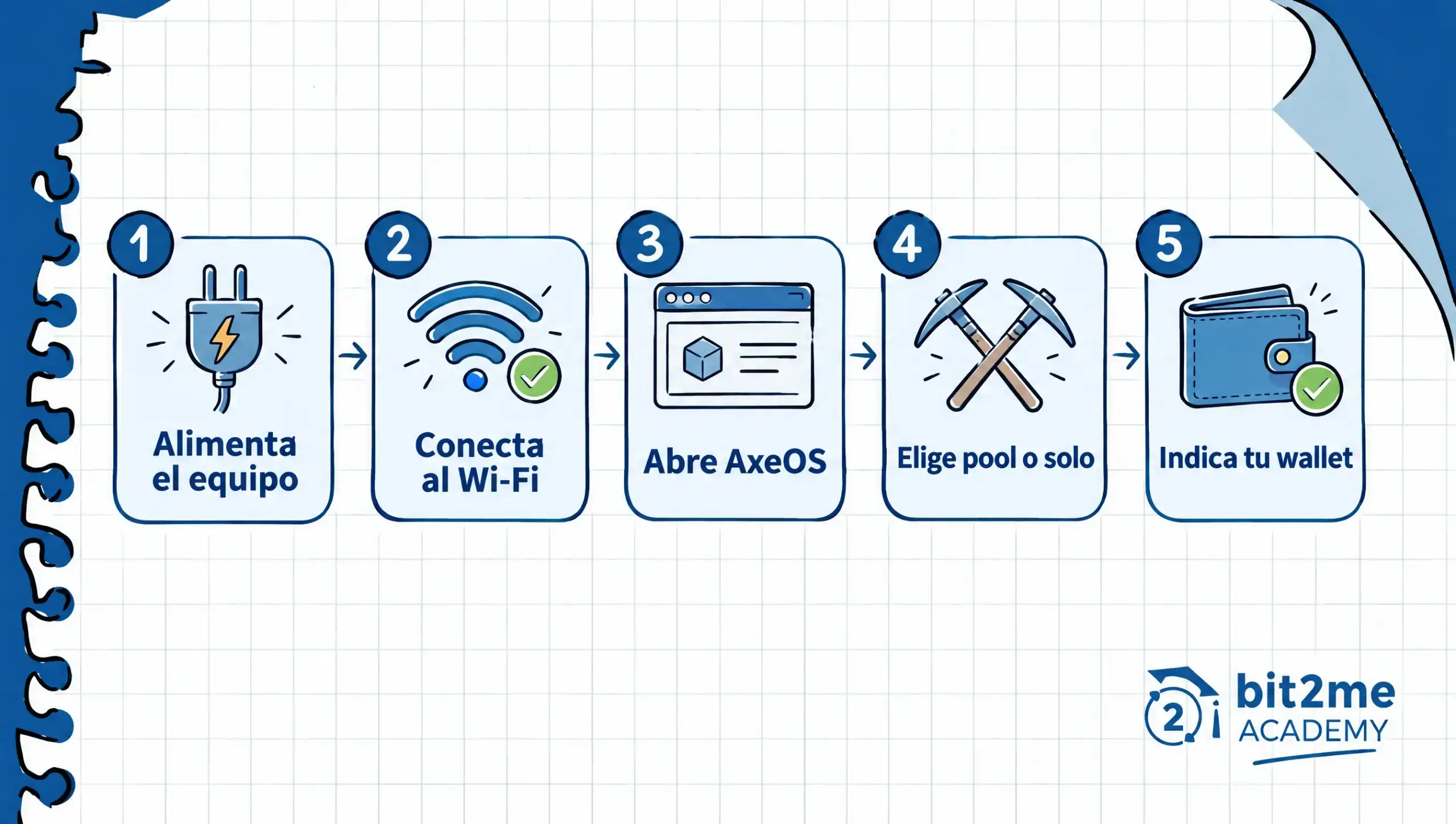
How do you set up a BitAxe step by step?
The process is simple and doesn't require typing commands, although the details of the initial connection vary depending on the model and firmware version, so always follow your device's documentation. These are the five typical steps, ordered from unboxing to seeing the first hashrate:
- Power the device with a 5V DC power supply and the power indicated by your model, because any other voltage may damage it.
- Connect it to your Wi-Fi network following the instructions in your model's documentation.
- Open AxeOS from your browser, at the address http://bitaxe if your network supports mDNS or at the IP address assigned by your router.
- Choose in the settings whether you mine in a pool or solo, and enter the Stratum service address and port.
- Enter your Bitcoin address as the username, with an optional worker name, and check that the hashrate starts to appear.
Before you begin, keep in mind two warnings from the ESP-Miner documentation. Some routers, including certain ASUS and TP-Link models, may block mining, and if you don't see a hashrate, you should check features like AiProtection or your IoT device settings. Additionally, the chip's frequency and voltage fields are hidden by default, and the project itself warns that increasing them without additional cooling can overheat or damage the equipment.
Mining only or pool, what changes?
In solo mode, your BitAxe works on its own, and if it finds a block, the reward is sent to the address you specified. In pool mode, many miners combine their mining power and receive a proportional share of the pool's earnings, with a more regular but smaller distribution. For a more in-depth explanation of how this distribution works, see the guide on What is a mining pool?.
| Appearance | Solo mining | Pool |
|---|---|---|
| Who gets paid? | You, if your team finds the block | All participants, according to their contribution |
| Regularity | Very irregular: it may never arrive. | More frequent and of small amount |
| Commission | The one that charges for the service (only.ckpool.org indicates 2%) | The one set by each pool, with different payment schemes |
| What you configure | Stratum server and your Bitcoin address | Stratum server and the account or address requested by the pool |
The block reward consists of the subsidy and transaction fees. The subsidy is 3,125 BTC starting with block 840.000, and block 957.382, mined on July 10, 2026, paid out a total of 3,13823506 BTC, that is, 3,125 BTC plus 0,01323506 BTC in fees, according to Data from the blockchain.com explorerThe commission changes in each block.
Transaction fees change with each block, and the pool's fee is subtracted from your total reward, so the term "full reward" requires some nuance. If you mine solo through a service like solo.ckpool.org, as of October 31, 2026, their website indicates a 2% fee, meaning your reward would be less than the total block reward. Before choosing a service, check its fees and how it distributes payments.
How much does it consume and how much does it cost to mine with a BitAxe?
BitAxe's main repository indicates that the system requires 15W, while other motherboards require power supplies ranging from 15W to 30W depending on the model. If you take 15W as a starting point, which is the value for the Ultra model, and an example electricity price of €0,15/kWh, you get the following table. This price is an assumption for calculation purposes and not a market price, so replace it with your actual electricity rate.
| Concept | Figure | How it is calculated |
|---|---|---|
| Starting power | 15 W | Data from the official repository (Ultra) |
| Daily consumption | 0,36 kWh | 15 W × 24 h |
| Daily cost | 0,054 € | 0,36 kWh × €0,15/kWh (assumed) |
| Annual cost | About €20 | €0,054 × 365 days (estimate) |
| Expected reward with 1 TH/s | About 42 sats per day | 144 blocks × 3,125 BTC × 9,3·10⁻¹⁰ (estimate) |
The last two rows are our own calculations, not published data. They are based on 15 W, an example price of €0,15/kWh, a block every 10 minutes, and the network hashrate of October 31, 2026, and will change if any of these values change. If your model requires more power, like the Gamma, which requires a power supply of at least 20 W, the cost increases proportionally, and the above calculation will fall short.
The table doesn't include the cost of the equipment itself, which doesn't have an official price and therefore isn't listed, nor the cost of the power supply. With these added expenses, the final cost is higher, so calculate it using your own information before buying.
Is it worth mining Bitcoin at home with a BitAxe?
If you're looking to receive a Bitcoin reward, the short answer is there's no reason to wait. A 1 TH/s hashrate has a 9,3 x 10⁻¹⁰ probability of finding each block, and with approximately 52.560 blocks per year, the average wait time is about 20.000 years. This is my own estimate based on the 1,07 ZH/s hashrate of October 31, 2026, and a block every 10 minutes, and its practical meaning is that the most likely outcome is never finding a block.
It works like a lottery ticket whose prize is very large and whose probability is tiny: the expected value is small and the usual result is zero, something that should be assumed before starting.
With a pool, you receive fractions of that same expected value, minus the commission, in exchange for collecting them regularly, and the amount is still around 42 satoshis per day with 1 TH/s. If you want to convert those satoshis to euros, you can consult the Bitcoin price todayRemembering that the value of crypto assets can change rapidly.
Compare that figure with the €20 annual electricity cost from the previous example, and you'll see that the expected financial balance is negative. Mining solo with a BitAxe can be an expense without reward, and accepting that beforehand is part of the decision. The honest answer to the initial question is that it's worthwhile if what you value is learning and mastering your hardware, and it's not worthwhile if you need the equipment to pay for itself.
Does a BitAxe help decentralize Bitcoin?
Their individual contribution is symbolic, and it's worth putting that into perspective. A 1 TH/s team represents around 9,3 x 10⁻¹⁰ of the total network hashrate as of October 31, 2026, so it neither brings anyone closer to controlling anything nor measurably changes Bitcoin's security.
What it does offer is something else: open firmware reduces dependence on a specific manufacturer and allows you to review the code running on your machine. True decentralization depends on having thousands of different miners and, above all, on many people running their own full nodes—a task for which you have the guide from Set up a Bitcoin node in less than 10 minutes.
If you're interested in the technical sovereignty aspect, the best approach with BitAxe is to combine it with your own node and a Stratum V2-compatible pool, which allows the miner to regain some control over the transactions. This is a more demanding method than using the default configuration.
Current state of domestic mining with BitAxe
Network data changes daily, so this section includes dates. The table compiles the data that affects any calculation for mining Bitcoin at home with a BitAxe as of October 31, 2026, and indicates the source of each piece of data.
| Date | Value as of October 2026 | Font or type |
|---|---|---|
| Chain height | 974.037 block | On-chain data from blockchain.com |
| Block subsidy | 3,125 BTC, valid until block 1.049.999 | Protocol rules |
| Network Hashrate | Around 1,07 ZH/s | Data from blockchain.com |
| Difficulty | 148,36 billones | On-chain data |
| Next adjustment | Block 975.744, towards November 13, 2026, with an estimated decrease of around 3% | Estimate |
| Next halving | Around April 2028 | Self-calculation, depends on the block rhythm |
| Commission from solo.ckpool.org | 2% | Service website |
| ESP-Miner Protocols | Stratum V1 and V2 | Official repository |
The halving is calculated by dividing the 75.963 blocks remaining until the 1.050.000th block by the 144 blocks produced daily, resulting in approximately 527 days. This estimate is subject to change depending on whether the blocks arrive faster or slower, and other estimates place it in the same two-week period of April 2028. The guide on what is bitcoin halving It explains why it is reducing the subsidy and how it affects miners.
The Gamma and Gamma Turbo are the most recent models in the official repositories as of that date. Check bitaxe.org and your model's repository to see which firmware and chip the one you're planning to buy uses, because anything released after that will not be included in these figures.
BitAxe as a mining lab, not as a source of income
Mining Bitcoin at home with a BitAxe delivers on its promise when used for learning: you see how an ASIC chip works, how it connects to a pool, and what parts of the process are beyond your control. What it doesn't offer is a reliable reward, and the 20.000-year average wait time from the previous calculation makes that clear. If you're already set on pursuing it as a technical hobby, your next readings should include the guide to... legality of cryptocurrency mining in Spainwhich also deals with the tax aspect, and that of mining pool.
If you want to own Bitcoin without setting up any equipment, you can also do that. buy Bitcoin at Bit2MeIt's a different way to mine, with its own market risks, and not a recommendation to buy anything. In either case, decide based on your own situation and not on anyone's promises about what a small device can achieve.

Frequently Asked Questions about BitAxe


 Author