Essential Points
- A paper wallet is a Bitcoin private key printed next to its public address and stored away from any connected device.
- Its isolation depends on generating the key offline, with trusted code and a local printer; a web generator can compromise it.
- Paper money burns, gets wet, and degrades, so a metal backing or a hardware wallet usually holds up better.
- When importing the key into a connected app for spending, the paper ceases to be cold and it is advisable to empty it completely.
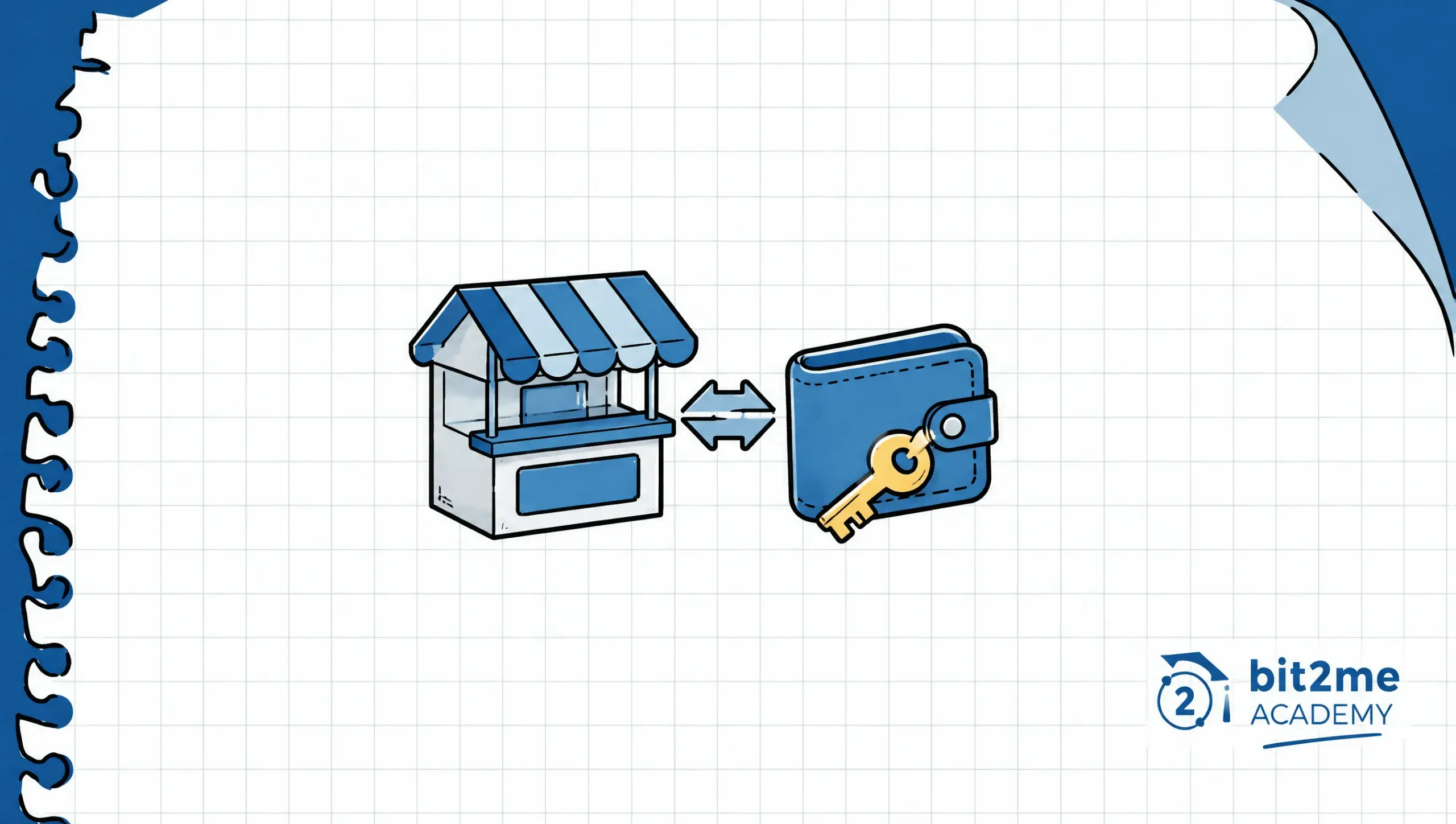
A paper wallet is a Bitcoin private key printed on paper along with its public address, so the key that controls the funds resides outside of any computer or mobile device. Also known as a paper wallet or paper card wallet, during Bitcoin's early years it was one of the simplest ways to store funds without relying on any third-party services.
The idea fits with what is described. bitcoin.org Regarding cold storage: keep the wallet in a secure location without network access and maintain copies in more than one physical location, using durable media. As of October 2026, this recommendation remains in place. Paper easily fulfills the first part, but durability is precisely where it falls short.
That's why the answer to whether it's worth it today is nuanced. A well-designed, offline paper wallet with secure backups isolates your key from remote attacks, but a wet piece of paper, a printer with a faulty memory, or a compromised generator is enough to lose access or give away the key. And when you import that key into a connected application to spend it, the paper ceases to be cold forever, which is the limitation that affects everything else.
 Certificate
What are Paper Wallets?
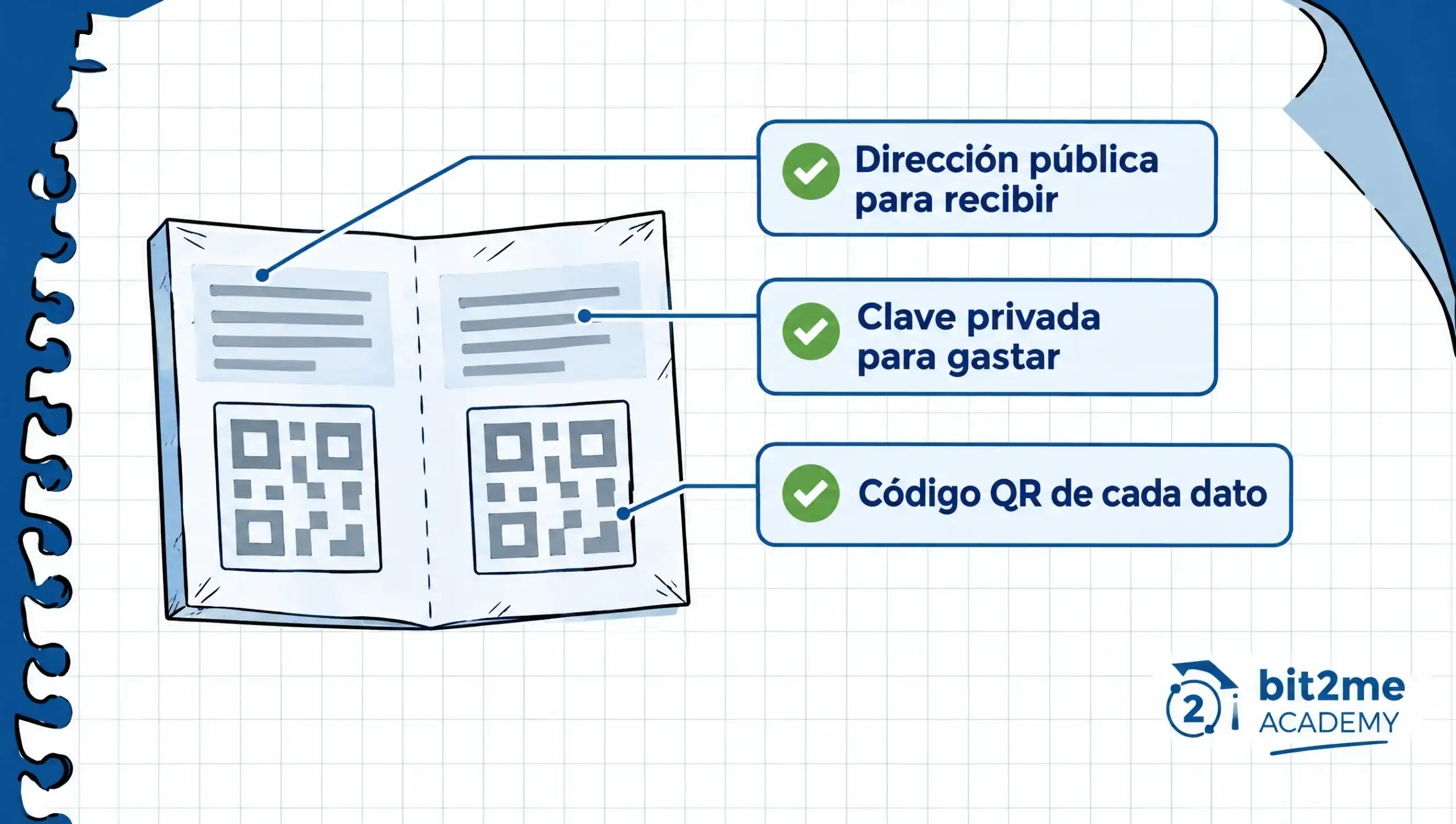
The paper has two pieces of information printed on it that should not be confused: the public addressThe QR code, which you give to whoever sends you funds, and the private key, which authorizes spending them and should not be seen by anyone. Both appear as text and as a QR code, and are created by a program that generates the key randomly and calculates the address.
Since paper doesn't execute code or connect to any network, a virus can't read it and a remote attacker has no way to gain access. That's its major advantage over a wallet stored on a computer, and in Bitcoin's early years, with few convenient alternatives, it explained its popularity.
The private key is usually written in WIF (Wallet Import Format), a Base58Check encoding that reduces errors when copying it and that other wallets can import, according to the Bitcoin developer guide.
If you want to password-protect it, there's BIP38, a standard that encrypts a private key with a passphrase and encodes it into a printable string, designed for paper wallets according to its specification on GitHub.
It's important to distinguish between a classic paper wallet and a simple paper backup of the seed phrase. The former stores a single key and a single address, while the seed phrase is the 12- to 24-word sequence that defines BIP39 and allows you to reconstruct a complete wallet with all its keys—something quite different in practice.

Characteristics of paper wallets
This wallet brings together five technical features that determine when it is useful and when it becomes a problem, and they all revolve around the same idea: the private key is only safe as long as no connected screen has seen it.
- A remote attacker cannot reach the key because it is not on any device, although that protection disappears if the generator you used was compromised.
- The key remains isolated from the internet, which is called cold storage, and the equipment that never connects to any network is described as air-gapped, that is, isolated from the outside.
- You can send funds to the public address as many times as you want, but to spend just one you must import the private key into software, which breaks the isolation.
- To check the balance, simply search for the public address in a browser such as mempool.spacewithout touching the private key, and if you also want to know how much that balance is worth in euros, check the Bitcoin price today.
- Creating one takes a few minutes, but that ease coexists with physical custody errors that cannot be reversed.
The unidirectional flow has a technical reason that explains why the entire paper is emptied. When you spend part of your balance, the remainder is returned to a change address, an address generated by the software, and the Bitcoin developer guide It is recommended to send that change to a new address to avoid reusing keys.
Therefore, after importing the key, it is prudent to move the entire balance at once, because what remains on paper would still be protected by a key that has already passed through a connected device and that you can no longer consider isolated.
Ways to create your paper wallets
Creating a paper wallet involves running a program that produces a random key, calculating its address, and printing both, and all the risk lies in where that program is run.
Web generators made it possible to have it in minutes, and that convenience is also their weakness, because a connected browser full of extensions can copy the key the instant it is created.
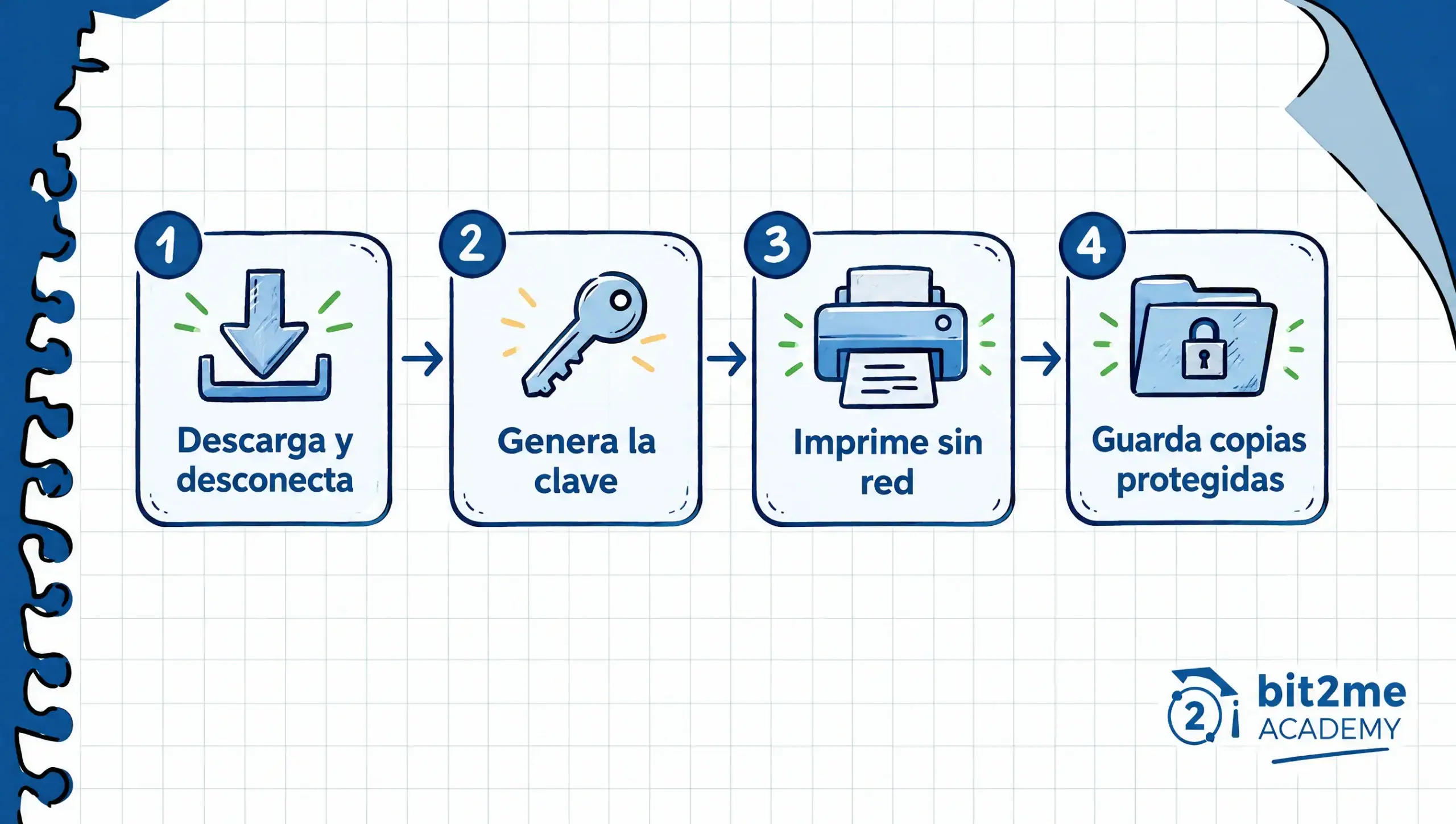
The secure process always follows the same order, and each step exists to close a different leak path: the download is done only once with a connection, but the generation and printing occur with the equipment isolated from any network.
- Download the code from its official repository and copy it to a computer that you will disconnect from the network.
- Disconnect the equipment, open the generator, and create the offline key.
- Print with a wired printer without a network connection, and encrypt the key with BIP38 if you want an extra layer.
- Store the paper and its copies in separate, secure locations, and verify the address in a browser before sending funds.
BitAddress
This open-source generator, written in JavaScript, produces Bitcoin paper wallets. According to the official repository on GitHubYou can load that JavaScript locally and trust that it hasn't changed after loading, and its code doesn't make XMLHttpRequest calls (no AJAX), so you can save the page on an offline computer. If you prefer the web, the site is bitaddress.org.
An important correction: the public address receives the funds, and the private key spends them. These funds can be spent later by importing the key into another deterministic wallet—that is, one that generates all its keys from the same seed.
The repository does not publish versions (its Releases section is empty) nor does it indicate whether it is still maintained, according to an inquiry from October 30, 2026, so treat it as code that you should get from the repository and run offline, and not as a service to rely on.
Online generators and forks
Avoid web generators and unofficial forks, because you don't know what code is running on them. On February 24, 2021, it was reported that researchers had discovered a backdoor in BitcoinPaperWallet.com, a site that, according to the research, sent a copy of every generated key to its servers.
The person in charge disputed the accusations. Even so, the case offers a useful warning: generation must be done entirely offline and with a trusted source, which is precisely what the process described above describes.
A simple check before trusting any generator is to ask yourself who maintains the code and whether you can read it. An open-source project that you can download, review, and run offline leaves less room for surprises than a web service that asks you to create the key on its own server.
What are the risks of a paper wallet?
The risks are spread across the creation process, the physical medium, and the point of use, and paper alone doesn't solve any of them. It's wise to keep these risks in mind before printing anything, because almost all of them can be avoided with a prior decision, and almost none can be corrected afterward.
- If you generate the key in a browser connected to a network or with dubious extensions, the paper's protection is null from the very beginning.
- Paper burns, gets wet, and the ink degrades, so without proper storage, it is not a medium designed to last for decades.
- A printer can keep a copy of what it prints, so using the office printer or a network printer adds a potential leak.
- Scanning the QR code with your mobile phone to spend exposes the key to a connected device, and from that moment on, the paper is no longer cold.
It's important to be precise about the printer. NISTIR report 8023 from NIST Regarding photocopiers and printers, it explains that many of these devices incorporate internal storage, usually a hard drive or a solid-state drive, which can save scanned or printed documents. This doesn't mean all of them do, but the possibility is enough to make a network printer an unsuitable place to print a private key.
The weak point and the human factor
They're marketed as a way to store funds for years because of their offline nature, but they require almost military-level security. If the paper gets wet, burns, or someone takes a picture of it with their phone, the private key is rendered unusable or exposed, and there's no one to hold accountable.
The practical question is whether you can safeguard a physical secret for ten years without humidity, carelessness, or a drawer cleaning destroying it. If you're unsure of the answer, a metal backup or a hardware wallet offers more leeway.
It's also worth considering who else knows the paper exists. Storing it somewhere only you know about, rather than in a shared space, reduces the risk of someone finding it, photographing it, or throwing it away without knowing what it is.
Hardware wallet, metal backing and other options
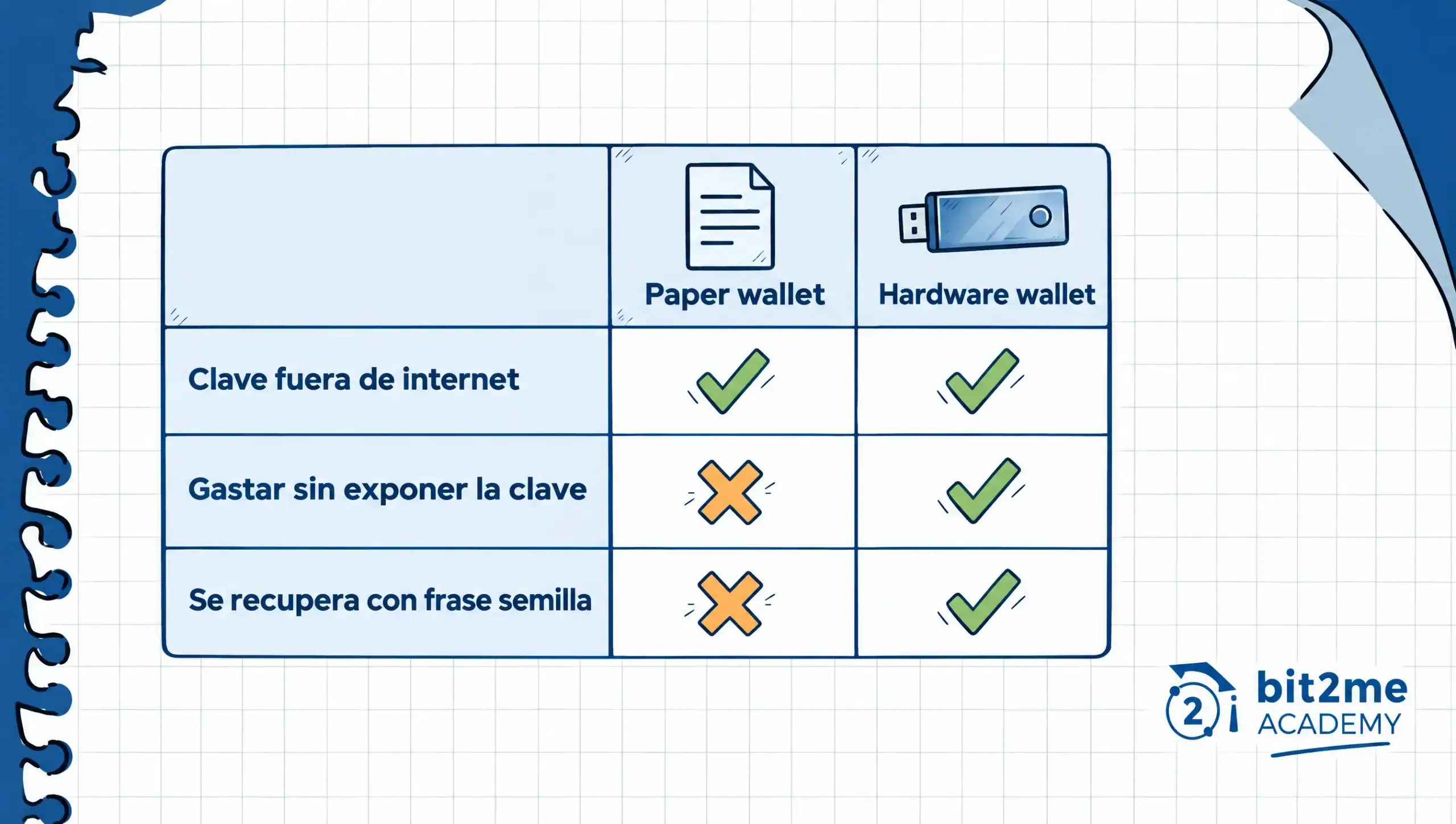
Choosing how to store a key depends on who has custody of it and how much control you want to exercise, and paper is just one of the four most common options. A hardware wallet, a dedicated device that stores and signs the key without exposing it, solves the problem that paper wallets leave open: spending without regard for the key on a connected device.
The metal backing of the seed phrase is not a coin purse but a durable copy of those 12 to 24 words, engraved in steel or titanium to withstand fire, water and corrosion better than paper.
Bit2Me Wallet operates with custody managed by Bit2MeThis is very different from the custody offered by the other three options, and this table summarizes the differences without price figures or purchase recommendations.
| Choice | Who holds the key | Internet connection | Main risk | typical use |
|---|---|---|---|---|
| Paper wallet | You | No, not until you import the key. | Damaged paper, compromised generator, or exposed key when spending | Save funds without touching them for a long time |
| Metal backing of the seed phrase | You | Not applicable, it's a copy | Either someone finds it or you store it in an unprotected place | Keep the seed phrase from another wallet |
| Hardware wallet | You | It only operates when connected. | Losing the device without having a copy of the seed phrase | Self-custody with frequent operations |
| Bit2Me Wallet | Bit2Me, who holds the keys for you | Yes, it's an online service | Relying on the provider and protecting your access | Operate conveniently from your mobile phone or computer |
If you want to delve deeper into the dedicated device, you have the guide for Bit2Me Academy about hardware walletswhich explains how it stores the key and how it signs a transaction without taking it out of the device or exposing it to the internet.
Bit2Me Wallet: The balance between custody and agility
Storing the key in a paper wallet is a technical way to maintain control, but that control comes at a practical cost. If you make a mistake importing the key when you need it most, you could lose access to your crypto assets permanently, and there's no support to turn to for help.
Bit2Me Wallet is a custody service managed by Bit2MeSo you don't control the keys. According to the page of Bit2Me WalletAccess is protected with two-step authentication (2FA), a second code requested in addition to the password, although that does not eliminate phishing or vendor dependence.
Agility versus technical rigidity
With a paper wallet, moving a token involves importing the key, scanning codes, and carefully reviewing each piece of information, whereas with a custodial wallet, you operate from your mobile phone or computer without handling physical keys. In exchange for this convenience, you agree that another entity will safeguard your keys, and therefore the decision depends on how much control you want to retain and how much work you are willing to undertake.
Combining self-guardianship and service
You don't need to choose one method for everything. Some people keep a portion of their crypto assets in their own custody, untouched, and use a service like Bit2Me Wallet for what you need to move frequently.
If you don't already have Bitcoin, you can buy Bitcoin at Bit2Me and then decide how much you keep in your own custody. To access your service, log in to Bit2Me WalletRemembering that crypto assets are high-risk assets and their value can fluctuate greatly.
A role that reveals more than it protects
The paper wallet remains a good exercise for understanding what a private key is, why a public address can be shared, and how isolation is broken when spending. As a tool for everyday custody, it has lost ground to solutions that sign without exposing the key, and any decision to use it should stem from understanding its process, not from its apparent simplicity.
If you decide to create a paper wallet, do so with a secure code, offline storage, and backups in different locations, and empty it completely when you need to spend. If you're looking for a secure, frequently used wallet, a hardware wallet saves you many of those manual steps, and the final choice is yours and depends on how much you're willing to manage.

Frequently asked questions about paper wallets



 Author