
Since the birth of Bitcoin a lot has happened. Sometimes its price has gone up and other times it has gone down, which is normal considering that it is a currency whose value comes from use.
However, this has taken it from being worth absolutely nothing to exceeding the historic brand de $100.000 in December 2025.
Factors that influence the price of Bitcoin
The increase in value of Bitcoin responds to several elements. Among them the most notable are:
- Offer and demand:
- Limited offer: Bitcoin has a maximum supply of 21 million coins. This inherent scarcity increases in value as demand grows.
- Increasing demand: As more people and businesses adopt Bitcoin as a means of investment or transaction, the demand for it increases. For example, large companies such as Tesla have invested in Bitcoin, which has increased its popularity and price.
- Institutional adoption:
- Investments from large institutions: Hedge funds, banks and technology companies are beginning to invest in Bitcoin. Examples include MicroStrategy and Square, which have purchased large amounts of Bitcoin, which has generated confidence and driven prices higher.
- Regulatory acceptance: The approval of Bitcoin ETFs (exchange-traded funds) in some countries has facilitated access to this asset for traditional investors, thus increasing demand and price. We have seen the latter very clearly in the increase in bitcoin price during 2024.
- Macroeconomic and geopolitical events:
- Inflation and devaluation of fiat currencies:In times of high inflation and devaluation of traditional currencies, investors seek safe havens like Bitcoin.
- Economic and political crises: Crisis situations in different parts of the world, such as in Venezuela or Argentina, have led people to trust Bitcoin to protect their assets, thus increasing its demand and price.

Impact of supply and demand
The price of Bitcoin is heavily influenced by the basic principles of supply and demand. Bitcoin has a predetermined maximum supply of 21 million coins, meaning that as it approaches this limit, the relative scarcity of Bitcoin increases. This scarcity factor can drive up the price as investors look to acquire a limited amount of Bitcoin.
Furthermore, demand for Bitcoin can increase due to various factors, such as institutional adoption, interest from retail investors, and the perception of Bitcoin as a store of value or a hedge against inflation. For example, when large companies like Tesla or MicroStrategy announce significant investments in Bitcoin, this can generate greater interest and, consequently, higher demand, which in turn can drive up the price. Conversely, if there is a decrease in demand, for example, due to a loss of confidence in the cryptocurrency or negative events in the financial markets, the price may fall.
Influence of global economic events
Global economic events also play a crucial role in Bitcoin's price fluctuation. During periods of economic uncertainty, such as financial crises, high inflation, or geopolitical conflicts, Bitcoin can be seen as an alternative to fiat currencies and traditional assets. In these cases, investors may seek refuge in Bitcoin, which can increase its demand and, therefore, its price.
Government regulations and their effect
Government regulations have a significant impact on the price of Bitcoin. Regulatory decisions can range from accepting and promoting cryptocurrencies to prohibiting or restricting them. In countries where cryptocurrencies are viewed favorably and regulated, such as the United States or Europe, investor and institutional confidence in Bitcoin tends to increase, which can lead to greater adoption and demand, and therefore, a price increase.
On the other hand, in countries where cryptocurrencies are viewed with suspicion or are subject to strict restrictions, such as China, demand for Bitcoin may decrease, potentially leading to a price drop. Furthermore, announcements of new regulations or changes to existing policies can generate market volatility as investors react to uncertainty.
Bitcoin All-Time High (ATH)
Now, all this price dynamics is what leads Bitcoin to reach its all-time highs or ATH (All-Time High), which is the term used to describe the highest price that Bitcoin has reached in its history in the market. . This indicator is relevant because it shows the maximum valuation point that investors have been willing to pay for Bitcoin at a specific time, reflecting the peak of optimism in the market.
Throughout its history, Bitcoin has reached several ATHs, the most relevant being:
- December 2017Bitcoin reached what was then an astonishing all-time high of nearly $17.760. This peak was the result of the first major wave of public and speculative interest in cryptocurrencies.
- April 2021After a series of ups and downs, Bitcoin shattered all expectations, reaching a new all-time high of approximately $63.500. This surge was driven by a combination of institutional adoption, retail investor interest, and speculation in the cryptocurrency market.
- November 2021: Bitcoin hit another impressive ATH, crossing the $66.000 mark. This spike was driven by factors such as the approval of Bitcoin ETFs in some markets, greater adoption by companies and the perception of Bitcoin as a “digital gold” in the face of inflation.
- March 2024: Bitcoin reaches its new ATH, crossing the $70.000 mark ($73.750 to be exact).
- November 2024: New ATH reached on November 6, 2024, with a price of $75620. But the trend does not end there, as the price of Bitcoin was quickly surpassed as on November 9 it was over $76.630. And by November 11, the price had already reached $88.000 and finally on November 13 it reached $93.477, demonstrating what which is a bull run or the beginning of it.
- January 2025: In the days leading up to Donald Trump's inauguration (January 20), Bitcoin broke its ceiling again, trading above $109.000.
bitcoin price 2009-2010
The history of the price of bitcoin price It begins in 2009, at that time Bitcoin was a nascent and little-known project. Let's see how the evolution was then:
- January 2009 – January 2010, nothing (0€): There were no exchange houses where buying bitcoins. Users traded it among themselves on forums as a test. As a digital currency, it was a simple experiment that sought to transform the world.
- February 2010 - May 2010, less than $ 0.003: On May 22, 2010, the user Laszlo Hayneck made the first transaction for a good Laszlo would have bought two pizzas in Jacksonville (Florida) for 10,000 BTC. User “SmokeTooMuch” tried to auction 10,000 BTC for $50, but no one bought it. Laszlo's action became what we know today as Bitcoin Pizza Day.
- July 2010, $ 0.08: In five days the price of Bitcoin grew by 1000%, going from $0.008 to $0.08 per bitcoin.
How much did a bitcoin cost in 2011 and 2013?
Little by little, the strength of Bitcoin became more and more evident. But history would give an important advance when Bitcoin reached parity with the dollar, that is, when each Bitcoin became worth one dollar.
- February 2011 – April 2011, $1: Bitcoin achieves something that was believed impossible, increases its price to reach parity with the dollar. A great interest in virtual currencies is beginning to develop.
- 8 July of 2011: Bitcoin reached $31 the maximum of the first “bubble”. Then came the first price drop. Those who managed to invest in Bitcoin made their first big profits, taking advantage of the BTC price fluctuation.
- December 2011, $ 2: The minimum after a few months. Distrust in Bitcoin spreads.
- December 2012, $ 13: It grows slowly for a year. Bitcoin stabilizes in a short term and a slow price rise begins.
- April 2013, $ 266: Maximum of a dizzying ascent where the price increases between 5% and 10% every day.
- May 2013, $ 130: A few months of stability in the cryptocurrency financial markets.
- June 2013, $ 100: In June it falls to $70 but in July it rises to $110.
Already for this period, the historical price of Bitcoin had transformed the community that supported the project. With exchanges, a rich community that grew more and more daily, and with a very clear vision of the future.
Bitcoin was destined to become a respectable global currency, on a par with other currencies and store-of-value items like gold. The following years would be the most important for Bitcoin to show its capabilities.
Bitcoin Evolution
The end of 2013 was highly dynamic, and here we show a part of what happened back then.
- November 2013, $ 350 - $ 1250: Between October and November it went from $150 to $200, growing to $400 in one month. Then $600, $900 and finally breaking the $1000 ceiling on November 27, 2013.
- December 2013, $ 600 - $ 1000: The price plummets to $ 600, rebounds to $ 1000, and falls back to $ 500. It ranges from $ 650 to $ 800.
- January 2014, $ 750 - $ 1000: The price touched $1000 in early January briefly, then hovered between $800 and $900 for the rest of the month.
- February. 2014, $ 550 - $ 750: After MT closure. Gox the price is affected and is between $ 600 and $ 700.
- March 2014, $ 450 - $ 700: The price falls due to a false report in which the Chinese government censored Bitcoin. In the false report they forced the banks to close the accounts of all the exchange houses that worked with Bitcoin.
- April 2014, $ 340 - $ 530: The lowest price since 2012-2013 was reached on April 11 at 3:25AM.
- May 2014, $ 440 - $ 630: In the last days of May the price of Bitcoin grows 30%.
- March 2015, $ 200 - $ 300: Price drops again in early 2015
- November 2015, $ 395 - $ 504: During 2015 the price was increasing regularly reaching $504 in November.
Bitcoin price in 2017 bull market
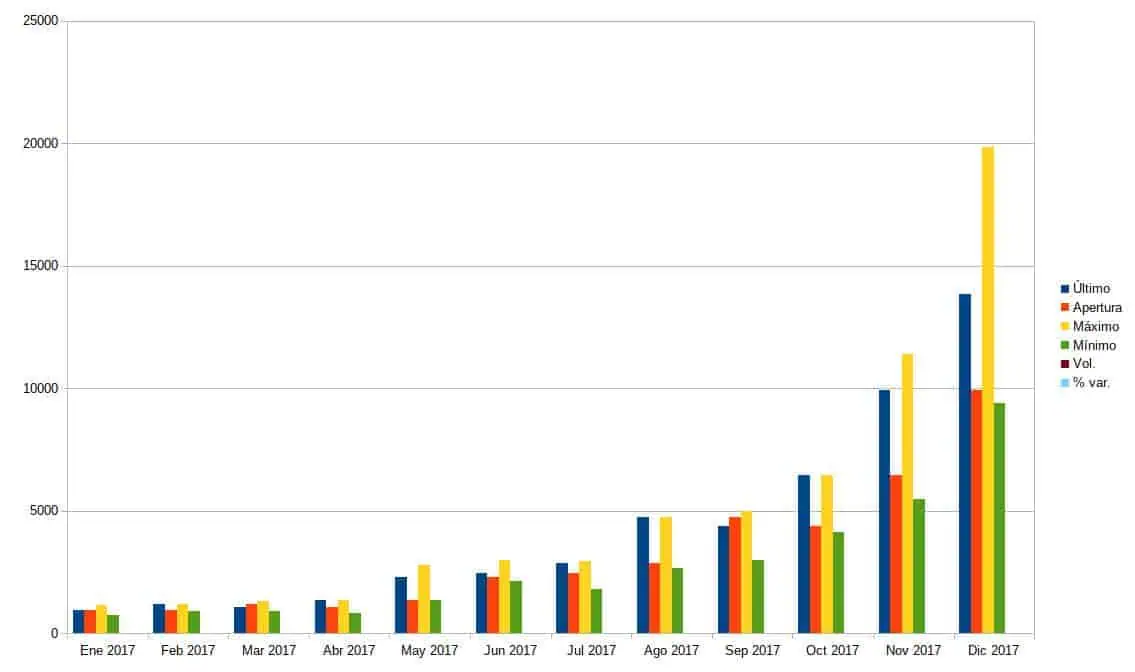
The year 2017 was perhaps the most intense for crypto investors and traders. This year, Bitcoin began to grow rapidly and its evolution led us to milestones such as:
- February 2017, $ 1222: During 2016 and early 2017, the price had large increases, multiplying by 3 due to world political events: Brexit, Trump as president of the United States, China and its crises, India and its economic policies, crisis of new banks. Besides Bitcoin halving which took place in July 2016.
- March 2017, $1270: With the advent of ETF Promoted before the SEC by the Winklevoss brothers, Bitcoin breaks all kinds of records: highest price in history, even surpassing gold, highest capitalization in history, highest number of users, highest number of endorsements and acceptance.
- May 2017, +$2.000: It opens the month with a price of approximately $1.400 and on May 20, 2017 it exceeds $2.000 for the first time.
- May-June 2017, +$3.000: On June 12, Bitcoin breaks the $3.000 barrier for the first time and reaches $3.200.
- August 2017, $4.400: On August 1 it forks and Bitcoin Cash is born, fact that causes a slight setback in the value of Bitcoin but on August 12, 2017 the barrier of $4.000 is passed and on August 14, 2017 it reaches a maximum of $4.400.
- September 1, 2017, $5.000: Break the $5.000 barrier.
- September 12, 2017, $2.900: Its value is plummeting due to China's restrictions on ICOs, Bitcoin, and financial repression of crypto assets.
- October 13, 2017, $5.600: A month later, it is found that the strong repression in China does not exist and the price rises again.
- October 21, 2017, $6.180: The Bitcoin Gold fork is near and its value is escalating rapidly.
- November 17-20, 2017, $7.600-8.100: Its value shoots up reaching $ 8004,59 for 1 BTC. It is speculated that this could be caused by the coup in Zimbabwe where a local Bitcoin exchange would have sold bitcoins for $ 13.500.
- December 8, 2017, $18.300: The value of Bitcoin skyrockets due to the avalanche of acceptances and a large amount of funds that entered the market.
- December 17, 2017, $19.900: Bitcoin's all-time high according to CoinMarketCap. Exchanges In South Korea, the price of 1 BTC surpassed $21.000. This all-time high marked the boom of cryptocurrencies worldwide and brought their potential to the forefront of public discussion.
At this point, Bitcoin's all-time high price reached its peak. It was the boom of cryptocurrencies and attracted the attention of millions of people worldwide.
bitcoin price 2018 bear market
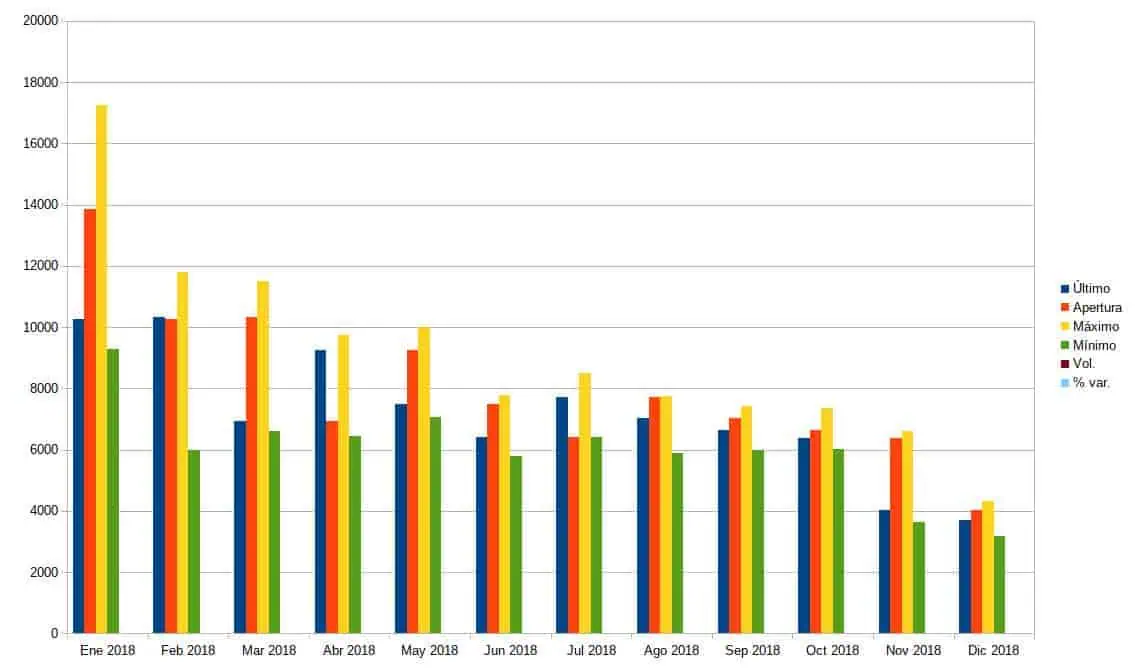
However, the high prices came to an end and in 2018 the bear market (bear market) began to take its toll on the price. So, the historical prices of Bitcoin marked the following milestones:
- February 2, 2018, $6.375: Just over a month after the all-time high, it loses more than two-thirds of its value in an extremely strong price correction.
- February 20, 2018, $11.785: The value of Bitcoin rises again.
- April 2018, $6.700-9.400: It starts at $6.700, but throughout the month it goes up to $9.396 with which April closes.
- May-July 2018, $9.900-5.995: It goes from $9.900 marked on May 5, 2018 to $5.995, being the first time since October 21, 2017 that it falls below $6.000.
- July 1-August 15, 2018, $6.354 / $8.315 / $6.341: Large fluctuations that have their origin in part in the refusals of the US SEC to admit Bitcoin ETFs and the proximity of the summer vacation period.
- September / October 2018, $6.400 / $6.700: The price has remained stable with minimal variations during this period.
- November 14, 2018, $5.600: Bitcoin price plunges to around $ 1.000 (-10%) in less than ten minutes per a massive sale of 80.000 BTC. It is not known who the seller of all these bitcoins is, but BitMEX and Bitmain are being targeted as the Bitcoin Cash hardfork approaches. Other information suggests that 106.000 BTC would have finally moved between cold wallets from Binance, claiming a security move.
Bitcoin and hard forks
If anything has defined Bitcoin, it is the strong cohesion of its community. However, this has not prevented certain people from creating projects emulating their capabilities. One of those projects is Bitcoin Cash (BCH) which from the beginning was plagued by internal disputes.
One of them, starring Craig Wright, led to the creation of a Bitcoin Cash hard fork, called Bitcoin Cash Satoshi Vision (BSV). Both hard forks had a certain impact on the Bitcoin price as the history shows.
- November 19, 2018, $5.000 / $4.900: Another drop in the price of Bitcoin due to apparently high movements in a few accounts that would have moved around 60.000 BTC in the middle of the hard forks war between Bitcoin Cash ABC and Bitcoin Cash Satoshi Vision.
- 20 November of 2018, $ 4.388: After breaking the support of $5.044, the price of each bitcoin fell to $4.388, quickly rebounding to $4.500.
2019, new hopes and new bull markets
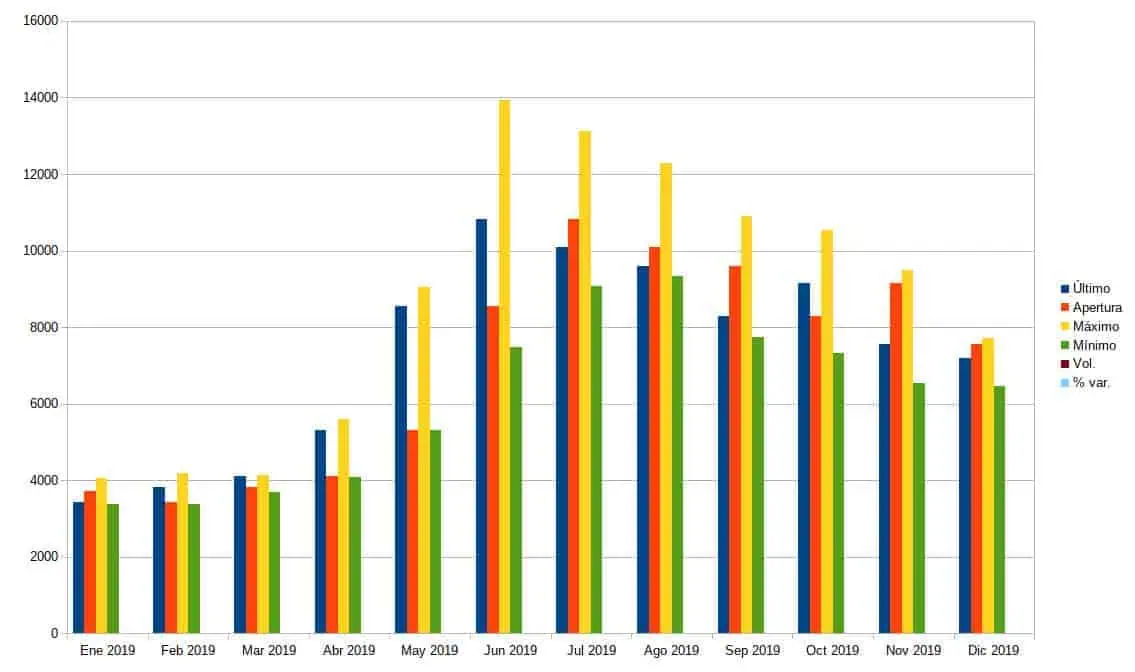
The arrival of 2019 kept prices down, but stable. However, many expected the recovery of Bitcoin, they announced it, and finally it arrived.
- January 2019: The price of Bitcoin keeps fluctuating between $ 3700 and $ 3400.
- April 2019: The price of Bitcoin was beginning to recover. On April 1, 2019, the price was at $4126 USD and ended the month above $5000 USD.
- July 2019: On July 12, 2019, Bitcoin reached $12.958 USD, in what would be the highest price reached this year. The recovery of the markets brought projects to the fore again and gave them the economic boost they needed to become stronger again.
- July to December 2019: The price of Bitcoin falls and remains fluctuating in the band of $7500 and $8000 USD. The market stabilized again.
2020, the stable crypto market and the new Bitcoin halving at the gates
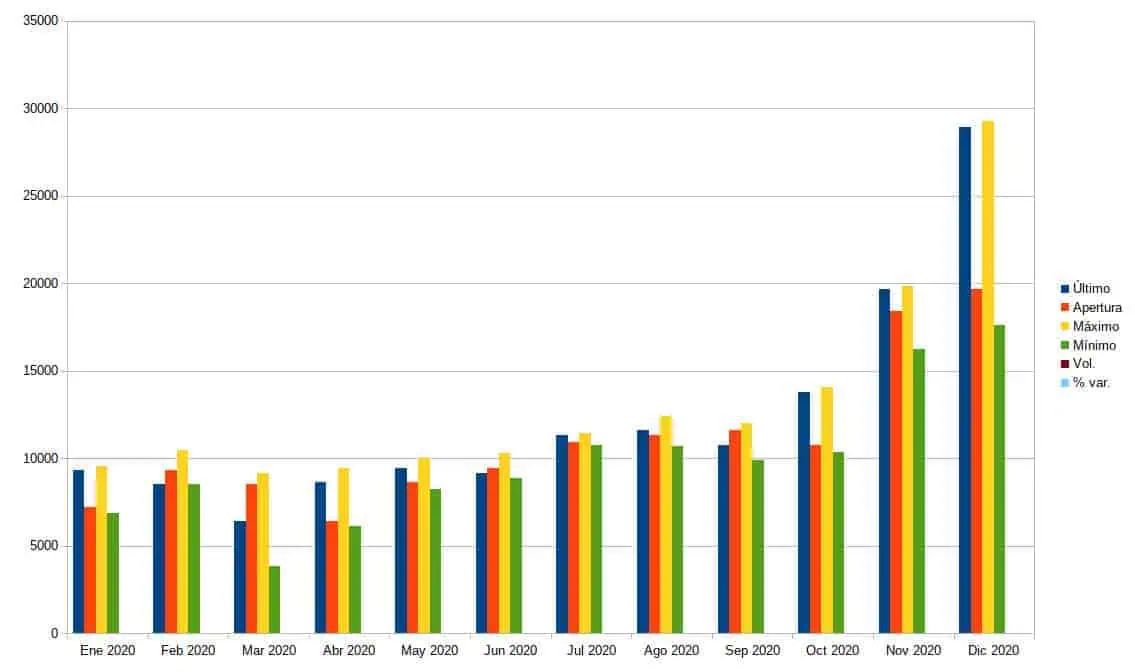
The year 2020 began with a price of Bitcoin fluctuating between $8500 and $9000 USD. The specialists thought that this dynamic would continue to give rise to a new bull market with the activation of the new halving In the net.
The third Bitcoin halving took place on May 11 (approx. 21:00 UTC) and had a strong impact on the Bitcoin price.
- January 2020: A low of $6884 USD and a high above $9000 USD at the end of the month, the Bitcoin and crypto markets were in the green.
- February 2020: Bitcoin price reaches its resistance above $ 10.400 USD, but ends the month with a value of $ 8543 USD.
- March 2020: With the global lockdown and the shock of the coronavirus, Bitcoin suffered a resounding fall to $3800 USD. However, it quickly recovered and hovered around $6400 USD.
- April 2020: The month started with a price of $6400 USD, rose to $9100 USD and ended again at the support of $6000 USD.
- May 2020: The wait for the Bitcoin halving begins and the markets feel the pressure, a bullish rally took Bitcoin to $10500 USD, and days later in less than 5 minutes, the price plummeted to $8500 USD. A few days before the halving, the buying pressure of Bitcoin continued favoring the rise in prices, high expectations due to the post-halving situation.
- June 2020: Bitcoin's entry price this month was $9551 USD, with its low point in the middle of the month touching $9050 USD, and ending with a value of $9141 USD.
- July 2020: Bitcoin's entry price was $9141 USD and everything seemed to indicate that it would end the month with a value of over $11.000 USD due to a small bull run.
- August 2020: The entry price in August was $11800 USD and ended at $11727 USD.
- September 2020: This month, the entry was $11727 USD and ended the month with a value of $10780 USD.
- October 2020: October started with a value of $10780 USD and ended with a value of $13533 USD.
- November 2020: Bitcoin rally began, starting at $13800 USD and ending at $18.000 USD.
- December 2020: The new Bitcoin bull run effectively begins, starting the month at $18.900 USD and ending the year on $28 USD. Bitcoin broke its old 2017 ATH on December 16, when most exchanges started marking Bitcoin's new ATH above $20 USD.
2021, a new year, a new bull run
The arrival of the new year seems to mark the beginning of a new bull run, just as happened in 2017, but this time, everything points to this bull run lasting longer due to the arrival of institutional players, companies, and large investors to the world of crypto assets.
- January 2021: Bitcoin started the year in a bullish mode and headed for new ATHs, on January 1, as a new year gift, Bitcoin reaches $29 USD. However, in just under 8 days (January 9), Bitcoin reaches $41 USD. At this point, a price correction begins and takes Bitcoin to $35 USD. Despite the correction, market sentiment was bullish.
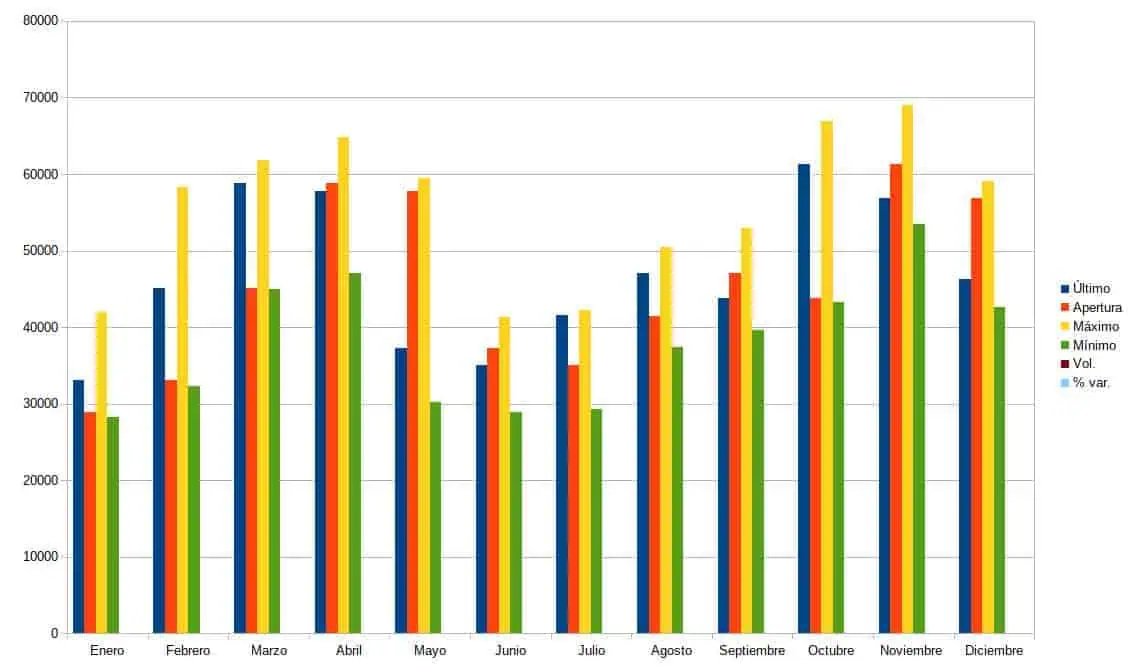
- February 2021: it opened with $33.500 and ends the same at $45.159. The bull run continues to take hold and markets in general were in the green.
- March 2021: it started the month with a price of $49.512 and ended with $58.526 per BTC. The upward trend continued.
- April 2021: it opened the month at $59.028 and ended slightly lower at $57.200.
- May 2021: It started the month at $57.800, but the previous bearish momentum held and pushed the price of BTC to $37.290, returning to the previous support price.
- June 2021: it started the month with a price of $36.699 and ended with a price of $35.035, a month of sideways movement and contained markets.
- July 2021: the month started at $35.030 and ended with a slight recovery that placed the price at $41.553.
- August 2021: It started the month at $41.510 and ended the month with another slight rally in value that took BTC to $47.130.
- September 2021: the month started at $47.120, but ended with a drop to $43.820.
- October 2021: the month started at $43.820 and rallied to $66.900, but then leveled off to end the month at $61.300 per BCT.
- November 2021: November started with $61.300, but began a deep fall and instability that takes the price to $56.882 to close the month.
- December 2021: the market decline continued and the final price for the month was $46.200.
Despite the ups and downs, Bitcoin started the year at a much lower price than it had at the end of the year, demonstrating that 2021 was a good year for the bull run of cryptocurrencies and markets in general.
2022, bear-market and unscrupulous players
2021 ended up being a good year despite its ups and downs, but it finished with a sharp decline and poor forecasts for 2022. What no one expected was that a number of unscrupulous players would throw everything overboard and the bear market would prevail in the cryptocurrency markets.
- January 2022: the decline continued and the price of BTC fell to $38.940.
- February 2022: The month started strong, with an initial price of $38.470, but it ended with a recovery that took the price to $43.200.
- March 2022: it opened the month with the same momentum, with a price of $43.270 and ended the month with a price of $45.525. Confidence in the markets was growing, but there was some fear about measures that could be taken in the Terra/Luna DeFi ecosystem.
- April 2022: andThe month opened with confidence at $45.520, but the situation in Terra/Luna and its ramifications began to generate fear, the market generally retreated and the BTC price ended at $37.650.
- May 2022: The month started with the same fears as Terra/Luna, the price of BTC opened at $37.520. On May 5th the problems started on Terra/Luna, UST was destabilized. In the following days until May 12, 2022, Terra/Luna suffered a drop of more than 100000%. LUNA token price plummeted from $82 to $0,0001089, all tokens related to the Terra ecosystem fell. BTC was affected by DeFi lending correlation which sent the price down to as low as $31.700.
- June 2022: the Terra/Luna chaos continued to wreak havoc, this time with companies that had extensive exposure to this ecosystem. The sale of BTCs is forced trying to recover liquidity and the market is flooded. The price of BTC that starts the month at 31.700 continues to fall to $19.900.
- July 2022: the market stabilizes, the Terra/Luna hecatomb and its ramifications were over, at least the worst part. A slight market recovery caused the price of Bitcoin to end the month above $23.300.
- August 2022: again bad players within the ecosystem affected the price of BTC. This time with ramifications that affected giants like BlockFi, Alameda Research, Celsius, 3AC, among others. The price of Bitcoin fell as low as $20.050, amid bankruptcy fears for some major companies.
- September 2022: The fall of 3AC, Celsius and what happened in Lido, hit the market although the price of BTC remained strong in its area, ending the month with a slight fall that took it to $19.400, to be expected in the midst of so much commotion and such a strong bear market.
- October 2022: a quiet month, the bear market was still present, but the price of BTC remained in its zone. The month started at $19.420 and ended with a recovery to $20.490.
- November 2022: It started the month at $20.480 and, although it seemed that the price was beginning to recover, reaching the barrier of $21.000, the collapse of FTX and its investment arm Alameda Research, as well as the following scandals due to the mismanagement of Customer funds pushed Bitcoin to multi-year lows, dipping below $16.000 and ending near $17.000.
- December 2022: December began at around $17.000 and, although it recovered towards the middle of the month, it fell again (caused by investors' lack of confidence in the crypto markets) and closed the year in that price range.
2023, starting a new market year
The year 2022 ended with a significant bear market for the entire crypto sector; however, it also delivered a clear message: the value of Bitcoin and many other crypto assets prevails even against the wildest predictions of decline made by many of the technology's detractors. Thus, in this new year, Bitcoin begins as follows:
- January 2023: we started the month with a price of $16.585 per BTC and closed the month with a value of $22.930, an important recovery that seeks to leave behind the red numbers of the bear market at the end of 2022.
- February 2023: the month opens at $23.100 and throughout the month there is a strong lateral movement in the price, which goes as low as $21.100, but ends up closing at $23.150.
- March 2023: The month opens at $23.400 and we see a slight recovery that takes the price of Bitcoin to $28.400.
- July 2023: The months of April until the end of June keep Bitcoin in a sideways trend. Its price remains between $27.000 and goes up to $29.000. However, in July we see Bitcoin recover the $30.000 line and close the month at $29.704. A good month, since Bitcoin had not seen $31.000 for a year (in June 2022).
- October 2023: The month of September keeps Bitcoin sideways, without many changes in its price. But October brings good profits, Bitcoin takes off on October 10 with a value of $26.752 and closes the month with $34.274.
- November – December 2023: The last two months of 2023 are a rapid recovery for Bitcoin, fueled by the upcoming arrival of the halving (in April 2024) and the possibility that the Bitcoin ETF will finally be approved. Thus, November begins with Bitcoin above $34.200 and by the end of the year, Bitcoin stands at $43.900. A level that has not been seen in Bitcoin since April 2022.
2024, the year of the Bitcoin ETF and the fourth halving
Although 2023 was a fairly tough year for the Bitcoin market, its last two months were very good, and the signal it sent was very clear: Bitcoin was recovering. There were two reasons for this: the imminent SEC decision on Bitcoin ETFs and the arrival of the new halving (the fourth Bitcoin halving).
The initial news (the ETFs) boosted Bitcoin's price, fueled by the certainty of a massive capital infusion from major financial funds. On January 10, 2024, that news arrived, bringing with it a huge financial investment. In total, Bitcoin ETFs injected over $10 billion in their first week of operation. And alongside this, the halving event further supported the price.
Thus we have that in the months of 2024, Bitcoin has evolved in the following way:
- January 2024: Bitcoin opens the year at $42.100 and the month of January ends with a price of $42.030. The price movement is strange, since most traders expected a sharp increase after the approval of the ETF. Many specialists explain that the lack of revaluation is due to the fact that "the value was already reflected in the increase in the last two months of 2023."
- February 2024: but February opens strong, from 42.030 the price of Bitcoin shoots up to $54.500, the largest recovery on record.
- March 2024: Bitcoin begins to recover and reaches its new maximum: $71.482 on March 12.
- April – May 2024: Bitcoin maintains laterality with a price that fluctuates between $69.900 and is as low as $58.200 (May 1).
- May – June 2024: Bitcoin's sideways movement continues with price fluctuations between $54.000 and $59.000, with peak moments that momentarily take the price to $65.900.
- July – August 2024: At this point Bitcoin is starting to show signs of a strong bullish trend, with prices reaching as high as $70.000 and averaging above $62.000 over this entire time period.
- September – October 2024: Bitcoin's bullish trend continues to gain strength. During this period, Bitcoin fluctuates between $63.000 and $72.700, marking a new ATH at this point. However, it loses momentum and falls below $70 again.
- November 2024: The month begins and the expectation of a new bull run is still in the air. The United States Election and the victory of Donald Trump, with his pro-crypto agenda, kicks off a tremendous rise in BTC, which begins on the same day of the election. Going from $62.000 to $92.000 and maintaining an average price over $80.000 so far this month (15 days as of this writing). The current market momentum is clear, Bitcoin and the entire crypto market is in a Bull Run, one that is expected to last for several months driven by Trump's pro-crypto agenda and several institutional events that will transform the sector.
- In December 2024, Bitcoin price experienced a remarkable increase, breaking the $100.000 barrier for the first time. On December 17, it reached an all-time high of $108.315. This rise was driven by factors such as the approval of exchange-traded funds (ETFs) linked to the spot price of Bitcoin by the SEC in January, and the electoral victory of Donald Trump in November, who promised to make the United States the “crypto capital of the world” and establish a “strategic reserve.” Despite a slight correction towards the end of the month, Bitcoin closed the year at around $94.000, consolidating its position in the financial market.
Year 2025: The year of institutional consolidation and new highs
Following the 2024 halving, 2025 was characterized as the period of maximum expansion of the cycle, driven by the massive inflow of capital through ETFs and a change in global monetary policy.
-
New All-Time High (ATH): Bitcoin surpassed the psychological barrier of $ 100.000 USD at the beginning of the year (around January). The surge was fueled by a combination of post-halving supply shortages and unprecedented demand from institutional investors.
-
Corporate and Government Adoption: During 2025, more companies followed MicroStrategy's model, integrating BTC into their balance sheets. Furthermore, regulatory clarity in key markets like the US allowed pension and sovereign wealth funds to begin allocating small percentages to Bitcoin.
-
Peaks of euphoria and volatility: The price reached levels close to $120.000 – $130.000USD around mid year. However, the last quarter of 2025 showed signs of the cycle running out, with a significant correction towards the end of the year that brought the price back to the area of $ 95.000 USD, closing the year with a consolidated market capitalization but with a downward trend ("cool down").
Year 2026: The beginning of the market correction and maturation phase
Following the historical patterns of previous cycles (where the second year after the halving is usually a correction year), 2026 has begun with a focus on sustainability and the real value of the network rather than pure speculation.
-
Market Adjustment (Bearish Bias): The first few months of 2026 have seen Bitcoin trading in a range of $75.000 to $85.000 USD. Many of the "long-term holders" (HODLers) who bought before 2024 began taking massive profits, which generated constant selling pressure.
-
Performance compared to projections: Although some Wall Street analysts maintained targets of $150,000 USD for this year, the macroeconomic reality (with persistent inflation and interest rates falling more slowly than expected) has kept Bitcoin in a "readjustment" phase.
-
Technological Evolution (Layer 2): The focus in 2026 is not just on price, but on utility. The Lightning Network and other Layer 2 solutions have seen explosive growth, allowing Bitcoin to be used more as an efficient means of payment, establishing a higher price "floor" than in previous cycles (historical support now sits well above $60.000 USD).
-
Current scenario (March 2026): Bitcoin is currently experiencing moderate volatility. The remainder of 2026 is expected to be a year of "quiet accumulation," paving the way for the next cycle, with institutional support preventing the 80% declines seen in the past decade.
- A brief respite (April 2026): As April drew to a close, price support had strengthened considerably. Analysts agree that it is highly unlikely Bitcoin will fall below $65.000 USD in the short term. This price floor is much higher than in any previous cycle, demonstrating that the network has gained a user and business base unwilling to sell at any price. We are in an accumulation period where the market is clearing away speculative excesses and building a solid foundation for the future.
- Back to 80 (May 2026): After a sharp drop, Bitcoin has recovered its valuation above $80 and is currently trading at an average of $78.



 Author