Essential Points
- Technical sovereignty as a priority: In 2026, choosing between Bitcoin Core or Bitcoin Knots is not just a software decision, but a political stance on how you want to validate your digital assets and which consensus rules you choose to support.
- The legacy of the scalability debate: After years of proposals like Classic or Unlimited, the market has rejected aggressive hard forks (increasing block sizes to 2MB or more), preferring higher-layer solutions that do not compromise the decentralization of the basic nodes.
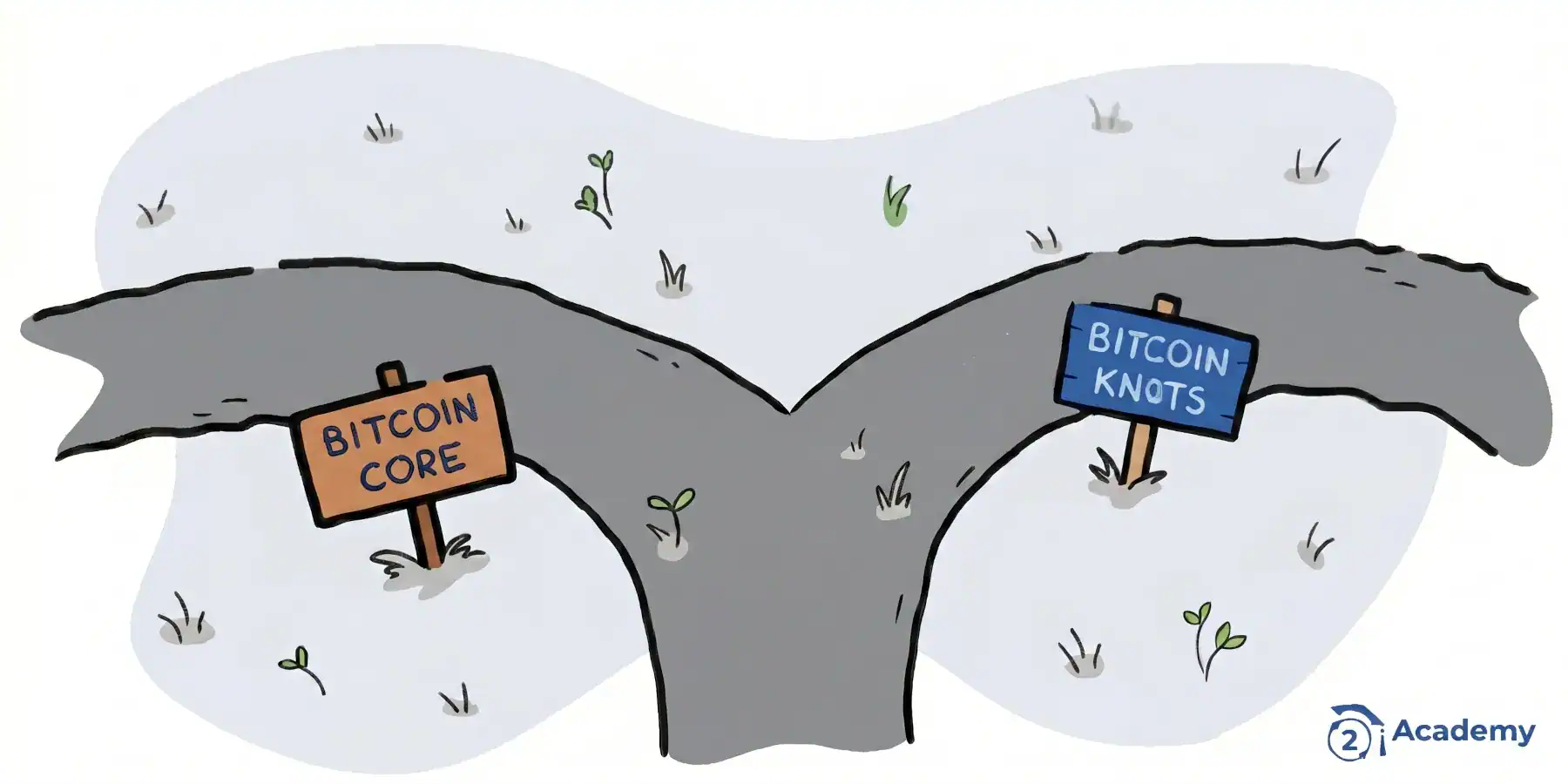
- Core vs. Knots: While Bitcoin Core remains the gold standard for its conservative and ultra-secure approach, Bitcoin Knots is emerging as the option for advanced users seeking more granular data filtering features and complete control over their node's traffic.
- Conflict resilience: Community "fights" and the existence of multiple implementations are not a weakness; they are the defense mechanism that ensures that no single entity or group of developers can unilaterally control the future of the protocol.
The world's largest digital asset network has never been a monolithic bloc of one-track thinking. On the contrary, its history is written through heated debates that, far from being a weakness, represent its greatest strength. Looking back, we recall those "block size wars" that marked a milestone in decentralized governance. But where are we now in 2026? While the market is distracted by price, purists and technical experts remain focused on what truly matters: the software that validates our rules.
Today, the choice of client you run on your computer is not a minor technical detail. It's a statement of principles about how you understand the scalability and security of the ecosystem.

The scalability map: Between consensus and fragmentation
Over the years, we've seen proposals like Bitcoin Classic, Bitcoin Unlimited, and the now-defunct XT. They all shared a similar diagnosis (the need to process more transactions), but differed drastically in their solutions. Most of these alternatives opted for a hard fork, a radical change that forces all nodes to upgrade or be forced off the network.
Do we really need to force a split in the supply chain every time we want to improve performance? History tells us that consensus is a difficult beast to tame. Those debates, which sometimes resembled a schoolyard tantrum more than an engineering discussion, taught us that in this sector, efficiency is meaningless if you sacrifice decentralization along the way.
Bitcoin Core: The backbone of the protocol
If we're looking for a gold standard in the development of this digital asset, it's Bitcoin Core. We're not talking about simple software. It's the direct descendant of the code that Satoshi released almost two decades ago and the environment where the most meticulous developer community on the planet operates. Its approach doesn't allow for experimentation: maximum security and surgical changes.
Bitcoin Core does not "They break things to go faster." Here, every line of code undergoes scrutiny that would drive any Silicon Valley startup to despair. Is the process slow? Yes. Is it necessary? Absolutely. In an ecosystem plagued by tokens that vanish overnight due to flaws in their smart contracts, Core's robustness is what allows millions of people to sleep soundly.
The legacy of Segregated Witness (SegWit)
Although it may seem like a museum piece to us today, the implementation of followed It was the move that changed the rules of the game without breaking the board. By separating signatures from transaction data, block space was optimized with enviable technical elegance. It was the first major victory of common sense over the media noise of the "block wars."
For those who prefer to get down to the technical mud, this structure allows the Merkle Tree (that hash tree that guarantees data integrity) handles the witnesses separately. The practical result is that, although the theoretical limit remains anchored near 1MB, the actual processing capacity is substantially greater.
From SegWit to Taproot: The Maturity of Code
We can't understand Bitcoin Core in 2026 without mentioning the leap forward that Taproot represented. If SegWit streamlined the infrastructure, Taproot brought efficiency and a much-needed layer of privacy. Thanks to Schnorr signatures, complex multi-signature transactions now appear as a single transaction to the network.
This not only saves space on the blockchain; it improves the fungibility of our crypto assets. Why should everyone know you're using a multi-signature wallet or payment channel? With the current Core updates, discretion is the norm, not the privilege of a select few experts. Evolution is still slow, but each step is a slab of concrete reinforcing the world's most secure infrastructure.
Bitcoin Knots: The Sophisticated Sibling
It is often confused with Bitcoin Knots It's not a simple copy of Core, but it's much more than that. It's not a mirror image; it's an evolution with its own criteria. Maintained with an iron fist by Luke dashjrKnots is an implementation that integrates functionalities that the Core team sometimes discards because they are considered too specific or simply inconvenient for the general consensus.
If Core is the mobile phone you take out of the box and it works flawlessly, Knots is the open-source operating system you install to squeeze every last bit of performance out of your processor. It's the domain of enthusiasts who demand total control over what happens on their computer and which transactions they decide to validate on their node. Is it for everyone? Certainly not. But its existence is vital to the health of the ecosystem.
Filtering as a tool for sovereignty
But faced with the prospect of a network saturated with metadata spam and those inscriptions that some don't want to see, Knots has become a haven for purists. While other nodes process any unnecessary token or data that comes their way, Knots allows for much stricter filtering. It's the difference between letting just anyone into your house and having a gatekeeper who only allows what truly matters—value transfers—to pass through.
Many users have migrated to this implementation seeking to keep their nodes lightweight and efficient. It's not about censorship; it's about technical sovereignty. If you run the node, you decide which spam rules to apply. Knots offers that freedom, which, in the main implementation, is sometimes diluted in favor of more lax compatibility.
The alternatives that were left behind
It's worth remembering why proposals like Bitcoin Classic or Unlimited didn't quite catch on with ordinary users.
- Bitcoin Classic: It attempted to raise the limit to 2MB using a voting system based on mining power (BIP 109). It promised a fast payment network, but many feared that increasing the block size would exclude users with less powerful internet connections, centralizing control in the hands of large mining farms.
- Bitcoin Unlimited: He took the idea to the extreme by eliminating the fixed code limit. His proposal was that the market should decide the size organically. It sounds good on paper, but in practice, an "infinite" block is a gift to those who want to attack the network with massive spam.
Are you really going to entrust the future of your wealth to an experiment that prioritizes speed over resistance to censorship? I prefer the slowness of well-developed consensus.
The value of conflict in open source
The best thing about this ecosystem is precisely its conflicts. Other closed financial systems see these disputes as a sign of weakness or chaos. They don't understand that a global community working for free and with passion is what makes the system indestructible. Every time a press release announces the "end of Bitcoin" due to a technical debate, the protocol emerges stronger.
We're not here to decide which side is absolutely right. We're here to help you understand that you have options. Building your own node, whether using Core to follow the mainstream or Knots for finer control, is the only real path to financial sovereignty. At the end of the day, your node is your law.
FAQ – What do Bitcoin Core and Bitcoin Knots propose?



 Author