The digital economy, driven by blockchain innovation, is redefining global finance. However, this revolution is not without challenges, and one of the most pressing is the fight against money laundering and terrorist financing.
In this context, the regulations of Anti-Money Laundering (AML) They emerge as fundamental pillars to ensure the integrity and sustainability of the crypto ecosystem. Navigating this complex regulatory framework is essential for any player in the sector, from developers to investors.
Therefore, we will unravel the definition of AML, the insidious stages of money laundering, and the proactive strategies that protect the digital economy, offering a clear guide to understanding its vital importance and application in the dynamic world of cryptocurrencies.
What is AML (Anti-Money Laundering)?
The concept of Anti-Money Laundering, or AML, refers to a robust set of laws, regulations and procedures designed to prevent and combat money laundering. Money laundering is, in essence, the process by which proceeds from illegal activities are disguised as legitimate funds. Criminals seek to "clean" dirty money, a task that involves concealing its illicit origins so they can enjoy it without raising suspicions from the authorities. AML regulations impose obligations on financial institutions, including cryptocurrency exchanges, banks, and other intermediaries, to implement measures to detect, prevent, and report suspicious activity that may be related to money laundering.
At its core, AML seeks to protect the integrity of the global financial system, ensuring it is not used as a conduit for criminal activity. This entails constant vigilance and the adoption of rigorous policies to identify and verify customer identity, monitor transactions for unusual patterns, and report any suspicious activity to the appropriate authorities.
The effectiveness of AML relies on international cooperation and a legal framework that severely penalizes financial crimes. The inherent complexity of digital transactions, especially those that move across borders at high speed and with a certain degree of anonymity, makes the implementation of AML policies even more critical in the cryptocurrency space.
Beginnings of AML
The history of AML dates back to the late 20th century, with regulatory frameworks established in response to the growing problem of drug trafficking and organized crime. Laws such as the Bank Secrecy Act (BSA) In the United States, and similar directives in Europe, laid the groundwork for what we know today as AML. These regulations are constantly evolving to adapt to new technologies and the changing tactics of criminals.
But the advent of cryptocurrencies and blockchain technology presented a new paradigm that required adapting and expanding these AML frameworks. Regulators were faced with the challenge of applying AML principles to digital assets that operate in a decentralized and often cross-border manner, leading to the development of crypto-sector-specific regulations in many jurisdictions.
AML implementation is not limited to prevention; it also encompasses the investigation and prosecution of those involved in money laundering activities. This involves gathering evidence, analyzing transactions, and collaborating between national and international law enforcement agencies. Technology plays a crucial role on both fronts: both for criminals seeking to exploit vulnerabilities, and for authorities and companies seeking to strengthen their defenses. The adoption of advanced technological tools, such as data analytics and artificial intelligence, has become essential for detecting money laundering patterns in massive transaction volumes.
The spirit of AML is to act as a deterrent and a barrier. By making it more difficult and risky for criminals to launder money, AML regulations seek to make illicit activities less profitable and therefore less attractive. This, in turn, contributes to economic stability and public confidence in the financial system. Adherence to AML principles is not only a legal obligation but also a demonstration of corporate responsibility and a commitment to market integrity, especially relevant in a sector as innovative and rapidly evolving as cryptocurrency.

Importance of AML in the Cryptocurrency Economy
The cryptocurrency economy, with its decentralized and often global nature, presents fertile ground for financial innovation, but also for illicit activity. This is where AML regulations become paramount. The widespread adoption of cryptocurrencies, by both retail and institutional investors, depends largely on trust in the security and legitimacy of the ecosystem. Without robust AML mechanisms, the risk of cryptocurrencies being used to launder money, finance terrorism, or evade economic sanctions increases significantly.
A well-implemented AML framework is critical for institutional adoption. Large investment funds, banks, and corporations are reluctant to get involved in markets they perceive as poorly regulated or prone to illicit activity. Regulatory clarity and demonstrated compliance with AML standards are therefore prerequisites for traditional finance to flow into the crypto space. This not only drives market growth but also brings liquidity and stability. Cryptocurrency exchanges that rigorously apply AML procedures, such as the identity verification of its users (KYC), they position themselves as reliable partners for financial institutions and institutional investors.
Protecting users
In addition to attracting institutional investment, AML also protects retail users. By preventing malicious actors from operating freely, it reduces the likelihood of innocent users becoming involved, unwittingly or not, in money laundering schemes. For example, an exchange without AML controls could be used by fraudsters to launder funds obtained from Ponzi schemes or phishing scams, harming legitimate users who interact on the platform. AML measures act as a filter, helping to maintain the integrity of transactions and protecting the reputation of the industry as a whole.
Combating terrorist financing is another key pillar of AML's importance in the crypto world. Terrorist groups actively seek methods to fund their operations, and cryptocurrencies, due to their relative novelty and the complexity of tracing them compared to traditional banking systems, can be attractive for this purpose. AML regulations, which include transaction monitoring and suspicious activity reporting, are essential tools for law enforcement agencies to track and dismantle these financing networks. The ability to trace cryptocurrency flows, even when obfuscation techniques are used, is a constant focus area for compliance teams and law enforcement.
Promoting transparency and sustainability
The reputation and long-term sustainability of the crypto ecosystem also depend on compliance with AML regulations. Public perception and regulatory response are crucial. If the crypto sector is perceived as a haven for criminals, regulators around the world could impose restrictive and punitive measures, stifling innovation and adoption. Conversely, a proactive and transparent approach to AML demonstrates maturity and responsibility, fostering an environment conducive to organic growth and public trust. This includes ongoing collaboration between the crypto industry, regulators, and law enforcement agencies to ensure regulations are effective and proportionate to the risk.
The inherent globality of cryptocurrencies also highlights the importance of international cooperation on AML. Money laundering is rarely limited to a single jurisdiction. Therefore, it is essential that countries coordinate their regulatory efforts and share information to effectively address cross-border illicit activities. Harmonizing AML regulations across different jurisdictions helps close loopholes that criminals could exploit. This is achieved through international organizations such as the Financial Action Task Force (FATF), which establishes global standards for combating money laundering and countering terrorist financing. Compliance with these recommendations is a key indicator of how seriously a country or industry addresses these challenges. In short, AML is not an obstacle to crypto innovation, but rather an essential enabler for its sustainable growth, mass adoption, and legitimacy in the global financial landscape.
Stages of money laundering
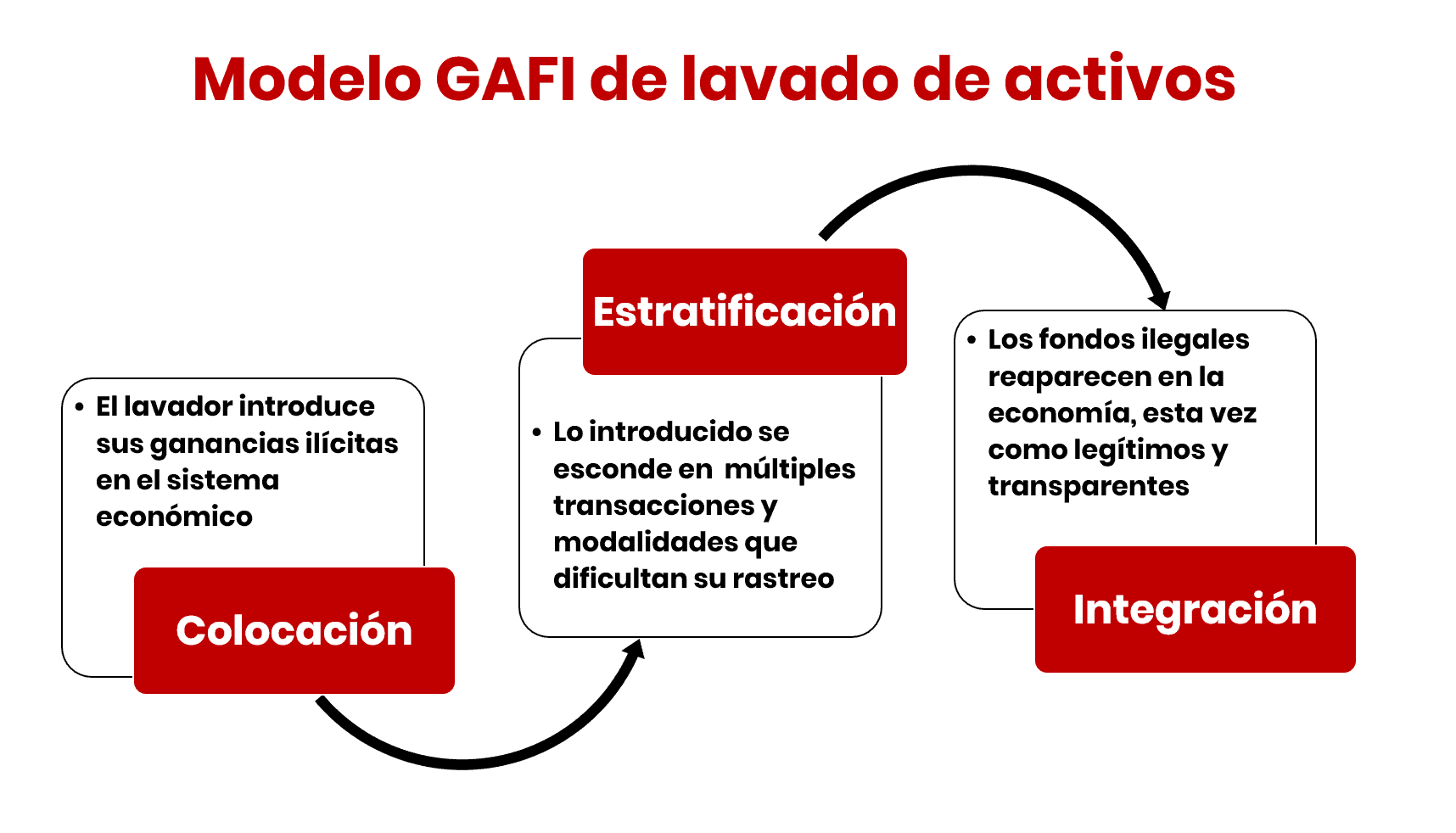
The money laundering process is a complex and multifaceted phenomenon that can be broken down into three main, sequential stages. Each stage is designed to increasingly distance itself from the illicit source of the funds, making detection and tracking progressively more difficult. Understanding these stages is critical to identifying and preventing this criminal activity.
Placement: Introduction of illicit funds into the market
The first stage of money laundering, known as "placement" or "deposition," is the entry point of illicit funds into the financial or economic system. In this phase, criminals seek to introduce physical cash or digital assets obtained from their illegal activities into the formal economy. The primary objective is to separate the money from its illicit source, which is often a criminal activity such as drug trafficking, extortion, fraud, or corruption.
Historically, placement involved depositing large amounts of cash into bank accounts, often in small, split installments to avoid mandatory reporting thresholds. Another common method was mixing illicit cash with legitimate income from businesses that handle large volumes of cash transactions, such as restaurants, laundromats, or casinos.
In the context of cryptocurrency, placement can occur in a variety of ways. For example, criminals can exchange large amounts of cash for cryptocurrency on P2P (peer-to-peer) exchange platforms or use Bitcoin ATMs, which have fewer identity checks. They can also purchase goods or services using cash and then sell those goods or services for cryptocurrency, or make direct cryptocurrency purchases through prepaid cards or exchange services that operate with less regulation.
The challenge at this stage is the volume and physical nature of the cash, or the relative ease with which cryptocurrencies can be acquired. Criminals seek to diversify placement locations to avoid detection due to unusual transaction patterns at a single institution. The tactic of "structuring" or "smurfing" is particularly common here: dividing a large sum of money into multiple deposits or small purchases that don't trigger suspicious transaction reporting alarms. Success at the placement stage is crucial for the rest of the laundering process, as it establishes the basis for the apparent legitimacy of the funds.
Stratification: concealment of the origin of the money
Once the illicit funds have been placed in the financial system, the next stage is "layering." The goal here is to create a complex web of financial transactions to hide the trail of the funds and make it extremely difficult, if not impossible, to trace their illicit origin. This phase focuses on the complexity and volume of transactions to confuse investigators and authorities.
Layering methods are varied and sophisticated. They can include transferring funds through multiple bank accounts and jurisdictions, often in tax havens or countries with lax financial regulations. Shell companies or legitimate businesses can be used to channel funds, conducting simulated business transactions or overbilling goods and services. Investing in financial assets, such as stocks, bonds, or real estate, and then selling them also serves as a form of layering.
In the cryptocurrency world, layering can involve the use of "mixing" or "tumbling" services that mix funds from multiple users to obscure the origin of transactions. Sending cryptocurrency through multiple addresses, using exchanges that don't require KYC, and converting between different cryptocurrencies (chain hopping) are common tactics to make the blockchain more opaque.
Criminals seek to create a large number of seemingly legitimate transactions that cause illicit funds to disappear in the noise. The more layers of transactions there are, the more difficult it is for authorities to reconstruct the original money trail. This stage requires meticulous planning and often the complicity of financial professionals or companies that, knowingly or negligently, facilitate these operations. The sophistication of global financial networks and the speed of digital transactions make layering a significant challenge for compliance and law enforcement agencies.
Integration: reintroducing clean money into the economy
The final stage of money laundering is "integration." At this point, the funds, which have been layered and lost their apparent connection to illicit activity, are reintroduced into the legitimate economy. The money, now "clean," or at least with a difficult-to-trace trail, can be used by the criminal without immediate fear of detection. The goal is to make the funds appear to have been generated from legitimate sources.
To achieve this, criminals use the money to purchase luxury goods, invest in legitimate businesses, fund new criminal activities, or simply spend it on their lifestyles. Investments can include real estate, high-end vehicles, stock market shares, or even opening businesses that appear legitimate. In the crypto ecosystem, this could mean purchasing luxury items with cryptocurrency, investing in startups, or transferring the funds to traditional bank accounts for everyday use. If the laundered funds are used to invest in a business, that business can generate legitimate income from the originally illicit funds.
The key to integration is making transactions appear completely normal and transparent. Money that was once dirty is now disguised as legitimately earned wealth. It is at this stage that criminals can fully enjoy the benefits of their illegal activities. For authorities, integration represents the most difficult point in connecting funds to the original crime, as the trail has been deliberately blurred through the previous stages. However, if the placement and layering stages have been detected, it is possible to infer the illicit nature of the funds even at the integration stage. Therefore, prevention and detection at the early stages are crucial.

Main AML Measures and Strategies in Cryptocurrencies
To counter the complex stages of money laundering, institutions operating in the cryptocurrency space must implement a series of rigorous AML measures and strategies. These strategies are designed to identify customers, monitor their activities, and mitigate the risks inherent in the use of digital assets. The effectiveness of these measures depends on their diligent implementation and ongoing adaptation to new threats and technologies.
Customer Identification and Verification (KYC)
The cornerstone of any effective AML program is the Know Your Customer (KYC) process. This procedure requires companies to collect and verify their customers' identities before allowing them to conduct transactions or open accounts. The goal is to establish the veracity of the information provided by the customer and confirm that they are not using false or stolen identities.
In the context of cryptocurrencies, this means that exchanges, wallet providers, and other related services must require their users to present valid identification documents, such as passports, driver's licenses, or national identity cards. In addition to basic identification, the KYC process often includes verification of residential address and, in some cases, verification of phone number or email. Some regulations may also require customers to provide information about the source of their funds or the purpose of their transactions, especially for high-value transactions.
The importance of KYC lies in its ability to deter criminals from using cryptocurrency platforms for illicit activities. By making it more difficult to operate anonymously, it significantly reduces the attractiveness of these platforms for money laundering and terrorist financing. A robust KYC process makes it difficult to create multiple accounts with false identities and helps authorities trace transactions back to specific individuals if necessary. Technology plays an important role in improving KYC processes, with digital identity verification solutions that use facial recognition, document analysis, and databases to streamline and ensure the accuracy of the process.
Monitoring and Reporting of Suspicious Transactions
Once customers have been identified and verified, financial institutions must continuously monitor their activities to detect unusual or suspicious transaction patterns. This involves implementing rules-based monitoring systems and, increasingly, behavioral analytics and machine learning. The goal is to identify transactions that deviate from the norm or that may be linked to illicit activity.
Indicators of suspicious transactions in the crypto space may include the movement of large volumes of cryptocurrency without clear justification, the frequent use of wallet addresses known to be associated with illicit activities, or participation in rapid and frequent currency exchange schemes with no apparent legitimate business purpose. The use of "mixers" or "tumblers" and sending funds through multiple addresses to obscure the trail are also red flags.
When a suspicious transaction is detected, the institution is required to submit a Suspicious Transaction Report (STR) to the relevant authorities, such as the Financial Intelligence Units (FIUs) of each country. STRs are crucial to the investigative work of law enforcement and intelligence agencies, as they provide valuable information about potential criminal activity. The accuracy and timeliness of these reports are essential to the effectiveness of the fight against money laundering. Monitoring systems must be carefully configured to minimize false positives and ensure that truly suspicious activity is efficiently identified.
Risk Assessment and Management
An effective AML program requires a continuous assessment of the risks associated with the different activities, clients, and jurisdictions in which an institution operates. This involves identifying, analyzing, and mitigating the money laundering and terrorist financing risks to which the company is exposed.
The risk assessment should consider factors such as the complexity of the products and services offered, the customer base (including their domicile, profession, and transaction size), the distribution channels used, and the geographic jurisdictions involved. For example, a customer operating in a high-risk jurisdiction or engaging in frequent cross-border transactions may pose a greater risk than a local customer engaging in sporadic transactions. The nature of cryptocurrencies themselves may also present specific risks, such as volatility, the partial anonymity of some transactions, and rapid technological evolution.
Based on this risk assessment, institutions must implement AML controls and procedures commensurate with the identified risk level. This may mean applying more rigorous KYC measures to high-risk customers, intensified monitoring of their transactions, or even deciding not to establish business relationships with certain customers or in certain jurisdictions if the risk is unacceptably high. Risk management is not a static exercise; it must be a dynamic process that is regularly updated to reflect changes in the threat landscape, new regulations, and the company's own activities.
Employee Training and Awareness
The human factor is fundamental to the successful implementation of any AML program. Employees, especially those in compliance, customer service, and operations roles, must be properly trained and aware of the risks of money laundering and terrorist financing, as well as their responsibilities in preventing these activities.
Training should cover all relevant aspects of the company's AML policies and procedures, including customer identification, transaction monitoring, suspicious activity reporting, and applicable laws and regulations. Training should be ongoing and updated to reflect changing regulations and criminal tactics. In addition to formal training, it is important to foster a culture of compliance within the organization, where all employees understand the importance of AML and feel empowered to report any concerns.
Lack of training or awareness can lead to costly mistakes, regulatory fines, and even unwitting complicity in illicit activities. Companies must ensure their employees have the knowledge and tools necessary to identify and respond appropriately to money laundering threats. Internal and external audits can help verify the effectiveness of training programs and identify areas for improvement. A well-informed and vigilant workforce is an essential defense against criminals' efforts to exploit the system.
AML Regulatory Bodies
The fight against money laundering and terrorist financing is a global effort involving multiple regulatory and standard-setting bodies at the international, national, and, in some cases, sectoral levels. These bodies set the rules, oversee compliance, and facilitate cooperation between countries.
At the international level, the Financial Action Task Force (FATF) is the most influential authority. The FATF is an intergovernmental body that sets global standards for combating money laundering, terrorist financing, and the proliferation of weapons of mass destruction. Its Recommendations are the most recognized and widely adopted international framework. The FATF has no direct enforcement power, but its members (countries and regional organizations) commit to implementing its standards and conducting mutual evaluations to ensure compliance. Jurisdictions that do not comply with the FATF Recommendations may be subject to scrutiny, which can affect their financial reputation and access to global markets.
Within each country, there are various agencies responsible for implementing and overseeing AML regulations. These typically include:
- Financial Intelligence Units (FIU / FinCEN in the US, etc.): They are government agencies responsible for receiving, analyzing, and disseminating suspicious transaction reports (STRs) and other financial reports. They act as the link between financial institutions and law enforcement agencies. In the United States, the Financial Crimes Enforcement Network (FinCEN) is the primary FIU.
- Central Banks and Financial Regulators: Institutions such as central banks (e.g., the Bank of Spain, the European Central Bank) and securities commissions (such as the SEC in the U.S. or the CNMV in Spain) are often responsible for establishing and enforcing AML regulations for the financial institutions under their supervision, including cryptocurrency exchanges in many jurisdictions.
- Law Enforcement Agencies: Justice departments, federal police, criminal investigation agencies, and specialized financial crimes units are responsible for investigating and prosecuting money laundering and terrorist financing cases. They work closely with FIUs.
In the context of cryptocurrencies, the application of these regulations can be complex. Different jurisdictions have different approaches. Some have adopted specific regulations for Virtual Asset Service Providers (VASPs), requiring them to comply with AML/KYC requirements similar to those of traditional financial institutions. The FATF has issued specific guidelines for VASPs, recommending that they be subject to the same obligations as financial intermediaries. The global trend is toward greater regulation and oversight of the crypto space to ensure it does not become a haven for illicit activities.
 Certificate

Introductory course to DeFi
Medium levelTime to update. Traditional finance has changed, discover the revolutionary ecosystem of decentralized finance (DeFi).
The Future of AML in the Crypto World: Trends and Challenges
The AML regulatory landscape in the cryptocurrency sector is constantly evolving, driven by rapid technological innovation, growing adoption, and the need to maintain the integrity of the global financial system. The future lies in the further integration of traditional regulations, the use of advanced technologies, and the adaptation to new business models.
One of the most significant trends is global regulatory harmonization. As more countries adopt frameworks to regulate Virtual Asset Service Providers (VASPs), there is a growing push to align these regulations with international standards, especially the FATF recommendations. This seeks to create a more level playing field and prevent crypto companies from operating in jurisdictions with lax regulations to circumvent compliance. Implementing requirements similar to those of traditional banking, such as rigorous KYC and transaction monitoring, is becoming the norm in many parts of the world.
The adoption of AML technologies (RegTech) is another key area. Companies are investing in advanced technological solutions to improve the efficiency and effectiveness of their AML programs. This includes the use of artificial intelligence (AI) and machine learning (ML) for transaction analysis, anomaly detection, and the identification of money laundering patterns that might go undetected by traditional rules-based systems. Digital identity verification tools, blockchain network analysis to trace fund flows, and the automation of compliance processes are also gaining traction. These technologies not only help with regulatory compliance but can also reduce operational costs and minimize false positives.
The challenge of "anonymous cryptocurrencies" and transaction obfuscation techniques such as mixers and chain hopping remains a major focus. While the FATF has issued guidelines stating that mixing services should also comply with AML/KYC obligations where applicable, the practical implementation of this is complex. Regulators and compliance firms are continually working to develop more sophisticated methods for tracing transactions through these layers of obfuscation, utilizing advanced blockchain analytics and collaboration with exchanges and other ecosystem participants.
Another significant challenge is identifying beneficial ownership in cryptoasset transactions, especially when using decentralized wallets or complex smart contracts. Determining the ultimate beneficiary of funds can be significantly more difficult than in traditional banking systems. This requires innovative approaches to due diligence and information gathering.
The expansion of decentralized finance (DeFi) presents a new set of challenges for AML. As DeFi platforms grow in popularity, operating with a high degree of decentralization and automation, the question arises of who is responsible for implementing AML measures. Regulators are exploring how to apply AML principles to ecosystems that lack traditional centralized intermediaries. This could lead to novel regulatory approaches, perhaps focused on developers, protocols, or even the "oracles" that interact with the outside world.
Finally, oversight and compliance in a seamless, global environment remains a perpetual challenge. Cryptocurrency transactions cross borders instantly, requiring even greater international cooperation between enforcement agencies and authorities. The lack of a globally uniform regulatory framework can create opportunities for criminals to exploit jurisdictional differences.
In short, the future of AML in the crypto world will be marked by a balance between fostering innovation and ensuring the security and integrity of the financial system. Companies that proactively adopt advanced technologies, stay abreast of changing regulations, and foster a robust compliance culture will be best positioned to thrive in this dynamic ecosystem.

 Author