Essential Points
- Pillar of Decentralization: Bitcoin Core is not just a wallet; it is the software that ensures no central entity can alter the rules of Bitcoin's economic consensus.
- Independent Validation: Running this software allows the user to verify their own transactions without relying on third parties, becoming a "financial sovereign" within the network.
- Open Source and Auditing: Its transparent nature allows any developer in the world to propose improvements (BIPs), ensuring constant evolution in the face of vulnerabilities.
- Network Compatibility: As a reference client, it sets the standard that other implementations must follow to maintain global interoperability of the crypto ecosystem.
When we talk about the architecture that underpins the Bitcoin ecosystem, Bitcoin Core isn't just another option; it's the gold standard. This open-source development, distributed under the MIT license, bears the responsibility of being the reference implementation of the protocol. What does this mean in practice? Basically, that any technical change or improvement to the network must be reviewed and approved by this software.
It is no accident that Satoshi Nakamoto I laid the foundation for this code. By downloading Bitcoin Core, you're not just installing a simple financial application; you're running a full node. This allows you to validate every transaction and every block autonomously, without asking third parties if your digital assets are there. Sovereignty isn't negotiated, it's verified.
Seamless infrastructure and validation
As of today, in 2026, Bitcoin Core's dominance remains undiminished. Although alternatives have emerged, this client is the only one that fully implements the consensus rules, serving as a benchmark for other developments in the sector. Its structure combines the power of a network engine with the utility of an integrated wallet for managing your crypto assets.
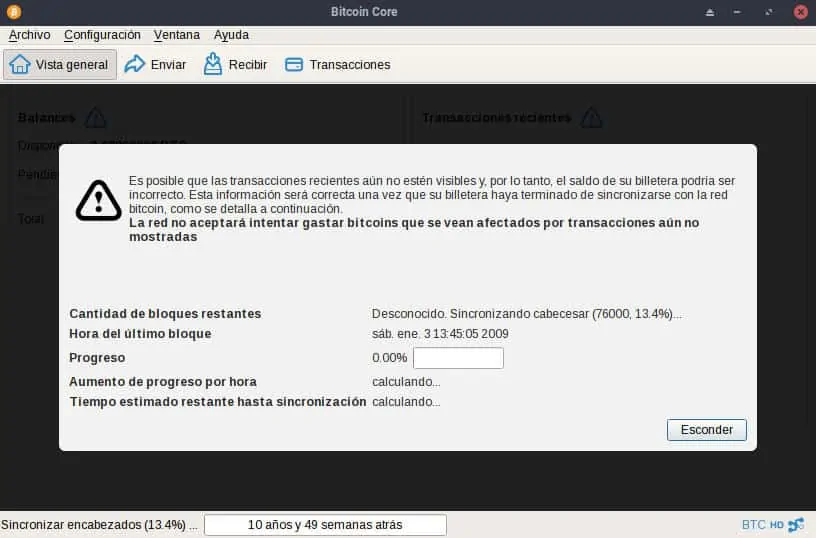
Setting up a Bitcoin Core node requires disk space and some patience to synchronize the entire network history, but the result is well worth the effort. You become an active participant in the infrastructure. By verifying transactions directly from your own computer, you go from being a mere spectator to being part of the mechanism that ensures the integrity of the world's most robust network.
 Certificate
Technical Anatomy and Deployment of Bitcoin Core
Any user can download the software from its official website and install it on their computer like any other application. However, don't be fooled: this is not a lightweight program. By running Bitcoin Core, you transform your computer into a full node. This means that you will download and validate every single transaction performed on the network from back in 2009 to the present day.
Hardware and storage requirements
If you're going to take the plunge, make sure you have plenty of space. By 2026, the blockchain will have grown considerably, and you'll need at least 1 TB of SSD storage to manage the entire backup without bottlenecks.
Forget mechanical hard drives; the latency will test your patience. Furthermore, initial synchronization isn't instantaneous. Depending on your internet connection and processor power, the process can take several days before the node is fully operational.
The engine under the hood: bitcoind and bitcoin-cli
The real magic happens behind the scenes through bitcoind. This "daemon" is the engine that maintains constant communication with the rest of the network via remote procedure calls (RPCs). If you prefer getting your hands dirty with the terminal instead of using shiny buttons, bitcoin-cli is the tool for you. It's the command-line interface that lets you issue direct commands to the engine to manage your crypto assets with surgical precision.
Is it for everyone? Probably not. While it offers the highest levels of privacy and security in the ecosystem, its learning curve is real.
Experimental environments
For developers or those who prefer not to risk their real tokens on untested tests, the software allows them to set up a testnet. It's a simulation environment identical to the main network where changes, complex scripts, or new implementations can be tested at no cost. It's the perfect laboratory to understand how the protocol works before interacting with the production network.
Are you prepared to sacrifice some convenience in exchange for complete control over your digital assets? Ultimately, being your own bank requires more than just a secure password; it requires understanding the infrastructure that supports it.
Bitcoin Core development and improvements
Bitcoin Core development started with version 0.1.0. This is considered the first implementation of the Bitcoin software created by Satoshi Nakamoto. It was only available for Windows. In version 0.2.0, support for Linux systems was introduced for the first time and later MacOS.
Nakamoto participated in the development and improvement of Bitcoin Core until version 0.3.19 in 2010, then abandoned the project, leaving it in the hands of Gavin andresen. It was Andresen who later, in 2014, gave the project to Wladimir J. van der Laan and other major developers.
In version 0.3.20 the testnet testing network. And from version 0.5.0 of 2011 it started to be called Bitcoin QT. This referring to an implementation based on the MIT licensed Qt4 graphical interface library. It was developed by the developer Wladimir van der Laan and provides a friendly interface to Bitcoin code. All in order to make its use easier, friendlier and more intuitive for users not familiar with programming.
Later, in version 0.9.0, the software recovered the name of Bitcoin Core, and in it, transaction fees were reduced as a measure to encourage the completion of microtransactions.

Leaving OpenSSL behind and improving capabilities
In its early days, Bitcoin Core used OpenSSL for many crypto operations. However, this started to change in 2015 due to bugs discovered in OpenSSL. Among the security flaws was one that allowed an attacker to read the memory of a server and obtain private keys. Another bug detected is that OpenSSL uses a "weak" font for random numbers, and the Bitcoin Core developers decided to create their own font. For those reasons, OpenSSL was removed from the Bitcoin Core source code.
In version 0.11.2, developers incorporated a feature into the network, where certain future conditions could be established to prevent the expense of some transactions. Then with version 0.12.1 the functionality of allowing multiple soft forks simultaneously.
Almost close to 100 collaborators worked on version 0.13.0, where they introduced more than ten significant changes. For 2016, the soft fork was activated CheckSequenceVerify. In that same year the soft fork of followed as an improvement to transaction malleability and the space of the blocks without changing their size.
In 2018, version 0.16.0 was released, which allowed the use of a native address format for SegWit, also called an address format. beach32, which was originally developed by Peter wuille y Greg Maxwell.
The era of efficiency: From Taproot to advanced programmability (2021-2026)
Following the consolidation of SegWit, the next major technical leap came with the activation of tap root in November 2021. This update not only improved privacy by making complex transactions appear as simple payments, but also introduced the Schnorr firmsBy replacing the old algorithm ECDSAThe software achieved faster and more efficient signature validation, drastically reducing the weight of the data on the hard drive.
As the 2020s progressed, development focused on the robustness of the scripting language. The integration of Miniscript into Bitcoin Core allowed developers to write complex spending conditions—such as time-based multi-signatures or inheritance clauses—in a secure and readable manner. This eliminated human errors that previously resulted in the irreversible loss of digital assets.
As of 2026, the current version of Bitcoin Core has refined the management of Erlays, a transaction propagation protocol that reduces bandwidth consumption by 40%. This is vital for users with modest connections to continue maintaining a full node at home, combating the technical exclusion imposed by networks with absurd hardware requirements.
The governance dilemma: Is the code the law, or are the maintainers?
The dominance of Bitcoin Core, which is projected to exceed 96% of the node share in 2026, keeps the debate about protocol sovereignty alive. Although the software is open source, the final filtering of pull requests rests with a very small group of maintainers. What happens if the interests of this few do not align with those of the users?
In recent years, we've seen an extreme professionalization of development. Many core programmers are employed by entities like Chaincode Labs or Spiral. While this guarantees full-time dedication to securing the network against cybersecurity attacks, it also raises concerns about potential corporate capture. Pressure from institutional lobbies to integrate compliance functions directly into the codebase is a constant threat that the ecosystem is closely monitoring.
The true defense against this centralization of development hasn't been the creation of new hard forks—which often end up forgotten—but rather the diversification of secondary implementations and the use of Stratum V2. This new mining protocol allows individual miners, not large pools, to choose which transactions to include in blocks. Ultimately, Bitcoin Core is a powerful tool, but its value lies in the community's willingness to reject any version that compromises the essence of cryptocurrencies: censorship resistance.
The risks of centralization
As we have said, Bitcoin Core is the quintessential Bitcoin client. It is not just any client, it is the most used. On the Bitnodes website it may look As the Satoshi client (that's what Bitcoin Core is called internally), it is the client of over 95% of all nodes connected to the network.
This has a positive part: all the nodes speak a very homogeneous protocol. However, this also has a negative and potentially horrible side for some detractors: the control capacity that the developers of that client have.
Although a client is nothing more than a program that implements the Bitcoin protocol, it must be understood that the protocol alone does nothing, requires the program to execute it. For this reason, this program has control over which parts of the protocol to implement and which not, for example what beeps to integrate.
Although it is true that it is an open source program, which we can see its code and even propose changes, only a small group of programmers has the control so that those changes enter the program. A small and closed group, which is constantly tempted with offers from multinationals and governments. After all, open source software does not give money directly, and they must live on something, corporations and governments know this and have the ability to fool with what is necessary, putting these programmers on the payroll and lobbying them as a lobby to direct the functionalities in one way or another. Just like in politics with representatives.
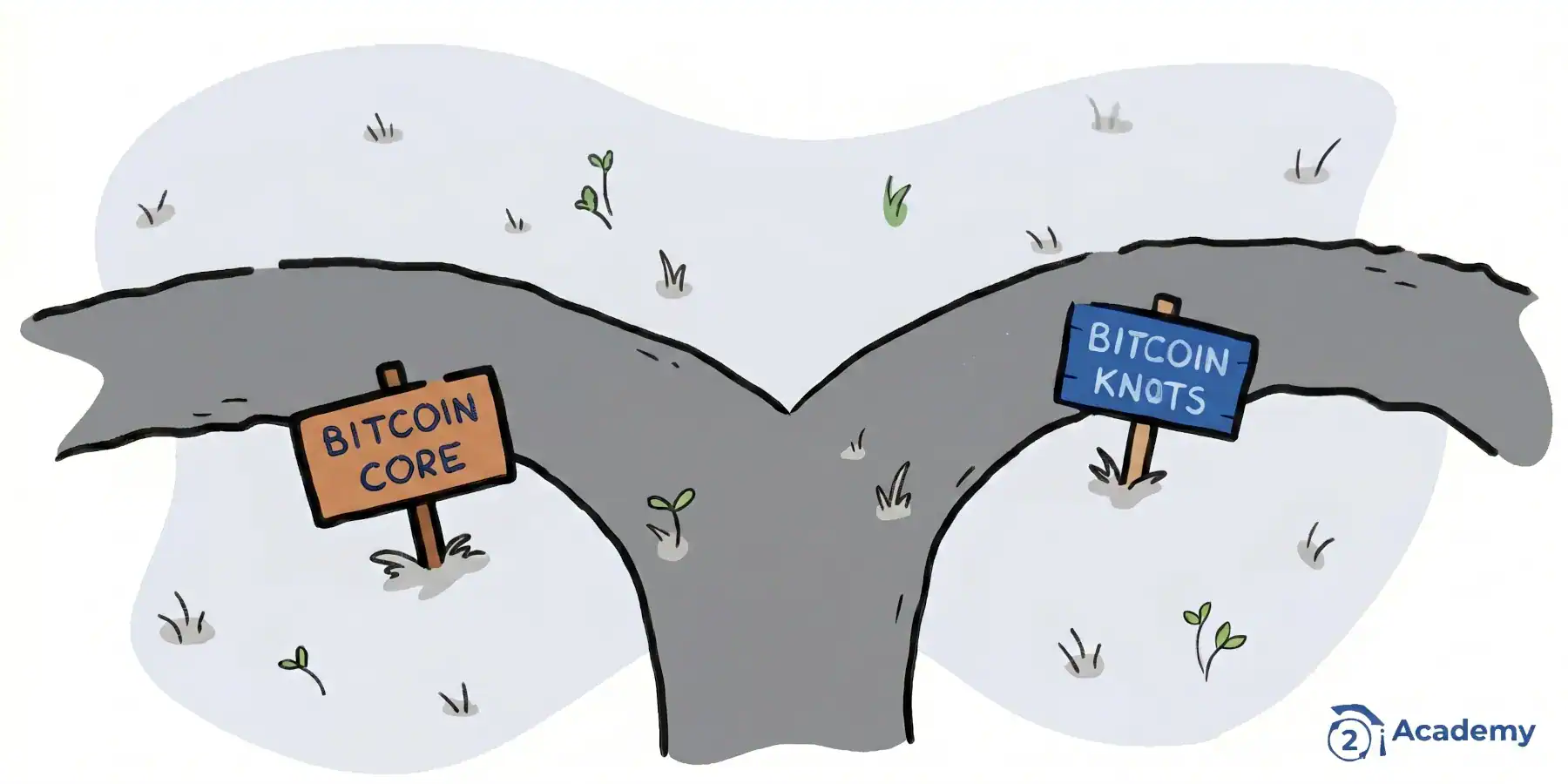
In this situation, being the client par excellence and seeing how complicated it is to create a new client where committed and anonymous developers without the ability to be corrupted maintain the code, some developers chose to do a hard fork Bitcoin.
The centralization problem is something real, a problem that Bitcoin seeks to solve, but without a doubt there are still many opportunities for improvement that exist around Bitcoin and this concept.

FAQ – What is Bitcoin Core?



 Author