Essential Points
- The Technical Trilemma: Bitcoin prioritizes security and absolute decentralization, which inherently limits its speed on the main chain (Layer 1).
- On-chain solutions: Updates like SegWit optimize block space, allowing more transactions without increasing file size, while maintaining compatibility.
- The Layer 2 Revolution: True massive scalability lies in off-chain protocols like the Lightning Network, which enable instant and nearly free micropayments.
- Future of the Internet: The implementation of technologies like Taproot and Schnorr signatures opens the door to more efficient and private scalability, preparing Bitcoin for institutional use.
Bitcoin continues to gain users. That's a fact. But this mass adoption holds up an uncomfortable mirror to us: Is its infrastructure ready for the real world, or is it just a giant with feet of clay? The question of network scalability is not new, but now it has gone from being a technical debate to a necessity for survival.
Imagine for a moment that tomorrow a billion people decide to use this digital asset to pay for their morning coffee. The result would be an absolute disaster. Far from being a victory, a sudden surge in adoption would wreck the user experience, drive fees to absurd levels, and clog the network for days. Bitcoin, at its base layer, is not designed for frantic micro-payments, but for unbreakable security.
Can this ecosystem become the main global means of payment? If we limit ourselves to the original protocol, the short answer is a resounding "no".
Fortunately, developers haven't sat idly by watching the ship sink. The obsession with scaling this cryptocurrency has led to technical proposals that seemed like science fiction just a few years ago. We're no longer just talking about theories; we're in the phase of deciding, through node consensus, which layers will be implemented and how they'll be integrated into our daily lives.
In the following lines, we'll delve into the inner workings of the network to understand its current limitations. We'll not only point out the structural flaws hindering its growth, but also analyze the scalability solutions that are attempting to salvage the situation. Will state channels or sidechains be enough to prevent collapse? Let's find out.
 Certificate

Introductory course to DeFi
Medium levelTime to update. Traditional finance has changed, discover the revolutionary ecosystem of decentralized finance (DeFi).
The myth of scalability: Why does Bitcoin continue to suffer in its base layer?
Before we get down to business, let's clear up the noise. Scaling this digital asset has nothing to do with whether or not people understand its value proposition, nor with the token's price making it prohibitive for the average person. Much less with a supposed shortage of units; that's why Satoshi invented fractional units.
When we talk about scalability, we're referring to the technical capacity to process a massive volume of transactions without the system crashing or costs becoming absurd. And here's the unfiltered truth: as of today, Bitcoin's base layer remains painfully slow for everyday use.
Cracks in the infrastructure
If we analyze current performance, we encounter obstacles that we cannot ignore if we want to be honest:
- Confirmations paused: Seeing a transaction reflected on your phone is gratifying, but the statistical analysis takes ten minutes (if you're lucky) or an hour. In a world that moves in milliseconds, that's an eternity.
- Impossible micropayments: Trying to pay for a coffee with your main credit card is simply financial folly. The fees end up costing more than the coffee itself.
- Hashrate Centralization: The risk of mining becoming concentrated in a few hands remains the sword of Damocles hanging over the decentralization of the crypto asset.
Does this mean the project has failed? Not at all. It means we're moving away from seeing Bitcoin as a "jack-of-all-trades" and starting to understand it as the ultimate settlement layer.
Software under perpetual construction
It's curious that, after more than fifteen years, we still see Bitcoin as an experiment. But that's precisely what it is. Although we've far surpassed those early versions from 2020 mentioned in old manuals, the software continues to evolve under one clear premise: security is non-negotiable.
The obsession with not breaking what already works is what slows down change. It's not a lack of technical ability, it's excessive caution. The debate about block size remains, simmering, reminding us that every byte of information comes at a cost in the decentralization of nodes.
If we want millions of people to operate concurrently, we can't just "make the blocks bigger." That would be a short-term fix with long-term consequences. The real challenge is building higher layers that don't compromise the integrity of the foundation. Will we be able to make the code withstand global pressure, or will we die of success? The answer, as always, lies in consensus.
The Block: The bottleneck of decentralization
As you know, blocks are the lifeblood of this distributed ledger. They contain all the information about the transactions that occur on the network, but with a physical drawback: space is an extremely scarce resource.
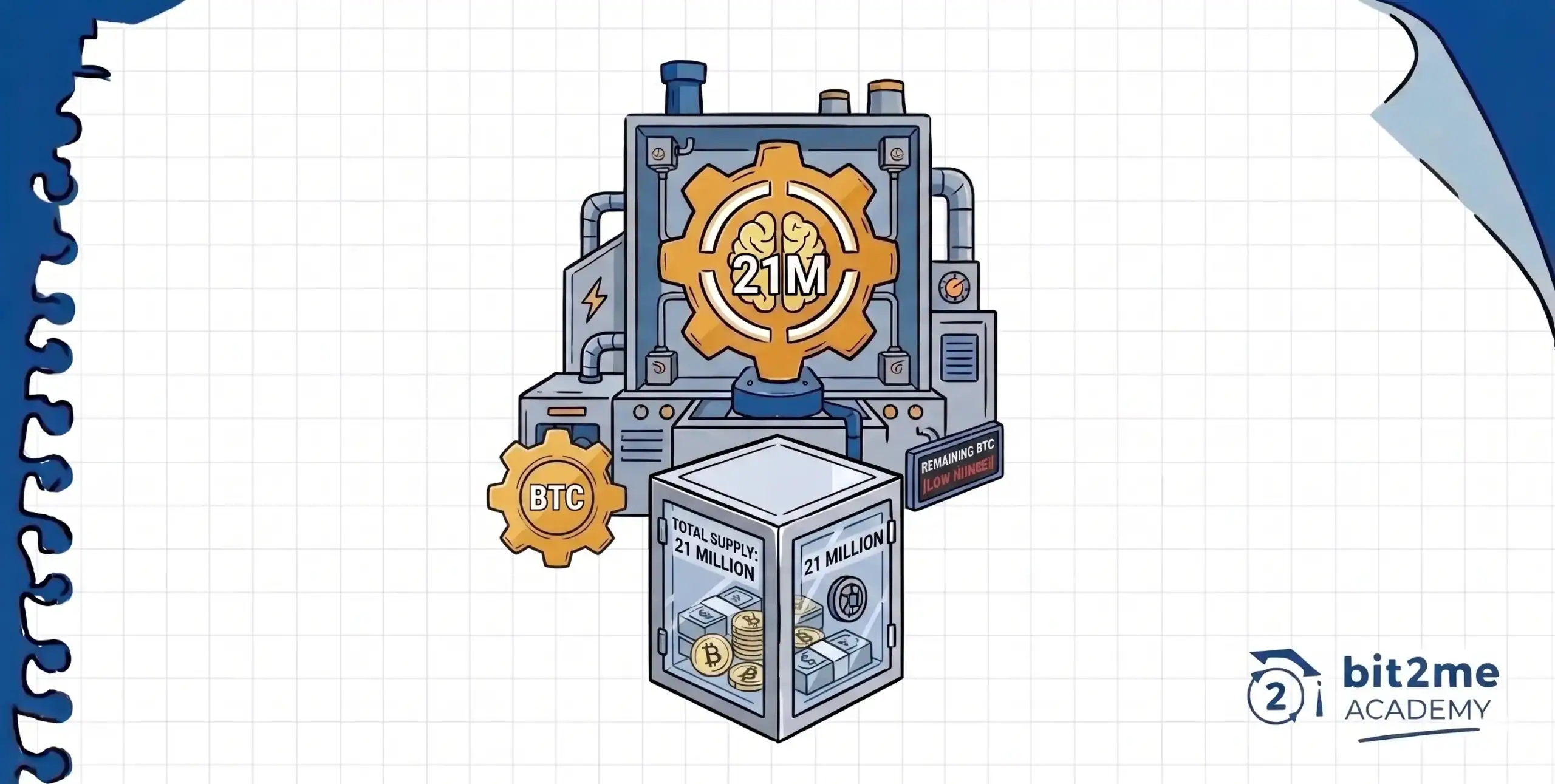
In the beginning, Satoshi Nakamoto limited the size of each block to 1 Megabyte. This was an emergency measure to prevent anyone from flooding the network with junk and causing it to crash. At the time, 1 MB was more than enough.
Today, it's a battleground where every byte is worth its weight in gold. It's important to understand that this isn't a suggestion: it's a rule hardcoded into the source code that every node runs on its computer. If a miner tries to submit a block that exceeds the allowed size, the rest of the network will spit it out without hesitation. This rigidity is what makes this digital asset so secure, but also what limits its speed.
Mathematics versus optimism: How much can really fit?
Let's look at the real numbers. Forget that mantra of 7 transactions per second (tps) that was repeated a decade ago. Reality is much more stubborn. A standard transaction usually occupies about 0,5 KB. If we have a block that is generated every 10 minutes (600 seconds), the operation is simple:

Do we really expect a system that processes 3,5 transactions per second to be the alternative to the global financial system? To put that in perspective, networks like VISA handle peaks of up to 56.000 transactions per second. Comparing those two figures is, on paper, a bad joke.
Why don't we just expand the block?
If 7 tps is already a ridiculous figure for 2026, real-world usage data tells us that the network often operates at even lower levels when transactions are complex. So why not raise the limit to 100 MB and fix the problem?
Because with this cryptocurrency, scale comes at a price: freedom. If we create giant blocks, only large data centers could manage a Bitcoin node. You, at home, with your regular computer, would be left out. And the moment only a few companies can verify transactions, Bitcoin will cease to be Bitcoin and become a "PayPal 2.0."
Making a completely decentralized system, where no one is in charge, process thousands of operations per second is the greatest technical challenge of our time. It's not about "adding more information," but about being smarter with the space we have.
Is 3,5 tps enough? For transferring fortunes between continents, yes. For buying bread, not even close. That's why the real battle for scalability isn't being fought at the core level, but in the layers we build on top of it.

The bloc's war: Why not "expand" the engine?
The debate over block size isn't just casual conversation; it's the conflict that nearly broke the community in its early days and that, even now in 2026, continues to define our vision of digital assets. It's not a problem of the future: it's the friction we feel every time the network becomes congested.
Many are asking: if Satoshi limited the block size to 1 MB as a temporary fix, why not change that line of code to 10 MB or 100 MB and end the problem? It seems like a five-minute solution, but in this ecosystem, shortcuts are often traps for decentralization. If we did that, we would sacrifice your ability to validate the network from home.
Let's analyze the three pillars that support this decision:
Storage: The weight of history
Today, the Bitcoin blockchain has far exceeded 700 GB. In 2016, it barely reached 90 GB. If we tried to process the transaction volume of a network like VISA at the base layer, each block would weigh around 600 MB.
Do the math: 600 MB every ten minutes is almost 90 GB a day. Who has a computer capable of storing and managing that rate of growth? Only large corporations. In the end, we would be delegating the security of the token into the hands of a few, destroying Bitcoin's original purpose. Although the pruning (data pruning) Help, a full node needs to verify everything to be sovereign.
Computing Capacity and Network: The Technical Barrier
At the CPU level, a modern mid-range computer has no problem verifying cryptographic signatures. Thanks to optimizations such as the library libsecp256k1We've gained amazing speed. However, the bottleneck is in network propagation.
Moving massive blocks of land across the internet instantly is a logistical challenge. In many parts of the world, a mediocre upload speed would prevent a small node from staying synchronized. If a node takes too long to receive the latest block, it becomes inoperable. This encourages the formation of mining clusters in regions with superior infrastructure, a risk of centralization that we cannot afford.
Energy costs: Reality vs. alarmism
It's a favorite topic of critics. It was said that by 2020 Bitcoin would consume more energy than Denmark; the reality in 2026 is that, although consumption is massive, the debate has shifted to carbon intensity.
Mining this cryptocurrency has become the largest buyer of surplus and renewable energy on the planet. It's no longer just about how many megawatts it consumes. Proof of Workbut rather how that energy stabilizes electrical grids and harnesses methane that would otherwise end up in the atmosphere. Yes, the impact exists, but comparing it to the maintenance costs of the entire traditional banking system (buildings, cash transport, central servers) puts things into perspective.
The challenge of global scale: Can Bitcoin support humanity?
If we project a scenario where the planet's 8.000 billion inhabitants made just two transactions a day with this cryptocurrency, the numbers reveal a stark physical reality. We're not talking about a software problem, but rather infrastructure limitations that would cripple the network as we know it.
Let's consider a realistic technical scenario. To process that demand, Bitcoin would need to handle approximately 162.000 transactions per second (tps). This would translate to 46 GB blocks every ten minutes.
The cost of an overdeveloped network
If we were to decide, in a display of recklessness, to force the base layer to accommodate this volume, the consequences would be lethal for the philosophy of the project:
- Death of home nodes: The chain would grow at a rate of 2,3 petabytes per year. No individual user would be able to maintain a node on their computer, leaving validation exclusively in the hands of corporate data centers.
- Absolute centralization: Only a handful of entities would have the infrastructure to mine and verify, turning Bitcoin into a closed system, similar to what we already have with central banks.
- Collapse of sovereignty: If you can't verify your own payments, you cease to own your money. Bitcoin would cease to be Bitcoin.
Is the solution to expand the block or reduce times?
Increasing the block limit (as proposed by BIP102 and other factions) has proven to be, as we say in Spain, "a short-term fix that will lead to long-term problems." It's a band-aid solution that doesn't address the underlying issue: the inefficiency of recording every coffee or tip in the most secure and expensive ledger in the world.
On the other hand, the proposal to reduce mining time (for example, to 5 minutes) is not a panacea either. Reducing this interval compromises the stability of the consensus and increases the probability of orphaned blocks. In a mass adoption environment, we would still hit the same storage and bandwidth wall within months.
The end of the network: Is Bitcoin doomed?
Many critics of the digital asset ecosystem are rubbing their hands together at these metrics. However, the solution lies not in forcing the base layer engine, but in understanding its purpose. Bitcoin is not a retail payment network; it is the global settlement layer.
Unlike centralized systems such as VISA, which operate in closed and controlled environments, Bitcoin must be resilient to distributed denial-of-service (DDoS) attacks and malicious spam in an open and hostile environment. Therefore, the priority for developers in 2026 is not "to cram in more data," but to optimize the use of every byte.
The answer to scalability isn't about making the house bigger, but about building entire cities on its foundations. The real revolution is happening in the upper layers, allowing Bitcoin to maintain its integrity while the entire world operates on top of it with the main network barely affected.
5 Pillars of Optimization: How are we scaling Bitcoin for the future?
Bitcoin's open-source nature is its greatest asset. No amount of marketing budget can match thousands of brilliant minds collaborating in a decentralized way. But make no mistake: consensus is slow because the future of money is at stake.
To transform this digital asset from a cumbersome cargo truck into a high-speed network, the community has deployed solutions that tackle the problem from different angles. These are the five architectures that are defining scalability today:
Lightning Network: The layer of immediacy
It is, without a doubt, the jewel in the crown. lightning It's not just a proposal; it's a vibrant network that enables instant payments and microtransactions with ridiculously low fees. By using payment channels that function as smart contracts off the main chain, it allows scaling to millions of transactions without overloading the blockchain. Do we really need every coffee purchase to be recorded forever on the main blockchain? The answer is a resounding "no," and Lightning is proof.
Dynamic blocks and space management
The idea of blocks that expand or contract according to demand has been the subject of intense debate. Although Bitcoin's base layer maintains a rigid structure to ensure security, tuning algorithms have been explored that seek a balance between capacity and ease of validation for a home node. The goal is clear: to allow the system to function smoothly without overwhelming users running the network from their home computers.
Propagation efficiency: Compact Blocks and IBLTs
One of the biggest scalability risks is the time it takes for a new block to reach every corner of the planet. Technologies like Compact Blocks (and evolutions of IBLTs) have optimized this process, drastically reducing the bandwidth required. By sending only transaction summaries instead of the entire block, nodes save energy and time, mitigating the risk of mining becoming concentrated in regions with ultra-fast internet.
Sidechains: Innovation Labs
The side chains or side Chains They allow the creation of environments with different rules—faster or with greater privacy—but anchored to the security of the main network. They don't increase the Bitcoin block size, but act as safety valves. By moving traffic from specific use cases (such as decentralized finance or real asset tokens) to these chains, the main network remains free for large-scale asset liquidations.
SegWit and Schnorr: Tidying the house
Before extending the walls, the unnecessary partitions had to be torn down. Segregated Witness (SegWit) It marked a milestone by separating signature data from the transaction, optimizing the size of each operation. In 2026, this was complemented by Schnorr signatures, which allow multiple signatures to be combined into one, saving vital block space. We're doing more with less—pure cryptographic efficiency.
Strength lies in unity
Bitcoin's scalability isn't solved with a single "silver bullet," but rather through a layered orchestration. While a decade ago many predicted the network's collapse, today we see a modular ecosystem where the security of the base layer coexists with the speed of the upper layers.
It's not about winning a race against centralized systems like VISA; it's about building a global financial system that no one can shut down. The future of this cryptocurrency is not just exciting, it's solid. We are witnessing how the world's most robust software is adapting to support the weight of the global economy without sacrificing its essence: decentralization.
FAQ – Scalability in Bitcoin



 Author