AI, that transformative force that promises to revolutionize every corner of our existence, is often presented shrouded in an aura of mystery and corporate control. Imagine a future where advances in artificial intelligence are not dictated by a handful of tech giants with their own agendas, but flourish from the ground up, driven by collective intelligence and the needs of communities.
This is the ambitious panorama that FLOCK.io It aims to build, establishing itself as a beacon of democratization in the development of AI. Far from being just another project in the blockchain ecosystem, FLOCK presents itself as an innovative solution to the intrinsic centralization problems that plague traditional AI.
Introduction to FLOCK
Artificial intelligence, in its current state of development, is highly centralized. A small number of technology corporations lead the research and deployment of AI models, which inevitably orients its evolution toward their own commercial or strategic interests.
This dynamic creates a number of significant challenges: from the amplification of inherent biases in training data and algorithms to limited access to the tools and computational resources necessary for the development of advanced AI. Furthermore, the lack of transparency in these processes and unilateral control over technological direction can marginalize public participation and misalign AI progress with the needs and values of society as a whole.
FLOCK.io was born precisely to counter these trends. This platform is positioned at the forefront of a new paradigm: the decentralized development of artificial intelligence.
A fusion of disruptive technology
Its central proposal is the integration of two disruptive and complementary technologies: artificial intelligence, specifically through federated learning, and blockchain technology. Federated learning, a technique that allows AI models to be trained on distributed data without the need to centralize it, becomes the cornerstone of FLOCK's decentralization. When combined with the robustness, transparency, and security of blockchainFLOCK.io creates a collaborative and equitable ecosystem. In this environment, various actors—data contributors, model developers, and network validators—work together to build and refine AI models.
FLOCK's architecture is designed to allow communities to propose their own ideas for AI models, actively participate in the training and validation process, and maintain full control over their data, thereby ensuring privacy and digital sovereignty. This approach breaks through traditional centralization bottlenecks, ensuring not only a fair distribution of rewards and generated value, but also fostering the development of AI models that are ethical, responsible, and aligned with the interests of society.
In essence FLOCK.io harnesses the power of decentralized governance and federated learning to forge a cutting-edge AI platform, whose main mission is to ensure that the artificial intelligence of tomorrow is defined and shaped by the communities of today, and not by the monolithic corporations of the past.
The story behind FLOCK and its developers
FLOCK.io was born from the concern of a group of visionaries, researchers, and technologists regarding the increasing centralization of Artificial Intelligence (AI) development. They recognized the risks of algorithms reflecting the biases and objectives of a few corporations, limiting diversity and concentrating power. Driven by the vision of a more democratic, inclusive, and ethical AI, they sought technological solutions.
In this context, blockchain technology emerged as a natural ally for achieving transparency, security, and decentralized governance. However, the key to truly decentralized and privacy-respecting AI development lay in combining it with federated learning. This approach, initially developed by Google, allows AI models to be trained on distributed data without centralizing it, sharing only anonymous model updates.
The genius of FLOCK.io lies precisely in this fusion: federated learning provides the basis for training with private data, while the blockchain orchestrates the process, incentivizes community participation through tokens, and establishes a transparent and censorship-resistant governance framework.
The core team behind FLOCK.io is led by Jiahao SunJiahao, a seasoned innovator in artificial intelligence and decentralized systems, holds a Master's degree in Computer Science from the University of Oxford and has been an Honorary Research Fellow at Imperial College London, focusing on knowledge graph generation, natural language processing, and machine learning for financial prediction. Professionally, he held key roles at RBC Wealth Management, rising to Director of Artificial Intelligence, where he led the development of systems such as "NORA," an AI-powered platform.
His extensive entrepreneurial background includes the founding of UiiTech and leadership roles at Boolv Tech, specializing in AI for computer vision and decentralized technologies. This deep knowledge and experience are the foundation upon which FLOCK is built.

How does FLOCK work?
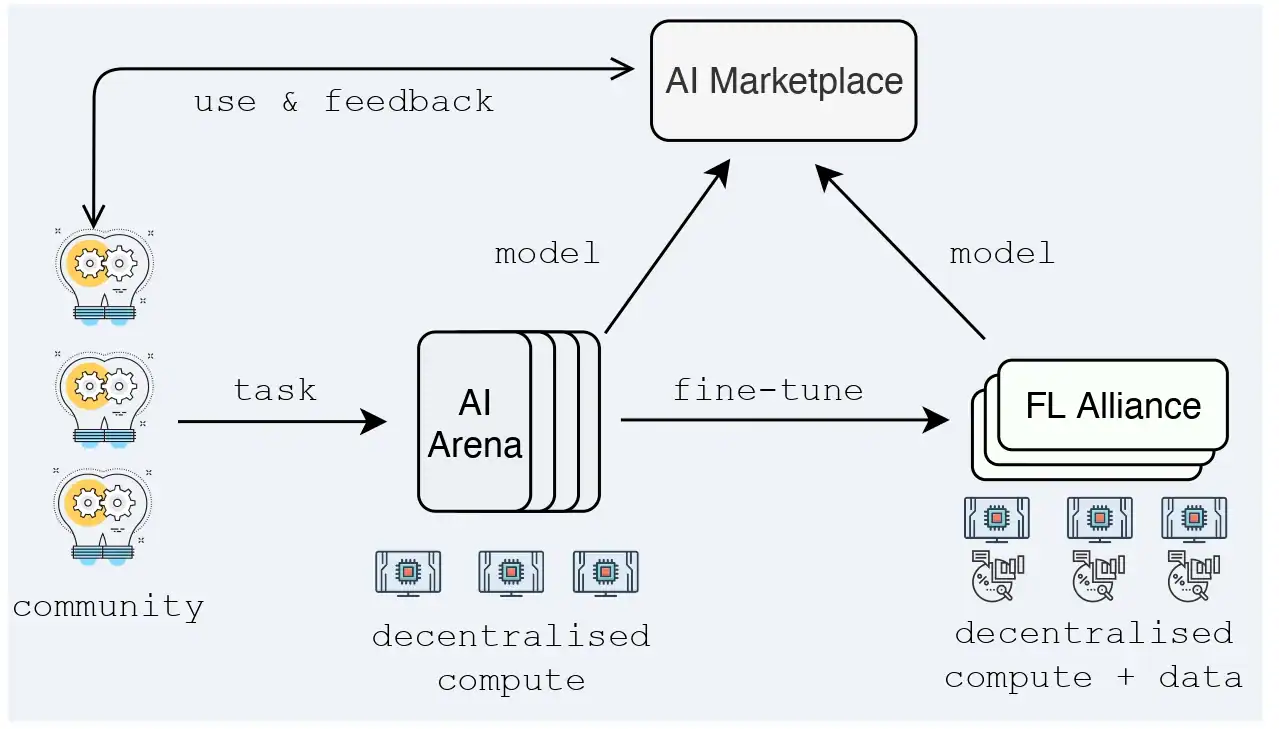
At the heart of FLOCK.io lies an ingenious design that merges federated learning with blockchain architecture to create a virtuous cycle of AI development. This system is designed to be robust, transparent, and participatory, allowing the collective power of a community to drive the evolution of increasingly sophisticated and ethical AI models. To understand how it works, we must break down the roles of participants and the processes that run within the platform.
The FLOCK ecosystem is based on the interaction of several key stakeholders, each with a specific role and motivation to participate. These are primarily Data Contributors, who, by maintaining their data in their own local environments, agree to participate in the training of AI models.
Then there are the Model Developers, individuals or teams who propose model architectures and initialize them for training on the platform. Network Validators are crucial in ensuring the integrity of the training process and the quality of the models, acting as gatekeepers of the system. Finally, AI Users benefit from the trained models, either by using them directly or integrating them into their own applications.
Start of the development process
The AI development process at FLOCK begins when a developer proposes a model. This initial model is distributed to a select set of data contributors who possess relevant training information.
Furthermore, the data never leaves these contributors' local environments; instead, the AI learns directly from them. The model is trained locally on the contributors' devices, and only updates to the model's weights and parameters, which are anonymous and encrypted aggregations, are sent back to a coordinator or the blockchain network.
This is where blockchain plays a pivotal role. Model updates received from contributors are aggregated and consolidated using the blockchain's cryptographic and consensus mechanisms. This ensures that the aggregation process is transparent and that the provenance and validity of the updates can be verified. Each contributor, upon sharing their model updates, is rewarded with FLOCK tokens, thus incentivizing their participation and the value they contribute to the ecosystem. The blockchain acts as an immutable record of these contributions and the distributed rewards, ensuring fairness and traceability.
Technology behind FLOCK
FLOCK.io's technological architecture is a sophisticated blend of federated learning and blockchain technology, designed to address centralization challenges in AI.
Federated Learning
This is the cornerstone of decentralized AI training in FLOCK. Unlike traditional centralized learning, where all data is collected on a server to train a single model, In Flock, federated learning allows training to occur in a distributed manner.
This means the data resides locally on users' devices or on their own servers. Furthermore, the AI model is sent to these devices, trained using the local data, and only updated model parameters (gradients, weights) are sent back to a centralized server or, in the case of FLOCK, added and validated on the blockchain.
This not only preserves data privacy, but also reduces bandwidth and storage requirements, enabling training on massive and diverse data sets that would otherwise be impossible to centralize. FLOCK uses this technology to build AI models on heterogeneous data without exposing sensitive participant information.
Blockchain as a Coordination and Governance Platform
Blockchain technology serves as the backbone of FLOCK, providing the infrastructure to coordinate the federated learning process and manage ecosystem governance and rewards.
At the same time, the blockchain records interactions between participants. It is used to identify contributors of available data, distribute initial versions of models, securely receive model updates, and verifiably add these updates.
Transparency, auditability and tokenomic sustainability
Every step of the training process, from model proposal to contributor rewards, is recorded on the blockchain. This creates an immutable and transparent record that can be audited by any participant, ensuring the integrity of the system.
This is where the FLOCK token comes into play. It is used to incentivize participation. Data contributors who actively participate in training, developers who propose high-quality models, and validators who secure the network receive token rewards. These tokens are also used for governance, allowing holders to vote on proposals and the future development of the platform.
Conflict Resolution and Validation
Blockchain provides mechanisms for resolving disputes and validating the quality of model updates. Validators play a key role here, ensuring that submitted updates are correct and non-malicious, often using proof-of-stake mechanisms or reputation systems.
Advanced Cryptography
To ensure privacy and security, FLOCK employs various cryptographic techniques. In addition to the inherent features of the blockchain, methods such as zero-knowledge proofs or homomorphic encryption can be used optionally to verify that training was performed correctly on the data without revealing the data itself, or to allow computations on encrypted data.
Model aggregation techniques, such as Secure Aggregation of Gradients, ensure that individual updates are indistinguishable once combined.
Together, these technologies create a system where AI development is a community-based, safe, and ethically aligned process. Artificial intelligence learns from real, diverse data, while the owners of that data remain in control and are rewarded for their contributions.
 Certificate

Introductory course to DeFi
Medium levelTime to update. Traditional finance has changed, discover the revolutionary ecosystem of decentralized finance (DeFi).
FLOCK Tokenomics
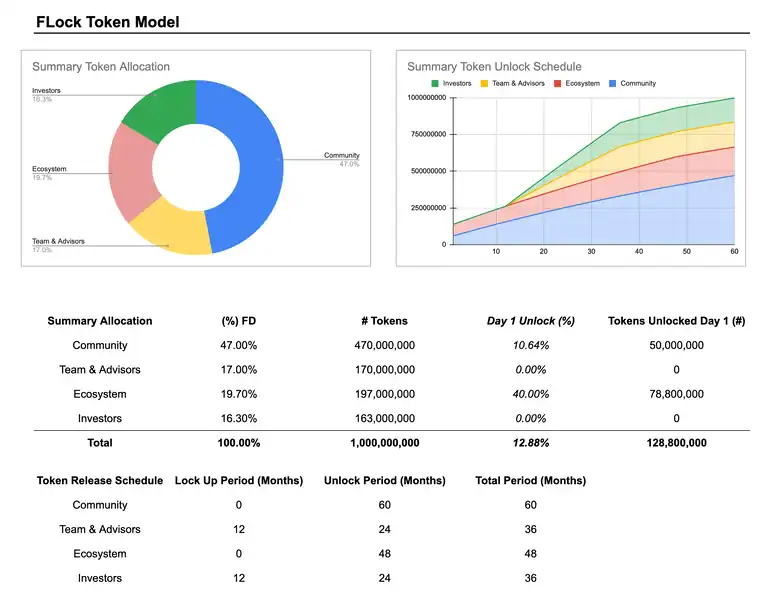
La tokenomics FLOCK.io is the economic engine that drives its decentralized ecosystem, incentivizing participation, facilitating governance, and creating sustainable value for its users and contributors. The FLOCK token is not merely a cryptocurrency, but an essential tool for the operation and evolution of the platform.
The design of tokenomics seeks to align the interests of all participants, from data providers to developers and validators, creating a virtuous cycle where contributions generate rewards, and rewards enable greater participation and governance.
Token and FLOCK issuance
The FLOCK token is the unit of account and medium of exchange within the FLOCK.io ecosystem. Its issuance and distribution are designed to foster the organic growth of the network and reward those who contribute to its development and security.
Thus, among the purposes of the FLOCK token are:
- Participation Incentive: Data contributors receive FLOCK tokens for providing their computational resources and data for training AI models and for the quality of their contributions.
- Reward to Developers and Validators: Developers who propose innovative and valuable models, and validators who ensure the integrity and security of the network, are also rewarded with FLOCK tokens.
- Governance: The FLOCK token grants its holders the right to participate in decision-making regarding the future of the platform. This includes voting on improvement proposals, changes to protocol parameters, or the selection of AI projects to prioritize.
- Access to Services: In the future, FLOCK tokens may be required to access certain premium services on the platform, such as advanced development tools or the ability to deploy specific AI models.
- Issuance and Supply: The total supply of FLOCK tokens is defined at the project's inception. The issuance of new tokens is carried out through various mechanisms, all controlled and transparent via the blockchain and smart contracts.
- Participation Rewards: A significant portion of new tokens are issued to reward data contributors, developers, and validators for their activities on the network. The amount distributed is based on contribution metrics, such as the amount of data used, the quality of model updates, and validation activity.
- Launch Phase/ICO/Airdrops: An initial portion of the supply may have been distributed through token sales (ICO, IDO), to early investors, or through airdrop campaigns to encourage adoption and initial distribution of the token.
- Stabilization Mechanisms: Depending on the design, there may be mechanisms to control inflation or volatility, such as token burning in certain transactions or through buyback mechanisms. The supply could be fixed, inflationary, or deflationary, depending on the economic strategy defined by the project.
The goal is for token issuance to be intrinsically tied to network growth and activity, ensuring that token value increases as the platform gains traction and utility.
FLOCK Staking
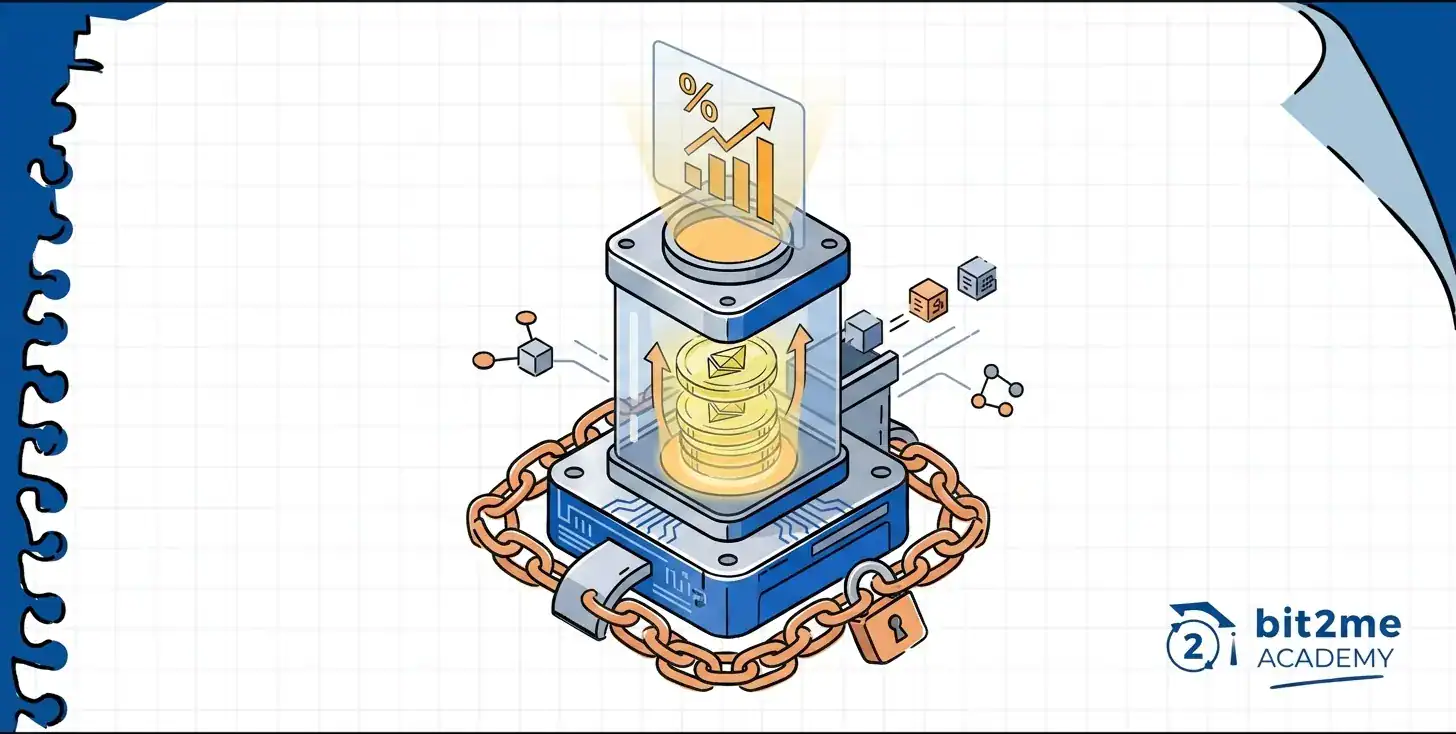
El staking FLOCK token staking is a key feature that enhances the security and decentralization of the network, while providing token holders with a way to generate passive income and actively participate in the ecosystem.
- Staking Mechanism: FLOCK token holders can choose to stake their tokens, that is, lock them into a specific smart contract on the FLOCK blockchain. By doing so, they become potential validators or delegate their validation power to other validators.
- Selection of Validators: In a model of Proof-of-Stake (PoS)Validators who stake a significant amount of FLOCK tokens are chosen to propose and validate new transaction blocks on the blockchain. The probability of being chosen is typically proportional to the amount of staked tokens.
- Staking Rewards: Validators who actively and honestly participate in the network consensus are rewarded with a share of the network's transaction fees and/or newly issued FLOCK tokens. These rewards are an incentive to keep the network secure and operational.
- Slashing (Penalty): To ensure honesty, validators who act maliciously (for example, attempting to validate fraudulent transactions or being offline for extended periods of time) may be subject to "slashing," which results in the loss of some or all of their staked tokens. This penalty mechanism discourages dishonest behavior and protects the integrity of the network.
- Stake Delegation: Token holders who do not wish to run a full validator node can choose to delegate their tokens to trusted validators. In return for this delegation, they receive a share of the validator's rewards, less a fee. This democratizes participation in network security, allowing even small token holders to contribute and benefit.
- Additional benefits: Staking FLOCK may offer additional benefits, such as increased voting power in governance, priority access to certain platform features, or discounts on transaction fees.
Governance
Decentralized governance, on the other hand, is a cornerstone of FLOCK.io, designed to empower the community and ensure that the platform's development evolves according to the needs and values of its users. The FLOCK token is the primary vehicle for exercising this governance power.
Additionally, any FLOCK token holder, or a collective group holding a minimum amount of tokens, can submit proposals for platform improvements or modifications.
FLOCK Use Cases
FLOCK.io's versatility and innovative approach open up a range of possibilities for its application in diverse sectors, democratizing access to advanced AI and fostering the creation of more ethical and personalized models. By enabling the training of AI models on distributed data without compromising privacy, FLOCK becomes an ideal solution for scenarios where data is sensitive, fragmented, or subject to strict regulations.
- Personalized Health and Medicine: In the healthcare sector, patient data privacy is paramount. In this case, FLOCK enables the training of medical diagnostic models, predictive disease analysis, and personalized treatments using medical records from multiple hospitals or clinics without the data ever leaving the institutions. This could accelerate the discovery of cures, improve diagnostic accuracy, and offer tailored therapies for each individual, while scrupulously respecting patient privacy. For example, a hospital could collaborate with other research centers to train a model that detects cancer patterns in medical images, without sharing individual patient images.
- Finance and Fraud Detection: Financial institutions handle large volumes of sensitive transactional data. FLOCK can be used to train fraud detection, credit risk assessment, or market analysis models, aggregating intelligence from diverse financial sources without sharing raw transactional data. This enables the creation of more robust and efficient security systems, improving protection against illicit activities and optimizing investment decisions, all while complying with financial data privacy regulations.
- Autonomous Vehicles and Smart Cities: The development of autonomous vehicles requires the analysis of vast amounts of data from sensors, cameras, and driving systems collected by thousands of vehicles. FLOCK facilitates the training of perception and decision-making models for autonomous driving, learning from the experience of a fleet of vehicles without the need to transfer travel data from each car. Similarly, in smart cities, data on traffic, energy consumption, or mobility patterns can be used to optimize urban infrastructure and services through federated learning in FLOCK, while preserving the privacy of citizens.
- Language Model Training and General AI: The creation of advanced language models, more capable virtual assistants, or general-purpose AI all benefit greatly from massive amounts of text and dialogue data. FLOCK allows the community to contribute text snippets, interactions, and other language data to refine these models, ensuring that conversational AI development is more inclusive and less susceptible to the biases inherent in centralized datasets.
In each of these use cases, FLOCK.io not only enables the development of advanced AI, but does so in a way that respects privacy, fosters community collaboration, and democratizes control over the technology, laying the groundwork for a future where AI truly serves everyone's needs.
 Author