Essential Points
- MiCA is Regulation (EU) 2023/1114: common European rules for crypto assets and for companies that provide services with them.
- It has been in effect since December 30, 2024, and the Spanish transition period ended on July 1, 2026, according to the CNMV.
- It distinguishes three types of crypto assets (other, ART and EMT) and does not cover financial instruments, which follow other rules.
- It does not eliminate the risk of loss: before trading, check that the provider is registered with the CNMV or ESMA.
The MiCA law is the popular name for Regulation (EU) 2023/1114, the European regulation on markets in crypto-assets, which establishes the same rules for issuing, offering, and trading crypto-assets and for providing services with them in all EU countries. Although it is called a law, it is a regulation: it applies directly in each member state, and therefore affects a company in Madrid just as much as one in Berlin.
The text was published in the Official Journal of the European Union on June 9, 2023, according to the European Commission, and came into effect on December 30, 2024, according to the CNMVIn Spain, the transitional period for companies already operating ended on July 1, 2026, so that as of October 26, 2026, only entities authorized by the CNMV or another European authority can provide services with crypto assets.
That doesn't mean MiCA regulates everything. It excludes financial instruments, unique NFTs, and fully decentralized services, and it's not the regulation that requires you to identify yourself when opening an account, because that obligation comes from European anti-money laundering rules, which apply to the same companies but have their own specific text.
 Certificate
What is the MICA law and why is it called a Regulation?
The acronym refers to a specific text, Regulation (EU) 2023/1114, which you can read in full at EUR-LexIn English they mean Markets in Crypto-Assets, or crypto-asset markets; the nickname of law comes from custom, because the legal form chosen is that of a regulation.
The difference is not just in name. A European regulation applies directly in all member states, without each country having to approve its own version, and that is precisely the idea: a single rule for the entire Union market, instead of a patchwork of different national frameworks.
According to European CommissionMiCA covers crypto-assets and related services and activities not already regulated by another European financial services regulation. The Commission itself lists four objectives:
- inform customers and prospective holders of the features, functions and risks of crypto assets;
- to set organizational, operational and prudential requirements for issuers and providers, to support market integrity and reduce fraud;
- address market abuse and demand cybersecurity procedures to combat cyber risks;
- to place suppliers under the anti-money laundering framework as obligated entities.
In practice, the Regulation targets two groups: those who issue or offer crypto assets to the public and those who provide services with them, such as exchanges or custody platforms. You, as a user, have no obligations under MiCA for holding or moving crypto assets, because those obligations fall on the companies.
You can find a country-by-country map of Bitcoin's legal status at Is Bitcoin legal?where MiCA is just one more piece; here the main interest is how the European piece is constructed and what changes for someone who uses a supplier in Spain.
When does MiCA apply and what happened to the transition periods?
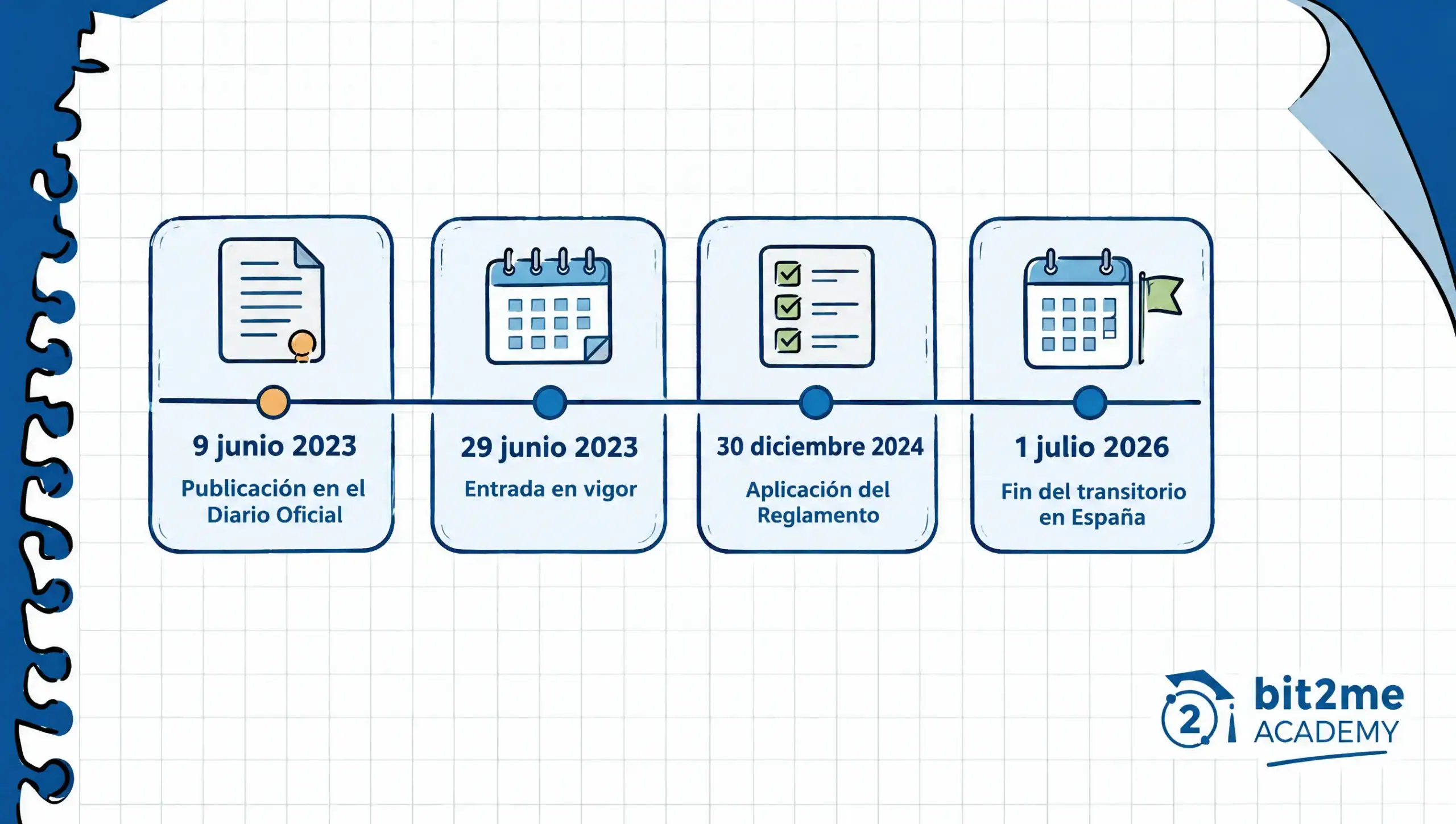
MiCA did not come into effect on the day it was published, and this difference matters because entering into force is not the same as being applied. According to the European Commission, the Regulation was published in the Official Journal on June 9, 2023, and entered into force on June 29, 2023, while according to the CNMV (Spanish National Securities Market Commission), it came into effect on December 30, 2024.
Between the application of the regulation and the reality of the market, there is a piece that almost no one remembers: the transition period. The CNMV explains that the Regulation allows Member States a period of up to 18 months for entities that already provided services with crypto assets under national regulations, and that in Spain this period ended on July 1, 2026.
Entities registered with the Bank of Spain by December 30, 2024, could continue operating until that date, or until their registration was denied if that occurred earlier. After that date, only those that had obtained MiCA authorization could continue providing services in the country.
The table lists the key dates to keep on hand, each with its source. The last row shows the closing date of a review consultation, indicating the deadline for the European Commission to seek feedback on how the Regulation works.
| Date | Milestone | Source |
|---|---|---|
| 9 June, 2023 | Publication of Regulation (EU) 2023/1114 in the Official Journal of the EU | European Commission |
| 29 June, 2023 | Entry into force | European Commission |
| December 30th 2024 | Entry into force of the Regulation | CNMV |
| July 1, 2026 | End of the transition period in Spain | CNMV |
| 30 September 2026 | Closing of the targeted consultation on the MiCA review | European Commission |
From July 1, 2026, according to the CNMV (Spanish National Securities Market Commission), only providers authorized by the CNMV or other European authorities can operate in Spain. This means that a company name on its website is not enough, and that authorization is verified in the... CNMV register of crypto asset service providersnot in their advertising.
What crypto assets does MiCA regulate?
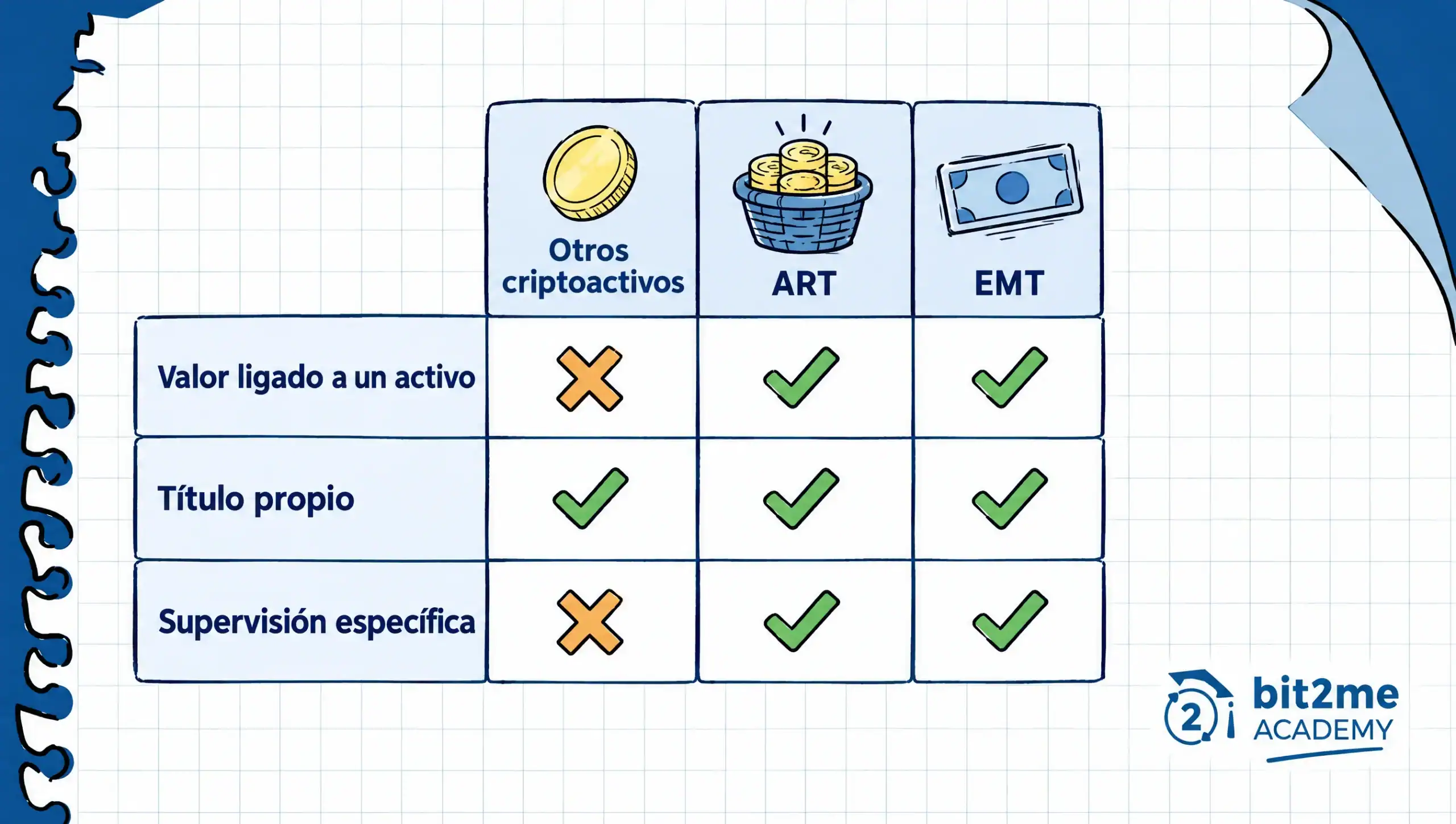
The Regulation divides crypto assets into three groups according to how they attempt to maintain their value, and each group has its own title and authority. According to the CNMV (Spanish National Securities Market Commission), asset-referenced tokens (ARTs) stabilize their value against other assets or pools of assets, and e-money tokens (EMTs) are referenced to the value of an official currency.
Everything else falls into the category of other crypto assets, which the CNMV illustrates with examples such as Bitcoin and Ethereum. Utility tokens are also included in this category. This distinction is important because each group is subject to a different section of the Regulation and is overseen by a different authority in Spain.
The table summarizes what each type is, which title of the Regulation it fits into and who supervises it in Spain, based on what the CNMV publishes on its page about MiCA.
| Type | What is | Title of the Regulations | Who supervises in Spain | Source |
|---|---|---|---|---|
| Other crypto assets | Those that are neither ART nor EMT, such as Bitcoin, Ethereum, or utility tokens | Title II | CNMV | CNMV |
| ART | They stabilize their value against other assets or sets of assets | title III | Bank of Spain, for issuers | CNMV |
| EMT | They are referenced to the value of an official currency, such as stablecoins pegged one-to-one to the euro or the dollar. | Title IV | Bank of Spain, for issuers | CNMV |
The fact that Bitcoin is cited as an example of other crypto assets does not mean that the Regulation treats it as a business product. What MiCA requires authorization for is the activity of those who provide services with it, and the CNMV, which is the competent authority for monitoring compliance, is also responsible for Title II regarding issuance and admission to trading.
The three groups share an information tool: the white paper, a document that accompanies each cryptocurrency and describes its characteristics. The CNMV (Spanish National Securities Market Commission) requires providers to publish links to their white papers on their websites, so you can read them before investing.
Stablecoins are the natural habitat for ARTs and EMTs, but it's best not to define which ones fit in a single article, because the list changes with each issuer authorization. For specific and up-to-date examples, see Academy's guide on stablecoins. euro-pegged stablecoins adapted to MiCA It's the best place to look.
What does MiCA leave out, and what about NFTs and DeFi?
What MiCA doesn't cover is just as important as what it does cover, because a crypto asset not covered by the Regulation may still be subject to other, albeit different, rules. The European Commission clarifies that MiCA is limited to what is not already regulated by another European financial services regulation, and according to the CNMV (Spanish National Securities Market Commission), financial instruments covered by the MiFID II directive are excluded.
NFTs are the case that generates the most questions. According to the consultation document that the Commission published in 2026 to review MiCA, Article 2.3 excludes unique crypto assets that are not fungible with other crypto assets, although the exclusion is not total: NFTs from a series or collection may fall within the scope of the Regulation.
With decentralized finance (DeFi), the nuance is different. Recital 22 excludes crypto asset services provided in a fully decentralized manner and without intermediaries, as summarized by the Bank of Spain in an article in its 2023 Financial Stability Review, and the CNMV acknowledges that current regulations do not cover all DeFi activity.
It's important to read that exclusion literally: it refers to services without intermediaries, not just any service that uses smart contracts. To find a specific example, you can ask yourself three questions in this order, as editorial guidance from Academy and not as a legal assessment:
- Is it a financial instrument regulated by MiFID II? If so, it falls outside the scope of MiCA.
- Is it a unique, non-fungible NFT? If so, it's excluded unless it's part of a series or collection.
- Does it operate in a completely decentralized manner and without intermediaries? If so, recital 22 excludes it.
If none of the three answers are yes, the cryptocurrency most likely fits into one of the three groups in the previous section. The table sorts what falls inside and outside the group, with the source for each row.
| Subject: | Does MiCA cover it? | What regulates it? | Source |
|---|---|---|---|
| Other crypto assets, ART and EMT | Yes | Mica | CNMV |
| MiFID II Financial Instruments | No | Financial markets regulations | CNMV |
| Unique and non-fungible NFTs | No, with nuances for series and collections. | Article 2.3 of MiCA | European Commission |
| Fully decentralized services without intermediaries | No | Considering 22 of MiCA | Bank of Spain |
| Anti-money laundering and Travel Rule | No | Regulation (EU) 2023/1113 and anti-money laundering legislation | EBA |
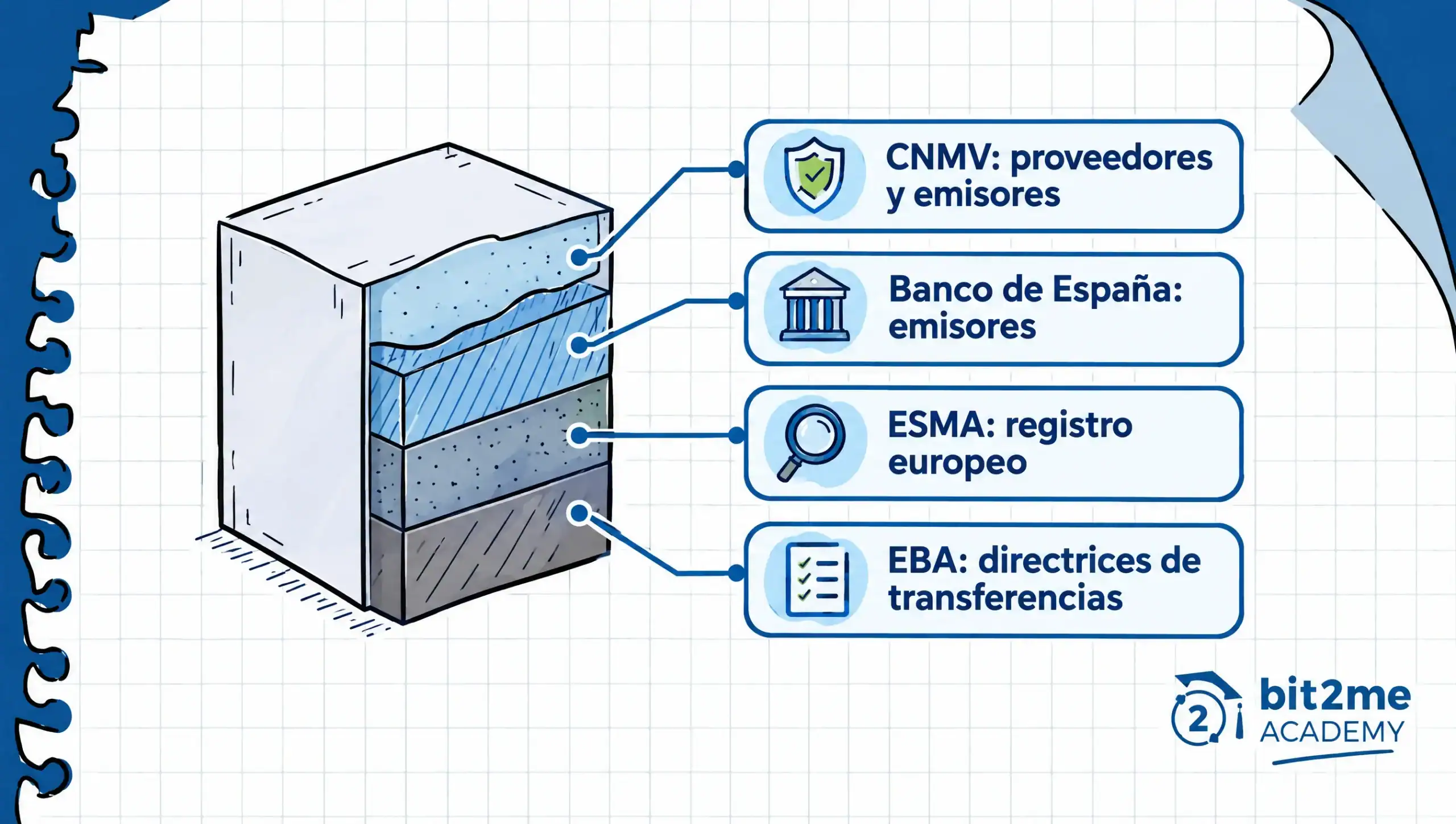
The last row is often confusing. Anti-money laundering rules and the Travel Rule are governed by other regulations, including Regulation (EU) 2023/1113, and suppliers must comply with them in addition to MiCA, according to the CNMV (Spanish National Securities Market Commission). The EBA (European Banking Authority) published guidelines on this rule on July 4, 2024, applicable from December 30, 2024.
These guidelines explain how payment and cryptocurrency providers should detect missing information in a transfer and what to do in that case. If you want to understand why you're asked for information when you register, customer identification explains it. What is KYC? and anti-money laundering controls, What is AML?.
What obligations do crypto asset service providers have, and who supervises them?
The Crypto-Asset Service Provider (CASP), abbreviated as PSC by the CNMV (Spanish National Securities Market Commission), is the company that provides crypto-asset services to its clients. It is the central subject of the Regulation: it requires authorization from the CNMV or another competent EU authority, and licensed financial institutions submit a notification rather than requesting it.
Supervision is distributed. In Spain, the CNMV is the competent authority for monitoring compliance with MiCA, and the Bank of Spain supervises ART and EMT issuers. At the European level, ESMA publishes a register of providers that the CNMV recommends consulting, and the EBA publishes the Travel Rule guidelines mentioned earlier.
The CNMV summarizes what MiCA requires of these companies in a list that should be read carefully, because it defines what you can ask of them as a customer and what should appear on their website before you contract anything with them:
- Prices, costs and fees are published on their website, with links to the white papers of the crypto assets they offer.
- Clear and non-misleading information, with a warning of the risks.
- Defined internal governance, with management of conflicts of interest and a grievance procedure.
- Customer funds safeguarded and an orderly liquidation plan.
- Compliance with anti-money laundering regulations and IT resilience requirements.
There are two nuances that prevent misunderstandings. The first is that the list describes obligations for companies, not a specific outcome for you: MiCA does not eliminate the risk of loss or price fluctuations, and the CNMV warns that anyone who contracts with an unauthorized entity is outside the scope of the Regulation's supervision and protections.
The second point is that these protections apply only to the legal entity authorized in the EU, and not to other companies within the same group. The brand you see in an application may belong to a group with several companies, so it's important to check which one is registered and which one appears in your contract.
The CNMV also publishes a list of entities under warning, meaning companies about which it has issued an advisory, and recommends consulting this list along with the relevant registers before trading. If a company does not appear on any register, the practical conclusion is not to send it funds until the situation is clarified.
Current status of MiCA in October 2026
MiCA is fully applicable as of October 26, 2026, and the Spanish transition period is closed: according to the CNMV, only providers authorized by it or another European authority operate in Spain, and checks are carried out in their supplier registration and in the ESMA record.
What is still underway is the review, and it is important to carefully distinguish what is in force from what is only a consultation or proposal, according to what is stated in the pages of the European Commission about crypto assets and about their review consultation:
- In force: Regulation (EU) 2023/1114, applicable from 30 December 2024, with the Spanish transition period closed from 1 July 2026.
- Under review: a public consultation and a targeted consultation, opened on May 20, 2026 and closed on August 31 and September 30, 2026, to prepare the report on Articles 140 and 142.
- Proposed: the market integration and supervision package that the Commission presented on December 4, 2025, which is a legislative proposal and not a rule in force.
The report under Articles 140 and 142 may be accompanied, if the Commission deems it justified, by a legislative proposal to amend the Regulation, and its consultation page does not indicate a publication date for that report. We will have to wait for its processing to know if anything changes, and in the meantime, the MiCA rules you just saw remain in force.
Direct verification in the official register is more reliable than the date of any article, including this one, and the data in this section were verified on October 26, 2026 on the cited pages.
What should you check about a supplier under the MiCA law?
The MiCA law regulates the market from the company's perspective, so the most useful thing you can do as a user is to check who you're entrusting your crypto assets to. Look up the company's legal name in the CNMV or ESMA registry, verify that the entity listed in the contract is the authorized one, and consult the list of entities warned against by the ESMA. CNMV.
What falls outside the scope of the Regulation also lacks the oversight that MiCA provides to authorized providers, so when faced with a single NFT or a service without an intermediary, it's advisable to ask which regulation covers it before signing up. Furthermore, an authorization is neither a recommendation nor a promise regarding price.
To do it calmly, the Academy guide on the cryptocurrency exchange regulated in Spain It explains what to look for before opening an account. The regulations are under review, so it's advisable to check official sources periodically rather than relying on a fixed date.

Frequently Asked Questions about the MiCA Act



 Author