- Payments without "Fees": Forget about buying extra tokens just to move your money around. Plasma allows USDT transfers with zero fees and the option to pay for gas with other stablecoins you already have in your wallet.
- Speed, Security over Bitcoin: Thanks to the PlasmaBFT engine, transactions are confirmed in less than a second. Furthermore, the Plasma network anchors its history in the Bitcoin blockchain, inheriting the security of the world's most robust network.
- Liquidity from day 1: The project doesn't start from scratch; it's born with $2 billion in liquidity and the backing of industry leaders, guaranteeing a solid and reliable ecosystem.
- Developer Ready (EVM)It is fully compatible with Ethereum tools. Any existing application can migrate to Plasma without changing its code, leveraging an infrastructure designed exclusively for the massive flow of digital dollars.
What is Plasma (XPL)?
Plasma (XPL) is a Layer 1 blockchain specifically designed to optimize global payments with stablecoinsOperating under an architecture fully compatible with the Ethereum Virtual Machine (EVM), the project is led by its CEO and co-founder, Paul Faecks, who leads a team of 30 professionals with experience in leading companies such as Apple, Microsoft and Goldman Sachs.
Plasma's origins are marked by strong institutional backing, including Tether CEO Paolo Ardoino, Peter Thiel's Founders Fund, and Framework Ventures. Its main network entered beta on September 25, 2025, quickly positioning itself as a specialized financial infrastructure for the new era of digital money.
A space dedicated to stablecoins
Plasma's fundamental objective is to establish itself as "the best possible home for stablecoins"solving critical problems of general-purpose networks such as Ethereum These traditional networks were not built to meet the specific demands of digital dollars, resulting in high transaction fees, a complex user experience, and the need to hold additional volatile tokens to pay for gas. Plasma addresses these shortcomings by integrating stablecoin support directly into the core of its protocol, enabling near-instant settlements and removing the technical barriers that limit the everyday use of these assets.
Plasma's importance lies in revolutionary features such as its zero-fee USDT transfers, made possible by an integrated paymaster system that covers gas costs for users. Furthermore, the protocol allows the use of custom gas tokens, meaning users can pay for more complex transactions with the same assets they already own, such as USDT or pBTC, without needing to acquire the native XPL token. The network also stands out for its robust security. Bitcoinbecause it periodically saves its transaction history on said blockchain to offer institutional-grade protection.
Therefore, since its launch, Plasma has demonstrated its relevance by having $2 billion in liquidity and partnerships with giants in the DeFi sector such as AaveEthena and Fluid. Its economy is based on the native token XPL, which is the heart of the Plasma network.
Ultimately, Plasma is important because it establishes a specialized financial rail that combines the robustness of Bitcoin with the flexibility of smart contracts to efficiently and scalably process massive volumes of digital payments.
 Certificate
How does Plasma (XPL) work?
The core of Plasm's (XPL) operation resides in its consensus layer called PlasmaBFTwhich is based on the protocol Fast HotStuff Byzantine Fault Tolerant (created in 2022) to guarantee safety even in the face of bad behavior by some participants.
This consensus layer optimizes speed by running the block proposal, voting, and confirmation steps in parallel rather than sequentially, allowing a transaction finality to be achieved in a matter of seconds.
Complementing this process, Plasma's runtime layer runs on About, an Ethereum client written in Peace which handles state changes and EVM logic. This architecture allows developers to use Solidity and standard Ethereum tools seamlessly, while the efficiency of its layers enables rapid settlement of operations.
Thanks to this design, the network can offer advanced features such as fee-free USDT transfers via a paymaster system that covers gas costs, as well as the ability to use custom gas tokens so users can pay fees with stablecoins they already own. Finally, the infrastructure supports a Bitcoin bridge that allows for the conversion of BTC to 1:1 backed pBTC, securely integrating this asset into smart contracts through a threshold signature scheme.
XPL Tokenomics
Plasma's economy is based on its native asset, XPL, which has an initial supply of 10 billion tokens (initial issuance). The final issuance is infinite because the token is inflationary, due to the scheme of Proof of Stake which uses its PlasmaBFT-based network.
This asset fulfills fundamental functions similar to those of Ethereum or Bitcoin, acting as the necessary resource to pay transaction fees in complex operations. XPL's relationship with stablecoin mobilization is unique: Although the network allows USDT transfers with zero fees for the end user through a "paymaster" system that sponsors gas, the protocol uses XPL in the background to cover network services.
Furthermore, even when users choose to pay fees in custom gas tokens such as USDT or pBTC, the system is designed to make using these stablecoins quick and easy.
Token distribution
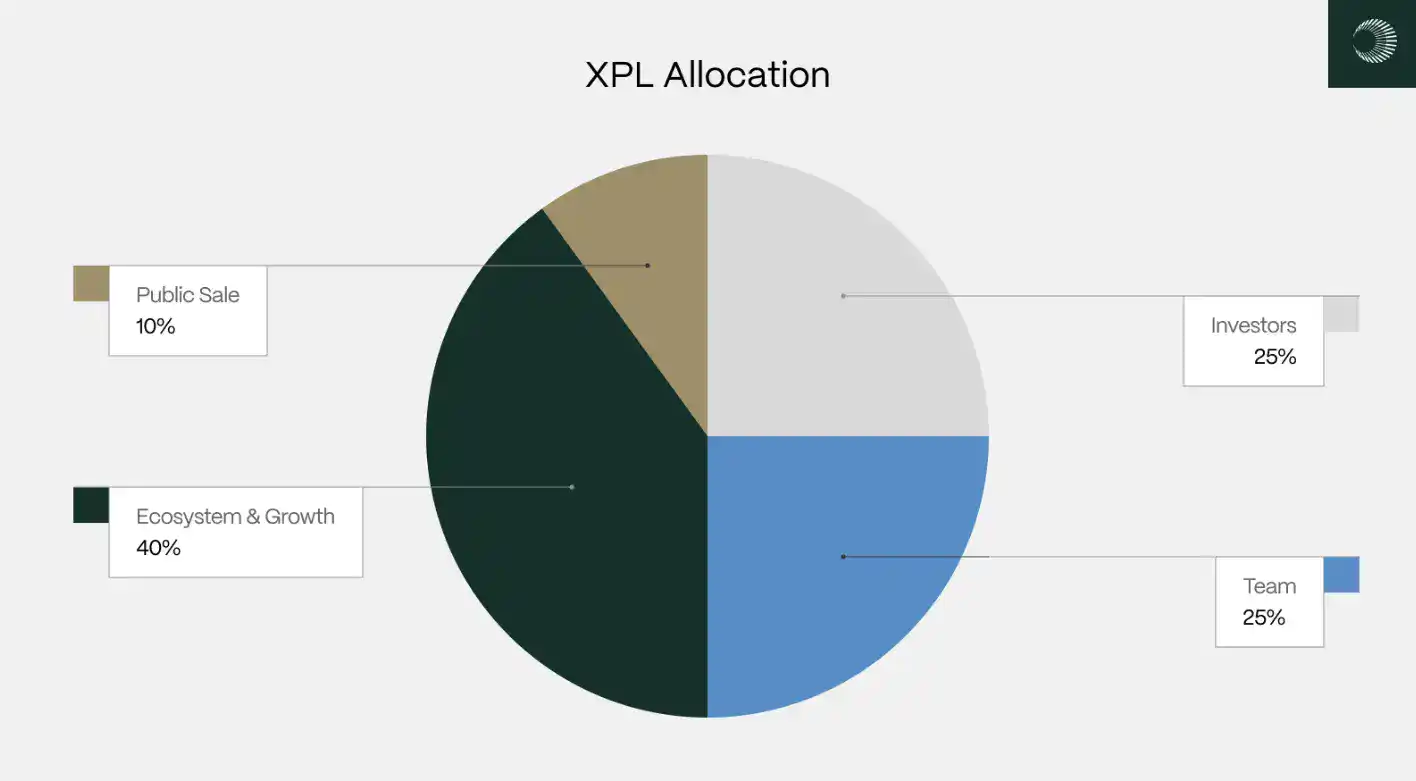
Regarding token distribution, the model aims to balance incentives between institutional development and community participation. 40% of the total supply (4 billion XPL) is reserved for ecosystem growth, with 8% unlocked at launch for DeFi incentives and the remainder released monthly over three years. The community received 10% (1 billion XPL) through a public sale that raised $373 million, where buyers outside the US gained immediate access at launch, while US buyers faced a 12-month lock-up period.
On the other hand, the development team and initial investors each have a 25% allocation, totaling the remaining 50% of the offering. To ensure a long-term commitment, both the team and investors are subject to a one-year cliff period, followed by a prorated monthly release over the next two years, with full unlocking occurring three years after the mainnet launch.

A before and after in the stablecoin sector
Plasma (XPL) marks a turning point in the crypto industry by offering a network where stablecoins are the true protagonists, not merely secondary assets. By shifting the focus from speculation to real-world utility, the protocol overcomes the most persistent barrier of Web 3: operational friction. Eliminating the need to hold volatile tokens to cover "gas," thanks to its innovative paymaster system and custom gas tokens, radically transforms the user experience, making sending digital dollars as intuitive and straightforward as any traditional financial application.
Beyond its ease of use, Plasma's proposition is strengthened by a cutting-edge technical architecture. The implementation of PlasmaBFT consensus ensures near-instantaneous finality, while its security anchoring to the Bitcoin blockchain provides institutional-grade robustness that few Layer 1 solutions can claim. This balance between the agility of the EVM and the immutability of Bitcoin creates an ideal environment of trust for both retail users and large financial institutions.
Ultimately, Plasma's success lies not only in its technology but also in a balanced economic model. The XPL token acts as the silent engine of this ecosystem, even when users operate exclusively with stablecoins. With top-tier institutional backing and liquidity already in the billions, Plasma is establishing itself as the definitive infrastructure for digital money to finally achieve everyday, global, and borderless use, leading the transition to a truly scalable programmable economy.

 Author