Essential Points
- Reental tokenizes real estate projects; RNT is a different, utility token that does not represent ownership of any property.
- RNT has a fixed supply of 200 million, runs on Polygon PoS, and, according to its whitepaper, is already fully deployed.
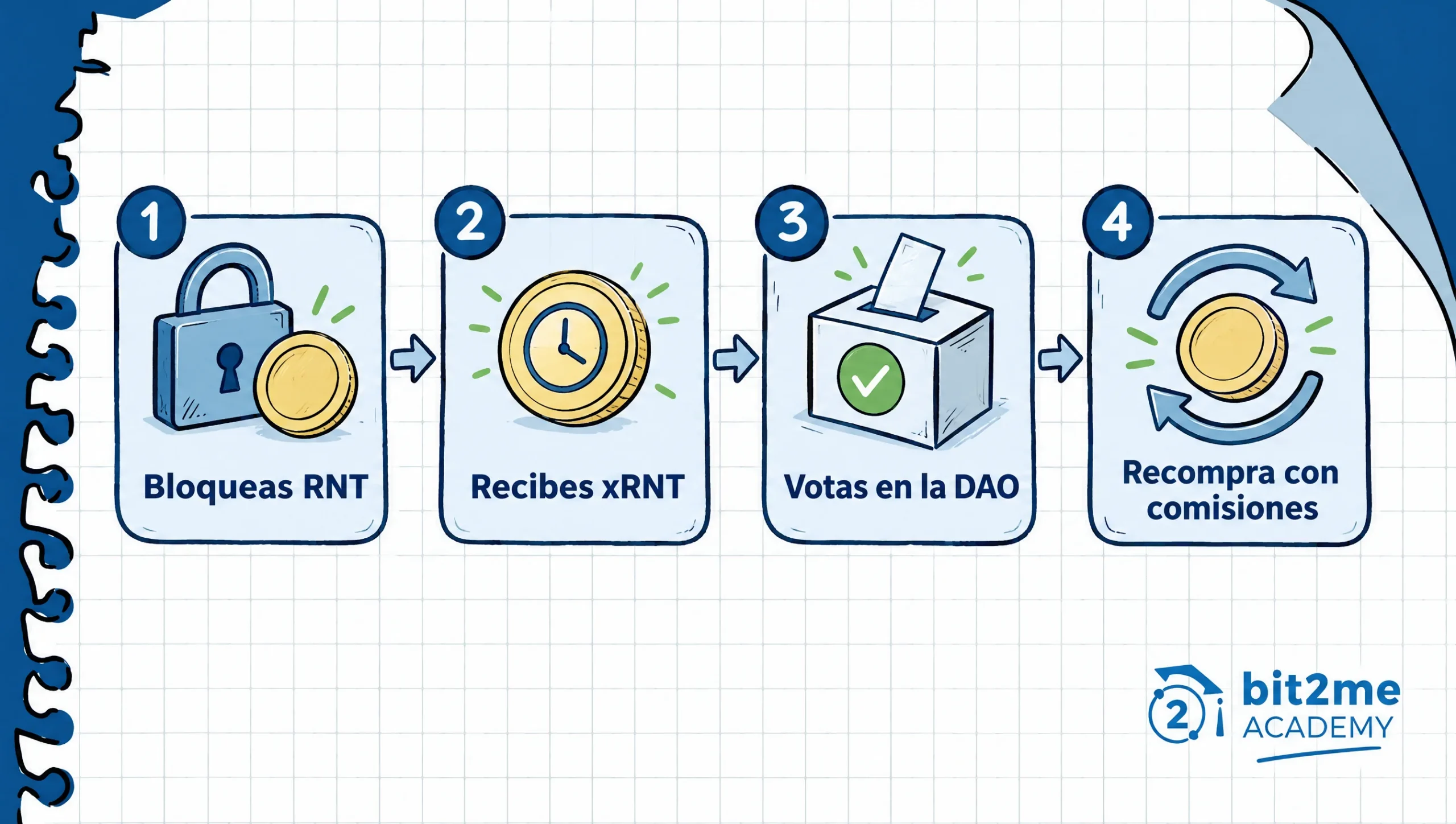
- By blocking RNT you receive xRNT, which gives voting rights in the DAO and access to levels; no reward or buyback is guaranteed.
- Project tokens can cost capital and liquidity, and the legal framework varies between Spain, the United States, and the EU.
Reental is a real estate tokenization platform that converts projects like flats or apartments into tokens that a verified user can buy and sell within its ecosystem, and RNT is the utility token used to organize access levels, voting, and commission distribution. According to the RNT Protocol 2026 whitepaperThe RNT supply is set at 200.000.000 units, issued in 2023 and already fully distributed, and the Rental website It estimated that there were 128 tokenized projects as of November 1, 2026.
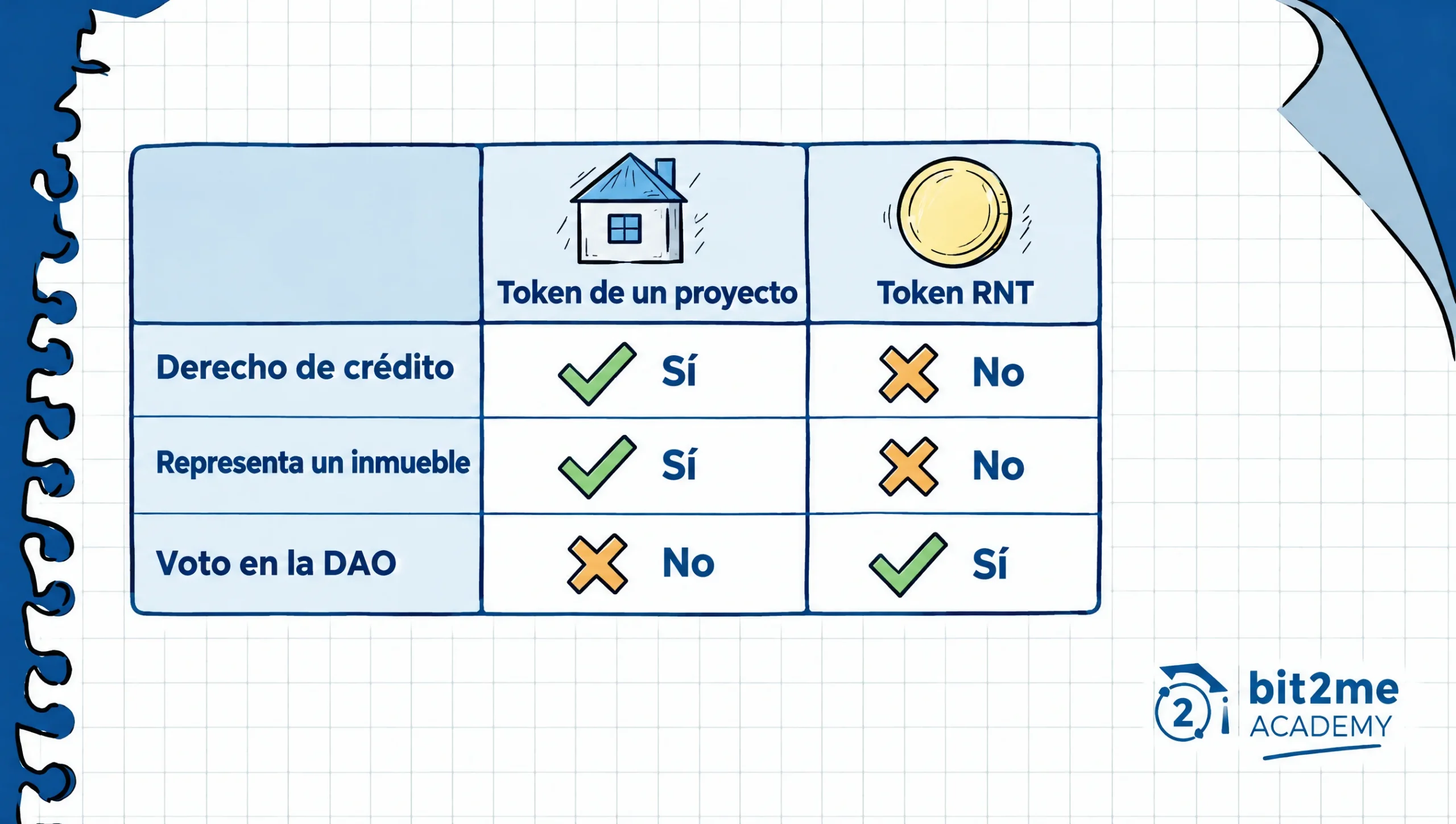
It's important to distinguish between two things that are often confused. On the one hand, there's the token for each real estate project, which, according to the company itself, is offered as a negotiable security subject to securities market regulations. On the other hand, there's RNT, which, according to its documentation, doesn't represent ownership of any property nor does it grant economic rights to a specific project. Each has different rules, rights, and risks, and mixing them leads to expecting from one what only the other can provide.
Just because a platform works doesn't mean its product is risk-free: a project might not pay out as expected, a token might be difficult to sell, and the value of RNT could plummet. That's why it's important to know what documentation backs each token, which authority oversees it, and who is responsible if something goes wrong. Anything not found in an official company or regulatory source has been omitted.
 Certificate
What is Rental and how does real estate tokenization work?
Tokenization involves representing a right to a real-world asset with a token, recorded on a blockchain. This is the idea behind the category of Real World Assets or RWAIn the case of Rental, the asset is a property that the company selects and operates through rental or sale, and according to the 2026 whitepaper, its first tokenized asset dates back to 2021.
Rental's website and white paper present activity figures that don't entirely match, indicating that each document is updated on different dates. These are data reported by the company, without any independent audit that we could consult, so they serve as a general guideline rather than an exact measurement.
| Declared data | Rental website (Nov. 1, 2026) | RNT Protocol Whitepaper (version 2026) |
|---|---|---|
| Tokenized projects | 128 | 120 |
| Tokenized or captured amount | More than 124 million dollars | 120 million |
| User community | More than 46.000 users | 40.000 users from 100 nationalities |
| First tokenized asset | Not included or provided | 2021 |
That table measures the volume the company reports, not the outcome of any project. Having tokenized many projects says nothing about whether the next one will meet expectations, and the website itself refers to each project's whitepaper to learn about its specific risks.
How does Rental work in practice?
To use Rental you need to register and verify your identity. According to the Frequently asked questions about the platformAnyone over 18 can do this after passing KYC and AML checks, with an identity document and proof of residence. The Academy guide on What is KYC? It explains why regulated platforms are requesting it.
Next, you choose a project from the list, which the website categorizes as "Operating," "Funded," or "Closed." Each listing links to a white paper detailing the property, its legal structure, and the associated risks, and reading this document is the only way to determine your entitlement. The company states that payments come from the property's operation, but no future payments are guaranteed.
The exit option has conditions. According to the same FAQ section, you can sell your tokens to a third party as long as they are verified on the platform, and the site menu mentions a peer-to-peer marketplace. This avoids waiting for the property to sell, but it doesn't guarantee a buyer, or at the price you're looking for.
The general terms and conditions state that they may be modified without prior notice and that, in case of discrepancy with a translation, the Spanish version prevails. Keep a copy of the terms and conditions and the project information sheet on the date you participate.
What is the difference between property tokens and the RNT token?
At Reental, two distinct token families coexist. A project's token represents what the company defines for that issuance. In Spain, according to their FAQs, it represents participation in a tokenized participatory loan whose remuneration depends on the property's operation, with tokens that "represent credit rights against the issuing company."
In the United States, according to the same source, each issuance is made through a limited liability company (LLC) whose shares are tokenized under Regulations D and S. RNT, on the other hand, is a utility tokenIt provides access to ecosystem functions and, according to the whitepaper, does not represent ownership of any real estate or grant financial rights over a specific project.
This difference has a practical consequence: the price and risk of RNT depend on the market for that token, not on the rental status of an apartment. Those who hold RNT do not receive payments from any property for that reason, and those who hold a project's token do not gain votes in the DAO for it.
RNT token supply, network and distribution
The 2026 whitepaper summarizes RNT's technical specifications in a table, and it is the only official source we have been able to verify. The data is as follows, as of November 1, 2026.
| Parameter | Data according to the 2026 whitepaper |
|---|---|
| Name and symbol | RNT |
| Standard | ERC-20 |
| Red | Polygon PoS |
| total supply | 200.000.000 RNT, fixed |
| Emission | 2023, fully distributed |
| Contract | 0x27ab6e82f3458edbc0703db2756391b899ce6324 |
A fixed supply means that no more than 200 million units can be created, but it doesn't say how many are in circulation or how much each one is worth. Market aggregators publish different circulation figures, so we don't reproduce them; if you need them, check the contract in a web browser. Polygon.
The previous version of this article showed a categorized distribution with vesting schedules. That information is outdated: the 2026 whitepaper indicates there are no active private sales or pre-sales. It only describes the distribution qualitatively, with the majority going to community rewards and incentives, and allocations for liquidity, equipment, treasury, and advisors.
Two further factors are important for assessing the risk. The protocol applies periodic burns, meaning it removes units from circulation, and these decisions are reported to the DAO. Furthermore, Reental is the largest holder of RNT, so its market or governance decisions could have a significant impact, as acknowledged in the risk section itself.
What is RNT staking and what is xRNT?
Locking your RNT for a period of time earns you xRNT, a governance token that cannot be bought. According to the whitepaper, the longer the lock, up to a maximum of two years, the more xRNT you receive and the more influence you have in voting.
With the staking of other networks It shares the idea of immobilizing an asset for a period of time, but here what you get is voting rights and access level, not a fixed remuneration or a periodic payment that the protocol guarantees.
Reental's tiers depend on xRNT. The whitepaper gives the example that the platform requires users at its highest tier, SuperReentels, to have a minimum of 28.000 xRNT, a figure set by the company and subject to change. Specific payouts for each tier are not detailed in a verifiable way.
Buybacks are the other mechanism. According to the whitepaper, the fees from the protocol's services (exchanges, farming reward withdrawals, and RNTlend fees) are used to buy back RNT and redistribute it among those who hold xRNT.
It is a design description and not a promise: the document clarifies that there is no guarantee of value, remuneration or repurchase, and that the assets are not covered by guarantee funds or deposit insurance.
Governance is implemented in a DAO Built on Aragon, on the Polygon network, with two-step voting: first you activate your voting power by delegating it to yourself or another address, and then you vote when a proposal is opened.
The DAO decides the reward parameters, burns, and treasury management. Its own warnings indicate that low participation or the concentration of xRNT in few hands could skew those decisions.
The ecosystem includes other named components that the 2026 whitepaper describes as follows, and which should be distinguished from the RNT token so as not to attribute the functions and risks of the others to one:
- RNT DeFi, the application for trading staking, farming and exchanges.
- RNTp2p, the peer-to-peer marketplace where real estate tokens are bought and sold.
- RNTlend (formerly Reenlever), which allows the use of real estate tokens as collateral for a USDT loan, with automatic liquidation if the collateral loses value.
- RNT Studio, the tool for other operators to tokenize their assets.
- RNTDAO, the organization that votes on protocol changes.
What is the legal framework for rentals in Spain, the United States, and the EU?
The first thing is to know who's behind it. legal notice of the site The document identifies Rental Token SL, based in Seville, as the responsible party, while the FAQs describe Rental as "a North American company" operating from the United States and Spain. These are two descriptions of the same transaction in different documents, so it's advisable to verify who you are contracting with for each project.
In Spain, the company claims to offer tokenized negotiable securities under Law 6/2023 on Securities Markets. law Article 6 allows for values to be represented by systems based on distributed ledger technology.
Rental also maintains that its activity is not subject to prior authorization or registration by the CNMV (Spanish National Securities Market Commission). This is a position the company has claimed, which we have been unable to verify, as we could not locate any CNMV document that either confirms or contradicts it.
In the European Union, the MiCA Regulation comes into play, which has been in effect since December 30, 2024, according to the CNMVMiCA excludes from its scope Crypto assets are financial instruments, and it defines the utility token such as the crypto asset intended solely to provide access to a good or service provided by its issuer.
The whitepaper applies this logic: real estate tokens would be financial instruments governed by MiFID II, and RNT a utility token within the scope of MiCA. This is the company's classification, and the document itself warns that a competent authority could interpret it differently, with significant consequences.
To check a supplier, you have public tools available. CNMV warning about crypto assets It is recommended to check if the company is listed by ESMA and on your national regulator's lists of unauthorized entities. In Spain, the MiCA transition period ended on July 1, 2026, and since then, only providers with the necessary authorization have been allowed to operate.
Taxation depends on each case. According to frequently asked questions, residents of Spain are subject to a 19% withholding tax on payments, which are reflected in the tax records of the Spanish Tax Agency.
The whitepaper also warns that the tax treatment of tokens is uncertain, varies by jurisdiction, and can change retroactively, so before participating, consult a tax advisor about your specific case.
What are the risks of participating in tokenized projects and RNTs?
The Reental and RNT Protocol advisories are extensive. The most relevant ones for an Academy reader are summarized in the table below, and all are included in the official company or protocol documentation, 2026 version.
| Risk | What it means to you |
|---|---|
| Loss of contributions | You can lose all or part of what you put into a project, as the Rental website warns. |
| management | You can only sell to verified users, and market depth may not be sufficient. |
| No payment guarantee | There is no guarantee of value, remuneration, or repurchase, nor is there a guarantee fund. |
| Counterparty | A right to credit depends on the issuing company fulfilling its obligations. |
| Operator dependence | Reental develops and maintains the ecosystem and is the largest holder of RNT. |
| Smart contracts and third parties | Code errors, Aave failures, Polygon network failures, or price oracle failures |
| RNT volatility | Its price can vary greatly and depends on factors unrelated to the protocol. |
| Governance | Low participation or concentration of xRNT in few headlines |
| Regulation and taxation | Legal changes, end of transitional periods and uncertain taxation |
| Private keys | If you are the custodian, losing the keys means an irreversible loss. |
Counterparty risk means that if the right you receive is a credit against a company, what you collect depends on its ability to pay, and there is no deed that gives you ownership of the property.
The risk of smart contracts means that a technical failure, a network failure, or a price oracle failure can cause losses even if the code has been audited, something that the whitepaper expressly acknowledges.
There's also a risk of misunderstanding: it's easy to read "real estate tokenization" and think it means owning a piece of an apartment. To know what you're acquiring, read the project's white paper and find out who is responsible if something goes wrong. If anything is unclear, consult a qualified professional.
Current status of Rental and RNT in November 2026
The Reental website is live as of November 1, 2026, with registration and access, a list of projects in different stages, and a 2026 copyright notice. The most relevant change from the previous version of this article is in focus: the 2026 whitepaper presents RNT Protocol as an infrastructure open to other operators and describes Reental as one of them, its largest fork, and its first production operator.
This changes information that was previously considered final. RNT is no longer described as a token being distributed, but as a fixed and fully distributed one; Reenlever is now called RNTlend; and the DAO runs on Aragon with xRNT as the voting right. The website still links to a Reental Club, but we haven't been able to verify with an official source what benefits it offers today, so we won't detail them.
This data changes frequently. The best way to verify this is to do it yourself on the date you choose: read the project's current whitepaper, the terms of service, and the token information sheet, and don't take any figures from this article as a prediction of what will happen.
How to read a real estate tokenization project before approaching Rental
Real estate tokenization solves some access and procedural problems, but leaves the fundamental ones unresolved: you need to understand what rights you receive, who issues them, and how much it costs to exit. Before approaching Reental or a similar platform, it's advisable to answer four questions.
The first is what document describes the token. The other three are who the issuing company is, what authority oversees the offering, and what the actual process is for selling if you change your mind.
To understand how these instruments are classified, see the Academy guide on What is a security token? It explains the difference with utility tokens, and that of tokenization of real assets and open standards It shows where the sector is headed.

Frequently Asked Questions about Rental and the RNT Token


 Author