Essential Points
- A Bitcoin ETF is a listed product whose value tracks the price of Bitcoin: you buy shares, not bitcoins.
- The SEC approved several Bitcoin spot ETFs on January 10, 2024, which began trading on January 11.
- In Europe, the equivalent products are ETPs or ETNs, debt securities backed by Bitcoin; there is no UCITS fund with direct exposure to Bitcoin.
- None of them eliminate risk: value can fall rapidly, there are annual fees, and the issuer or custodian adds their own risks.
A Bitcoin ETF is an exchange-traded product whose value tracks the price of Bitcoin, so the buyer gains exposure to that price without managing private keys or holding funds in custody. The SEC, the US securities regulator, approved the listing of several spot Bitcoin ETFs on January 10, 2024, and they began trading on January 11, according to the statement from its presidentHe did so after years of denials that began in 2017, and clarified that he did not approve or endorse Bitcoin itself.
In Europe, the system is different. The products that track Bitcoin on markets like Xetra or Euronext are ETPs or ETNs, that is, debt securities backed by UCITS funds: according to the CSSF guideAccording to the Luxembourg supervisor, a UCITS can only have indirect exposure to crypto assets, with a limit of 10% of its equity.
Having exposure to the price of Bitcoin through a listed product does not eliminate risk: its value can fall rapidly, you can lose all your investment, and you pay an annual fee ranging from 0,15% to 2,00% on the five products compared below, as of October 31, 2026. Understanding the mechanics and differences between structures helps you know what you are buying.
 Certificate

What is a Bitcoin ETF and how does it work?
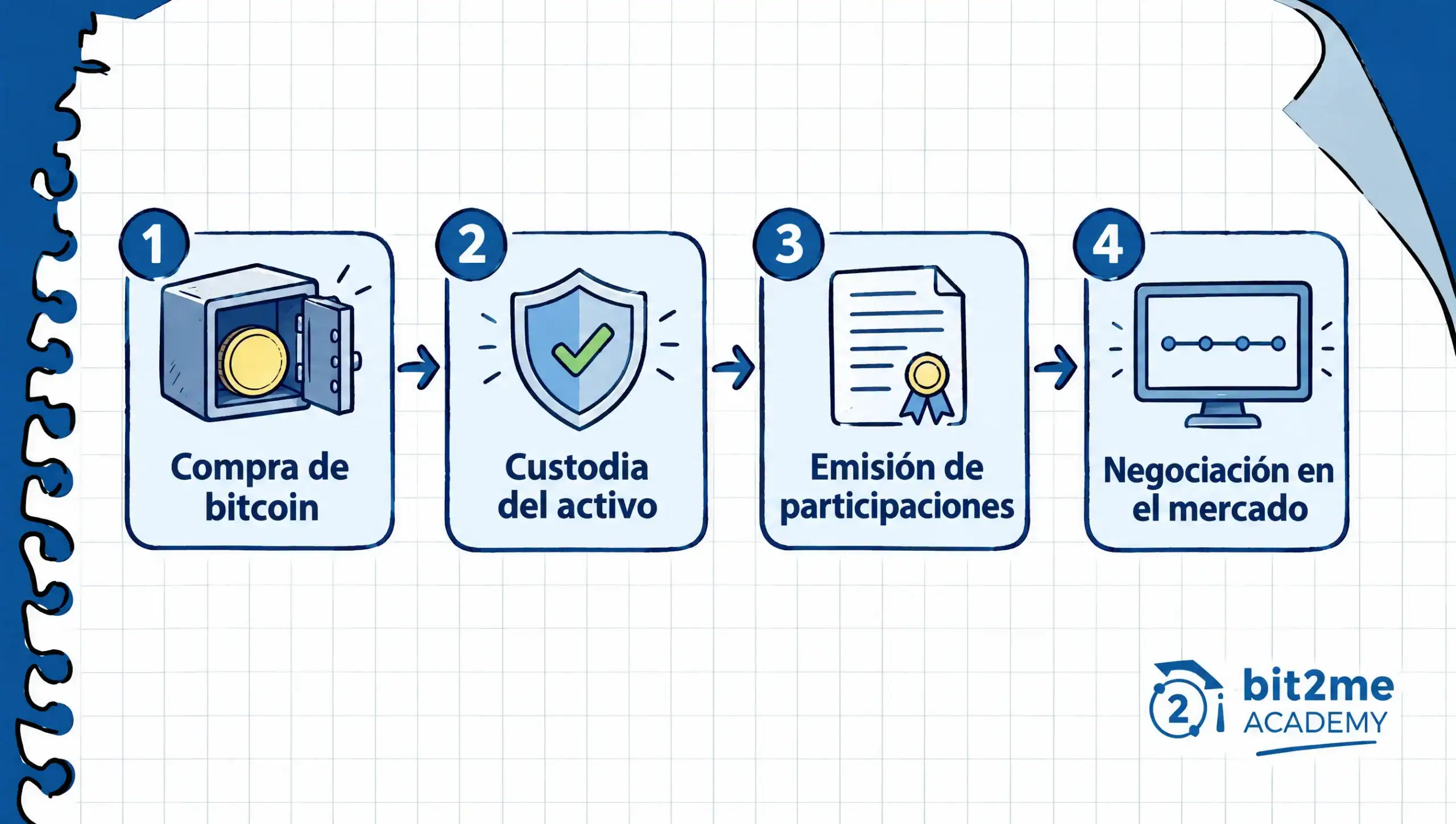
An ETF (Exchange Traded Fund) is a type of exchange-traded fund: it pools assets and issues shares that are bought and sold during a trading session. In the case of Bitcoin, the issuer acquires the asset, holds it with a custodian, and issues shares whose value tracks the price of BTC, minus fees. You don't buy bitcoins, but rather shares, through an authorized financial intermediary.
The clearest analogy is that of a gold ETF, which gives you exposure to the metal without you having to store bullion at home. Something similar happens with Bitcoin: you don't manage a wallet or a recovery phrase, but you relinquish custody to the issuer and pay an annual fee, the TER (Total Expense Ratio), which is deducted from the value of the stake. This convenience shifts custody to a third party, something that doesn't happen when you store your bitcoins yourself.
The value of the stake depends on the price of Bitcoin, which you can check at the Bitcoin price page Bit2MeSmall differences may appear due to fees and the supply and demand of the stake itself, and since Bitcoin continues to trade when the market closes, the price may open with a jump.
There are also two regulatory layers. The stake is a financial instrument subject to market regulations (in the European Union, MiFID II and the PRIIPs regulation, which requires a Key Information Document or KID), while the issuer's Bitcoin is a crypto asset. According to the CNMVMiCA excludes MiFID II financial instruments from its scope.
How much does a share cost and what commission does it charge?
A share is not equivalent to a bitcoin: it represents a fraction of the bitcoins held by the product, and its net asset value is the value of those bitcoins minus costs, divided by the number of shares outstanding. The iShares Bitcoin Trust ETF (IBIT) illustrates this well, because its Official Site As of October 30, 2026, it published a value of $43,2852 per share, a figure far below the price of a whole bitcoin.
| IBIT data | Price | Date of data |
|---|---|---|
| net worth | $ 62.297.756.860 | 30th October 2026 |
| Shares in circulation | 1.439.480.000 | 30th October 2026 |
| Value per share | $ 43,2852 | 30th October 2026 |
| annual commission | 0,25% | 30th October 2026 |
These figures are a snapshot of a single day; they change daily and don't predict how the product will perform. Dividing the equity by the number of outstanding shares gives you the value per share again.
The annual fee is deducted continuously from the product's value; it is not charged separately. In the United States, it is called the sponsor's fee, and in European ETPs, it is usually called the management fee or TER (Total Expense Ratio). In both cases, it is listed in the prospectus or the Key Information Document (KID). A 0,25% annual fee equates to €25 for every €10.000 held for a year, and a 2,00% fee equates to €200, regardless of Bitcoin's price fluctuations.
How were Bitcoin spot ETFs approved in the United States?
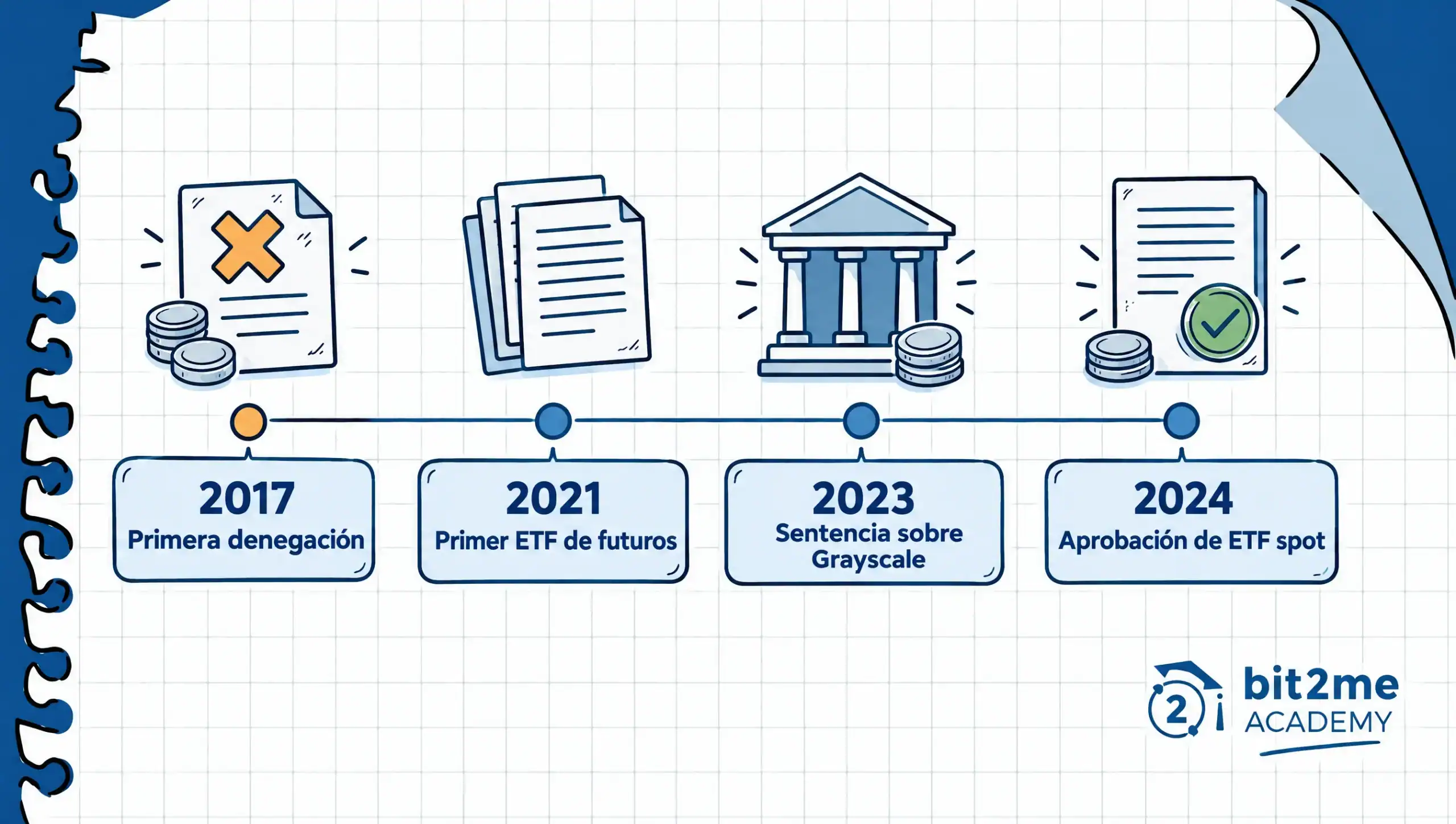
On March 10, 2017, the SEC denied the Winklevoss Bitcoin Trust, one of the first attempts at a spot Bitcoin ETF in the United States, because it lacked a surveillance agreement with significant, regulated exchanges that would allow for the detection of fraud and manipulation. This is reported in the order 34-80206And the SEC continued to reject similar applications: in its 2024 statement it cites more than twenty denials between 2018 and March 2023.
Other proposals followed different paths. The VanEck SolidX Bitcoin Trust would have held bitcoin directly, not futures, and its 2018 registration document warned that it might not be suitable for retail investors; the SEC notes in the order 34-84988 that proposal was withdrawn on January 22, 2019.
The futures route did advance. The ProShares Bitcoin Strategy ETF (BITO) began trading on October 19, 2021, as the first US-based Bitcoin futures ETF, according to [source missing]. ProShareswhich reported over $1.000 billion in about two days. SEC order of 2022 quote 1.210 billion in three days.
The timeline accelerated in 2023. BlackRock registered the iShares Bitcoin Trust on June 15, and on August 29, the District of Columbia Court of Appeals overturned the denial of Grayscale's application because the SEC had not adequately explained its decision. On January 10, 2024, the SEC approved the listing of several spot Bitcoin ETFs, which began trading the following day.
That approval had clear limits. The SEC itself clarified that it did not approve or endorse Bitcoin and recommended caution given its numerous risks. Commissioner Crenshaw further specified, in her statement of the same dayThe approved products are not funds registered as such, but rather products listed under the securities law of 1933, and that is why in the United States it is more accurate to speak of ETPs than ETFs.
What is the difference between a spot ETF and a futures ETF?
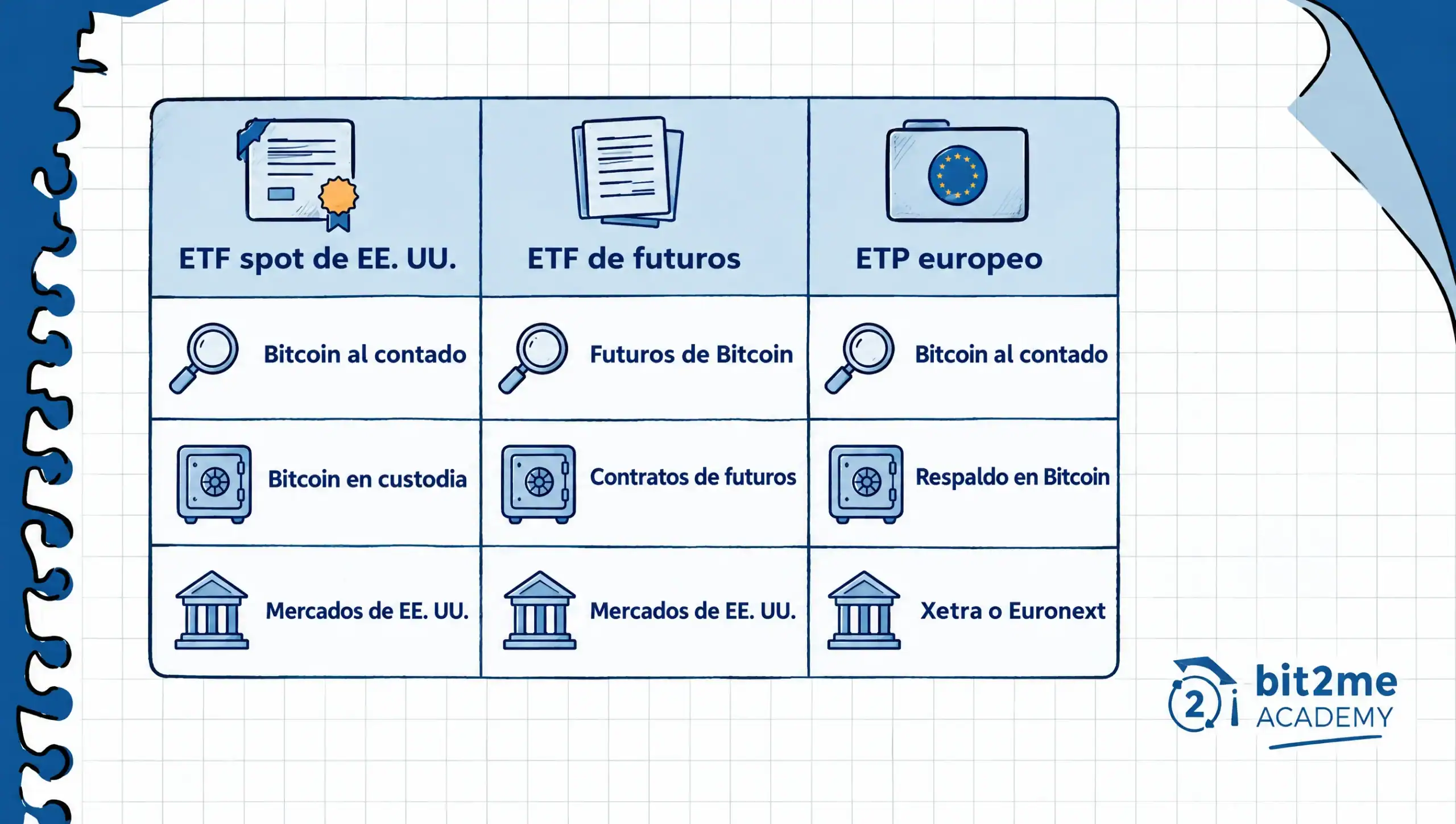
A spot ETF holds the underlying asset: the issuer buys and holds bitcoins, so the share price tracks the spot price. A futures ETF doesn't hold bitcoins, but rather contracts to buy or sell Bitcoin at a future date at a predetermined price, and its value tracks the price of those contracts.
The difference matters because the value of a futures ETF can diverge from the price of Bitcoin. When contracts with a longer expiration date cost more than those with a shorter expiration date, rolling over each contract reduces the product's value, and this effect doesn't exist in a spot ETF, which only incurs its fees and custody costs. The table summarizes the three structures with the data that changes most significantly from one to another, as of October 31, 2026.
| Appearance | US spot ETF | US futures ETF | European ETP or ETN |
|---|---|---|---|
| Whats Next | Bitcoin spot price | Bitcoin futures contract price | Bitcoin price |
| Structure | Listed product that holds bitcoins (1933 law, according to Commissioner Crenshaw) | Exchange-traded fund that holds futures contracts | Bitcoin-backed debt security |
| Construction inspection | SEC | SEC | European prospectus and KID (PRIIPs); not UCITS |
| Own risk | Custody and difference between market price and net asset value | Cost of renewing contracts | Issuer risk in addition to Bitcoin risk |
| Example | IBIT, FBTC | BITO | BTCE, ABTC |
To see the differences in more detail, see Academy's guide on Spot ETFs and Futures ETFs Compare them, and you can review how contracts work in the guide. Bitcoin futures.
Are there Bitcoin ETFs in Europe? ETPs and ETNs vs. UCITS Funds
An ETP (Exchange Traded Product) is the general category of listed product, and an ETN (Exchange Traded Note) is a debt security issued by an entity. Bitcoin ETPs in Europe, such as the Bitwise Physical Bitcoin ETP (formerly ETC Group Physical Bitcoin), are presented as debt securities backed by bitcoins, with the risk of issuer default, which the backing seeks to limit but not eliminate.
A UCITS fund is a fund harmonized within the European Union with strict rules on the assets it can hold, and Bitcoin Direct is not among them. The CSSF, in its guidance updated in February 2026, only allows indirect exposure through non-derivative securities and up to 10% of the fund's assets. ESMA, in a non-binding technical advice issued on June 26, 2025, suggested allowing only limited indirect exposures, up to 10%, to alternative assets, and it is up to the European Commission to decide whether to implement this.
Therefore, as of October 31, 2026, there is no Bitcoin UCITS ETF with direct exposure, and Bitwise The product information sheet indicates that it does not meet UCITS requirements. If such a product is offered to retailers in the European Union, it requires the KID (Key Information Document) from the PRIIPs regulation, as noted by the [unclear/unclear]. CNMVAnd in that document you'll find the commission, risks, and scenarios for the product. The table compiles the annual commission and structure of five products, with the date of each piece of information according to the issuers' websites.
| Product | Structure | ISIN | annual commission | Date of data |
|---|---|---|---|---|
| iShares Bitcoin Trust ETF (IBIT) | Product listed in the USA | Does not apply | 0,25% | 30th October 2026 |
| Fidelity Wise Origin Bitcoin Fund (FBTC) | Product listed in the USA | Does not apply | 0,25% | Effective from August 1, 2024 |
| Bitwise Physical Bitcoin ETP (BTCE) | Xetra-backed debt security | DE000A27Z304 | 2,00% | 31th October 2026 |
| 21Shares Bitcoin ETP (ABTC) | ETP of 21Shares AG | CH0454664001 | 1,49% | 30th October 2026 |
| WisdomTree Physical Bitcoin | Jersey debt security | GB00BJYDH287 | 0,15% with a temporary reduction until December 31, 2026, and 0,25% from January 1, 2027 | 31th October 2026 |
All figures are taken from the issuers' websites and change over time, so always check the current KID or fact sheet before making a decision, especially regarding WisdomTree's commission, which increases on January 1, 2027.
What risks and costs do these products have?
A product priced on Bitcoin reflects the volatility of the underlying asset, meaning its value can fall rapidly and the buyer can lose their entire investment. In addition to this market risk, there are the inherent risks of the product's structure, which should be separated to determine which one affects each product:
- Annual fee: This is deducted from the value even if the price of Bitcoin does not move, and the table above shows differences between 0,15% and 2,00%.
- Market price versus net asset value: the stake may trade somewhat above or below the value of the bitcoins it backs.
- Custody: the issuer entrusts the bitcoins to a custodian, and an operational or security failure of that third party would affect the product.
- Issuer: In a European ETP or ETN, which is a debt security, the buyer depends on the issuer fulfilling their obligations.
- Futures: renewing contracts can reduce value and distance the product's evolution from the spot price.
There are verifiable advantages: you can purchase these products through a regular financial intermediary, they are traded during the market hours where they are listed, and the annual fee is stated in the prospectus or the Key Identifier (KID). In return, you don't control any private keys, you don't receive bitcoins, and you depend on third parties for safekeeping.
Taxation depends on the product, your place of residence, and your personal circumstances, and there is no single rule for all cryptocurrency products. Consult a tax advisor or the tax authorities before buying.
What's the difference between an ETF and owning Bitcoin directly?
With an ETF, you buy a share of a product that holds Bitcoin, while with direct Bitcoin, you buy the asset itself and decide where to store it. In the first case, custody is handled by the issuer and a custodian, and you are governed by financial market regulations. In the second, the asset is a crypto asset under MiCA, offered by authorized crypto asset service providers, and you are responsible for protecting your keys if you use your own wallet.
If you prefer to own the asset yourself, you can also do that. buy Bitcoin at Bit2MeAnd if you later decide to undo the position, you can sell Bitcoin in Bit2MeThe value of crypto assets can rise or fall rapidly, and you may not get your investment back.
Bit2Me Invest, a service of Bit2Me Stocks SL, in collaboration with InbestMe, an entity supervised by the CNMV (Spanish National Securities Market Commission), offers UCITS funds, shares, and ETFs (Union Interbank harmonized funds traded on European exchanges). Their website clarifies that the funds do not include cryptocurrency funds such as Bitcoin. If you want to know how these products work, the Academy's guide to funds and ETFs He explains them. The hiring process is detailed in How to buy an ETF step by step from Spain.
If you compare it to more classic products, the Academy guide on the differences between an ETF and an index fund It helps you distinguish how each one is contracted and how it is negotiated, which is useful before deciding which product fits what you are looking for.
Current status of Bitcoin spot ETFs
As of October 31, 2026, the US framework differs from that of January 2024. On July 29, 2025, the SEC approved that authorized participants create and redeem shares in kind, that is, with bitcoins and not only in cash, according to its official noteOn September 17, 2025, it approved generic quotation standards for commodity-based trust shares, so that markets can accept compliant products without introducing a new rule for each one.
In Europe, the situation hinges on pending decisions. ESMA's June 2025 advisory is a recommendation to the European Commission, which decides whether to implement it. In the meantime, Bitcoin products remain ETPs or ETNs. In Spain, MiCA has been fully in effect since December 30, 2024, and the transition period ended on July 1, 2026, according to the CNMV (National Securities Market Commission). This affects providers offering Bitcoin directly, but not these listed products.
The fees and figures in the tables are from the issuers as of the end of October 2026, and IBIT publishes its assets under management daily. Always check the current fact sheet or Key Investment Document (KID) before making a decision, as this data changes frequently.
Understand the product before choosing how to own Bitcoin
A Bitcoin ETF simplifies access to a price, but not understanding what you're buying. Before choosing between a US ETF, a European ETP, or direct Bitcoin trading, it's worth considering two key factors: what the product holds and its annual cost. With these answers, you'll know what risks you're taking and which you're not, allowing you to make a well-informed decision or dismiss the idea without losing anything.
If you want to explore further, Academy's guide on Ethereum ETF It shows how this structure extends to another crypto asset, and that of What is Bitcoin and how does it work? Review the assets behind all these products.

Frequently Asked Questions about Bitcoin ETFs



 Author