Essential Points
- A Bitcoin address is the identifier you share to receive bitcoins; it is derived from your public key and does not reveal your private key.
- Current formats start with 1, 3, bc1q or bc1p, and each has its own length, encoding and script type.
- Sharing your address doesn't put your funds at risk, but reusing it leaves a public trail that can be linked to you.
- Before sending, check the full address and network; a confirmed transaction cannot be reversed.
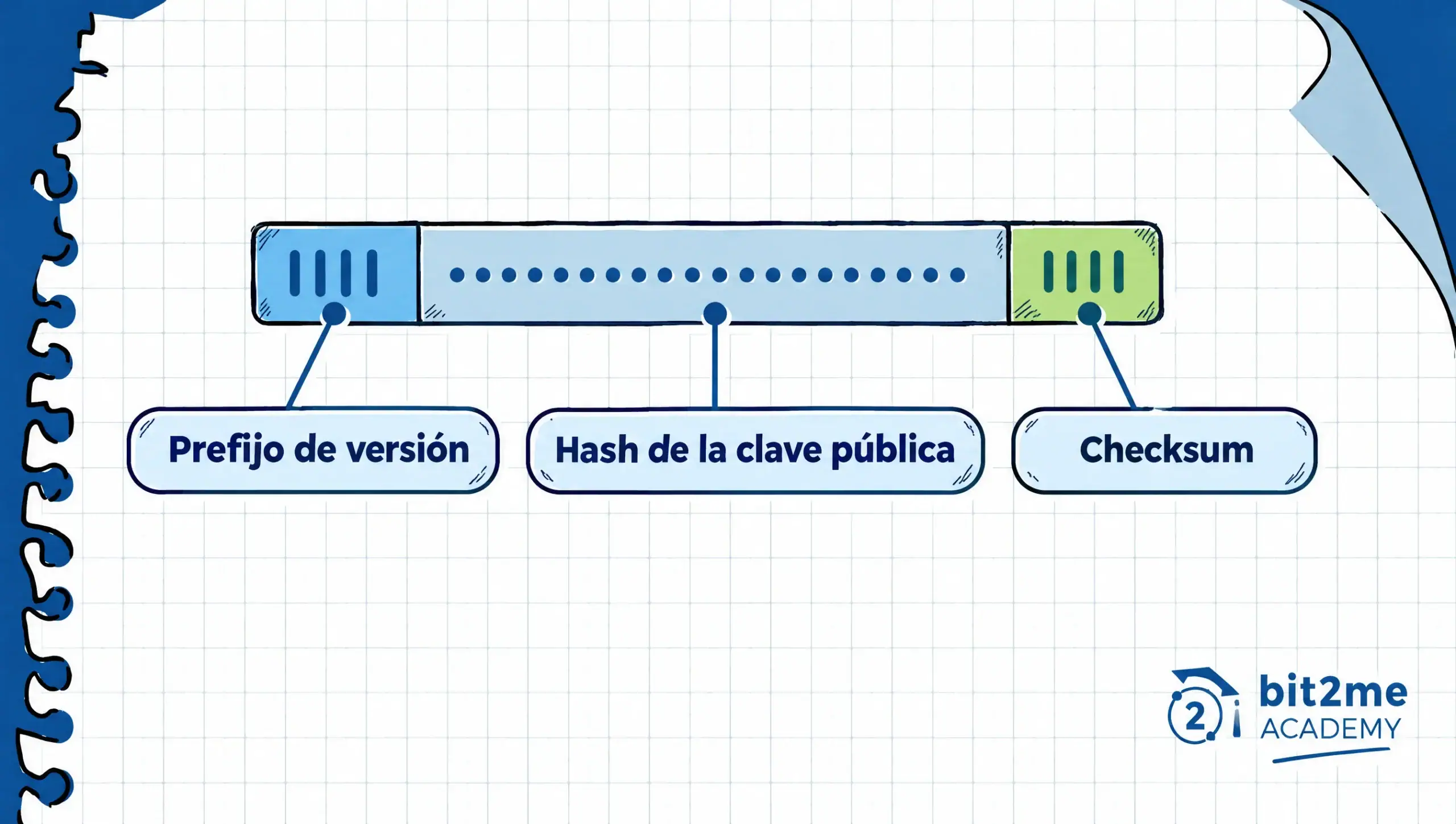
A Bitcoin address like 1PMycacnJaSqwwJqjawXBErnLsZ7RkXUAs has 34 seemingly random characters, but they follow a precise structure that any wallet can verify. If you copy even one character incorrectly, the wallet will usually reject the transfer thanks to the checksum. However, a valid address that closely resembles the correct one will receive the funds, and the network doesn't offer any way to undo the error.
That string is the identifier to which other users send bitcoins, and you can share it with whomever you want because it's calculated from your public key and doesn't reveal your private key. Several formats coexist today. According to the BIP173A native SegWit address for a single key starts with bc1q and is 42 characters long, while classic addresses start with 1 or 3.
Understanding how an address is constructed and what formats exist allows you to receive funds smoothly and recognize a fake address when it appears in a message or in your wallet history. The difference between someone who blindly copies and pastes and someone who verifies what they send lies in a few basic concepts. With these, you'll also understand why sharing an address doesn't put your funds at risk and why reusing it comes at a privacy cost that almost no one considers when starting out.
 Certificate
What is a Bitcoin address and what is it used for?
It's a string of letters and numbers that identifies the destination of a payment on the Bitcoin network. It works like the IBAN you provide to receive a transfer: anyone can use it to send you funds, but it's not an account and it doesn't store your name. The blockchain records the unspent funds that your private key can move, and your wallet totals them to show you a balance.
Whenever someone wants to pay you, they need your address, which can be displayed as text or as a QR code. A QR code is the same string drawn in a grid pattern that another camera can read, so scanning it prevents copying errors. In English, it's called a "Bitcoin address" or "wallet address," and you'll see that name in most applications.
At first, it looks like a difficult string to read, and that's by design. It mixes uppercase letters, lowercase letters, and numbers to create many more combinations than a number with only digits, so you can create as many addresses as you want without any of them repeating. To look up a specific address, you have a guide on the block explorer.
What are the characteristics of Bitcoin addresses?
There are six features to keep in mind when handling addresses, whether you generate them yourself or receive them from someone else. They all stem from how they are calculated and the fact that the blockchain is public:
- Unlimited creation: a wallet can generate thousands of addresses at no cost and without authorization from anyone.
- Free and open: you don't pay the network to create them or ask permission from any entity.
- Pseudonyms: they do not contain personal data, although their movements are public.
- Transparent: anyone who knows that an address is yours can check your balance and transactions.
- Offline generable: they are calculated locally from a private key and do not need to contact the network.
- Format-sensitive: classic fonts distinguish between uppercase and lowercase letters, while bech32 fonts are written in lowercase.
Pseudonymity is often confused with anonymity. Your name doesn't appear in the address, but every transaction is visible to everyone, and simply posting an address on a social network or withdrawing funds from a service that requested your identity is enough for someone to link it to you.
Transparency has a useful side, because an organization can publish its address and show how many bitcoins it holds. It has an uncomfortable side if you give yours to a stranger, who can look it up in a browser. A guide on what Bitcoin is and how it works It explains how transactions are recorded.
Sharing your address doesn't pose a risk of theft, because it can only be used to send funds, never to move them. However, someone could use it to impersonate you or track your activity, so it's best to treat it as information you share with caution.
What types of Bitcoin addresses exist?
The table summarizes the formats you will find on the main network and test networks. The prefixes and lengths are derived from the BIP173, from the BIP350 and the Bitcoin Core code, and reflect the state of October 2026.
| Type | Prefix | Standard length | Coding | Upper case and lower case |
|---|---|---|---|---|
| P2PKH (classical) | 1 | 34 characters, slightly less if the hash starts with zeros | Base58Check | They are distinguished |
| P2SH (includes classic multi-signature) | 3 | 34 characters | Base58Check | They are distinguished |
| P2WPKH (Native SegWit) | bc1q | 42 characters | Bech32 | It is written in lowercase. |
| P2WSH (native SegWit multi-signature) | bc1q | 62 characters | Bech32 | It is written in lowercase. |
| P2TR (Taproot) | bc1p | 62 characters | Bech32m | It is written in lowercase. |
| Testnet | m, n, 2 or tb1 | according to the type | Base58Check or Bech32 | according to the type |
Classic P2PKH and P2SH addresses
The first Bitcoin addresses start with 1 and are called P2PKHbecause they pay out to the hash of a public key. Those starting with 3 are P2SH and pay out to the hash of a script, so they hide the spending conditions until someone moves the funds. Both use Base58Check, which discards ambiguous characters like 0 and O to avoid confusion.
Native SegWit addresses bc1q
A native SegWit address starts with bc1q and uses the Bech32 encoding of BIP173. It is 42 characters long if it pays to a single key and 62 characters long if it pays to a script, as with a multi-signature address. Bech32 always outputs lowercase letters, accepts uppercase letters only for QR codes, and rejects any mixture of both. You can find more details in the guide. followed.
It's important not to confuse two concepts that share a prefix. The prefix 3 is also used by P2SH addresses that wrap a SegWit key, so an address starting with 3 is not necessarily SegWit or necessarily multi-signature. The prefix bc1 always indicates SegWit in one of its versions, but only bc1q corresponds to version 0.
Taproot bc1p directions
A Taproot address starts with bc1p, is 62 characters long, and uses Bech32m, a variant of Bech32 that, according to BIP350, corrects a weakness in the original checksum when the last character is a 'p'. Taproot was activated in block 709632 and adds the Schnorr signatures of the BIP340You can delve deeper into the guide on Taproot.
Multiple signature addresses
A multi-signature address requires multiple private keys to be signed to move funds, and the person who creates it decides how many are needed. This rule cannot be changed afterward without generating a new address. Classic multi-signature addresses are P2SH and begin with 3, while native SegWit addresses are P2WSH and begin with bc1q, which has 62 characters. There is a guide on multi-signature addresses.
Testnet addresses
The testnet is a test network with worthless coins, designed for developers and enthusiasts to practice without risking real funds. Its standard addresses begin with mon, P2SH addresses with 2, and SegWit addresses with tb1. The calculation is identical to that of the main network except for the version byte. There is a testnet network explanation at Academy.
How do you create a Bitcoin address?
It all starts with a private key, a 256-bit random number that your wallet generates locally. The public key is obtained by multiplying this number by the generating point of the elliptic curve. secp256k1It's an easy operation in one direction and virtually impossible to undo. ECDSA, and Schnorr in Taproot, are then used to sign transactions, not to calculate the public key.
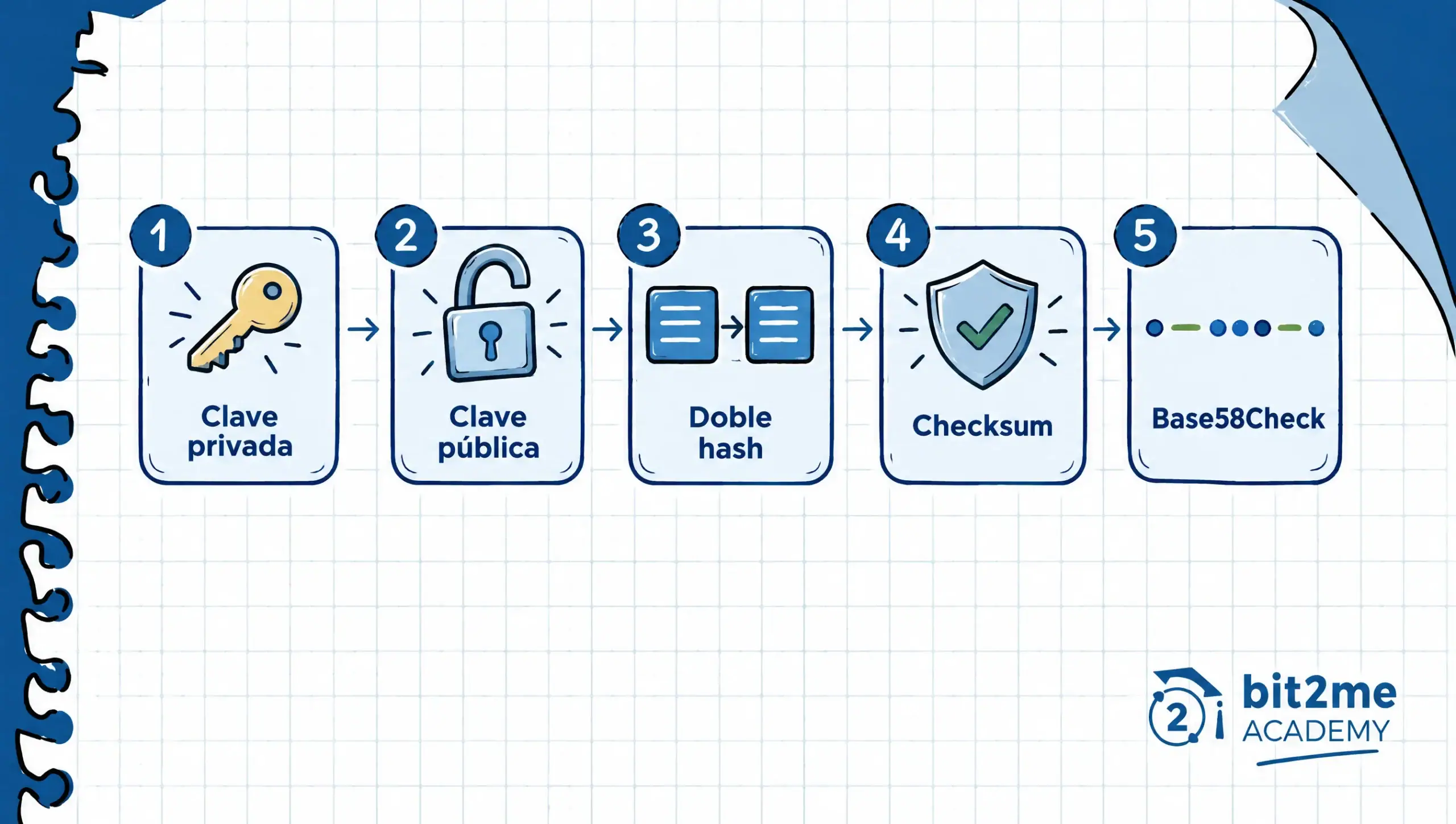
With the public key, you can now construct a classic P2PKH address. The following steps are those listed, and the example values in the table can be reproduced with any cryptographic library to verify that they match.
- It takes the compressed public key, of 33 bytes.
- Apply SHA-256 to it, which returns 256 bits.
- Apply RIPEMD-160 to that output and you will get a 160-bit hash, which is the hash of the public key.
- Add the main network version byte, 0x00, to the front, and you will have the address load in hexadecimal.
- Calculate SHA-256 on that extended result, including the version byte.
- Calculate SHA-256 again on the previous hash.
- Keep the first 4 bytes of that second hash: they are the checksum.
- Paste those 4 bytes to the end of the result from step 4 and you will have 25 bytes.
- Convert the 25 bytes to Base58Check to get the address you see on screen.
| Step | Operations | Example result |
|---|---|---|
| 1 | Compressed public key | 0250863ad64a87ae8a2fe83c1af1a8403cb53f53e486d8511dad8a04887e5b2352 |
| 2 | SHA-256 of the public key | 0b7c28c9b7290c98d7438e70b3d3f7c848fbd7d1dc194ff83f4f7cc9b1378e98 |
| 3 | RIPEMD-160 of step 2 | f54a5851e9372b87810a8e60cdd2e7cfd80b6e31 |
| 4 | Version byte 0x00 plus step 3 | 00f54a5851e9372b87810a8e60cdd2e7cfd80b6e31 |
| 5 | SHA-256 of step 4 | ad3c854da227c7e99c4abfad4ea41d71311160df2e415e713318c70d67c6b41c |
| 6 | SHA-256 of step 5 | c7f18fe8fcbed6396741e58ad259b5cb16b7fd7f041904147ba1dcffabf747fd |
| 7 | Checksum: First 4 bytes of step 6 | c7f18fe8 |
| 8 | Step 4 plus checksum, 25 bytes | 00f54a5851e9372b87810a8e60cdd2e7cfd80b6e31c7f18fe8 |
| 9 | Base58Check | 1PMycacnJaSqwwJqjawXBErnLsZ7RkXUAs |
The double SHA-256 fulfills a specific function: the checksum This allows a wallet to detect a copy error before sending anything, which is why a misspelled character usually results in a rejection rather than a lost transmission. hash Step 3 also explains why the address does not reveal the public key until you spend the funds.
bc1q addresses follow the same idea with a different packaging. They start from the same 160-bit hash, but encode it with Bech32, which has its own checksum and doesn't use double SHA-256. Custom addresses are obtained by brute-forcing keys until the address starts with the desired letters, as explained in the Vanity Address guide.
How to get your first address to receive bitcoins?
Obtaining an address takes less than a minute: open a wallet, choose to receive Bitcoin, and copy the address or QR code displayed. What changes is who controls the keys. In a non-custodial wallet, you store the recovery phrase yourself, while in a custodial wallet, it's managed by the provider, as detailed in the guide. custodial vs non-custodial wallet.
If you don't have bitcoins yet, you can buy Bitcoin at Bit2Me and then generate your address to receive them in your own wallet. And if you want to see how much what you receive is worth, check the Bitcoin price todayRemember that the value of crypto assets can change rapidly and that each transfer to another wallet is final.
Most modern wallets are HD wallets, meaning they derive all their addresses from a single recovery phrase. This means you can have dozens of addresses and recover them all with those words, so the important thing is to keep the phrase safe, not the address itself. guide to protecting your crypto assets It explains how to do it.
How to avoid mistakes and protect your privacy when sending and receiving bitcoins?
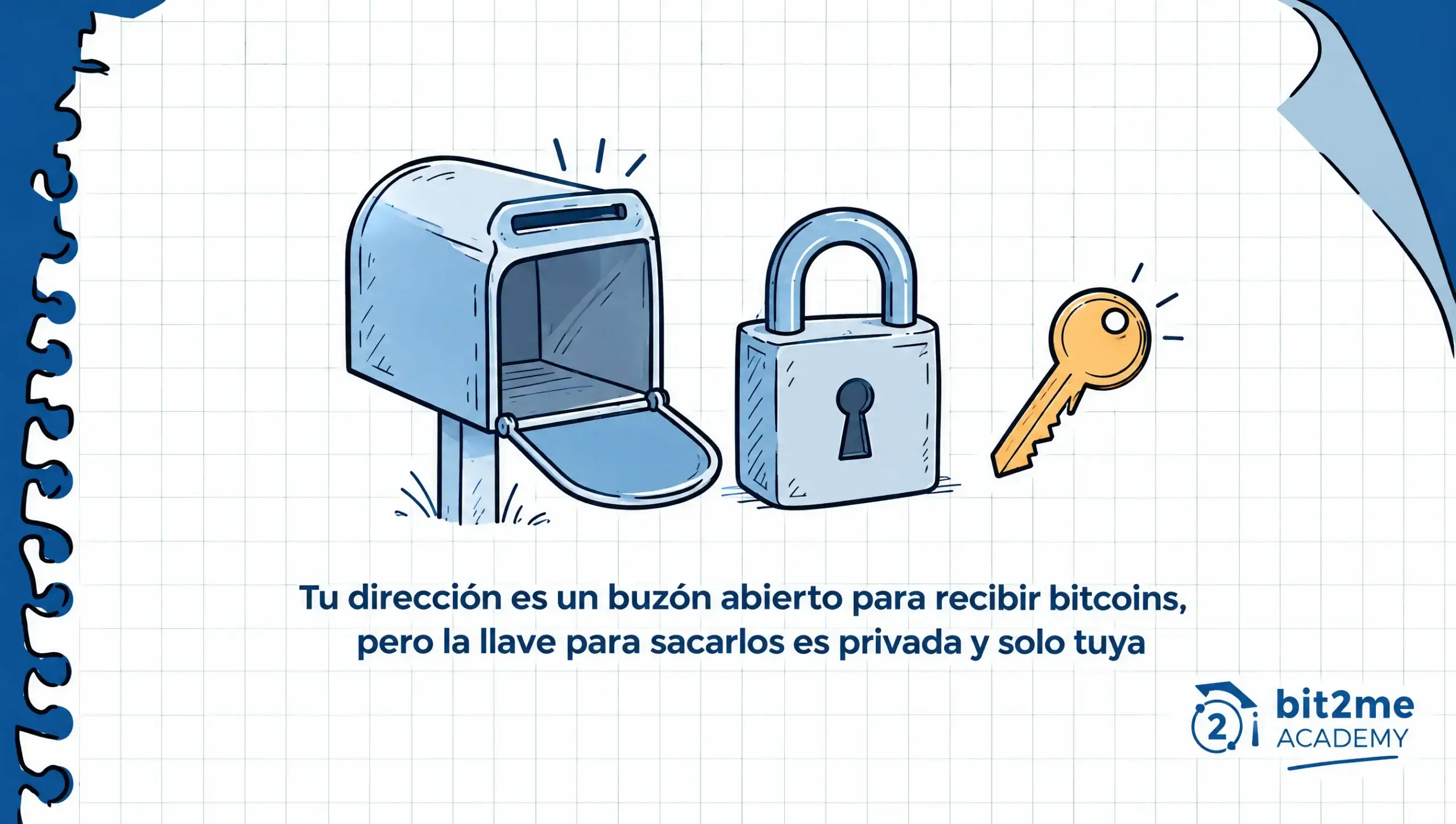
Your address is an open mailbox for receiving bitcoins, but the key to withdraw them is private and belongs only to you. That idea sums up almost all the precautions: the address is shared, but the private key and recovery phrase are never shared.
The first precaution is not to reuse addresses. developer.bitcoin.org It's recommended to avoid reusing keys, because anyone who sees two withdrawals to the same address can add up their activity and estimate your balance. HD wallets automatically generate a new address for each withdrawal, and if you use one of these, you just have to let it do its job.
The second tip is to always check the complete address before sending. In address poisoning, the attacker sends a small amount of data from an address that starts and ends exactly like one you've already used, so it appears in your history and you accidentally copy it. This attack doesn't require stealing passwords and can be prevented by checking every character in the address.
Before confirming an important shipment, take a minute to complete these four checks, because they prevent almost all the irreversible errors seen in practice and take very little time:
- Verify that the prefix corresponds to the main network and not to a testnet.
- Compare the full address with the one the recipient gave you through a trusted channel.
- Send a small amount first and wait for it to arrive.
- Keep the receipt with the date, amount, and address used.
If a transaction is confirmed with an incorrect address, you will only recover the funds if the account holder returns them to you, and no one on the network can force them to do so. There is no support to reverse the payment. To recognize messages and links that try to scam you, the Guide to identifying and avoiding cryptocurrency scams It gathers the most common signs.
Current state of Bitcoin addresses in October 2026
The formats in the table above remain valid as of October 2026, and none has completely replaced the others. The relative importance of each format changes from month to month and varies depending on who is measuring it; therefore, it is advisable to be wary of usage percentages circulating without a source or date.
On testnets, the situation changes more rapidly. Bitcoin Core added Testnet4 to its version 28.0Published on October 2, 2024, Testnet3 was supported alongside it. A proposal to retire Testnet3 was closed in May 2026 without approval, and a future Testnet5 is under discussion, so there is no single definitive testnet. Confirm which one your software supports in its documentation.
A new address for each payment and the passwords are only with you.
A Bitcoin address is a simple piece of information with practical consequences: it's calculated from your public key, includes a checksum to protect against errors, and starts with 1, 3, bc1q, or bc1p depending on the type of script it pays to. Knowing how to read this prefix immediately tells you what format you're dealing with and how many characters it should have.
The habit that protects you most is inconspicuous. Request a new address for each withdrawal, double-check the characters before sending, and keep your recovery phrase away from any screen. With these routines, the cryptographic chain becomes a tool you know how to use, whether you're receiving your first bitcoins or have been using them for years.

Frequently Asked Questions about Bitcoin Addresses


 Author