In a world where traditional finance faces significant challenges, blockchain technology has positioned itself as a promising alternative to transform the way we transact. VELO is an innovative project that seeks to use this technology to create a more efficient, accessible and secure financial ecosystem. Through its federated credit exchange network and focus on interoperability, VELO aims to be a bridge between traditional and decentralized finance, offering solutions that benefit both businesses and individuals.
This article explores in depth what VELO is, its origin, its objectives, how it works, and how its ecosystem is structured, including its tokenomics, governance, and digital identity framework. With a clear vision and focus on financial inclusion, VELO presents itself as a key player in the future of finance.
Origin of VELO
VELO was founded by Velo Labs, a financial technology company that has positioned itself at the forefront of innovation in the sector. Backed by Stellar Network and CP Group, one of Asia's largest conglomerates, VELO's mission is to build a federated credit exchange network. This network seeks to connect various entities in the financial field, allowing the issuance and transaction of digital credits in an efficient and secure manner.
The idea behind VELO arises from the need to improve the way financial transactions are carried out in an increasingly digital world. As more people and businesses look for quick and accessible solutions, VELO aims to offer a platform that integrates the advantages of traditional finance with the opportunities provided by blockchain technology.

Objective and problem to solve for VELO
VELO's main goal is to address the inefficiencies of current financial systems, which are often slow, expensive and inaccessible to many people.. Through its infrastructure, VELO aims to facilitate the transfer of value between participants quickly and securely, while complying with necessary regulations.
One of the key problems that VELO seeks to solve is the lack of interoperability between different financial platforms. Currently, transactions between different countries and systems can be complicated and costly due to market fragmentation. VELO seeks to be the solution to this problem by creating an ecosystem where transactions can be carried out fluidly and without friction, allowing users to access financial services more efficiently.
Additionally, VELO aims to foster financial inclusion, allowing unbanked and underbanked people to access services that would otherwise be inaccessible to them. By connecting traditional finance with DeFi platforms, VELO positions itself as an enabler of opportunity for millions of people.
How does VELO work? A look at its technology
The technology behind VELO is based on a financial protocol that allows the issuance of digital credits backed by the VELO token. This token acts as collateral in transactions carried out within the network, guaranteeing that each digital credit is always backed by an equivalent value in VELO. This leads us to review how VELO works and what its technology offers us.
Issuance of digital credits and reservation system
First, VELO facilitates the issuance of digital credits using a transparent and secure system. In this way, companies that wish to issue these credits only have to deposit the equivalent in VELO tokens as collateral in a smart contract. These tokens are kept safe in an escrow pool. Once this is done, the credits issued are linked to a fiat currency, providing stability and familiarity to users.
To ensure trust in the system, VELO has implemented a digital reserve system that maintains a 1:1 value relationship between the digital credits issued and the fiat currency to which they are linked. Here, a series of smart contracts automatically monitor and rebalance collateral pools in response to market fluctuations in the value of VELO tokens. This dynamic mechanism ensures that digital credits are always backed by the correct number of VELO tokens.
Hermes Warp Protocol
VELO uses the Hermes Warp Protocol to enable interoperability between different blockchains. This feature allows users to transact on various platforms without limitations, expanding the reach and usefulness of VELO. Furthermore, interoperability is crucial for the integration of VELO with traditional financial systems, facilitating mass adoption of its technology.
Among the key benefits of VELO technology are the security and transparency of transactions on the blockchain, which are immutable and reduce the risk of fraud. Blockchain technology also allows for faster and more efficient transactions compared to traditional systems, with lower costs by eliminating intermediaries. Finally, VELO facilitates access to financial services for people and companies that do not have traditional banking services.
VELO tokenomics and token distribution
The VELO token is the main asset that powers the VELO ecosystem. It is used for transactions within the network, providing token holders the opportunity to benefit from revenue generated by companies using VELO's infrastructure. Below are some of the key features of the VELO token:
VELO Token Utilities
- Collateral for digital credits: VELO tokens act as collateral to support the issuance of digital credits, guaranteeing their value.
- Exchange medium: Users can use VELO tokens to carry out transactions within the ecosystem, such as paying transaction fees or purchasing goods and services.
- Participation in governance: VELO token holders have the opportunity to participate in the governance of the project through VeloDAO, voting on proposals and decisions that affect the future of the ecosystem.
- Staking: VELO token holders can earn additional rewards by locking their tokens for a set period, contributing to the stability and security of the network.
Token distribution
The total distribution of VELO tokens is 30 billion, which have been distributed as follows:
- Private Placement: 1.462.900.000
- Founders: 3.000.000.00
- VELO Development Reserve: 5.000.000.000
- First Investors and Advisors: 2.370.000.000
- Strategic partners: 5.483.550.000
- community development: 3.483.550.00
- Book: 3.000.000.000
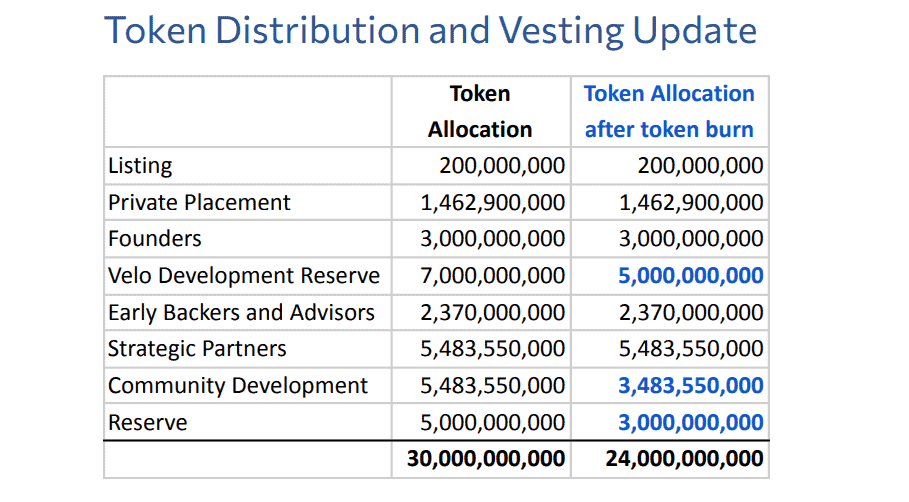
In 2022, VELO decided to burn 6 billion tokens, reducing the total supply to 24 billion. This action was taken to increase the token's scarcity and potentially its long-term value.
VeloDAO, governance within the project
Governance at VELO is carried out through a governance model. Decentralized Autonomous Organization (DAO), known as VeloDAO. This system allows VELO token holders to actively participate in decision-making related to the development and direction of the project. Through voting mechanisms, participants can influence key decisions such as the allocation of funds, the addition of new features, and the selection of projects to be integrated into the network.
VeloDAO Benefits
- Decentralized decision: VeloDAO distributes decision-making power among token holders, ensuring that the community has a say in the direction of the project.
- Transparency: All decisions and proposals are recorded on the blockchain, which guarantees that the process is accessible and verifiable by everyone.
- Aligned incentives: The interests of token holders are aligned with the success of the ecosystem, encouraging decisions that prioritize long-term growth and sustainability.
Velo Identity Framework, DID within VELO
An innovative aspect of VELO is its Veil Identity Framework, which integrates identity verification mechanisms such as KYC (Know Your Customer) and KYB (Know Your Business) in an environment that allows anonymous interactions. This framework seeks to balance the need for regulatory compliance with users' right to privacy.
The Velo Identity Framework works through a two-tier system:
- KYC/KYB Chain: Allows participants to verify their identity and that of their companies, ensuring that all network users are verified entities. This increases trust and minimizes the risk of fraudulent activities.
- anonymous string: Allows users to carry out transactions and interactions anonymously, protecting their privacy without compromising network security. This is especially important in an environment where data privacy is increasingly valued.
This hybrid approach offers the best of both worlds: the security and compliance of KYC/KYB verification, along with the privacy and anonymity offered by blockchain transactions.
Conclusion
VELO is presented as an ambitious project with the potential to transform the current financial landscape. Its focus on interoperability, financial inclusion and innovation makes it a platform to watch in the near future. As VELO continues to develop and expand its ecosystem, it will be interesting to watch its real-world impact and its ability to deliver on its promises to create a more efficient, transparent and inclusive financial system for all.
With a strong infrastructure, a commitment to transparency and community, and a focus on mass adoption, VELO is well positioned to be a leader in the future of finance. The combination of its advanced technology, its well-structured tokenomics and its focus on decentralized governance and digital identity, make VELO an innovative and promising project in the blockchain space.


 Author