Essential Points
- WebAssembly (WASM) is an ultra-efficient binary code format designed to run at native speed in any environment, not just in the browser.
- Executing smart contracts with WASM can be between 10 and 100 times faster than with current virtual machines, reducing costs and latency.
- Ethereum has been working on EVM Object Format for years and on a future transition to WASM; Solana already uses a variant called sBPF that shares a similar philosophy.
- The adoption of WASM on blockchain is not an experiment: it is the structural bet of the largest networks in the sector to scale without sacrificing decentralization.
In recent years, the debate about blockchain scalability has revolved around additional layers, network sharding, and consensus changes. But there's a piece of the puzzle that receives less attention and could be just as crucial as any protocol update: the virtual machine that executes smart contracts. This layer, invisible to most users, determines the gas cost of a transaction, its execution time, and the types of logic developers can implement. That's where WebAssembly comes in.
This article explains what WebAssembly (WASM) is, how it works technically without needing to delve into the code, and why projects like Ethereum and Solana have been focusing on this technology for some time to redesign the execution engine of their smart contracts. If you're already familiar with the blockchain ecosystem and want to understand where the underlying infrastructure is headed, you're in the right place.
What is WebAssembly and where did it come from?
WebAssembly, abbreviated as WASM, is a binary instruction format designed to be executed by a stack machine. It was originally conceived as an open web standard, developed by the World Wide Web Consortium (W3C) in collaboration with Mozilla, Google, Microsoft, and Apple, and achieved official recommendation status in December 2019.
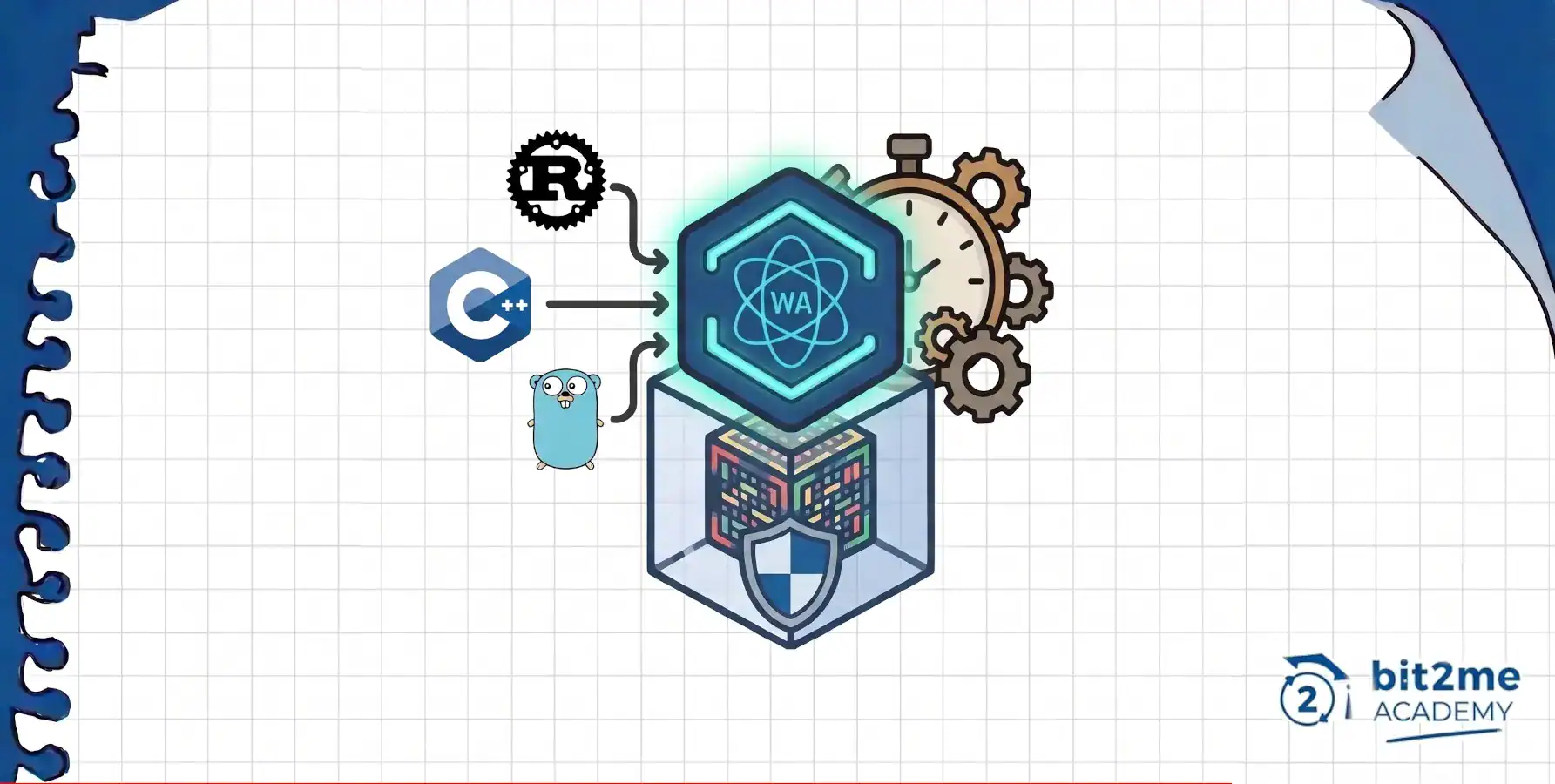
The idea behind WASM is simple yet powerful: to offer a portable compilation target for high-level languages like C, C++, Rust, or Go, so that the resulting code runs at near-native speed on any platform, regardless of the underlying processor architecture. In the web context, this allowed compute-intensive applications—video editors, game engines, design tools—to run directly in the browser with performance unimaginable a decade ago.
But what makes WASM especially interesting for blockchain is not its web origin, but its fundamental properties: it is deterministic (the same input always produces the same output), secure by design (it runs in a sandboxed environment without access to the underlying operating system), size-efficient (the binaries are compact), and portable (it works in any environment that implements the WASM runtime). These four characteristics are exactly what a blockchain network needs from its runtime layer.

How does WASM work: the execution model?
To understand why WASM matters in the context of smart contracts, it is helpful to have a clear understanding of how it works at a high level.
A program written in Rust, for example, is compiled into a .wasm file containing instructions in binary format that no real processor directly understands. What executes that file is a WASM runtime—a just-in-time (JIT) interpreter or compiler—that translates those instructions into the hardware's native code at runtime. This two-layer approach—portable code + local runtime—is what gives WASM its combination of portability and speed.
There are three execution models for a WASM runtime:
- Interpretation: The runtime reads and executes the instructions one by one. It is the slowest model but also the simplest to implement.
AOT (ahead-of-time) compilation: WASM code is compiled to native code before execution. Maximum performance, but loses immediate portability. - Just-in-time (JIT) compilation: the runtime compiles WASM fragments into native code during execution. This is the balance between speed and flexibility used by most modern browsers.
In blockchain, determinism is critical: all nodes in the network must arrive at exactly the same result when executing the same contract. This rules out some aggressive optimizations of Just-in-Time (JIT) runtimes that can produce slightly different results depending on the hardware. Blockchain projects that adopt WASM must address this issue with runtimes specifically designed to be deterministic, such as wasmtime o wasmer.
Why does the current EVM have limitations that WASM solves?
The Ethereum Virtual Machine (EVM) was designed in 2015 with the resources and knowledge available at the time. It has been extraordinarily successful: today, billions of dollars in digital assets move through smart contracts written in Solidity and compiled for the EVM. But its structural limitations are becoming increasingly apparent as the ecosystem grows.
The EVM is a 256-bit stack machine. This design choice facilitates common cryptographic operations in Ethereum (such as modular arithmetic for elliptic curves), but penalizes generic operations that any modern program needs. Current hardware works with 64-bit registers, which means the EVM must simulate 256-bit operations using multiple 64-bit instructions, introducing considerable overhead.
Furthermore, the EVM's instruction set (its ISA, instruction set architecture) is relatively small and closed. Adding new instructions requires going through Ethereum's governance process, which can take years. In contrast, WASM has a modern and extensible instruction set through standardized proposals and can benefit from years of investment by Mozilla, Google, and other players in optimizing its runtimes.
The performance differences are not marginal. Benchmarks published by the Parity Technologies team (developers of Substrate, the Polkadot framework) showed that contract execution on WASM could be between 10 and 30 times faster than on the EVM for computationally intensive operations. In a context where transaction costs (gas) depend directly on computation time, this difference translates into lower fees for users.

 Certificate

Ethereum's bet: EVM Object Format and the path to WASM
Ethereum isn't going to replace the EVM overnight. Backward compatibility is one of the ecosystem's most important principles: thousands of deployed contracts, billions in locked value, and decades of tools built on Solidity mean that any migration must be gradual and careful.
The path chosen by the protocol developers involves two phases. The first is the adoption of EVM Object Format (EOF)EOF is a structural revision of the EVM bytecode format that makes it more secure, verifiable at deployment time, and optimizable by customers. EOF is not WASM, but it shares its philosophy: clearly separating code from data, establishing a structure that toolchains can statically analyze, and eliminating problematic patterns inherited from the original design.
The second, longer-term phase involves a genuine transition to a WASM-based runtime environment or one inspired by it. The project eWASM The Ethereum WebAssembly (eWASM) explored for years how to replace the EVM with a deterministic WASM runtime. While eWASM as a specific project was absorbed by broader initiatives, the research direction remains active within the Ethereum Foundation.
Vitalik Buterin and other researchers have published proposals exploring a hybrid model where next-generation contracts can run in a WASM environment while compatibility with existing EVM contracts is maintained through a translation layer or coexistence model. The update Spectra The 2025 plan did not directly include WASM, but it did continue EOF's work that prepares the ground for that future transition.
Solana and sBPF: the variant that is already in production
Solana took a different approach from its original design. Instead of the EVM, it chose a runtime environment based on GMP (Berkeley Packet Filter), a technology originally designed for network packet filtering in the Linux kernel. Based on that, they developed sBPF (Solana BPF), a variant adapted to the needs of a high-speed blockchain network.
sBPF shares the same key philosophy as WASM: it is a low-level, deterministic, portable instruction format that can be compiled from high-level languages like Rust. Solana contracts (called programs(not smart contracts, in the protocol's nomenclature) are compiled to sBPF and executed in a runtime called sealevel, which allows the parallel execution of multiple stateless transactions.
In 2024 and 2025, the Solana Labs team announced and began implementing a migration of sBPF to a new version called sBPFv2This update incorporates additional instructions, improvements to the memory model, and greater compilation efficiency. This evolution follows the same direction as eWASM's proposal on Ethereum: modernizing the execution layer to support more complex contracts at a lower computational cost.
More importantly, the Solana ecosystem has also seen experiments with pure WASM runtimes through projects such as Neon EVM (which allows EVM contracts to be executed on Solana) and explorations of other contract programming languages. Convergence towards modern execution standards, whether WASM or formats inspired by it, is a clear trend across Layer 1 of the industry.
Current status: WASM on blockchain as of June 2026
The blockchain ecosystem hasn't adopted WASM uniformly, but the trend is clear. Several projects already have it in production.
- Polkadot / Substrate It is probably the ecosystem where WASM is most established. All contracts in Substrate-based chains, including pallets and module contracts, are included. pallet contractsThey run on a WASM runtime. The choice wasn't experimental: it's been running in production for years with Astar Network, Moonbeam, and other parachains.
- Cosmos and its framework cosmwasm They allow the deployment of smart contracts written in Rust and compiled to WASM on any blockchain in the Cosmos ecosystem, including chains like Osmosis, Sei, and Injective. CosmWasm has become one of the most active smart contract environments outside the EVM ecosystem precisely because it offers the security and performance guarantees of WASM.
- NEAR Protocol It adopted WASM as its primary runtime environment from the beginning and allows writing contracts in Rust or JavaScript (compiled to WASM). Its parallel execution model (sharding) particularly benefits from WASM's computational efficiency.
Regarding Ethereum, the post-Pectra roadmap maintains EOF as the immediate priority and WASM as an active research direction for the medium to long term. The coexistence of EVM and a future WASM environment seems the most likely scenario according to current discussions in the Ethereum research forum (ethresear.ch).
What does this mean for smart contract developers?
The practical question for a developer working with smart contracts today is whether they should change anything in their workflow or in the technology stack they choose.
In the short term, the answer for most Ethereum developers is no. Solidity remains the most widely used language, its tooling is the most mature, and contracts deployed on the EVM will continue to function. The EOF upgrade, when it reaches the mainnet, will be transparent to most projects.
In the medium term, however, learning Rust is becoming a strategic investment for any contract developer. Rust is the preferred language for writing contracts in Substrate, CosmWasm, Solana, and NEAR—all production environments with billions of dollars in value locked. If Ethereum also moves toward an environment where Rust can compile to a compatible runtime, the learning curve pays for itself across multiple ecosystems.
From the perspective of end users of blockchain platforms, the transition to WASM should be seamless: cheaper transactions, more complex contracts (expanding what decentralized applications can do), and greater security at the runtime layer. The efficiency of the unseen engine is what determines the user experience that is felt.
Beyond performance: WASM as the infrastructure of the digital future
The story of WebAssembly on blockchain is, at its core, the story of how decentralized networks are maturing into real-world computing platforms. For years, the dominant discourse surrounding blockchain has been that of digital assets and financial decentralization. That remains central, but the infrastructure supporting that economy is evolving into something more akin to a distributed operating system than a glorified ledger.
WASM embodies that evolution. It's not just a technical optimization: it's a sign that Ethereum, Solana, and the rest of the ecosystem are taking general code execution in decentralized environments seriously. When a technology designed to speed up the web browser ends up being the key component of the next generation of smart contracts, it's hard not to see the common thread: portable, efficient, and secure computing is the scarce resource that every digital infrastructure is striving to optimize.
The question isn't whether WASM will come to dominate smart contract execution on mainframes. The question is how quickly, with what transition model, and which ecosystems will lead that migration. What is already certain is that the engine running smart contracts of the future will look much more like a modern WASM runtime than the 256-bit stack machine of 2015.


 Author