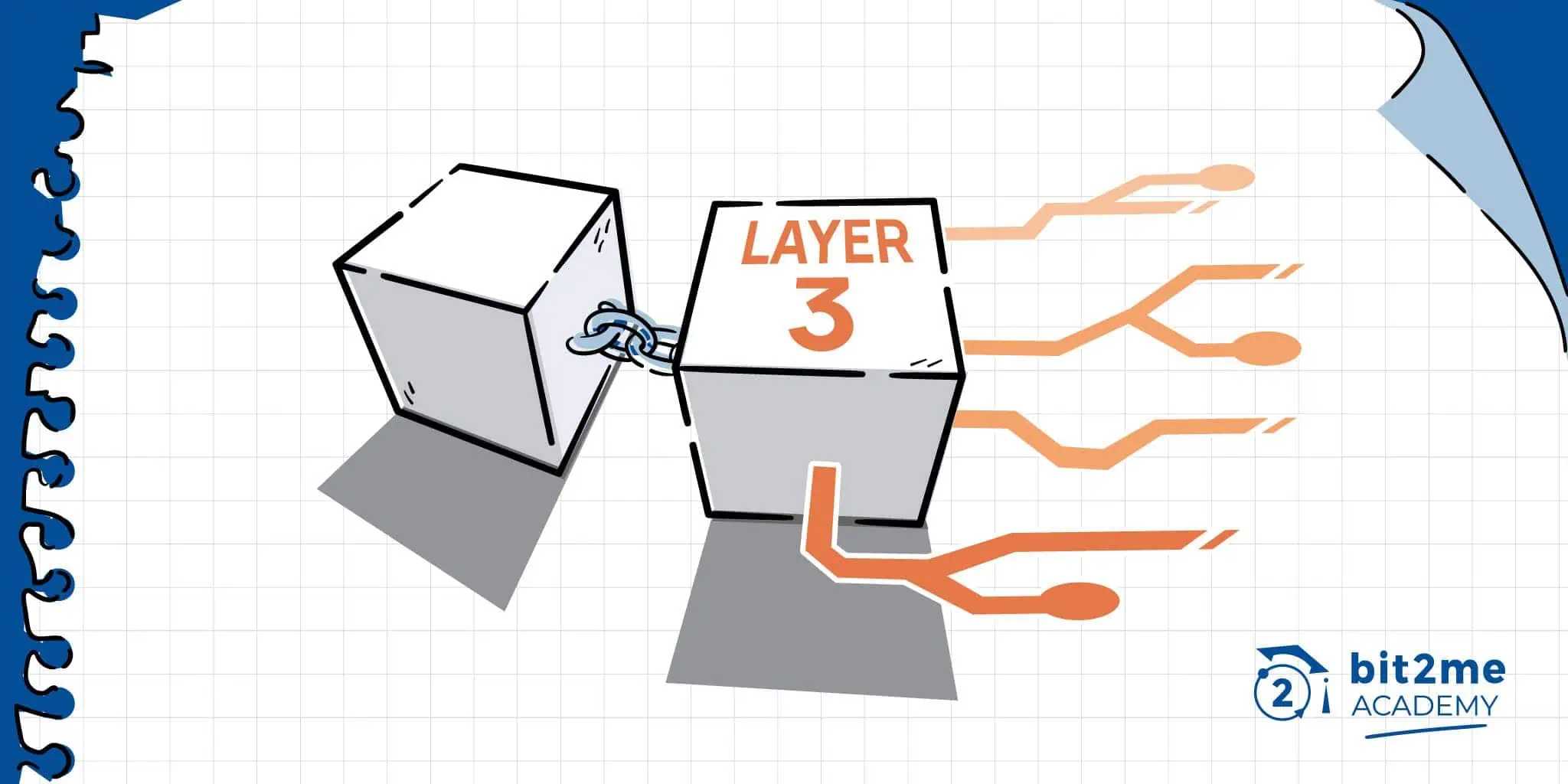
Layer 3 or layer 3 blockchains take advantage of the capabilities of Layer 1 and 2 to offer more flexible and customizable solutions and also inherit the scalability improvements of Layer 2 and, at the same time, can focus on optimization of the security and decentralization for specific applications.
💡 If you are not clear about what a Layer is within the blockchain ecosystem, here is an article where we explain it to you:
Currently, there is no doubt that blockchain technology has revolutionized our digital world, not only by offering us new ways to carry out transactions, but by opening the doors to new ways of storing data and building decentralized applications. And, since the creation of Bitcoin in 2009, we have seen a constant evolution in this space, where each new innovation seeks to solve problems that previous versions failed to fully address.
However, not everything is perfect. Since its inception, blockchain technology has had a serious problem: scalability. And the first blockchain protocols and networks have a poor capacity to deal with a large number of users concurrently, without this meaning a lack of services for them (DDoS or Denial of Service), or worse, security problems for users.
For this reason, the community has dedicated itself to building solutions to this problem, one of them being known as Layer 3.. Thus, Layer 3 has emerged as a promising solution that seeks to improve the scalability, interoperability and functionality that we so desire within blockchain applications.
But what is a Layer 3? How do they work? How are they similar to the already known Layer 1 and Layer 2?
Layer 3, a better solution to the Blockchain Trilemma
Before delving into Layer 3 and what they are, let's first understand a little about the reasons that led to their creation. In crypto, there is a concept known as the Blockchain Trilemma. This concept was developed by Vitalik Buterin, the creator of Ethereum and is focused on explaining the difficulty of simultaneously optimizing scalability, security and decentralization in a blockchain.
Basically, the Blockchain Trilemma proposes a triangle where its vertices have Security, Scalability and Decentralization. Thus, every time we approach one vertex, we move away from the other two, which leads us to a constant struggle to balance the advantages and disadvantages in the construction of new blockchain solutions.
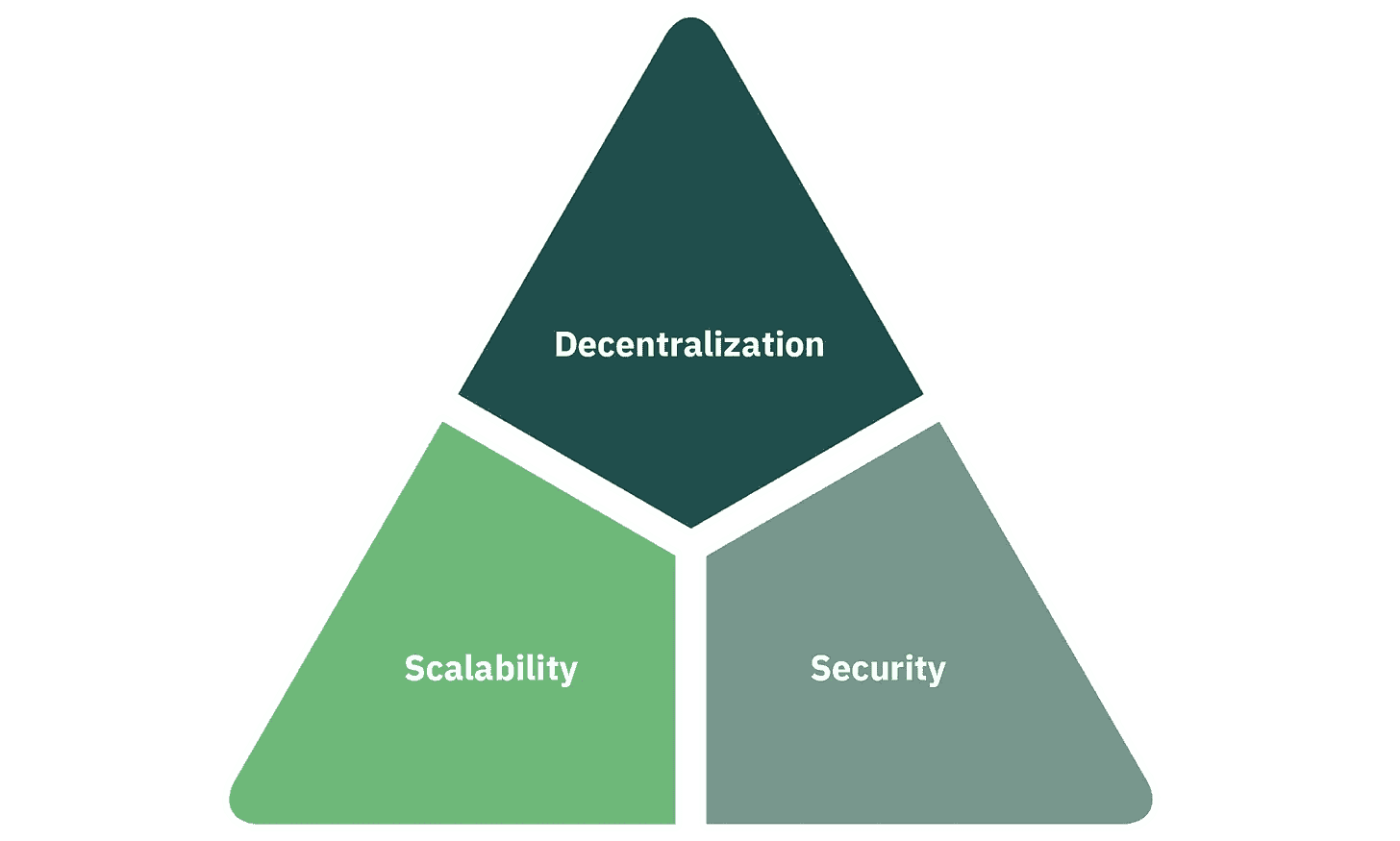
This is a complex problem to solve, so much so that it has not yet been solved. Let's look at some examples: Bitcoin It is very secure, has great decentralization, but lacks scalability, since its blockchain cannot exceed 8 transactions per second (8 TPS).
The same goes for Ethereum, which has a high level of decentralization, good security but limited scalability (32 TPS). Newer options, like Solana, offer a different picture. Solana has high scalability (10 thousand TPS), but its security and decentralization are much lower if we compare it with Bitcoin and Ethereum.
Here you have surely already grasped the point: Layer 1 (as the base protocols of cryptocurrencies are mostly known) are very limited, within the space of the Blockchain Trilemma. That is the main reason why Layer 2 has been created.
Example: Bitcoin has the Lightning Network (LN) as Layer 2, which is capable of offering up to 1 million transactions per second, minimal operating costs, and a better user experience. Of course, this comes at a cost: LN is not nearly as secure as Bitcoin is (in its Layer 1). And the same thing happens with Ethereum (e.g. Layer 2 like Polygon or Arbitrum).
The birth of Layer 3
Layer 3, being built on top of L2, inherits the scalability improvements of the latter and, at the same time, can focus on optimizing security and decentralization for specific applications.
For example, an L3 designed for a gaming application might prioritize transaction speed and low latency, while an L3 for a financial application might prioritize security and censorship resistance. This customization capacity allows L3 to offer more efficient solutions adapted to the needs of each use case. Even better, a Layer 3 can provide a generic development framework, so that developers can create specific Layer 3s based on their needs and these Layer 3s can intercommunicate with each other more easily.
💡 At this point, would you like to take a free course on DeFi when you finish reading this article? Here we leave it to you.
In this way, Layer 3 not only helps to overcome the Blockchain Trilemma, but also offers space to develop much more cohesive ecosystems that operate much more transparently for the user.
How do Layer 3 work?
Now, the magic of Layer 3 is in its capacity for abstraction over L2. This means that instead of interacting directly with the L1, applications in the L3 communicate with the L2, which is responsible for managing the interaction with the L1. This allows L3s to take advantage of the scalability improvements of L2, while benefiting from the security and decentralization of L1.
Basically, this means that L3s use different technologies to achieve their goals, including:
- Off-chain computing: Allows calculations and transaction processing off the main chain, reducing the load on L1 and improving transaction speed. We can see an example of this in RGB Protocol (Bitcoin), which we will learn about a little later.
- Sidechains: They are independent blockchains that connect to the main chain, allowing you to experiment with new functionalities and scale applications without affecting the L1. In general, Layer 2 and Layer 3 are built using this type of technologies.
- Rollups: This cryptographic technology allows multiple transactions to be grouped into a single transaction, which reduces commissions and increases the overall transaction speed, of a Layer 2 or Layer 3, over Layer 1 (where the rollup is finally recorded).
- Interoperability: Layer 3 allow different blockchains to communicate with each other. This is achieved through interoperability protocols and bridges that facilitate the transfer of assets and data between various networks. For example, a user could transfer an Ethereum token to a Layer 3 application without needing to go through a centralized exchange.
- Efficient consensus mechanisms: Layer 3 typically use consensus mechanisms that combine elements of proof-of-stake (PoS), proof-of-authority (PoA) and other algorithms, optimizing performance and energy efficiency. This allows Layer 3 to handle a higher volume of transactions without sacrificing security.
- Modular Architecture: This feature allows developers to tailor the network to specific needs, making it easier to create custom applications that can address particular industry problems. For example, a Layer 3 designed for finance could include specific features for asset management.
Examples of operation
But understanding all this is much easier with an example, and for this, we will use Bitcoin. Bitcoin (our Layer 1) has a very mature Layer 2, as is the case with the Lightning Network. The operation and interaction between the two is very simple: everything that happens in LN happens under a group of consensus rules very different from those found in Layer 1 of Bitcoin.
This is what allows LN nodes to open communication channels that allow sats (which are blocked in Layer 1) to be sent from one wallet to another (in LN) practically instantaneously. Of course, when an LN channel is closed, the entire history of operations and the satoshis that are within it are mobilized in Layer 1, leaving a transaction that serves as a witness to everything that has happened in Layer 1.
Thus, this link between Layer 1 and Layer 2 in the Bitcoin-Lightning Network is what allows us to use both technologies with a high level of security and trust. However, there is a problem: neither LN nor Bitcoin are capable of offering us advanced smart contract options at the level of Ethereum, which limits the ability to create decentralized applications.
Pushing the limits
This is a problem that a Layer 3 on Bitcoin comes to solve, in this case, RGB Protocol. RGB Protocol is a network that has its own rules, which allows us create advanced smart contracts and that can communicate with both Layer 2 (LN) and Layer 1 (Bitcoin) in order to offer us advanced smart contracts within Bitcoin and LN.
The best thing is that RGB Protocol does all this without modifying either Bitcoin or LN, everything it does does so following the already known structure and operation of Layer 1 and Layer 2, adapting to its possibilities.
For example, RGB Protocol, like Layer 3, can connect to Bitcoin directly and offer ultra-secure advanced smart contracts, but it will not give you capacity and scalability, because Layer 1 of Bitcoin is not capable of this. Instead, if as a developer you are looking for more scalability (but not as much security) you can choose to connect RGB Protocol with LN, accessing its scalability, offering advanced smart contract support and far surpassing other platforms such as Solana or Hedera.
And the best of all is that, in the end, everything you do in both RGB (Layer 3) and LN (Layer 2), will end up being printed in Layer 1 (Bitcoin) as an immutable witness of those operations you have performed. In the end, everyone ends up winning with this type of construction. Developers because they have new tools to create new technologies, users because they can access new services, and miners because they have new ways to monetize their work.
Layer 3: comparison with Layer 1 and Layer 2
The RGB Protocol example gives us a clearer idea of how Layer 1, Layer 2 and Layer 3 are related. But, to make it much clearer, here is a comparison table between these three layers:
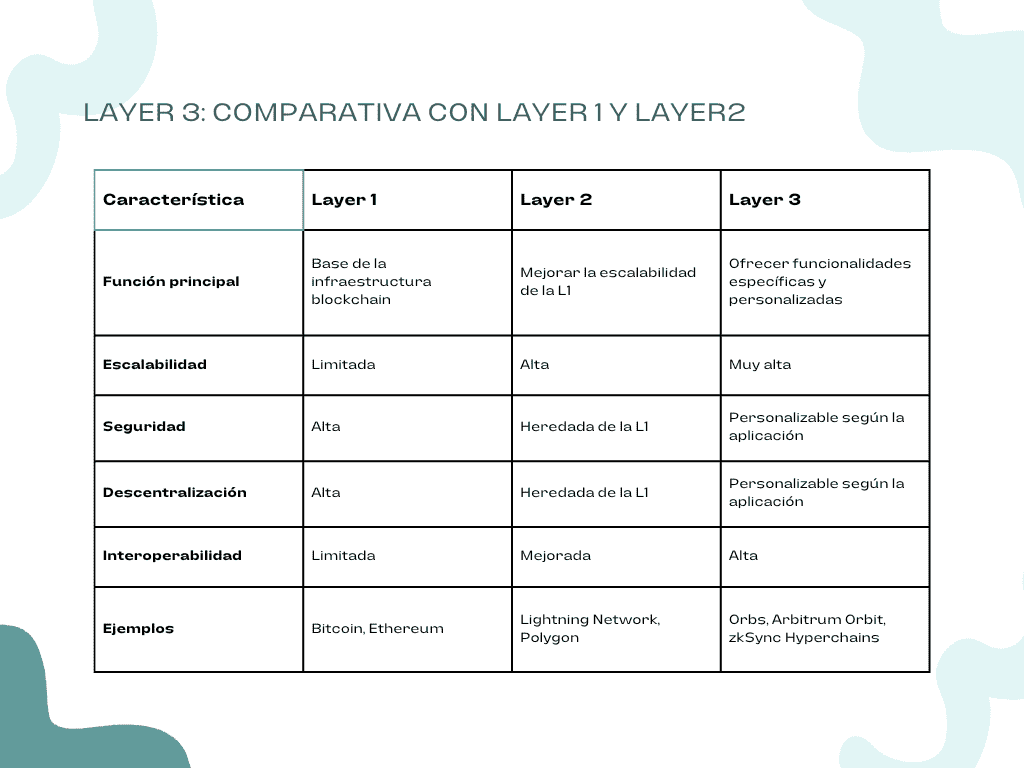
This allows us to conclude that Layer 1 are the basis of the blockchain architecture. They provide the security and consensus necessary to validate transactions. However, their ability to handle large transaction volumes is limited, which can result in long wait times and high fees.
At the same time, Layer 2s are built on top of Layer 1s to improve scalability. These solutions allow transactions to be processed off-chain and recorded later, reducing the load on Layer 1. For example, the Lightning Network allows users to make fast, low-cost transactions in Bitcoin, while rollups in Ethereum group multiple transactions into one, improving efficiency (e.g. Arbitrum and Optimism).
And finally, Layer 3 takes advantage of the capabilities of Layer 1 and 2 to offer more flexible and customizable solutions. By allowing applications to communicate between different blockchains and providing an environment for the development of dApps, Layer 3 is a natural evolution that seeks to solve the limitations of previous layers. This makes them an ideal solution for applications that require high scalability and customization.
Layer 3 Use Cases and Examples
Layer 3 have a wide range of applications in various industries. Here are some notable examples:
Decentralized Finance (DeFi) Applications
Layer 3 allows the creation of DeFi platforms that can interact with multiple blockchains, improving liquidity and efficiency in transactions. For example, Arbitrum Orbit It allows developers to build their own custom blockchains for DeFi applications, making it easier to create more complex and efficient financial solutions.
Gaming
In the gaming industry, Layer 3s can handle a high volume of microtransactions, which is crucial to delivering a smooth user experience. For example, a Layer 3-based gaming platform could allow players to make fast and cheap transactions, improving gameplay and reducing costs. This is precisely what we can see on platforms like XAI, which have been built as a Layer 3 that operates on Arbitrum (Layer 2) and the compatible chains that are Layer 2 (Ethereum)
NFT Marketplaces
In this case, Layer 3 facilitates the creation of NFT markets that can operate through different blockchains. This allows users to buy, sell and exchange digital assets without restrictions, increasing accessibility and liquidity. An example could be an NFT marketplace that allows users to trade assets on Ethereum and Solana simultaneously.
Privacy apps
Finally, Layer 3 can offer enhanced privacy solutions, allowing users to make transactions anonymously. This is especially important in applications that handle sensitive data or in markets where privacy is essential.
Future of Layer 3
Thanks to its design, the future of Layer 3 in the blockchain ecosystem is promising, as it is expected that they will continue to evolve and adapt to the changing needs of the sector. With the emergence of more blockchains, the need for interoperability solutions will become critical, and Layer 3s are well positioned to facilitate communication between different networks, which could lead to a more cohesive ecosystem.
Furthermore, as developers and companies recognize the benefits of Layer 3, its adoption is likely to expand across various industries, resulting in exponential growth in the creation of decentralized applications that transform sectors and improve everyday lives.
However, The maturity of blockchain technology will require the creation of clear regulatory frameworks to promote innovation and guarantee security, with collaboration between regulators and developers being key to establish standards that allow safe and sustainable development. Likewise, the education and training of developers and users on the functionalities and benefits of Layer 3 will be crucial for its effective adoption, which will be achieved through friendly interfaces and educational resources.
Finally, technological evolution will continue to drive innovations in Layer 3, allowing the development of more sophisticated and efficient applications. This will make Layer 3 represent a significant advance in blockchain technology, offering personalized, scalable and efficient solutions, and opening the door to a more interconnected and efficient future, where its adoption will transform various industries and improve people's daily lives.
And now that you've learned about Layer 1, Layer 2 and Layer 3, why not try our Advanced Bitcoin Course to deepen your knowledge about the first cryptocurrency on the market and on which the entire ecosystem is based? Go ahead, it's free, and you can do it from here.

 Author