Essential Points
- Definition of satoshi: The "satoshi" is the smallest and indivisible unit of Bitcoin; one Bitcoin is exactly equal to 100 million Satoshis, a fixed ratio engraved in its code.
- Conversion calculation: To find out the value in fiat currency (euros or dollars), multiply the amount of BTC by the current market price; if starting from Satoshis, first divide by 100 million.
- Importance of precision: Due to extreme volatility and the handling of many decimal places, it is vital to use web tools that update the price in real time via websockets to avoid costly human errors.
- Psychological and technical advantage: Counting in Satoshis (e.g., 50.000) instead of Bitcoin decimals (e.g., 0,0005) makes it easier to read, reduces confusion with leading zeros, and is the standard unit for small transactions.
If you still think the cryptocurrency market is a battle of wits between users analyzing charts in front of their computers, you're late to the party. The reality in this sector is much colder. And that's because the digital world isn't a forum for debate; it's a high-frequency trading arena where 90% of the trading volume is driven by algorithms that never sleep, never feel fear, and, above all, never hesitate to execute their trades.
In fact, current execution speeds have reached a point of no return. Trying to compete manually against software designed to detect inefficiencies in milliseconds is simply a very slow way to lose money.
Thus, trading bots have gone from being exotic tools for engineers to becoming the invisible infrastructure that sustains the liquidity of almost any token you hold in your wallet. But what are trading bots? How do they work? What happens when the code has more power than its owner?
 Certificate

What are trading bots?
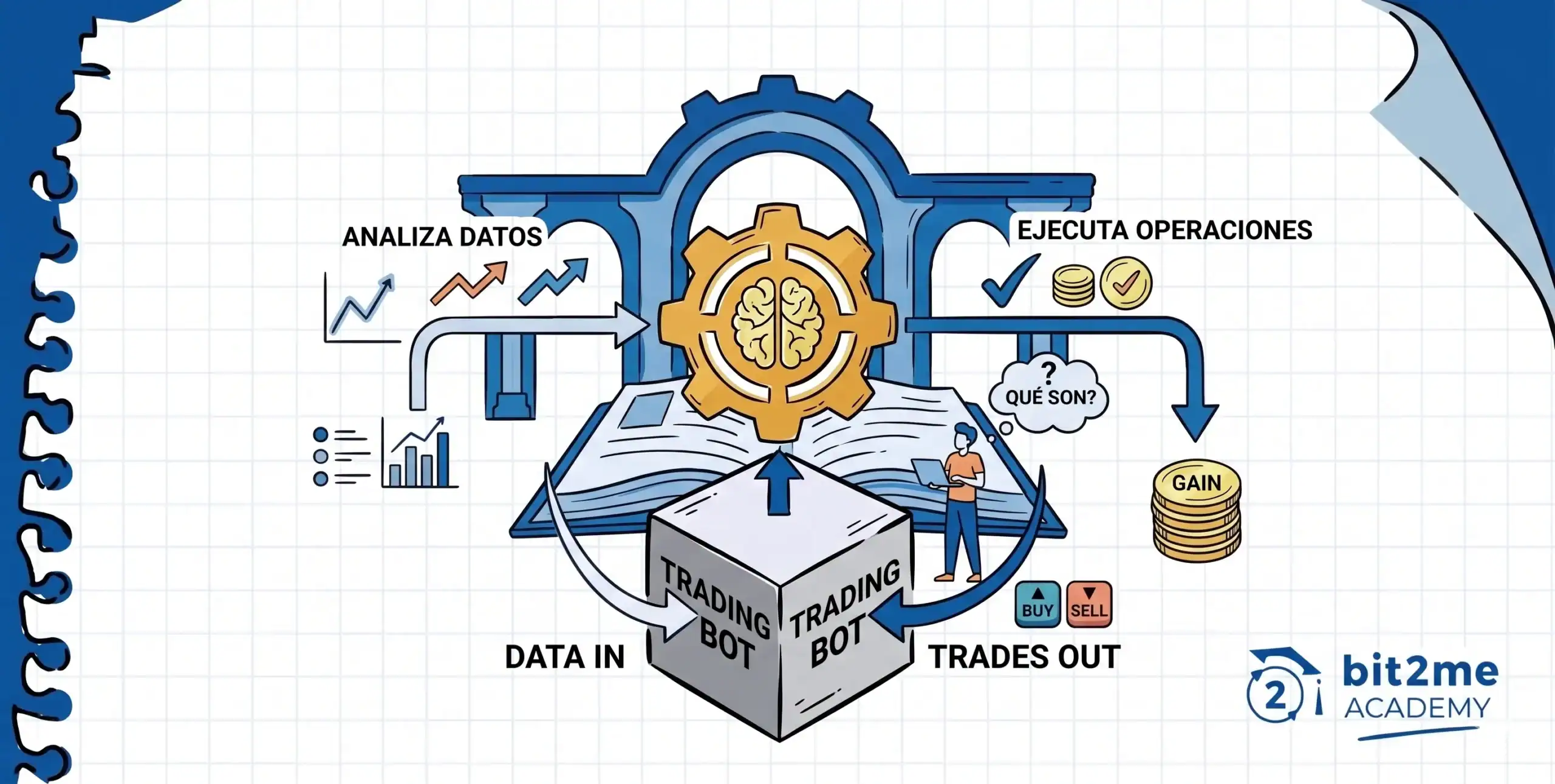
Despite the mystique surrounding them, A trading bot is simply a software program that executes buy or sell orders based on a set of predefined rules. There's no magic involved, just logic and mathematics. In the digital asset ecosystem, these programs connect directly to exchanges via API keys or interact directly with smart contracts on the blockchain.
But, unlike a human, who can get distracted by looking at their phone or panic after an inflammatory tweet, The bot is a disciplined extension of a strategy.
Their primary function is efficiency: buying when condition A is met and selling when variable B appears. However, bots have ceased to be simple order executors and have transformed into entities with the capacity for immediate response to global macroeconomic events.
Operational anatomy: How do bots work?
To understand its domain, we must dissect how it works. A successful bot operates under a three-layer structure that must be perfect:
- Data ingestion: The bot consumes real-time price feeds from multiple sources and oracles. In a fraction of a second, it compares the price of an asset in Seoul, London, and New York.
- Decision engine: This is where the brain resides. The software processes technical indicators (such as the RSI or complex moving averages) or even analyzes the natural language of financial news to determine the next move.
Execution layer: This is the critical phase. The bot sends the order to the order book. At this point, latency (the connection delay) is the factor that separates a million-dollar profit from an execution error. If your bot is even one millisecond slower than the competition's, your order will be executed at a worse price.
An operational example
To illustrate how this operational anatomy materializes in the real crypto asset market, the best example is a bot of High-Frequency Triangular Arbitration (ATAF) operating in a robust ecosystem like that of Bit2Me.
Imagine a bot designed to exploit inefficiencies between the Euro (EUR), Bitcoin (BTC), and a high-traction token (at the time you run the bot), such as Worldcoin (WLD) or a Layer 2 asset. This is how it applies the three points we discussed:
Data Ingestion (The Bot's Radar)
The bot doesn't look at a web page; it's connected via WebSockets to the APIs of multiple exchanges simultaneously. In milliseconds, it receives a constant stream of data.
- BTC/EUR price in Madrid.
- WLD/BTC price in the global market.
- WLD/EUR price in the local market.
While you blink, the algorithm has already compared these three prices 50 times, looking for a discrepancy of just 0,2% that the human eye would never detect.
Decision Engine (The Analytical Brain)
Here, the code processes the information instantly. The bot detects that, due to breaking news about AI in the United States, the price of WLD has risen in the BTC pair, but the EUR pair has not yet reacted due to a lack of immediate liquidity.
The engine calculates:
“If I sell BTC for WLD, and then WLD for EUR, I will end up with more euros than I had at the beginning, even after paying network fees.”
If the net profit is positive after discounting the "slippage" (price deviation), the brain gives the "fire" command.
Execution Layer (The Accurate Shot)
It's time for the truth. The bot sends three market orders on chain. In 2026, this is done via co-location servers (located physically close to the exchange's servers) to reduce latency to an absolute minimum.
- Order 1: Buy WLD with BTC.
- Order 2: Sell WLD for EUR.
- Command 3: Close the cycle by returning to the initial position.
If the execution takes 10 milliseconds, the profit is guaranteed. If it takes 500 milliseconds (the time it would take you to move your computer mouse), another, faster bot will have closed the gap, and yours could execute the trade at a worse price, incurring losses.
As a result, the bot has generated a small but guaranteed profit in seconds, without the trader having to touch their mobile phone even once, maintaining market liquidity and eliminating price inefficiencies completely autonomously.
Execution strategies: Algorithmic profit engineering
However, not all bots are designed for the same purpose. In the cryptocurrency ecosystem, an algorithm's architecture defines its risk tolerance and responsiveness. This can be understood very simply: Some bots seek survival in turbulent markets, while others act as predators. Your strategy will help you decide between one or the other, but to do that you need to get to know them a little better.
Grid Trading Bots
Grid trading is the technical response to market indecision. Instead of trying to predict a trend, this strategy allocates capital across a grid of proportionally distributed buy and sell orders.
In this case, the bot sets an upper and lower limit. Every time a token's price drops and reaches a buy level, the algorithm executes the order and immediately places a sell order one level above it.
This strategy is ideal for consolidation periods or sideways markets, where the price fluctuates without a clear direction. The bot "milks" volatility, accumulating small profit spreads with each micro-swing. If the price remains within the range, the bot acts as a cash flow generator; if the price violently breaks out of the range, the bot stops trading to avoid larger losses.
Bots for automated DCA
Dollar-cost averaging (DCA) is probably the most underrated strategy among novices and the most respected by veterans. In its automated version, the bot eliminates the trader's biggest enemy: your own brain.
The bot is programmed to buy a fixed amount of a digital asset (e.g., €100 worth of BTC) every week, regardless of whether the market is euphoric or panicked.
By averaging the entry price over time, the trader drastically reduces the risk of entering at a local high. In 2026, the most advanced DCA bots will include "Smart Buy" parameters, which detect extremely oversold conditions and slightly increase programmed buys, further optimizing the average portfolio cost without requiring the user to turn on their computer.
Triangular Arbitration, the opportunity hunter
This is the strategy of market "predators." Triangular arbitrage doesn't depend on the price direction (whether it goes up or down), but rather on the mathematical consistency between three trading pairs within the same exchange or DeFi protocol.
But what benefits does this bring us? Imagine you have Euros in your wallet. The bot detects that the price of Bitcoin in Euros is slightly out of sync with the price of Ethereum, and that Ethereum is, in turn, cheap against the Euro. The algorithm executes an instantaneous sequence:
- Buy BTC with EUR.
- Exchange that BTC for ETH.
- Sell ETH for EUR.
If at the end of the cycle the bot has more Euros than it started with, the trade has been a success. These discrepancies are usually minimal (from 0,05% to 0,2%) and disappear in milliseconds when other bots detect them. Therefore, arbitrage is a game of pure latency: whoever gets to the order book first gets the profit. And that's its greatest danger, because in such fierce competition, the chances of losing the trade are extremely high, especially if you're using your bot from your home internet connection.
The arrival of AI in trading bots
However, with the arrival of AI, there's another type of bot we should highlight: bots powered by AI agents. Thanks to this tool, we no longer configure the bot to "buy if it drops 5%." Now, we give it a broader objective:
"Manage this capital to achieve a 10% annual return while minimizing exposure to regulatory risks in Europe."
One instruction, and the bots are now able to generate strategies, adjust them, and understand the overall market context, in order to operate with a greater amount of data.
For example, if you connect your trading bot to MCP tools that allow it to read news, it will be able to see that Federal Reserve report and adjust its exposure to certain tokens before the human market has even processed the first paragraph. In this way, these algorithms can detect whether the hype surrounding a new protocol is genuine or orchestrated manipulation, and act accordingly.
That's why many people do things like use OpenClaw, connect a trading MCP to an exchange, and instruct their bot to execute market trades. It's like having one of those very expensive bots, practically for free.
But they also have their risks, so you must be careful. AI can be unpredictable; if you don't protect your agent, you can be hacked; if you don't know how to program skills, your bot won't be very useful; and operating with AI can be expensive. Despite this, it's a reality that's developing right now, and its impact remains to be seen in the coming years.
Predators in the food chain: The impact of MEV Bots
But not everything in trading bot code is benign. The biggest threat to the average user comes from MEV (Maximum Extractable Value) bots. These programs monitor the mempool (the transaction waiting room) to identify pending trades and anticipate them.
Have you ever tried to buy a token and seen the price rise just before your transaction was confirmed? Then you were probably the victim of a Sandwich attack.
This means a bot detected your intent, bought before you to drive up the price, and then sold to you immediately afterward. This value extraction is a silent drain that robs retailers of millions every day, generating systemic distrust in the integrity of decentralized networks.
On networks like Ethereum, MEV bots are commonplace. In fact, the most recent MEV bot incident involved a whale attempting to buy the $AAVE token using 50 million USDT. The result? After being attacked by a horde of MEV bots, the individual ended up with less than $70 in their wallet; the rest of their money literally vanished.
The danger zone: Risks of trusting code
And the above leads us to a very clear point: Entrusting your assets to an algorithm has its downsides.
Because when you delegate the management of your crypto assets to a bot, you are not only delegating the strategy, but also the integrity of your capital against systemic events and technical vulnerabilities.
The phenomenon of the "Algorithmic Cascade" and Flash Crashes
In today's ecosystem, homogeneity is a silent danger. Many trading bots share similar code libraries and respond to the same technical indicators (such as 200-period moving average crossovers or specific Fibonacci levels).
This means that if a token experiences a sudden 5% drop, hundreds of bots may have their stop-loss orders programmed at that same level. When these sales are executed simultaneously, the price plummets even further, triggering a second and third layer of bots programmed to sell at lower levels.
These events, known as Flash CrashesThey drive the price down to absurd levels in a matter of seconds. The risk for you is that your bot will sell at the lowest point of the crash, just before the market recovers, leaving you out of the position with an irreversible realized loss.
The Achilles' heel: API key management
For a bot to operate on your behalf, it needs "permissions." These are granted through API (Application Programming Interface) keys, which act as a remote control for your exchange account.
The risk is that if you use a third-party bot that hasn't been audited, the software may contain malicious code. An attacker doesn't need to steal your passwords; they only need your API key to have the "Withdrawal" permission enabled to empty your account.
The "Black Box" bias and the logical error
Many users operate with what we call "Black Boxes": algorithms whose internal logic they do not understand. This presents a massive operational risk when market conditions change.
This means that a bot optimized for a bull market can become self-destructive in a bear or sideways market. If you don't understand how your bot makes decisions, you won't know when to shut it down.
It's also possible that a minor error in the bot's code could cause it to enter a loop of endless buy-sell transactions (overtrading). Even if each trade is small, network and exchange fees can deplete your balance in a matter of hours.
The false security of AI
With the rise of agentic AI in 2026, many traders They believe the bot will "learn" to avoid losses. This is a dangerous trap. AI relies on historical data; faced with a "Black Swan" event (such as a critical failure in a Layer 1 protocol or an unforeseen regulatory change), the AI may become confused or make erratic decisions based on correlations that no longer exist.
Golden rule for 2026: Security in algorithmic trading is not a product you buy, but a habit you cultivate. This involves constant audits of your connections, API key rotation, and above all, never leaving your computer running with a bot without direct human supervision.
The new regulatory order: GENIUS Act and MiCA Act
For years, the digital asset sector operated under the premise that "code is law."
However, the impunity with which certain predatory algorithms operated has forced a coordinated response from major economic powers. By 2026, the net has closed: the freedom to innovate is no longer synonymous with the freedom to manipulate.
MiCA Regulation: The European gold standard for transparency
In Europe, the MiCA (Markets in Crypto-Assets) Act has gone from being a draft to becoming the definitive filter for the industry. Its impact on trading bots has been seismic:
- Mandatory audits: It is no longer legal to market a bot in Europe without technical certification. Service providers must demonstrate that their algorithms are free of manipulation bias and have passed stress tests under high-volatility scenarios.
- Algorithmic transparency: MiCA requires platforms to break down how their "white-label" bots work. If an exchange offers you a grid bot, it must clearly disclose execution risks and protection mechanisms against slippage.
- Robust cybersecurity: The law requires API key custody standards comparable to those of traditional banking, reducing the risk that a massive hack of a bot provider will leave thousands of users with their accounts wiped out.
GENIUS Act: The deck against the predators of the MEV
While Europe focuses on service transparency, the United States has opted for a punitive approach against toxicity in the blockchain through the GENIUS Act.
- Criminal prosecution of front-running: For the first time, the use of bots to "get ahead" of users' orders (taking advantage of prior knowledge of transactions in the mempool) is treated as a financial crime equivalent to insider trading on Wall Street.
- The end of anonymity for MEV developers: The law requires any entity operating nodes with maximum value extraction (MEV) software to register and comply with activity reporting protocols. Those who employ abusive techniques, such as sandwich attacks that drain retailers' funds, now face multimillion-dollar fines and prison sentences.
The hybrid trader as the winner
Does this mean the human trader is dead? Not necessarily. The future belongs to the hybrid trader. Machines are excellent at executing orders, but mediocre at understanding "black swan" events or ethical paradigm shifts.
Mastering bots is essential for anyone who wants to survive in the token ecosystem. However, leaving the wheel entirely in the hands of the algorithm is reckless. Technology should be your tool, not your replacement. At the end of the day, the code may be perfect, but the market remains a reflection of human ambition and fear.
Bit2Me Pros: Trading bot with native automation and security under MiCA
In the complex ecosystem of algorithms, Bit2Me Pro positions itself as a solution that prioritizes security and user simplicity. Unlike external platforms that require managing complex and risky API keys, Pro's trading bots Bit2Me Pro accounts feature native integration. This means the bot operates directly on your Pro account funds without exposing your credentials to third parties or connecting external applications, thus eliminating one of the main vectors of technical attack.
Furthermore, in an environment where regulatory uncertainty is a latent risk, Bit2Me It offers the peace of mind of operating under the MiCA license and being registered as a VASP with the Bank of Spain. This legal robustness is complemented by human and personalized support in Spanish, guaranteeing that any doubt about your strategy or the operation of your funds will be resolved in your language by experts.
From theory to practice: The DCA bot as a strategic ally
Taking your Dollar Cost Averaging (DCA) strategy to the next level is possible thanks to the advanced functionality of Bit2Me Pros. The platform allows for quick setup in just two minutes, where the user defines key parameters such as the trading pair, the amount per execution, and the frequency (from minutes to months). Once active, the bot handles disciplined execution, eliminating the emotional factor from trading.
For complete control, the user has access to a real-time performance dashboard that breaks down critical metrics such as Average Purchase Price, total acquired, accumulated performance (in EUR and percentage), and a detailed execution history. Furthermore, the system features smart alerts and intervention points; for example, if a bot enters an error state due to insufficient funds, the system sends proactive notifications (push or email) so the user can react immediately and not miss their accumulation window.
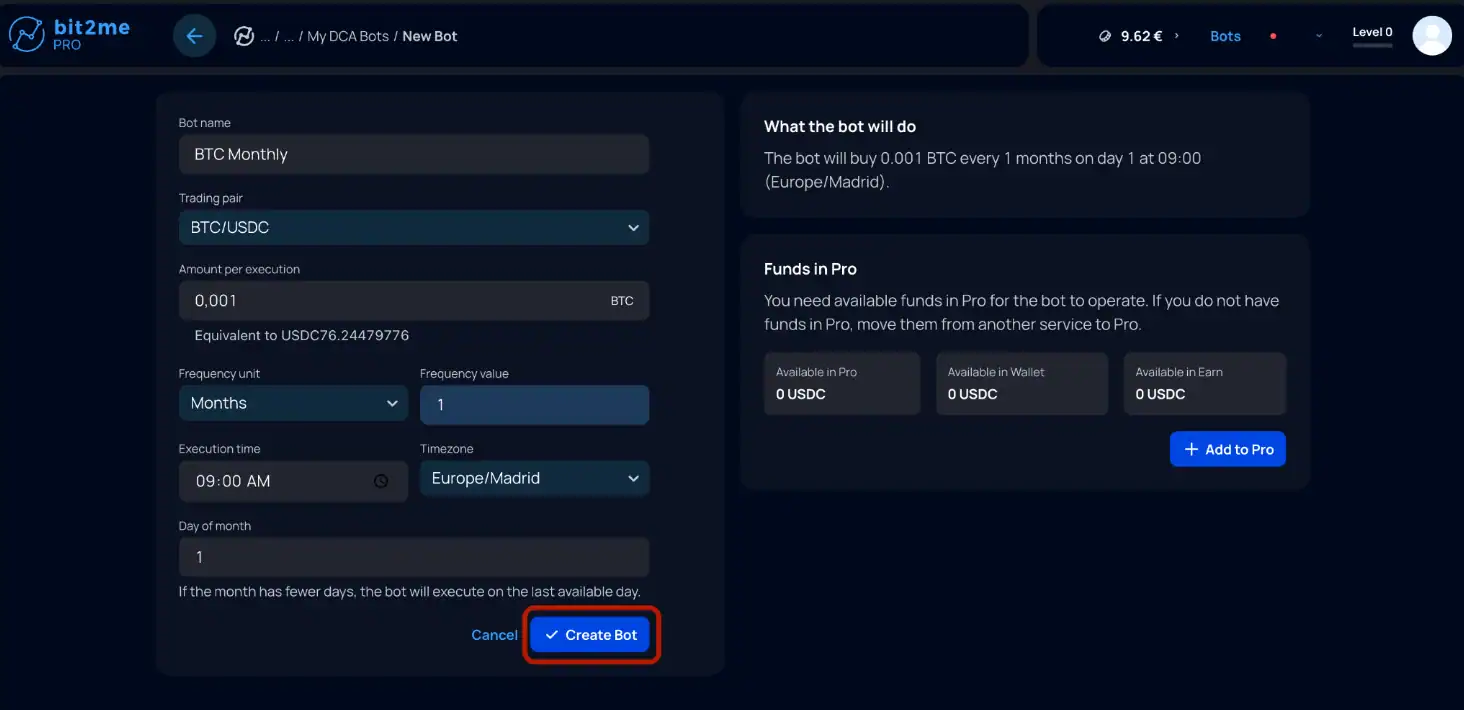
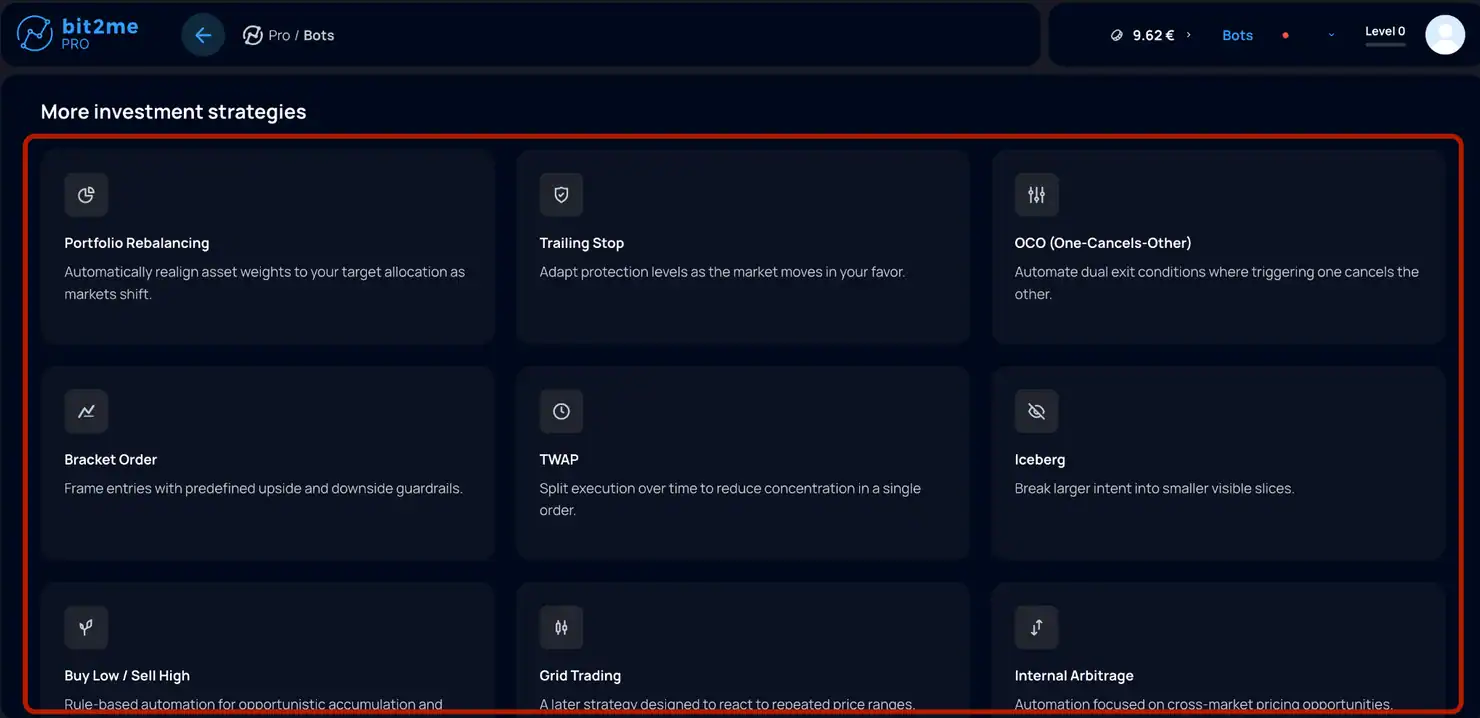
The best part is that the bot is integrated into Bit2Me It has a very easy-to-use interface, which facilitates interaction with it and allows everyone to enjoy its advantages, especially its automated modes and strategies, to perform the operations you want.
FAQ: Trading Bot



 Author