Essential Points
- Institutional staking transforms participation in Proof of Stake networks into a critical infrastructure project, not a simple treasury decision.
- Key security —with HSM or MPC schemes— and high availability determine whether a company avoids network penalties.
- It allows funds, corporate treasuries, and small exchanges to decide between setting up their own node operation or delegating it to a specialized provider.
- No staking reward is guaranteed: slashing for downtime or double signing can erode the delegated capital if the operation fails.
Institutional staking is the infrastructure, security controls, and compliance processes that enable a company to operate large-scale staking without relying on a retail account. Funds, corporate treasuries with significant positions in digital assets, and mid-sized exchanges are increasingly treating participation in Proof of Stake (PoS) networks as an operational line with its own audit, business continuity, and key governance requirements.
This article describes what is required to set up or outsource such infrastructure: high availability and redundancy, key security with HSMs or MPCs, slashing risk management, compliance as a Crypto Asset Service Provider (CASP) under MiCA, and the analysis of whether to operate in-house or outsource to a specialized provider. The goal is to give a treasury or infrastructure manager a decision-making framework, not a specific product recommendation.
Risk Advisory (MiCA)Investing in cryptocurrencies is not fully regulated, may not be suitable for retail investors due to its high volatility, and carries the risk of losing all invested funds. It is important to read and understand the risks of this investment, which are explained in detail at: https://up.bit2me.com/legalbit2me
Past performance is not a reliable indicator of future results. Services related to generating returns carry specific risks, including liquidity risk, counterparty risk, collateral risk, and product-specific terms and conditions, which businesses should carefully review before committing capital. No staking reward, at any volume or with any provider, is guaranteed.
 Certificate

What is institutional staking and why is it no longer an experiment?
Institutional staking describes the participation of an organization—not an individual user—in the consensus of a Proof of Stake network, with capital volumes and governance requirements that exceed those of a product designed for individuals. The difference is not only one of scale: when a company delegates or manages third-party digital assets, or commits part of its balance sheet, audit, traceability, and fiduciary responsibility obligations come into play that do not exist in retail staking.
This evolution reflects a change in the buyer profile. Funds with exposure to digital assets, corporate treasuries with positions in PoS networks, and mid-sized exchanges that want to offer staking to their clients all share the same question: how to participate in consensus without assuming disproportionate operational risk.
The answer lies not in replicating a particular user's exchange staking on a larger scale, but in treating participation in PoS networks like any other piece of critical infrastructure: with availability requirements, segregation of duties, and documented contingency plans. For the basic reward and validation mechanism that underpins all of the above, the general guide to staking de Bit2Me Academy It explains in detail how it works. Consensus Proof of Stake before entering into the institutional scale that this article addresses.
Infrastructure requirements: high availability and redundancy
An institutional validator cannot afford the same margin of error as a home node. The primary requirement is high availability: the infrastructure must remain synchronized and operational around the clock, because each proposal or block attestation window has a narrow margin, and interruptions result directly in penalties or lost rewards.
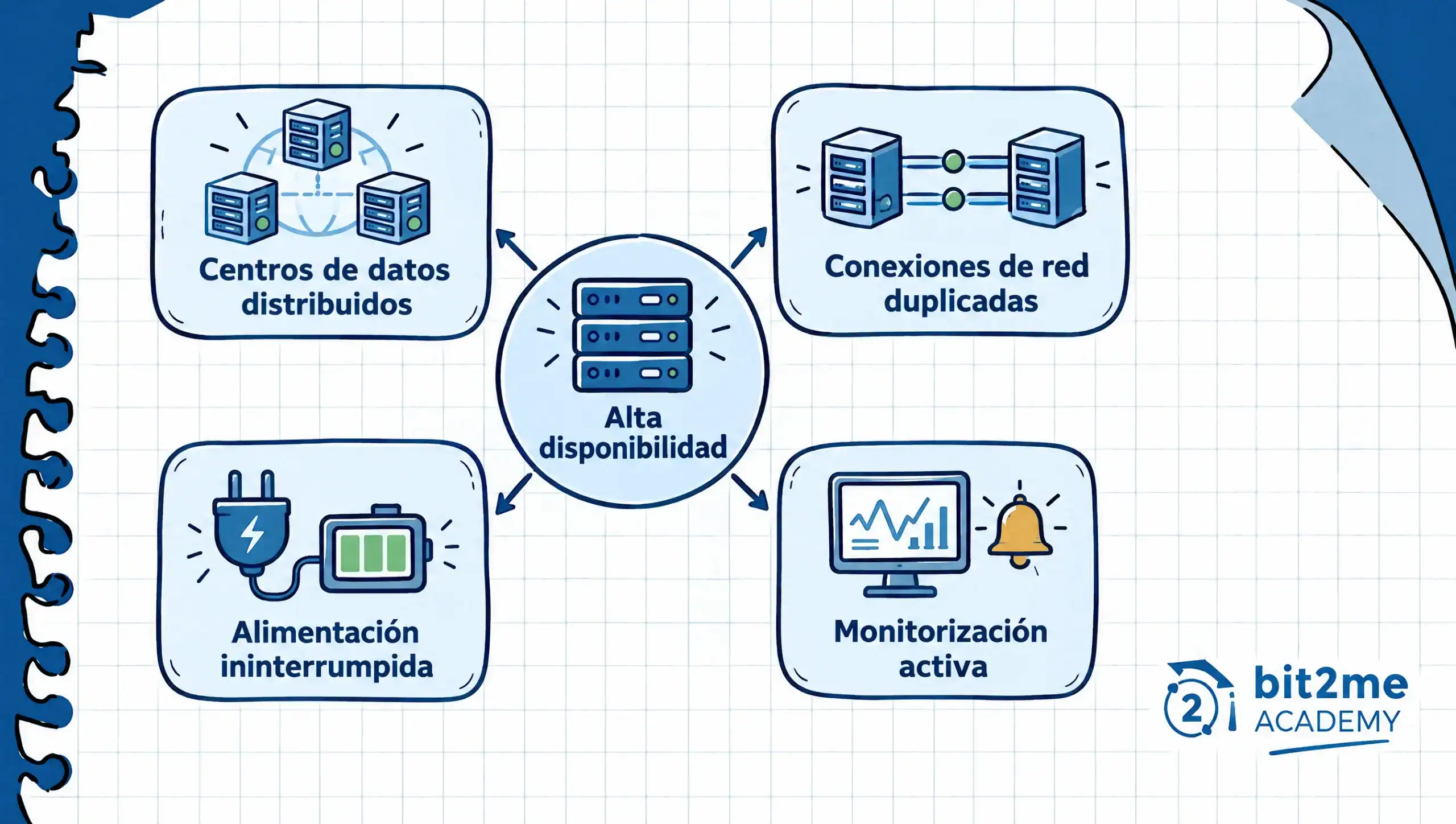
To maintain that availability, an institutional operation needs redundancy at multiple levels simultaneously: geographically distributed data centers or cloud providers, duplicate network connections with automatic failover, uninterrupted power, and a monitoring layer that alerts before a failure becomes a prolonged downtime. No single component should be a single point of failure capable of bringing down the entire operation.
Redundancy, however, introduces its own risk if not carefully designed: two instances of the same validator running simultaneously due to a configuration error is one of the most common causes of severe penalties in PoS networks. Designing redundancy without accidentally duplicating the signing process is precisely the engineering challenge that separates a mature institutional operation from an improvised one.
- Continuous synchronization of execution and consensus clients, with active monitoring of delays and disconnections.
- Redundant connectivity with automatic switching in case of network provider failure.
- Uninterrupted power supply and documented and periodically tested disaster recovery plans.
Key security: HSM and MPC in large-scale staking operations
While availability protects the operation against downtime, key security protects capital against direct compromise. In institutional staking, the validator's signing key must be constantly available, making it a more vulnerable target than a private key that is only used occasionally to authorize a transaction.
A hardware security module (HSM) is a certified physical device that generates and protects cryptographic keys, performing the signing process within an isolated environment that does not expose the key to the server's operating system. It is the long-standing standard in banking and critical financial infrastructure, and its application to institutional staking extends this discipline to validator key management.
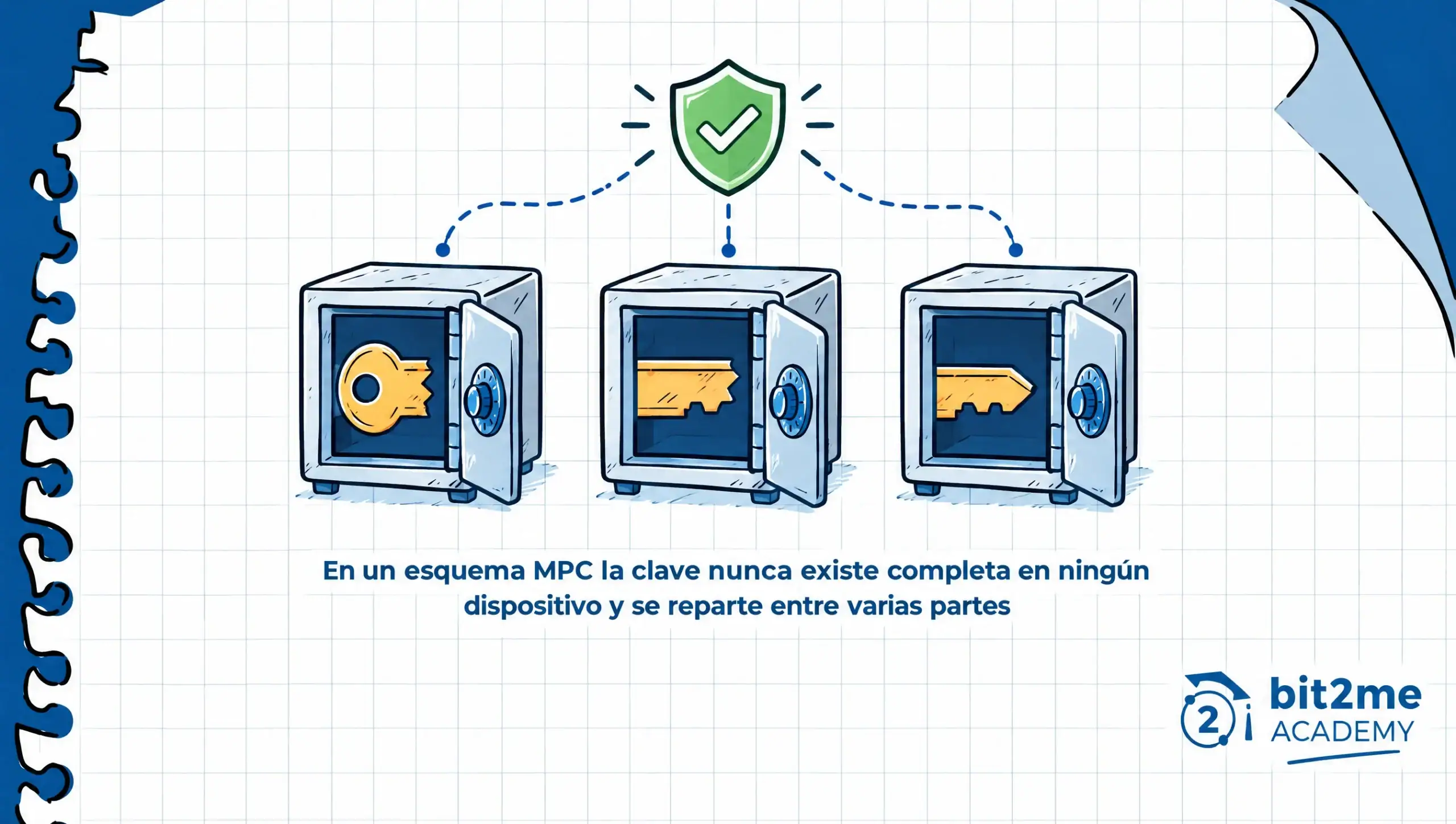
La multiparty computation (MPC) follows a different logic but pursues the same goal. In an MPC scheme, the key never exists complete on any device: it is divided into fragments distributed among several independent parties, and a signature is only completed when a minimum number of these fragments cooperate cryptographically, without reconstructing the key. This reduces the risk that the compromise of a single system will expose the full signing capability.
Neither solution is inherently superior: an HSM provides a certified and widely audited standard, while an MPC scheme facilitates the geographical and organizational distribution of control without relying on specific hardware at each location. What is essential in any institutional staking operation is that key management be documented, audited by an independent third party, and subject to a formal, multi-party process before any critical configuration changes.
Operational risk management: downtime slashing and dual signature
Most Proof-of-Stake (PoS) protocols incorporate a penalty mechanism, known as slashing, designed to punish behaviors that jeopardize network security. In an institutional operation, understanding what triggers this mechanism is as important as understanding the infrastructure requirements, because slashing directly reduces the capital committed, not just future rewards.
The first common trigger is prolonged downtime. When a validator remains offline or out of sync for an extended period, many networks activate a graduated penalty—the so-called inactivity leak in Ethereum— which progressively reduces the stake for the duration of the disconnection. This is not a penalty for a malicious attack, but for operational negligence—exactly the scenario that high availability requirements are designed to prevent.
The second, more severe trigger is double signing: proposing two different blocks in the same turn or attesting to incompatible votes with the same keys. This triggers much more aggressive penalties because the protocol interprets it as a sign that the keys of the same validator are running on more than one machine simultaneously, typically due to a migration failure or a poorly designed redundancy configuration. Therefore, redundancy must be built with explicit anti-double signing mechanisms, and not simply by duplicating the signing process without coordination.
No company can completely eliminate the operational risk of participating in the consensus of a PoS network, but it can control the likelihood of it materializing: documented change procedures, alerts for desynchronization, and a clear policy on who can modify the configuration of a validator in production.
Regulatory compliance: CASP authorization under MiCA
Within the regulatory framework of the European Union, the MiCA Regulation (Markets in Crypto-Assets) It requires that any entity providing crypto-asset services on behalf of third parties—including staking on behalf of a client—be authorized as a Crypto Asset Service Provider (CASP). For a company considering outsourcing its institutional staking to a third party, verifying this authorization is the minimum requirement before deeming any provider viable within the European Union.
BITCOINFORME, PSC, SL, which operates under the trade name of Bit2Me, is a crypto asset service provider authorized and regulated by the National Stock Market Commission (CNMV) in Spain, in accordance with Article 59 of the MiCA Regulation. This authorization framework legally governs any institutional staking or node infrastructure service offered to companies, and obliges the provider to clearly inform about how it manages the client's keys and what happens in the event of an operational incident.
A company dealing with an institutional staking provider should request the CASP authorization number, the issuing authority, and the exact scope of services it covers, just as it would verify the license of any other critical financial provider. It's also advisable to ask how the segregation of client and provider assets is documented.
Operating the infrastructure internally does not eliminate regulatory exposure: a company that manages staking for its own balance sheet remains subject to its audit and accounting obligations, but the responsibility for demonstrating that compliance rests entirely with its team, without an authorized provider to share that burden.
Blockchain nodes for businesses: operating your own infrastructure
When a company decides not to delegate and operate its own blockchain nodesThis enters a broader realm of technical responsibility. Operating blockchain nodes for businesses at that scale involves managing synchronized execution and consensus clients, keeping the infrastructure up-to-date with each protocol upgrade, and maintaining a team specializing in distributed systems, not just development or finance.
This approach makes sense when the volume of capital under management justifies the cost of building that internal team, and when direct control over the keys and configuration is a non-negotiable requirement, for example, due to the parent company's risk policy. A mid-sized exchange that wants to offer staking to its clients, or a fund with structural exposure to several PoS networks, are the profiles that most frequently justify this level of investment.
The downside is that operating blockchain nodes for businesses requires directly assuming all the responsibilities described in the previous sections: maintaining high availability, managing keys with an HSM or MPC, and bearing sole responsibility for any slashing events. There is no intermediary entity to absorb part of this risk, making this option the most demanding in terms of technical resources, but also the one that offers the greatest direct control over every configuration decision.
Outsourcing to a specialized provider versus operating internally
The alternative to building in-house infrastructure is to outsource institutional staking to a specialized provider that already operates validators across multiple networks under a contractual agreement with defined service conditions. This approach shifts the burden of high availability, key management, and incident response to the provider, while the company retains ownership of the digital assets and the contractual relationship as a control mechanism.
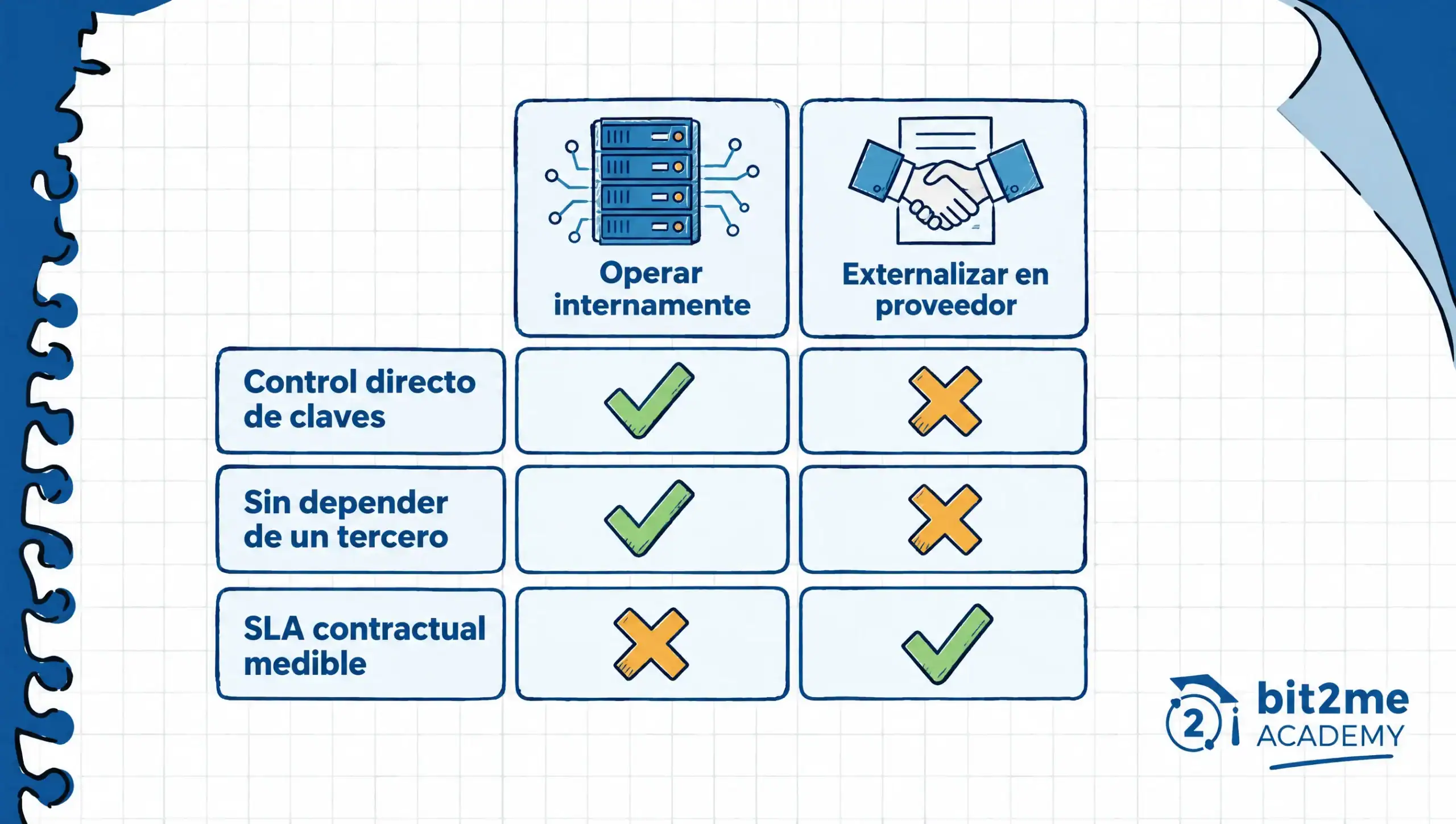
The main advantage of this option is that it transforms a critical infrastructure project into a service with measurable service-level agreements (SLAs): committed availability, incident response times, and periodic audits, all documented in the contract, instead of relying on an in-house team that may never have operated a validator in production at that scale. For a fund or treasury not aiming to become a blockchain infrastructure operator, this substantially reduces the operational risk surface described in the slashing section.
The trade-off is dependence on a third party and the need to verify, with the same rigor described in the compliance section, that this supplier has a valid CASP authorization. verifiable asset segregation and an auditable operating history. Bit2Me B2B offers node infrastructure services for companies that need to operate validators on different Proof of Stake networks under contractually defined availability and technical support conditions, designed for organizations that prefer not to assume the entire operational load described in the previous section.
Neither approach is inherently superior. The decision hinges on whether the company's capital and strategy justify building internal capacity that is unlikely to be used for any other purpose, versus outsourcing that infrastructure to a provider whose primary activity is operating institutional staking with the discipline required by a critical production environment.
How to evaluate the decision: questions before committing capital
The above criteria are summarized in a checklist that a treasury or infrastructure manager can use in the decision-making process, whatever the final outcome.
- Does the volume of capital allocated to institutional staking justify building and maintaining an internal node operations team?
- What key management scheme will be used—HSM, MPC, or both—and who will audit it independently?
- What availability and incident notification SLA can be compromised, internally or by an external provider?
- What CASP authorization supports the evaluated provider, and what scope of services does it cover?
- How is the response procedure to a slashing event documented and tested?
This list does not replace a full due diligence process, but it serves as an initial filter to eliminate options that do not provide documented evidence to answer basic questions. No response should include promises of fixed returns: a vendor or internal team offering a guaranteed staking reward is communicating something that no PoS protocol can sustain by design.
If your organization is evaluating these criteria or needs to compare them with a specific node infrastructure case, talk to the B2B team at Bit2Me It can help to organize the decision before committing capital to any supplier.
Current status: Institutional staking and MiCA regulation as of December 2026
As of December 2026, the MiCA framework continues to solidify CASP authorization as a mandatory benchmark for any European Union entity providing institutional staking on behalf of third parties, including the delegated operation of enterprise nodes. Increasingly, funds and treasuries are contractually requiring evidence of asset segregation and recent audits before signing agreements—a level of scrutiny previously reserved for institutional banks.
On the technical front, the adoption of MPC schemes continues to grow among specialized providers, alongside the more traditional use of certified HSMs, though neither has become the sole industry standard. Companies should regularly review the authorization status and certifications of any provider, not just upon signing the contract.
Deciding between operating enterprise blockchain nodes in-house or outsourcing is not a permanent choice. Available capital and technical expertise change over time, and institutional staking infrastructure should be reviewed with the same rigor as any other business-critical financial provider.
Frequently asked questions about institutional staking



 Author