Essential Points
- Actual Settlement vs. Payment Promises: In a traditional bank, money takes 24 to 48 hours to actually move behind the scenes. With crypto cards, the conversion of your asset to euros happens in the millisecond of purchase, eliminating clearing waits and weekend lock-ins.
- Sovereignty over your capital: At a bank, you're a creditor; the institution can block your account based on algorithmic criteria. In the crypto world, even if you delegate custody to use the card, you retain the freedom to move all your assets to another global wallet in a matter of minutes.
- Difference in costs and benefits: While banks often hide costs through unfavorable exchange rates (especially when traveling), crypto cards offer exchange rates closer to the real market and cashback programs (refunds of between 1% and 5%) that turn your expenses into small investments.
- Security and backup: The bank has a Deposit Guarantee Fund (up to €100.000). With digital asset cards, your security depends on the issuer's solvency and the robustness of its security code; it's vital to choose regulated platforms that segregate user funds.
- Privacy and data control: Both systems comply with Know Your Customer (KYC) regulations, but crypto cards offer a more robust technical architecture resistant to cloning fraud. Ultimately, the trend in 2026 is coexistence: using a bank for regular bills and a crypto card to optimize daily expenses and travel.
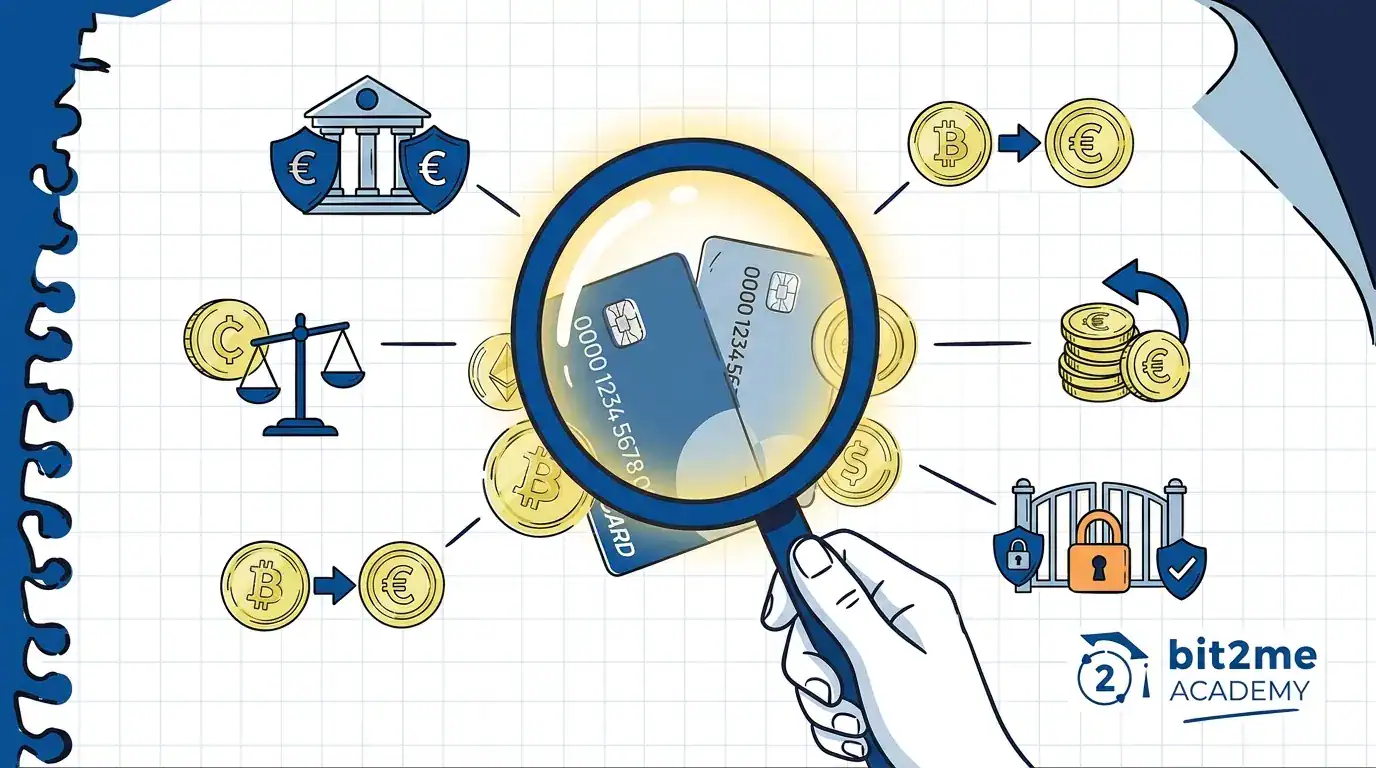
If you open your wallet and take out a plastic card, you probably won't be able to tell at a glance whether the funds it holds come from a Santander account or a digital asset wallet. Both have a chip, a magnetic stripe, and the Visa or Mastercard logo. However, beneath that polycarbonate surface lie two financial systems that couldn't be more different.
The crypto card vs. bank card debate isn't just a product comparison; it's a clash between the 20th-century model of institutional trust and the 21st-century architecture of atomic settlement. Does it really matter who's holding the digits on your screen? If you've ever tried to make an international transfer on a Saturday afternoon, you already know the answer.
 Certificate

Anatomy of the transaction: What happens when you pay for coffee?
When you swipe your traditional bank card to pay for a coffee, a complex dance of messages is set in motion involving the acquiring bank, the card network, and the issuing bank. Although you see the confirmation on the card reader instantly, the actual money won't move for 24 to 48 hours through clearinghouses. It's a system based on payment promises and deferred accounting entries.
But in the world of cryptocurrencies, the story is different. While current cards typically use an intermediary layer to interact with point-of-sale (POS) terminals, the underlying infrastructure allows for much faster settlement. If you use a card linked to a stablecoin, the processor converts your token into fiat currency (like the euro) in the exact millisecond of the purchase. There are no bank clearing delays or weekends to slow the flow. We are moving from a "messenger of value" system to one of real and direct "value transfer."
The sovereignty of capital and counterparty risk
This is where the story gets serious. In a traditional bank, you don't "own" your money; you have a right to collect from a private entity. You are a creditor. If the bank decides to block your account due to a poorly calibrated risk algorithm or an administrative decision, you are shut out of the system.
But digital asset cards, especially those linked to shared or hybrid custody models, offer a different level of sovereignty. While most current cards require you to deposit your tokens on the issuer's platform, the global nature of these assets allows you to move your holdings to another wallet in minutes if you're not satisfied with the service. Have you ever tried transferring all your capital from one bank to another in five minutes using your phone? Good luck with that.
But let's not kid ourselves: Absolute security does not exist. While banks are protected by the Deposit Guarantee Fund (up to €100.000 in Spain), in the cryptocurrency ecosystem, your insurance depends on the robustness of the code and the solvency of the issuer. If the platform goes bankrupt and the funds are not segregated, recovery can be a legal ordeal.
Cost structure: Hidden fees vs. volatility
Traditional banks have historically opted for a model based on customer loyalty. It's true that today it's easy to find accounts without maintenance fees, provided you meet requirements such as direct deposit of your salary or bills. However, their revenue stream often shifts towards specific services, such as mobile payments in foreign currencies, where the exchange rates applied can deviate from the official market rate.
Digital asset cards, on the other hand, offer a different approach: they almost always eliminate entry and maintenance barriers in exchange for a spread or conversion rate. Every time you buy a coffee, the platform sells a fraction of your tokens to deliver euros to the merchant. In this process, the issuer applies a small technical margin to cover the transaction. It is, essentially, a toll for the convenience of spending your assets in the real world.
The real differentiator lies in cashback. While bank loyalty programs have lost momentum, cryptocurrency platforms have revitalized customer loyalty by returning between 1% and 5% of each purchase. This isn't financial magic, but rather a growth strategy: they reward you with their own native token to integrate you into their ecosystem. For the user, it's an organic way to accumulate assets while spending, provided they understand that the value of that reward will fluctuate with the market.
Practical example: The weekend trip
Imagine you go to London for a weekend and spend the equivalent of €500 on hotels and dinners:
- With your standard bank card: You probably won't pay an issuance fee, but the bank might charge you 3% on the pound-euro exchange rate. By the end of your trip, you'll have paid €15 in hidden currency exchange costs and received no reward for the expense.
- With your digital asset card: You pay directly with a stablecoin (pegged to the euro or dollar). The platform applies a 0,8% conversion fee, which costs €4. However, if you have a 3% cashback plan, you'll receive €15 back in cryptocurrency to your wallet.
In this scenario, you have not only optimized the cost of currency exchange, but you have also turned a necessary expense into a small investment opportunity.
Privacy and the digital footprint
Let's be clear: privacy is dead in the conventional financial system. Your bank knows perfectly well if you shop at a pharmacy, a betting shop, or if you pay for a subscription to content you'd rather keep private. This data is gold for marketing profiling.
Digital asset cards are not entirely exempt from control (the MiCA regulations in the European Union are relentless with the KYC complianceHowever, they offer a somewhat more compartmentalized approach to data management. The merchant where you make the purchase only sees one Visa/Mastercard transaction, while blockchain traceability adds a layer of technical transparency that, paradoxically, can protect you against card cloning fraud more effectively than the old system.
Towards an inevitable convergence?
At the end of the day, computers and mobile devices have erased borders. Traditional banks are already integrating the purchase of digital assets, and token platforms are obtaining full banking licenses.
The real difference today isn't how you pay, but which channels you prefer your wealth to flow through. If you're looking for the protection of the state and a predictable (albeit slow) system, the bank is for you. If you prefer global agility, more aggressive reward programs, and don't mind managing exchange rate risk yourself, the cryptocurrency card is simply unbeatable.
Do we really need to choose just one side? Probably not. Most tech-savvy users in Spain already combine both, using traditional banking for recurring bills and digital asset cards for everyday spending and travel. Financial sovereignty begins, precisely, with having options.

 Author