The DeFi Boom or DeFi Explosion is something we are experiencing, and for which you must know the good and the bad of this moment, like the ICO Boom, there are opportunities to make money, but also many dangers to lose it all.
- What is the DeFi phenomenon?: It represents a revolution that seeks to eliminate banking intermediaries through smart contracts, allowing anyone with internet access to financial services such as loans or exchanges in an open manner.
- Meteoric growth: The article details how the ecosystem went from moving just a few dollars in 2017 to exceeding $11.000 billion in 2020, consolidating protocols such as MakerDAO, Uniswap, and AAVE as pillars of the sector.
- Historical warning: A parallel is drawn with the ICO boom of 2017, warning that the current euphoria also attracts scams, projects with no real value, and technical vulnerabilities that can put capital at risk.
- Risk-opportunity balance: While DeFi offers unprecedented financial freedom and transparency, the text underlines the importance of education and caution in a highly volatile and still maturing market.
EIn recent months a term that has become very popular in the crypto world is DeFi (Decentralized Finance) or Decentralized Finance. It is not for less, and more when we see that these protocols have reached market capitalizations that leave many behind cryptocurrencies, with great trajectory.
DeFi is assuming a revolution because many intermediaries in financial products such as loans, exchanges, credits are being eliminated. All of this through smart contracts, being all transparent and eliminating access barriers that allow its use by anyone with an internet connection.
But it's not all that pretty in the DeFi world, and like all new trends there are scoundrels who prey on newbies. To the acquaintance "DeFi Boom" the opportunists have also arrived. Yes, those who promise you heaven, but put a blindfold on you and give you a ticket with no direct return to hell of economic losses.
That's right, scams, thefts, useless protocols, and pointless ideas also abound in the DeFi world. And in fact, they are growing at a worrying rate. Suffice it to say, there are more protocols that seek to keep your money than those that really offer you real value.
In that regard, let us ask you something. Is all this familiar to you? Those who have been involved with cryptocurrencies for a few years will surely agree. We experienced something similar to what we saw in DeFi with what was called... "ICO Boom"And indeed, 2017 was the year of ICOs, where ICOs promised to take over the entire universe. Everything, suddenly, had a blockchain solution, everything was a feasible project, and to make it a reality, all that was needed was a PDF called whitepaper, a cheap website and an ICO.
But it wasn't just with ICOs; it previously happened with clones of Bitcoin and the appearance of projects that only copied and pasted their code. The same happened with the cloud miningand subsequently to ICOs, the masternodes, and now DeFi. They are trends that are generated after the real success of some projects, and where opportunists quickly emerge.
However What exactly are we talking about when we talk about the DeFi boom? Let's know a little more about this.
The DeFi Boom: The beginnings of the ecosystem
The web DeFiPulse It is perhaps one of the most recognized news outlets in the DeFi world today. On their website, we can see that the history of the DeFi ecosystem began in 2017 with a locked value of only $4. Yes, only $4 was locked in DeFi protocols as of August 2, 2017. It all seemed like DeFi was a crazy idea with little future ahead.
However, by September 11 of that same year, DeFi already had more than $ 1 million blocked. At that time, projects such as MakerDAO and DAI (now Sky), ETHLend (now AAVE) And things started to improve. By the end of 2017, the value locked in DeFi had reached $45 million. In just five months, it had gone from nothing to a multi-million dollar business, and it was only just getting started.
2018 was a difficult year for the crypto world. The start of the bear market (a market with falling prices) led everyone to seek safe haven in hodling (storing their crypto). Others, however, ventured into the new proposition: DeFi promised profits, minimal, but profits nonetheless, even in the worst-case scenario. What better than to generate profits in the middle of a bear market that causes the crypto markets to sink? Definitely, the idea is better than waiting for your coins to dilute in value, and in any case, generating even a few additional tokens wasn't bad, especially if you could hodle them while waiting for the next bull market (a market with rising prices).
The truth is that the idea caught, and by June 2018, DeFi was already blocking a total of 150 million. Not bad, a growth of 3 times its value in 6 months. In December 2018, the market closed with $ 295 million blocked, and a growth in the number of projects. It was there that DeFi started making a lot of noise. And, although their returns were quite small, they were still returns in times of drought (speaking of the active bear market at that time).

The arrival of the boom
As 2019 approached, many expected signs of recovery from the bear market, and many already saw it coming. The DeFi world, meanwhile, was gaining strength with new protocols and ideas. By June 2019, the $570 million locked in DeFi clearly demonstrated one thing: DeFi is here to stay and seemed to want to grow bigger. There it became the buzzword, lending platforms, liquidity pools, decentralized exchanges that were gaining more and more traction, pointed to DeFi becoming relevant in the future of cryptocurrencies and blockchain technology.
By the end of 2019, it had $690 million locked, but on February 5, 2020, DeFi reached a billion-dollar mark. To be exact, with $1,02 billion locked. However, the joy for DeFi fans was short-lived, as the market correction between mid-February and early March 2020 reduced it to half that value.
Despite this, on March 12 everything changed. DeFi entered an uptrend, and its locked value began to grow. As of today (October 2020) it has not stopped growing, going from 562 million to over 11 billion dollars. Many believe that the market will continue to grow, and because of the winds that blow, it seems so.
At this point, protocols like MakerDAO, Uniswap, Compound, AAVE, Year Finance, Balancer, CurveThey have played a fundamental role in the consolidation of this sector. They have become the spearhead of the DeFi sector and have maintained that position amidst a sector that changes every second. Now, certainly not everything is perfect in the DeFi world. For that reason, here we will examine the risks and opportunities that this new sector of the crypto world presents.
The expansion of DeFi: from individual to institutional
Thus, what began as an experimental ecosystem driven by retail users and technology enthusiasts has matured into a global financial infrastructure. Today, Decentralized Finance (DeFi) has surpassed the $120.000 billion mark in total value locked (TVL), a figure that demonstrates an unprecedented confidence in the programmability of money.
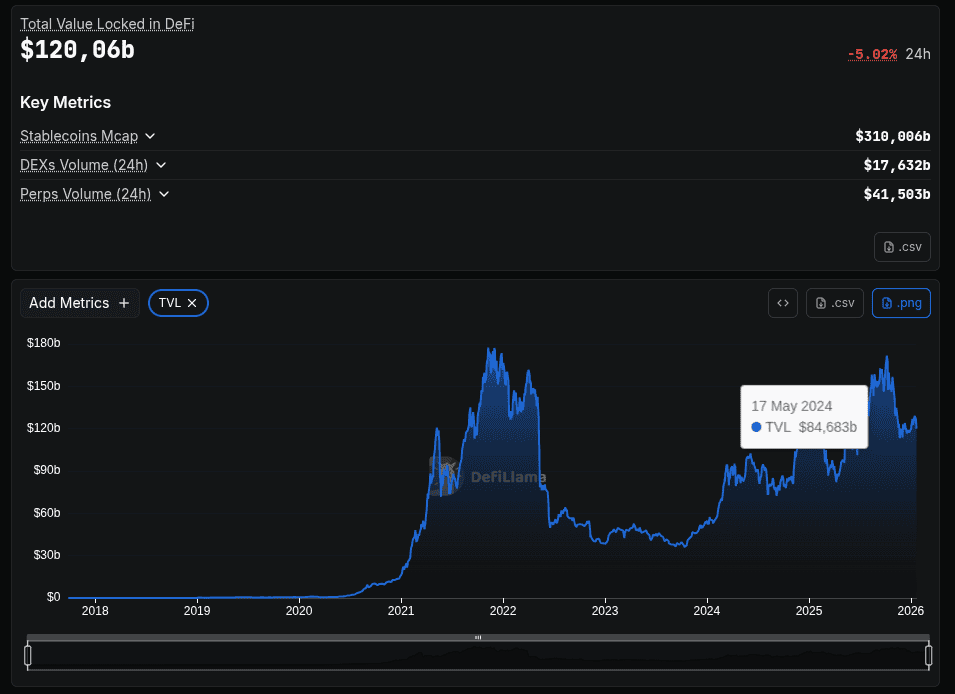
DeFi ecosystem TVL data in January 2026 – Bit2Me Academy – DeFiLlama
This evolution is not limited to capital alone, but also to the complexity of the ecosystem. We have gone from a few protocols on the Ethereum network to a multi-chain explosion with hundreds of protocols operating on networks like Solana, Layer 2s (Arbitum, OptimismMillions of people interact with these tools daily, but the most significant change is the participant profile: the arrival of financial institutions.
The entry of large investment funds, traditional banks, and the recent integration of Real World Assets (RWA) Within the blockchain, they have validated DeFi as more than just a passing trend. Institutions no longer see the sector solely as a speculative opportunity, but as an operational efficiency solution for lending, settlements, and custody, marking the beginning of an era where traditional and decentralized finance are inevitably converging.
Opportunities in the DeFi Boom
The Decentralized Finance (DeFi) ecosystem was born with the promise of democratizing access to sophisticated financial tools, eliminating barriers to entry, and operating transparently. Today, that promise has not only been fulfilled but has exceeded initial expectations, transforming into a robust financial infrastructure that manages a total value locked (TVL) exceeding $120.000 billion.
At this stage of maturity, DeFi has allowed crypto assets to evolve from mere static stores of value into productive capital. It's no longer just about HODLing; through hundreds of protocols on various networks (such as Ethereum, Solana, and Layer 2s), users can generate returns, provide liquidity, and participate in collateralized lending in an automated way. This dynamism has been fundamental to the price consolidation of assets like Bitcoin and Ethereum, which now act as the foundation of a parallel global financial system.
However, the biggest leap forward in current opportunities is institutional convergence. What was once a niche for retail users is now a playing field for large financial institutions seeking efficiency in asset settlement and transparency in custody. The integration of Real World Assets (RWAs)—such as treasury bonds or real estate—into the blockchain is opening a massive influx of capital seeking the security of decentralization combined with traditional market returns.
DeFi today represents the opportunity to overcome the limitations of the conventional banking system. In the early days of blockchain technology, it was a dream to imagine that an unbanked person could access a loan at a stable rate without going to a physical branch. Currently, thanks to the evolution of smart contracts and the arrival of institutional capital, that "dream" is a multi-billion dollar market reality that continues to expand the boundaries of what money can do.
New risks in a $120.000 billion market
Like any technological frontier that moves massive amounts of capital, DeFi has a dark side that has grown in proportion to its success. With a market exceeding $120.000 billion, malicious actors have moved from simple scam attempts to executing attacks of alarming technical sophistication.
It's no longer just about hackers looking for basic bugs in the code. Today, we face flash loan exploits, cross-chain bridge attacks, and oracle manipulations that can drain entire protocols in seconds. Furthermore, the ecosystem has become so interconnected—what we call "financial laypeople"—that a flaw in a single core protocol can trigger a systemic domino effect impacting dozens of linked platforms, putting the capital of millions of users at risk simultaneously.
In addition to technical risks, there are governance and centralization risks. With the entry of large institutions, there is a danger that certain protocols will become "too big to fail" or that regulatory pressure will force levels of censorship that betray the very essence of decentralization. "Professional con artists" have also evolved: they no longer just launch ephemeral projects like the old YAM or HOTDOG, but now create complex marketing structures and "guaranteed return" narratives that conceal highly dangerous algorithmic Ponzi schemes.
It's crucial to understand that, although blockchain technology is over 15 years old, the DeFi infrastructure remains a constantly evolving field. Each new network or scalability layer (Layer 2) adds another layer of technological risk. The erosion of trust following large-scale collapses not only affects investors but also provides ammunition for those seeking to overregulate or halt the advancement of this technology. Therefore, in an institutionalized market, continuous auditing, complete transparency, and user education are the only real defenses against the initial excitement of the boom ending in a blackout of trust.
Ponzinomics, it looks like the ponzi, but it isn't
One of the most curious points of DeFi (and of many of its projects) is its resemblance to a Ponzi scheme, in what they call a strategy "ponzinomics". To keep things simple, Ponzinomics is an economic strategy used by certain projects supported by aspects of a ponzi scheme, but deep down, the system is not.
Something like: "I use ponzi strategies, but don't worry, I'm not a ponzi"This has raised concerns among some members of the crypto community, especially because they are worried about how common these strategies have become in the DeFi world. In fact, the DeFi boom is largely due to these kinds of practices. For that reason, from Bit2Me Academy We have decided to dedicate a special section to this risk due to its vague nature, and to clearly explain why this is perhaps the worst risk of all in the DeFi world.
We are all well aware of the dangers of a ponzi scheme, fraudulent schemes that give profits out of the money of other people who enter the scheme.
Vitalik ButerinLately, he has been giving opinions on Twitter regarding DeFi and its excessive growth. Facts such as the lack of transparency of some protocols, the excessive growth of their value, granting interest rates of up to 90% per year (and some up to 4 million% per year), and rewards for amassing fortune in said protocols, are signs of alerts of this type of strategies. In fact, many see in the liquidity mining this type of practice, since the tokens received as a reward have no real use beyond the platform and their value is merely speculative.
At this point, it's clear that these kinds of schemes are unhealthy, and projects that base their operations on these types of strategies are dangerous. That's why from Bit2Me Academy We make the following recommendation:
Analyze the project VERY well. Observe and learn how it works, look at your community and above all understand the benefits and risks that it can give you. This is the best way to protect yourself from the “worst case scenario” and at the same time it can give you the best strategy to enjoy DeFi with the least possible risk. If you don't have the ability to understand where you put your money, DON'T DO IT.

 Author