Essential Points
- Comparing staking networks requires looking at the mechanism, withdrawal waiting period, penalties, and key custody, not a cryptocurrency ranking.
- Each network sets its own waiting period (unbonding) and penalty (slashing): some networks do not block funds, while others require you to wait to withdraw.
- The rewards are variable, paid in the same asset, and no one can promise them, so they don't necessarily compensate for a price drop.
- Bit2Me Earn is not covered by MiCA's deposit protection: you may lose some or all of your funds.
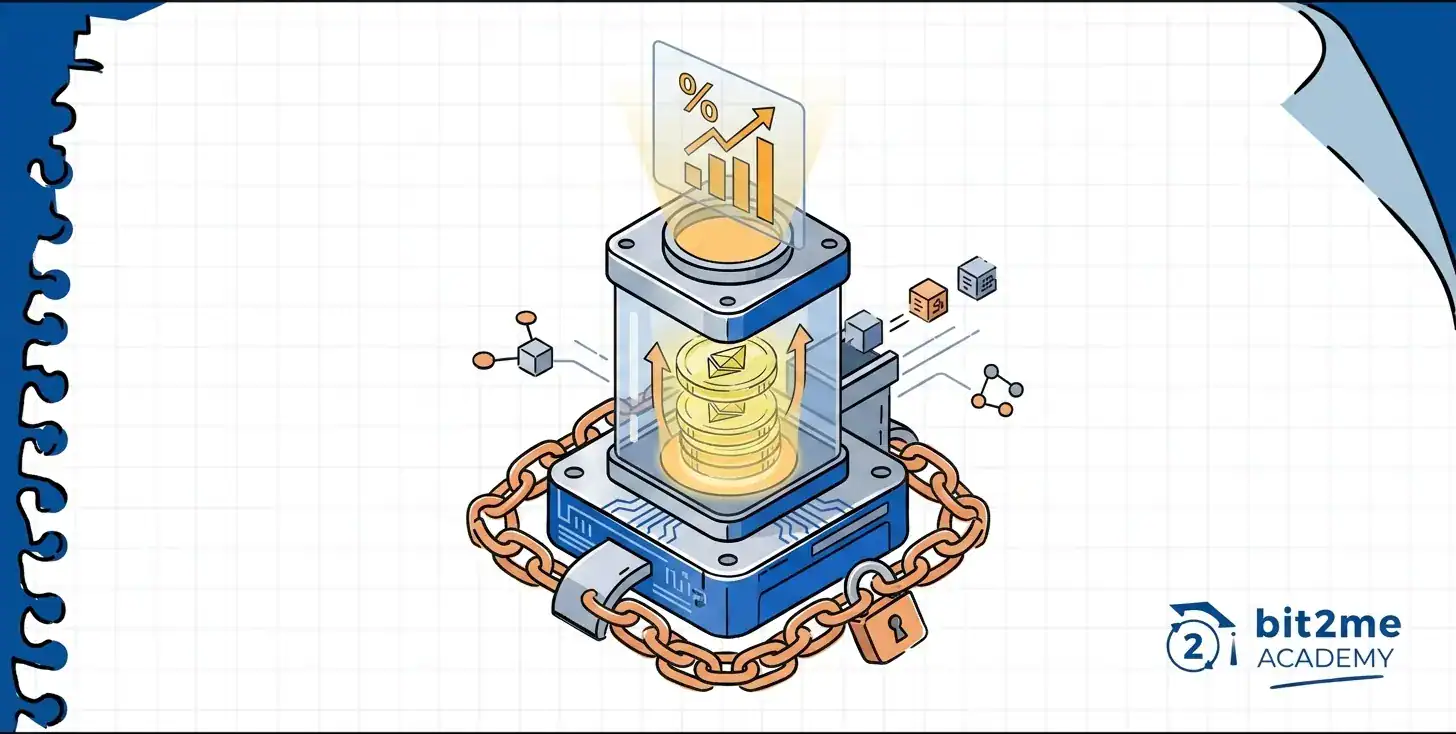
If you're looking to stake cryptocurrencies, the first thing to know is that no network is inherently better than another: each sets its own waiting periods, penalties, and methods for safeguarding your funds. Staking involves locking up cryptocurrencies on a proof-of-stake network to help validate transactions in exchange for varying rewards, and these conditions differ significantly from one network to another.
A single piece of data is enough to see the difference. According to ethereum.orgActivating your own validator on Ethereum requires at least 32 ETH, and anyone joining must wait in a queue that can last from hours to weeks. On other networks, you simply delegate a small amount to a third-party validator, and then the exit time, the penalty, and who controls the keys change, so the same word describes different products.
Comparing networks using the same criteria avoids deciding based on the cryptocurrency's name or past rates, because rewards are variable, paid in the same asset, and don't necessarily compensate for a price drop. With the source and date of each piece of data, you can verify what each network requires before locking anything and clearly see the risks you're taking, even if you don't control the validating node.
 Certificate
What are cryptocurrencies for staking and why isn't there a better one?
Staking involves locking up cryptocurrencies on a proof-of-stake network so that they contribute to validating the network and receive variable rewards in return. On these networks, called Proof of Stake (PoS), validators are the ones who propose and verify blocks, and the protocol chooses them based on the amount of capital they have locked, not their computing power.
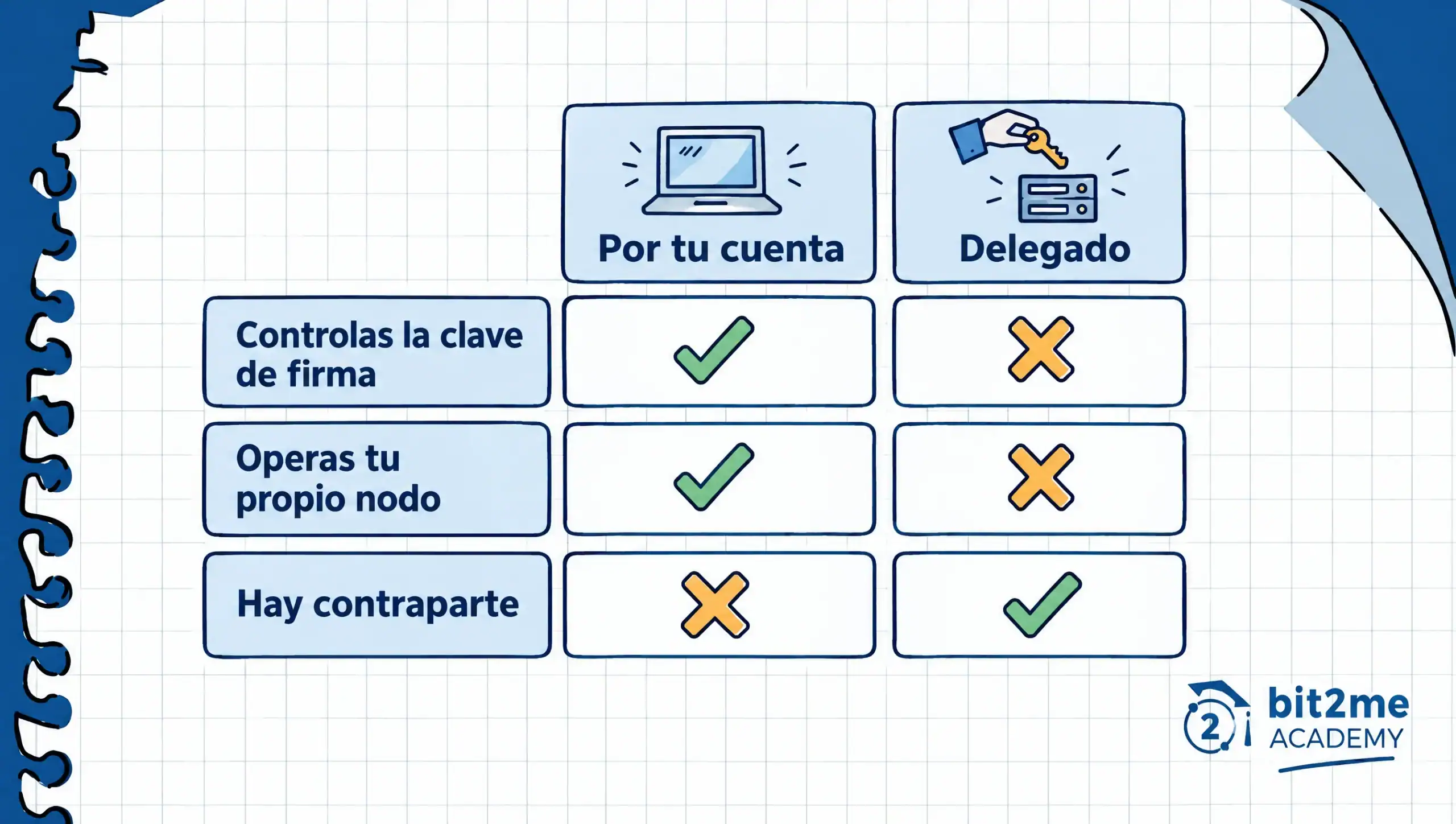
Delegating is the other way to participate: you give your participation to an external validator without running their node yourself, and the rewards are shared between both of you according to the rules of each network.
Academy's guide on What is cryptocurrency staking? The mechanism is detailed, and what matters here is that each network applies it with its own rules. That's why there isn't one single best cryptocurrency for staking, but rather a combination of term, penalty, and custody that may or may not fit your needs.
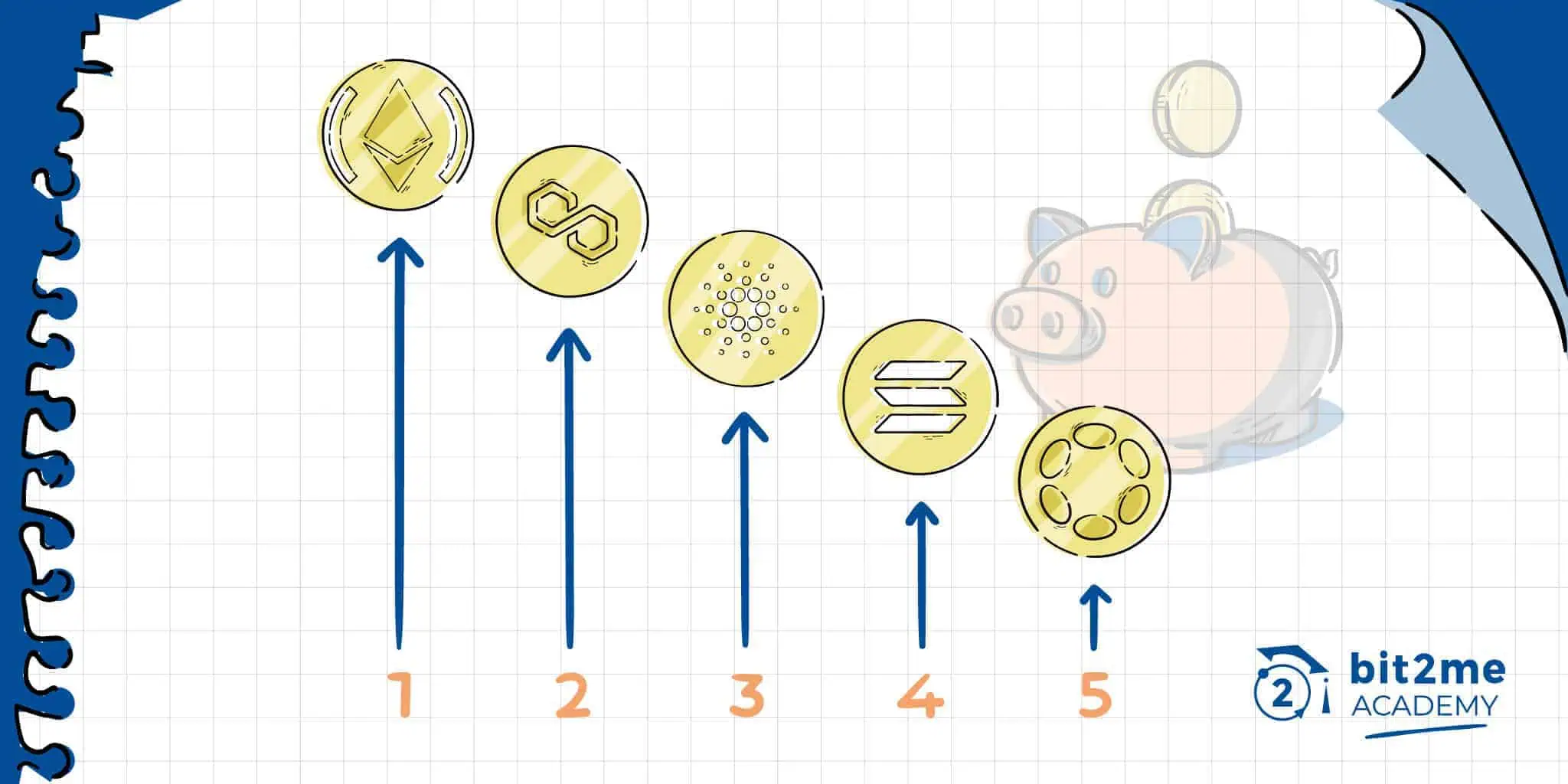
Five networks serve as examples, ordered by their participation method rather than merit: Ethereum, with validators that require their own lock; Polygon PoS, with delegation and unbonding; Solana, with stake accounts that nominate a validator; Cardano, with delegation without locking; and Polkadot, with nominators. None are listed as recommendations.
What criteria are used to compare the staking of each network?
Eight criteria allow you to compare two networks without being swayed by the cryptocurrency's name or past fees, which vary by network and provider. The first four depend on the protocol and can be verified in its documentation, while the other four depend on your specific situation and the platform.
The protocol's four criteria, with a brief definition that you can reuse on any network, range from the most technical to what most directly affects your funds, and it's best to review them in that order:
- Mechanism and validators: how the validator is chosen, whether you can delegate or must operate your own node, and what minimum quantity the network requires.
- Withdrawal waiting period: the unbonding period, the time between when you request to leave and when you can access your funds, during which you may or may not continue to earn rewards depending on the network.
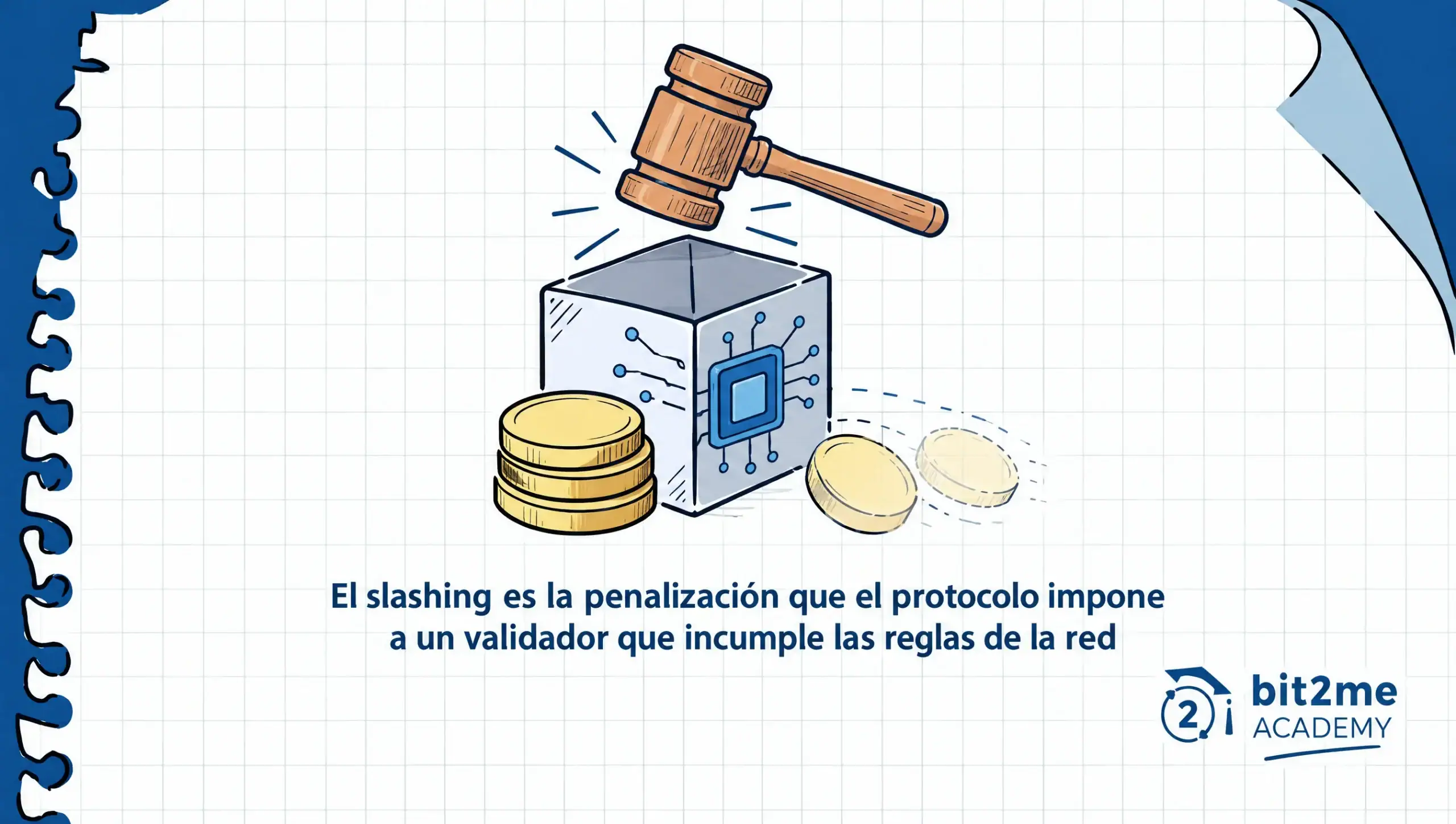
- Penalties: slashing, whereby the protocol destroys part of the stake of a validator who violates the rules, and in some networks also affects the person who delegates.
- Custody: who holds the signing and withdrawal keys and therefore who controls your funds if the provider or node fails.
The other four criteria are more personal. Rewards are paid in the same asset, so their value also depends on the price, and Academy's guide on How to calculate APY in staking It explains why a past rate does not predict what you will charge:
- Variable rewards: where they come from in each network and why they change with participation and the state of the network.
- Price volatility: how much value you could lose without your situation changing, with or without rewards.
- Availability on the platform: whether the provider you use supports that network and under what withdrawal conditions.
- Taxation: It depends on your specific situation and current regulations, so consult the Spanish Tax Agency (AEAT) and the Academy guide on the subject. Taxation of staking in Spain.
How do staking Ethereum, Polygon, Solana, Cardano, and Polkadot compare?
The following five tables apply these criteria to each network, with the source and date of each piece of data. A row only appears if the source consulted on October 26, 2026, confirms it, so its absence does not mean that the data is good or bad, but that it could not be verified.
Ethereum
Since The Merge on September 15, 2022, blocks have been produced by validators that lock ETH. The name "Ethereum 2.0" (Eth2) has been deprecated, according to ethereum.organd the Academy guide on the Ethereum staking It details each method.
| Criterion | Date | Source (accessed 26-10-2026) |
|---|---|---|
| Mechanism | A self-validator requires at least 32 ETH and can pool up to 2.048 ETH; pooled options support smaller amounts. | ethereum.org/staking |
| Waiting period | Activation queue from hours to weeks; the exit follows a queue whose duration varies depending on how many validators exit at once. | ethereum.org/staking y withdrawals |
| Penalties | Slashing for demonstrable bad behavior, such as signing two contradictory blocks: part of the stake is destroyed and the validator leaves the network | ethereum.org/staking |
| Custody | In a solo account you retain both keys; in a delegate account you usually retain the withdrawal key; in a group account you control the pool; in an exchange account you hold the exchange account. | ethereum.org/staking |
Polygon PoS (POL)
The POL token replaced MATIC in a 1:1 conversion, and according to the official blog of the network 99% of MATICs had already been migrated by September 3, 2025. With POL, the proof-of-stake network is now secured, and the guidance of What is Polygon? the project explains.
| Criterion | Date | Source (accessed 26-10-2026) |
|---|---|---|
| Mechanism | You delegate POL (or MATIC, with POL rewards) to a validator; there is no minimum delegation amount, and being a validator requires at least 10.000 POL. | docs.polygon.technology |
| Waiting period | Unbonding 80 checkpoints; with an estimated 30 minutes per checkpoint for documentation, approximately 40 hours | docs.polygon.technology |
Solana
The person delegating creates a stake account that appoints a validator, and many accounts can delegate to that validator without the validator having to do anything, according to Anza's documentation. The guide What is Solana? review the network from scratch.
| Criterion | Date | Source (accessed 26-10-2026) |
|---|---|---|
| Mechanism | The stake account names a validator's voting account, and multiple accounts can delegate to the same validator. | docs.anza.xyz |
| Waiting period | To exit, you must deactivate staking and wait for a cooldown period, during which you continue to earn rewards; the documentation consulted does not indicate its duration. | docs.anza.xyz |
| Rewards | They depend on the inflation rate, the total SOL staked, and the operation and commission of each validator. | solana.com/docs |
Cardano
Delegating doesn't lock up your funds, according to the project's official website: your ADA remains in your wallet and you can spend it at any time. That source, cardano.org, is not among those approved by the editorial catalog and should be read as the official voice of the project, and the guide for What is Cardano? provides context to contrast it.
| Criterion | Date | Source (accessed 26-10-2026) |
|---|---|---|
| Mechanism | You delegate to a stake pool without the ADA leaving your wallet | cardano.org |
| Waiting period | There is no lock-in; the first rewards arrive about 15 or 20 days after delegating. | cardano.org |
| Rewards withdrawal | Since the Plomin hard fork, withdrawals are only possible if the stake key has an active voting delegation; otherwise, they continue to accumulate. | cardano.org |
Polkadot
Nominators lock tokens and choose the validators they back, and only those tokens that enter the active pool receive backing, according to the project wiki. As in the previous case, it is a source from the project itself outside the approved catalog, and the guide to What is Polkadot? Add context.
| Criterion | Date | Source (accessed 26-10-2026) |
|---|---|---|
| Mechanism | Nomination: You lock tokens and choose validators, and the protocol distributes your stake among those you choose. | wiki.polkadot.com |
| Penalties | The stake of nominators and validators may be subject to slashing | wiki.polkadot.com |
| Waiting period | During unbonding, tokens remain locked and do not earn rewards; the duration is determined by the on-chain values. | wiki.polkadot.com |
| Rewards | An era lasts 24 hours, they are claimed on Asset Hub and expire after 84 unclaimed eras | wiki.polkadot.com |
Polygon, Solana, and Cardano don't have a row of penalties because the documentation consulted doesn't allow confirmation of whether they apply to the delegator, and Polkadot doesn't have an unbonding figure because its wiki refers to the values in the string. Not confirming a piece of information doesn't mean it's irrelevant, so check the current documentation before delegating.
How long does it take to recover the staking and what is the exit process?
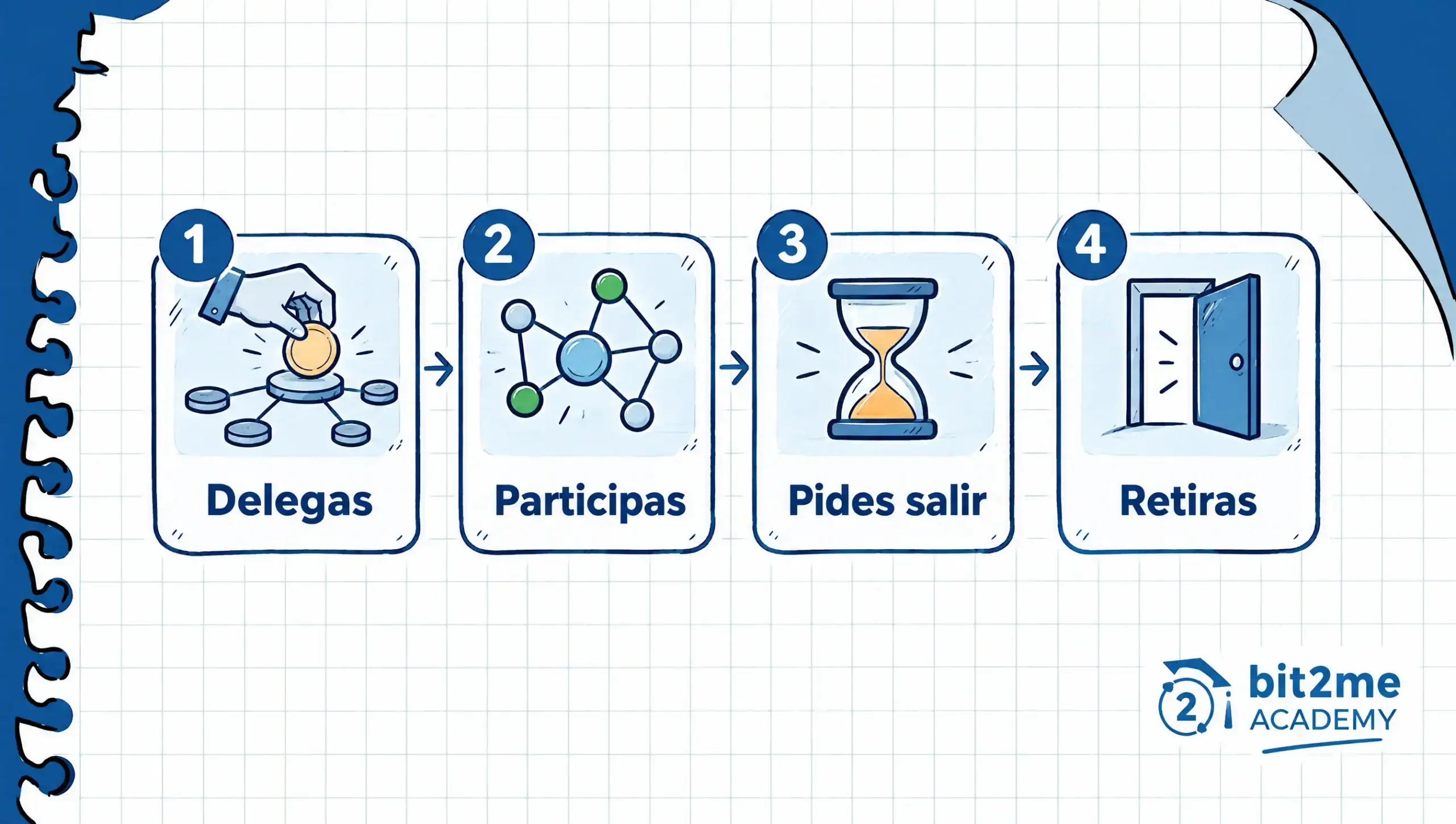
Almost all proof-of-stake networks follow the same process: you delegate, your funds participate, you request to exit, and you wait for unbonding before withdrawing. What changes is the duration of each stage and whether the funds continue to earn rewards while you wait, something that happens in Solana according to Anza's documentation but not in Polkadot according to its wiki.
The process has four steps, each with its own risk and timeframe, and the following list orders them from the moment you delegate your cryptocurrencies to the moment you withdraw them from the network:
- You delegate or activate a validator: you choose a validator or provider and block the amount required by the network.
- You participate: your funds help validate and receive variable rewards, with penalties set by each network.
- You ask to leave: the unbonding process begins, a queue or a period whose duration is determined by the protocol.
- Withdrawals: Once the waiting period is over, the funds and rewards are available to you, subject to specific conditions in some networks.
The timeframes depend on each network. On Ethereum, the activation queue ranges from hours to weeks, and the The exit depends on how many validators exit at the same time.With withdrawals enabled since April 12, 2023. At Polygon, unbonding takes 80 checkpoints, approximately 40 hours including documentation. Each platform may have its own withdrawal conditions.
What are the risks of staking depending on the network and provider?
The first risk is price, the most underestimated because it doesn't depend on the protocol. Rewards are paid in the same asset you lock, so if its price falls, your position is worth less even if rewards arrive, and Bit2Me Earn warns that they are variable and depend on the network, pool demand, and volatility.
Slashing is the second and most specific risk of staking. According to ethereum.org, it is caused by demonstrable misconduct, such as signing two contradictory blocks, and destroys part of the validator's stake. If you delegate, your exposure depends on the network: the Polkadot wiki indicates that nominators' stakes can also be slashed.
The launch timeline is the third risk, because during the wait you can't react to a price change. A queue of hours to weeks and a launch that depends on how many validators launch simultaneously, according to ethereum.org, forces you to consider how long you can do without those cryptocurrencies.
Custody and counterparty risk constitute the fourth risk. According to ethereum.org, delegated staking adds provider counterparty risk, and in a centralized exchange, the exchange itself holds custody of your ETH, so you depend on its security in addition to that of the network.
The fifth risk is believing that a platform is equivalent to a protected deposit. According to their website as of October 26, 2026, Bit2Me Earn is not a bank deposit and is not covered by MiCA's deposit protection, so you may lose some or all of your funds.
What changes if you stake on your own or with a platform like Bit2Me Earn?
Doing it yourself gives you control of the keys, but requires you to operate the infrastructure or choose a validator. With a platform, you delegate that operation and accept its terms, and key sharing varies depending on the method: on Ethereum, ethereum.org distinguishes between solo staking, delegated staking, pooled staking, and exchange staking.
In pooled staking, the contracts and pool operators control the validators, and you receive a token representing your stake—a model detailed in the guide. Staking pools and how they workTo see the delegation and risks of unbonding and slashing in another network, Academy has a Native staking guide by delegation.
Page Bit2Me Earn lists, as of October 26, 2026, ETH, POL, SOL, ADA and DOT among its assets, and does not list MATIC, which Polygon replaced with POL, so it is advisable to check the availability of the chosen network.
If you prefer to delegate the operations, Bit2Me Earn It offers staking of several cryptocurrencies with flexible withdrawal in most of them and a 12-month lock-up in the B2M Farming Pool, but with variable rewards that no one can promise, without MiCA's deposit protection and with the risk of losing some or all of your funds.
Current status of staking in October 2026
The framework in the European Union is MiCA, the regulation on crypto-assets. According to the CNMVIt came into effect on December 30, 2024, and the Spanish transition period ended on July 1, 2026, so crypto asset service providers must be authorized by the CNMV or another competent EU authority.
You can check if a supplier is authorized in the CNMV register and in the ESMA registers, and that direct check is more reliable than any data in an article, including this one.
| Date | Done | Source |
|---|---|---|
| 15 September 2022 | The Merge: Ethereum moves to proof-of-stake and the term Eth2 is deprecated | ethereum.org |
| December 30th 2024 | MiCA comes into effect | CNMV |
| January 29, 2025 | Cardano activates the Plomin hard fork, which launches on-chain governance | CoinDesk |
| 3 September 2025 | 99% of the MATICs in the Polygon network have been migrated to POL, in a 1:1 ratio | Polygon |
| July 1, 2026 | The transitional period for MiCA in Spain has ended. | CNMV |
| 26th October 2026 | Bit2Me Earn reports variable rewards and that it is not covered by MiCA deposit protection. | Page of Bit2Me Earn |
Ethereum's scalability took a different path than the shards planned for 2024: according to ethereum.orgThey are no longer part of the roadmap; proto-danksharding was activated with Dencun in March 2024, and full danksharding is still several years away.
Choosing cryptocurrencies for staking is choosing conditions, not promises.
Comparing using the same criteria changes the question: instead of looking for a winning network, you ask how long it would take to recover your funds, what penalty you assume, who holds the keys, and how much value you could lose. The answers change with each network, each platform, and over time, so repeat the check with the current documentation when you decide.
If you're unsure whether to lock up your cryptocurrencies or keep them, Academy's guide on HODL vs staking Compare both options with their respective risks. In any case, no network or platform can promise you a specific outcome, and those that do deserve your skepticism.

Frequently asked questions about cryptocurrency staking


 Author