Essential Points
- A Bitcoin transaction does not move coins: it spends unspent outflows (UTXOs) from previous transactions and creates new outflows with different owners.
- Each entry is authorized with a signature of your private key, and the nodes check those signatures before accepting the transaction.
- The commission is the difference between what comes in and what goes out, and it depends on the size of the transaction, not the amount.
- A pending transaction is not yet final: each block added adds a confirmation and makes it harder to reverse.
When you send bitcoins, you don't move any files or coins: you sign a message that reassigns previous outputs and broadcasts it to the network. This is how Satoshi Nakamoto conceived it in the Bitcoin white paper, sent to a mailing list on October 31, 2008, where he defines an electronic currency as a chain of digital signatures in which each owner transfers it to the next by signing a hash of the previous transaction.
That idea remains intact, although the details have changed considerably. Today's Bitcoin transactions don't store balances per address; instead, they consume unspent outgoings, called UTXOs, and create new ones. Furthermore, they carry signatures in a separate field since SegWit and calculate the fee as the difference between incoming and outgoing amounts, without that amount being displayed in any field.
Understanding this mechanic explains why your wallet gives you change, why a transaction with many inputs costs more even if you're moving a small amount, and why a pending payment isn't yet finalized. It also saves you from two common mistakes: offering a commission that's too low for current demand and marking a payment as complete before it has on-chain confirmations.
 Certificate
What is a Bitcoin transaction and how does it work?
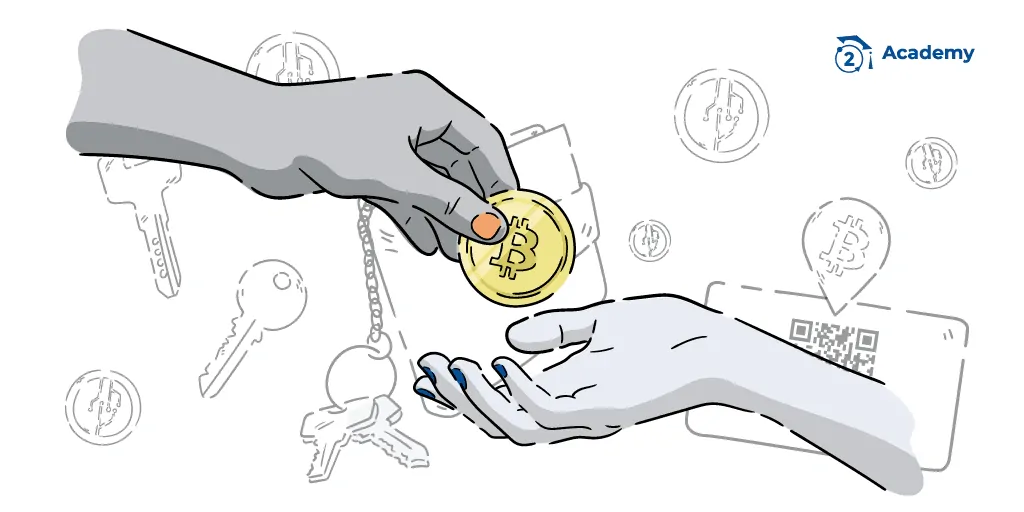
A Bitcoin transaction is a signed message that indicates which previous outflows will be spent and who will be able to spend new ones. No coins travel from one place to another: what changes is the shared ledger of who can spend what. When a block includes that message, each node Update your copy of the blockchain and the property is reassigned.
Tu wallet It doesn't store bitcoins either. It stores the keys that prove you can spend certain amounts, and when you press send, it constructs the transaction and signs it with your private key and passes it to a node, which forwards it to its neighbors. If you lose those keys, no one can sign for you, and if someone copies them, they can sign in your place.
This distinguishes Bitcoin from Ethereum, which keeps accounts with a balance and a transaction counter called a nonce, according to the documentation from ethereum.orgIn Bitcoin, what your wallet shows is the sum of the unspent outgoings that your keys can sign, with amounts in satoshis: according to the Glossary for developersOne bitcoin is equivalent to 100.000.000 satoshis.
How is a Bitcoin transaction structured?
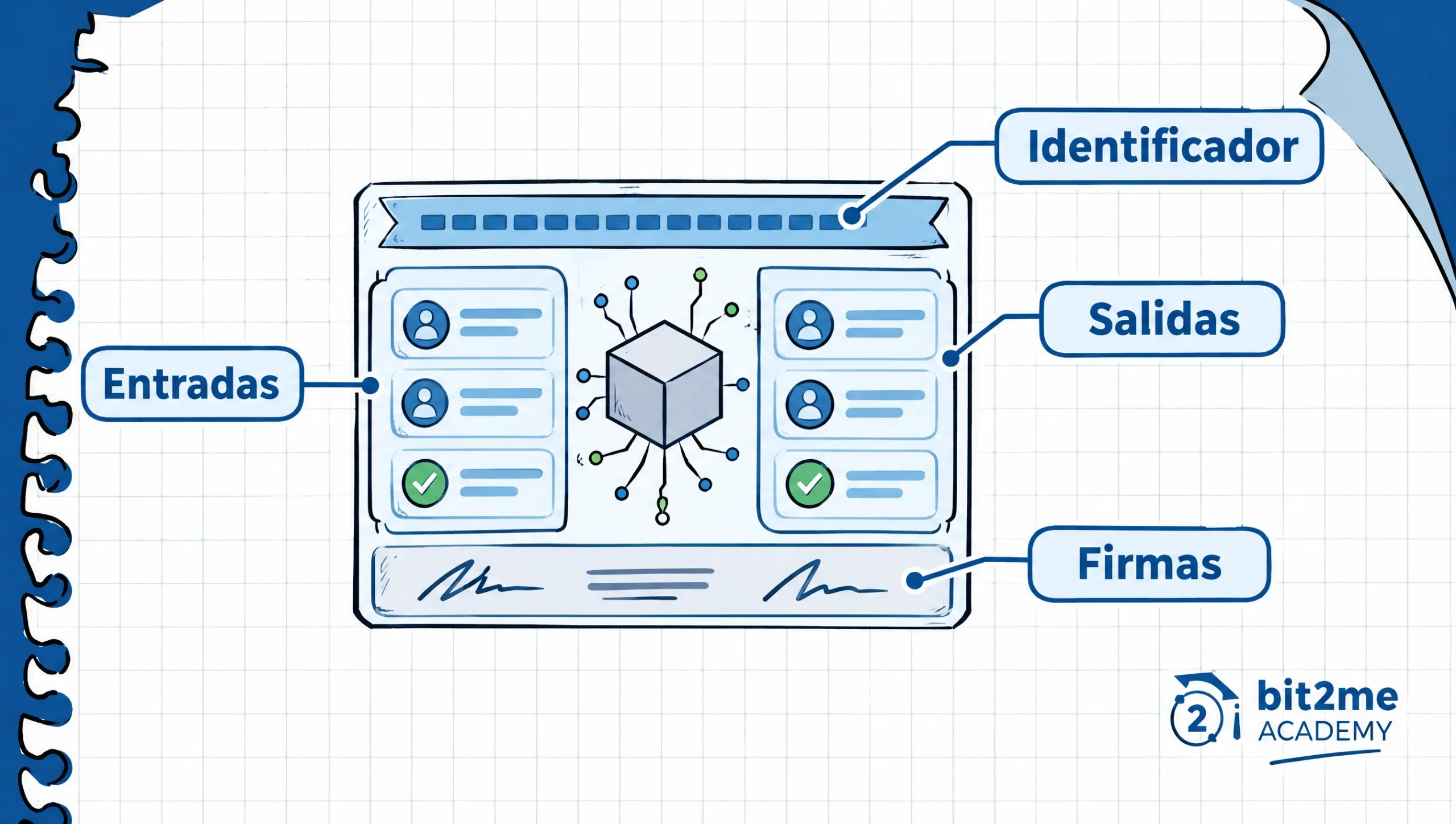
Every transaction shares the same basic structure, according to the transaction format reference From the developer documentation: a version, an input list, an output list, and a block time. Modern wallets add a witness field with signatures, which you'll see in the section on signatures and scripts.
These are the five elements you should distinguish when opening a transaction in a block explorer, even though your wallet builds them for you automatically without you having to touch anything:
- Inputs: each one points to a previous output by means of an outpoint, made up of the TXID of the transaction that created it and its order number, and provides proof that you can spend it.
- Outputs: each one sets an amount in satoshis and a lock script with the conditions for spending it, and the destination address is usually encoded there.
- Signatures: in SegWit transactions they travel in the witness field, separate from the rest.
- Locktime: a number that is read as block height if it is less than 500 million and as Unix date if it is not.
- Identifier (TXID): the double SHA-256 of the serialized transaction, without the witness.
Notice two details. The entries don't contain the source address, only a reference to the output being used, and the address is deduced from that output's script. And no field is called "commission": the fee is calculated by subtracting the total outputs from the total entries.
The identifier is a hash that locates the transaction in the chain. BIP141 It also defines a wtxid that does include the witness, and states that SegWit corrects malleability at its root, meaning that a third party can change the identifier of a pending transaction without invalidating it.
What are UTXOs and what about the change?
An Unspent Transaction Output (UTXO) is an output that has not yet been spent and can be used as input for a new transaction. Each output waits as a UTXO until a subsequent input spends it, according to the developer guideand must be spent in full. It works like paying with banknotes: you don't cut one in half, you hand over the whole note and receive the change. You can find more details in the guide on What is a UTXO?.
Imagine Maria has four UTXOs of 0,25 BTC each and wants to pay 0,30 BTC to Pedro. None of these are enough on their own, so her wallet selects two, totaling 0,50 BTC, and creates two outputs: one of 0,30 BTC for Pedro and another with the remainder for one of Maria's addresses. cultural, The figures are made up and the commission has been set at 2.000 satoshis to balance the books.
| Concept | Amount in BTC | Amount in satoshis |
|---|---|---|
| Entry 1 (Maria's UTXO) | 0,25 | 25.000.000 |
| Entry 2 (Maria's UTXO) | 0,25 | 25.000.000 |
| Total entries | 0,50 | 50.000.000 |
| Exit 1 (Pedro) | 0,30 | 30.000.000 |
| Exit 2 (Maria's change) | 0,19998 | 19.998.000 |
| Total number of departures | 0,49998 | 49.998.000 |
| Commission (income minus expenses) | 0,00002 | 2.000 |
The full value of the included UTXOs must be spent or given to a miner as a fee, according to the same guide. If the wallet forgets the exchange outflow, the remaining 0,19998 BTC will become a fee and there will be no way to recover them. Wallets calculate the exchange automatically, and the more tiny UTXOs you accumulate, the more inputs you will need for each payment, and the larger the transaction will be.
Bitcoin Core also rejects excessively small outflows, which are known as dustAccording to the comments of source codeThe default threshold is 546 satoshis for a typical non-SegWit output and 294 satoshis for a P2WPKH output. This is not a network consensus rule, but a node policy that each operator can change.
How is a transaction signed and what is a script?
Each output contains a lock script, and each input provides the data that unlocks it, typically a signature and a public key. The nodes execute both and only accept the input if the result is valid. That language is the Bitcoin scriptwhich allows conditions such as multi-signaturewhere several signatures are needed.
The signature works like this: you sign a summary of the transaction with your private key, and any node verifies that signature with your public key, without ever knowing the private key. The default signature type, SIGHASH_ALL, signs all inputs and all outputs, so no one can change the destination or amount without invalidating it, according to the developer guide. It's the practical application of the asymmetric cryptography.
The script type determines which address you see and where the signatures travel, and the table summarizes those you'll find on the main network along with the usual prefixes for each.
| Output type | Paying | Usual address prefix | Where do the signatures go? |
|---|---|---|---|
| P2PKH | The hash of a public key | 1 | In the entry script |
| P2SH | The hash of a script, like a classic multi-signature | 3 | In the entry script |
| P2WPKH | The hash of a public key, in SegWit version 0 | bc1q | In the witness |
| P2WSH | The hash of a script, in SegWit version 0 | bc1q | In the witness |
| P2TR (Taproot) | A Taproot key, in SegWit version 1 | bc1p | In the witness |
The classic scheme with OP_DUP and OP_HASH160 corresponds only to P2PKH addresses, and today several types coexist. SegWit was activated in block 481.824, in August 2017, and moved the signatures to the witness, which has less weight in the block calculation: the weight is the base size multiplied by three plus the total size, according to BIP141. You can find more context in the guide on followed.
Taproot was activated at block 709.632, in November 2021, and uses Schnorr signatures from BIP340. According to BIP341An expense with a single key or multiple keys combined looks the same as any other expense from a company. More information is available in the guide on... tap root.
What path does a transaction follow and how many confirmations does it need?
Between pressing send and your transaction being registered, several stages occur, none of which involve a central entity. Each node independently verifies signatures and ensures that spent outputs remain unspent, thus preventing... double-spendingThat is, spending the same coins twice.
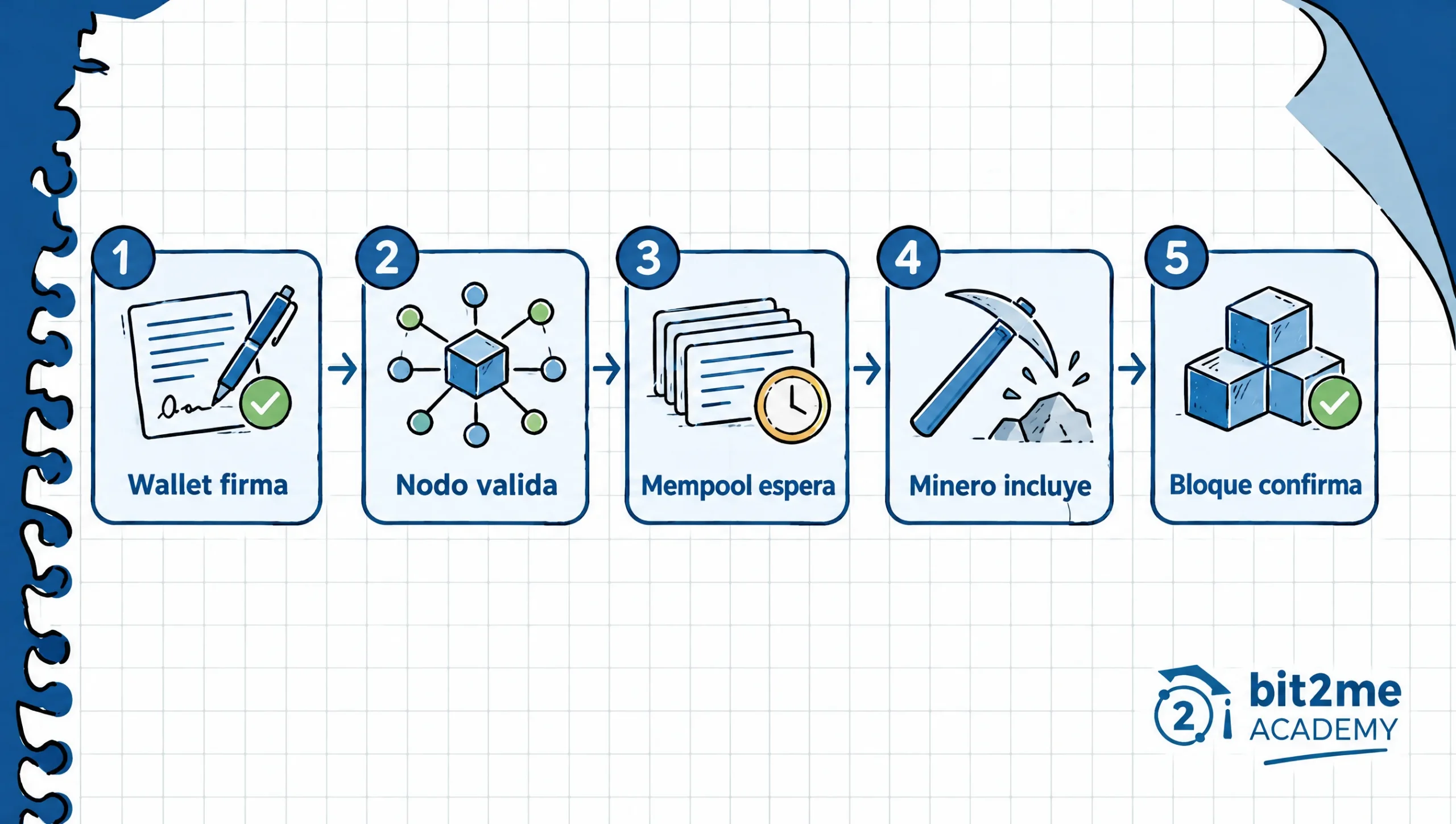
The entire process can be summarized in five consecutive steps that are repeated with each shipment, whether you move a small amount or a large amount, and these steps determine how long it takes to see your payment confirmed.
- Your wallet creates the transaction and signs it with your private key, without revealing it.
- A node receives it and checks that it is valid: correct signatures, unspent outputs, and sufficient commission for its policy.
- If it passes the checks, the node saves it in its mempool and forwards it to the nodes it is connected to.
- Un miner It chooses transactions from its mempool to build a block, starting with those that pay the most for the space they occupy.
- When someone mines a block that includes it, the nodes remove it from their mempool and the transaction receives its first confirmation.
Being in the mempool does not make a transaction final. The guide to Bitcoin payment processing It warns that unconfirmed transactions should not be accepted without a risk analysis, and each block after the one containing it adds a confirmation that makes it more difficult to replace.
| Confirmations | What does it mean | As described in the payment guide |
|---|---|---|
| 0 | The transaction has been publicized, but it's not on any block. | It should not be accepted without a risk analysis |
| 1 | It's in the last block | With sufficient commission, it takes about 10 minutes on average, and the last block is sometimes replaced accidentally. |
| 2 | There is a subsequent chained block | In March 2014, a two-block replacement was exceptionally rare. |
| 6 | Six blocks protect it | A somewhat arbitrary figure that the guide proposes as a minimum for high-value paid software |
Six is a prudent convention, not a protocol rule, and each service sets its own number based on the risk it assumes. Once confirmed and with blocks on top, there's no button to undo it, which is why we talk about irreversibility of transactions like a probability that improves with each block.
How much does a transaction cost and why does the fee vary?
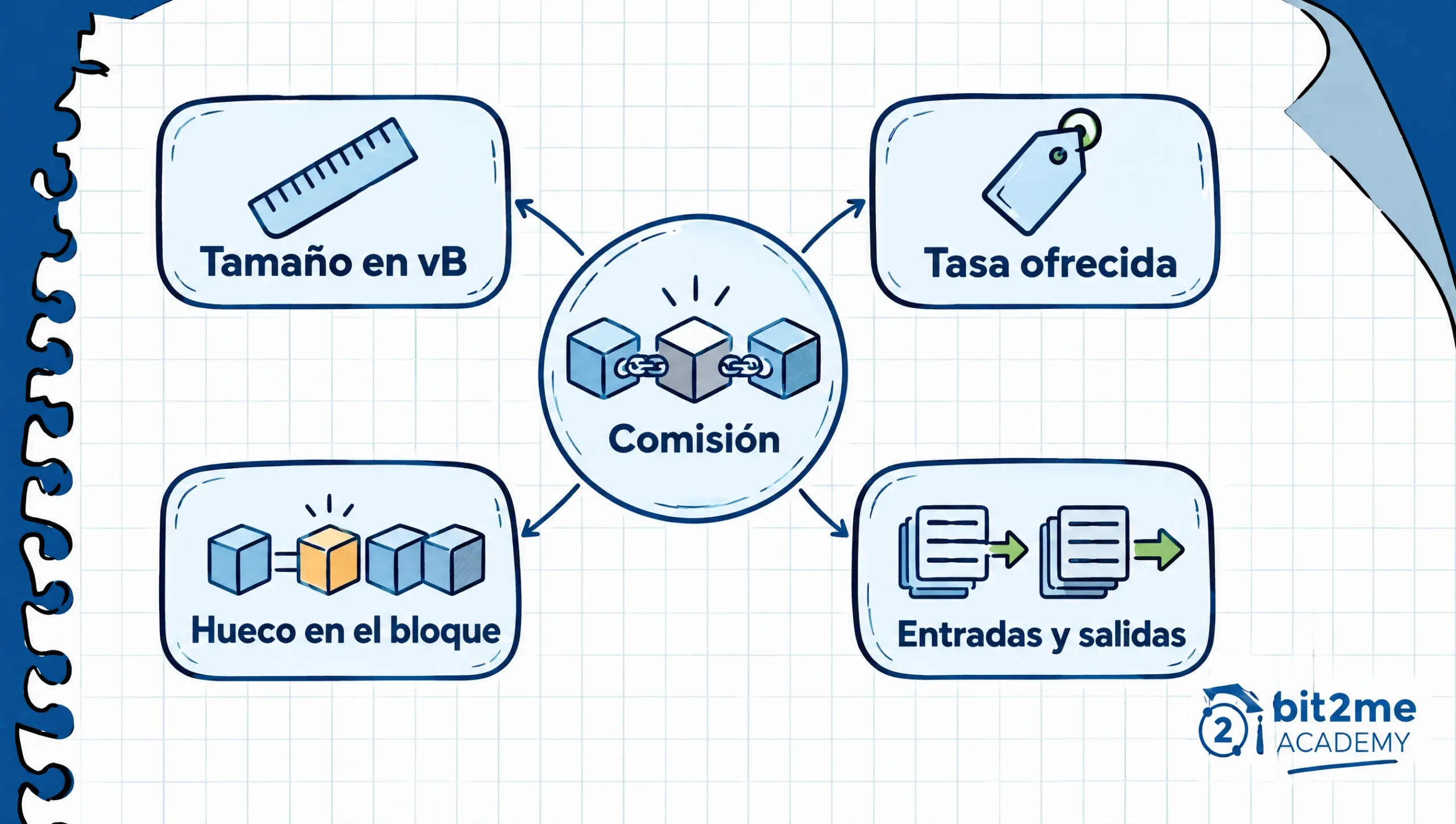
The fee is what remains after subtracting total outgoing transactions from total incoming transactions, according to the developer glossary. It doesn't go to any specific address: it's kept by the miner who includes your transaction in a block. It's calculated based on the space it occupies, not the amount of money you move, because the developer guide states that payment is based on the size in bytes of the signed transaction.
This space is measured in virtual bytes (vB). BIP141 defines virtual size as the weight divided by four and rounded up, and sets the block size limit at 4.000.000 weight units. The rate is expressed in satoshis per virtual byte, or sat/vB, and is what miners compare when choosing what to include.
In Maria's example, two native SegWit inputs and two outputs weigh around 209 vB, according to a calculation based on the 72-byte signature format, so her 2.000 satoshis would be equivalent to about 9,6 sat/vB. With more inputs, the transaction weighs more and costs more, even if the total amount is similar.
Because the space in each block is limited, the rate per byte increases when demand for that space rises, according to the developer guide. You won't find the daily rate here because it changes every few minutes, but the guide for to know the fee of a Bitcoin transaction It teaches you to value it.
To find out how much those satoshis are worth in euros, you need the Bitcoin price todaybecause the value of a commission in euros changes with the market even if the rate in sat/vB is the same.
If your transaction is stuck due to a low rate, you can replace it with another that uses the same number of outgoings but pays more. replacement by commission (RBF): according to him BIP125The substitute must pay an absolute commission at least equal to that of the original. The alternative is the CPFPwhich consists of spending an unconfirmed output with a high-commission child transaction, so that the rate of the set is judged.
What is a Coinbase transaction?
This is the first transaction of each block, created by the miner who finds it. It doesn't spend any previous output, and its outputs claim the block reward, which, according to the blockchain guide It consists of a subsidy plus the fees for the included transactions. You can find more information in the guide on the coinbase transaction.
The subsidy creates new bitcoins and is halved every 210.000 blocks in the halvingAs of April 20, 2024, at block 840.000, it is 3,125 BTC according to the bitcoin.org halving table, which estimates the next one for 2028. These coins cannot be spent until at least 100 blocks have passed, a waiting period designed so that the block can be discarded without dragging down whoever spent them.
Current state of Bitcoin transactions in November 2026
The rules that affect your transactions combine consensus changes, which bind the entire network, with default Bitcoin Core policies, which each operator can modify. The table reflects recent changes as of November 1, 2026, according to the bitcoin.org release notes.
| Milestone | Date | What changed for your transactions |
|---|---|---|
| Fourth halving | April 20th 2024 | The subsidy drops to 3,125 BTC |
| BitcoinCore 28.0 | 2th October 2024 | Full replacement by commission becomes the default value |
| BitcoinCore 28.3 | 17th October 2025 | The minimum retransmission rate drops from 1 to 0,1 sat/vB |
| BitcoinCore 31.0 | April 19th 2026 | The mempool is now limited to cluster limits of 64 transactions and 101 kB. |
Version 28.3 notes They warn that, until the minimum rate of 0,1 sat/vB is widely adopted, there is no guarantee that a transaction with such a low rate will propagate or be confirmed. With the version 31.0A replacement is only accepted if it improves the mempool rate diagram. These are default values for that program and not network-wide rules, so they describe a trend and not a guarantee for every shipment.
Read a transaction before pressing send
Viewing Bitcoin transactions as inputs that lead to outputs, signatures that unlock them, and a difference that the miner charges gives you practical habits. Check the change before confirming, review the rate in sat/vB, and don't consider a payment complete while it's pending.
If you don't already have Bitcoin, you can buy Bitcoin at Bit2Me and make a small initial shipment to see its structure in a browser. The guide for send Bitcoin from the Bit2Me Wallet It guides you step by step, and it's worth remembering that the value of crypto assets can change rapidly and that a confirmed transaction cannot be reversed.

Frequently Asked Questions about Bitcoin Transactions


 Author