New technologies have always found a way to improve finances and the economy. In 1871, the first system of money transfers through the telegraph appeared, laying the foundations of what would be international transactions and payments.
More than 150 years later, thousands of international transfers and payments are made every day. However, we are still stuck with long wait times due to endless peer-to-peer validations that cause these transactions to take several days from leaving an account to reaching their destination.
152 years later, international payments are slower than the telegraph.
Luckily, since Satoshi Nakamoto published the Bitcoin whitepaper in 2008, which already spoke of P2P transfers, between peers, without the need for intermediaries, the evolution of this system has skyrocketed.
Now, cryptocurrencies are changing the game forever.
Click here to open your user account in Spanish for FREE and securely and receive a €15 gift.
The problem with times in international payments
One of the main problems of traditional banking transactions is time. An international payment through a transfer can take several days or even weeks to process.
However, cryptocurrency transactions take place in a matter of minutes. The average validation time for a Bitcoin transaction is 44 minutes, while that of Ethereum varies between 16 seconds and 5 minutes.
Additionally, blockchain networks are continually working to improve processing times. In the case of Bitcoin, the Lightning Network, a layer designed for the management of payments and micropayments, is capable of processing transactions almost instantly. In the case of Ethereum, the change of the consensus mechanism to Proof of Stake has allowed it to increase up to 100.000 transactions per second, reducing the validation time.
Other third generation networks, such as Cardano, are even more powerful and can process up to 1 million transactions per second. Many more than any modern payment network like Visa or Mastercard.
For example, the SWIFT system used by traditional banks for international transfers is capable of making 35 million transactions per day; that is, 405,09 per second. In addition, once this transfer has started, it can take between 1 and 5 working days to complete due to the procedures for the prevention of fraud laundering and the fight against money laundering applied by the banks that are participating in the movement.
The end of high transfer fees
International payments with cryptocurrencies have an advantage and that is that the fees are much lower than those of traditional bank transfers, which implies significant savings for companies.
Payments with cryptocurrencies are cheaper because they are made in a decentralized way, which means that an intermediary is not required to carry out the validation operation. In this way, the associated costs are reduced, since large financial institutions usually charge higher fees for processing these transactions.
Use case: payments to international suppliers
What is it about?
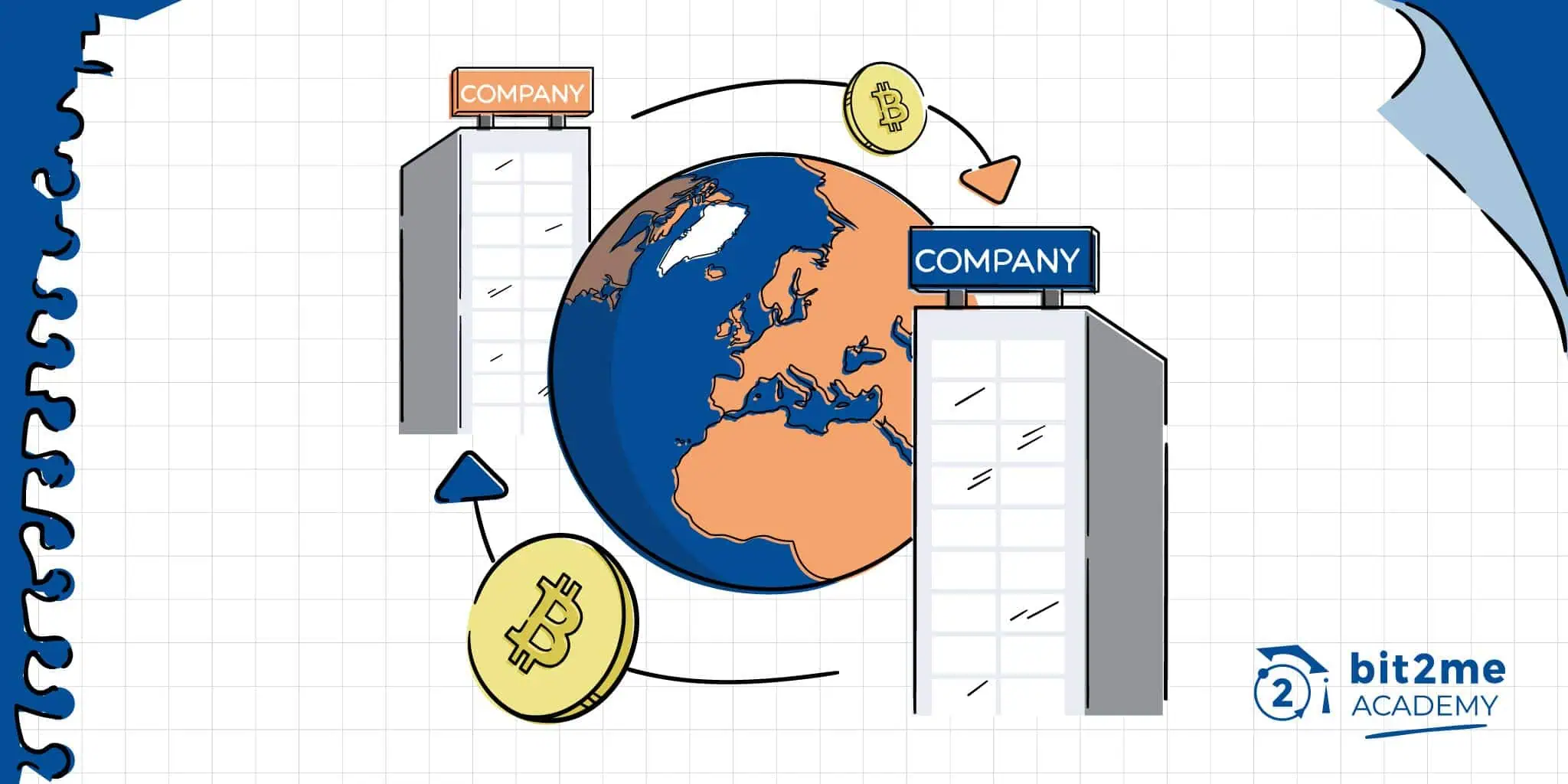
This involves using cryptocurrencies to settle invoices with international suppliers, eliminating banking intermediaries and taking advantage of blockchain technology to achieve secure and efficient transactions. This method transforms the traditional way of making payments, allowing companies to operate on a global scale with greater flexibility, lower costs and unprecedented speed.
How is it done?
- Prior agreement:
-
- Definition of currency: It is agreed with the provider which cryptocurrency to use (for example, USDC, EUROC or XRP).
- Exchange rate: Both parties agree on an appropriate and transparent exchange rate, ensuring that the transaction value reflects market conditions.
- Conversion to cryptocurrency:
- Fiat funds: If the company operates with fiat currency, the conversion is carried out through specialized platforms (for example, Bit2Me or other secure currency exchange offices).
- Risk management: Hedging mechanisms can be established to mitigate volatility by fixing the exchange rate at the time of conversion.
- Direct delivery:
- Immediate transfer: Once converted, the funds are transferred directly to the provider's digital wallet.
- Agile execution: The transaction is executed in a matter of seconds or minutes, eliminating the days-long wait that occurs with traditional systems such as SWIFT.
- Confirmation and subsequent management:
- Notification: The supplier receives payment confirmation almost instantly.
- Flexibility in reception: The provider can choose to convert the funds into their local currency or hold them digitally, depending on their financial strategy and operational needs.
Key benefits
- Speed and efficiency:
- Transactions that are completed in seconds or minutes, as opposed to the long times (3-5 days) of traditional banking systems.
- Reduced costs:
- Extremely low fees (between 0 and 0.01%), which contrasts significantly with the high fees (3-8%) of conventional banks.
- Transparency and security:
- Blockchain technology guarantees an immutable and verifiable record of each transaction, improving traceability and reducing fraud risks.
- Geographic and operational flexibility:
- There are no geographical limits; it is ideal for payments in regions as diverse as Asia, Africa or Latin America.
- It facilitates the integration of international payments into the company's global strategy, helping to optimize cash flow and liquidity.
- Tax and accounting optimization:
- The use of cryptocurrencies allows for greater efficiency in currency management and tax planning, being able to adapt to specific regulations and simplify accounting processes through automated reports.
object lesson
Let's imagine a design company in Spain that needs to pay a supplier in India. Traditionally, the transaction in euros would involve high fees (around 5%) and long waiting times. With the use of cryptocurrencies:
- Agreement and conversion:
- The company and the supplier agree to use USDC. An amount of €50,000 is converted to USDC using Bit2Me, fixing the exchange rate to avoid fluctuations.
- Transfer and reception:
- The transfer is executed in just 15 seconds, sending the equivalent amount in USDC to the provider's wallet.
- The supplier, upon receiving payment, has the option to convert the USDC to their local currency or keep it digitally, obtaining approximately €49,995 net after deducting a minimal commission (0.01%).
This method not only reduces costs and speeds up the operation, but also provides greater transparency and security in each transaction, making it extremely attractive for companies looking to expand their international operations in an agile and efficient manner.
 Certificate

Use case: Payroll payments to employees
What is it about?
This involves offering employees the option of receiving part or all of their salary in cryptocurrencies, such as EUROC, BTC or ETH. This option combines financial innovation with flexibility, allowing companies to differentiate themselves in attracting and retaining talent, while employees can benefit from potential revaluations and greater protection against inflation.
How is it done?
- Percentage selection: The employee decides what part of his salary he wants to receive in cryptocurrency (for example, 30% in EUROC).
- Internal definition: The company establishes internal protocols to convert fiat to cryptocurrency, integrating tools and policies that ensure transparency and consistency in each payment.
- Real-time conversion: At the time of payment, the company converts the corresponding part of the salary from fiat currency to the agreed cryptocurrency, using secure and low-cost platforms.
- Smart contracts: Smart contracts can be implemented to automate and schedule recurring payments, ensuring accuracy and reducing the possibility of errors in each payroll cycle.
- Shipping and Flexibility:
- Download:
- The cryptocurrency is sent directly to the employee's digital wallet, eliminating middlemen and speeding up the process.
- Employee options:
- The employee can choose to convert the cryptocurrency to fiat immediately, keep it in their wallet or even invest it, taking advantage of growth opportunities and protecting themselves against local devaluation.
- Download:
Key benefits:
- Attracting and retaining talent:
- Innovation in payment methods attracts technological profiles and young professionals, who value flexibility and the integration of new technologies.
- Efficiency and cost savings:
- Reduction of commissions on international transfers and automated processes that reduce errors and operating costs.
- Tax and accounting benefits:
- In certain countries, such as Estonia, gains from cryptocurrency appreciation are not taxed unless sold, and in Portugal VAT exemptions can be applied in certain cases, which optimizes the tax burden.
- Inflation protection:
- In markets with high devaluation of the local currency, receiving part of the salary in cryptocurrencies protects the employee's purchasing power, mitigating the effects of inflation.
- Transparency and security:
- The use of blockchain technology and smart contracts ensures an immutable record of each transaction, reducing fraud risks and increasing trust in the process.
Practical example:
A tech startup in Estonia, with a team spread across 7 countries, was facing high costs for international transfers in Euros. To improve its competitiveness and offer greater flexibility, the company decided that 30% of the salary would be paid in EUROC.
- Configuration and conversion:
- Each employee chose to receive 30% of their salary in EUROC, and the company proceeded to convert that fraction in real time using a reliable platform.
- Automation and shipping:
- With smart contracts, monthly payments were automated, transferring the cryptocurrency directly to each employee's wallet in a matter of seconds.
- Results:
- Employees saved between 3% and 4% on local conversion fees, enjoying fast, secure payments and the added benefit of having an innovative financial tool that protects their salary against inflation.
This system not only modernizes the payment process, but also positions the company as a pioneer in financial innovation, creating an attractive and competitive work environment in today's global market.

Use case: receiving payments from customers
What is it?
This involves accepting cryptocurrencies as a payment method for goods or services, offering customers the option of paying with digital assets. This system allows, depending on the chosen configuration, automatic conversion to fiat or the maintenance of funds in the form of crypto, giving the company operational and financial flexibility. By incorporating this modality, companies position themselves at the forefront of innovation, opening their markets to a segment with high purchasing power and reducing the risks associated with traditional payment methods.
How is it done?
- Gateway Integration:
APIs are used Bit2Me to incorporate the "pay with crypto" option in e-commerce, making it easier for customers to use cryptocurrencies during their purchase process. - Conversion (optional):
Automatic settlement to fiat is set up, for example, by converting 100% of ETH payments to euros on a daily basis. This measure allows to minimize exposure to market volatility and ensure financial stability in local currency. - Risk management:
In cases where it is decided to keep part of the funds in cryptocurrencies, hedging tools are implemented to protect against possible market fluctuations and ensure the solidity of the operation.
Key benefits:
- Market expansion:
Accepting crypto opens the door to a niche of innovative and high-spending customers, which can translate into increased sales and customer diversification. - Reduction of chargebacks:
Blockchain transactions are irreversible, eliminating the risk of chargebacks and fraud, improving profitability and reducing operating costs. - Operational efficiency and cost control:
Automation through APIs and smart contracts simplifies payment processes, reducing dependence on intermediaries and, therefore, the fees associated with traditional methods. - Transparency and security:
Blockchain technology guarantees an immutable record of all transactions, increasing customer and supplier confidence and facilitating traceability in audits.
Practical example:
A luxury e-commerce site in Italy was facing high transaction costs (around 2,5% in fees) and fraud-related problems. By integrating a payment gateway, Bit2Me By setting up automatic conversion of ETH payments to euros, the company not only significantly reduced associated costs but also virtually eliminated chargebacks. As a result, 18% of its sales came from users who chose to pay with crypto, demonstrating how this method can transform the shopping experience and generate competitive advantages in the market.
Tax implications
The tax treatment of cryptocurrency transactions varies by jurisdiction, so it is essential to have specialized tax advice. In general, it is important to take into account the following aspects:
- Accounting record and declaration: Every crypto transaction must be accurately recorded in the company's accounting. This includes the date of conversion, the exchange rate applied, and the identification of the cryptocurrency used. Gains or losses arising from the volatility of digital assets, when converted to fiat, may be considered capital gains or losses.
- Local regulations and rules: Some countries treat cryptocurrencies as financial assets, while in others they are considered intangible assets. For example, in countries such as Estonia and Portugal there are specific tax benefits: in Estonia, gains from cryptocurrency appreciation are not taxed if they are not sold, and in Portugal certain crypto payments may be exempt from VAT. It is vital to know and apply the regulations in force in each jurisdiction.
- Reports and audits: Transparency in the recording of transactions through blockchain facilitates audits, since an immutable history of transactions can be available. However, this traceability must be complemented with accounting and tax reports that comply with international standards (such as IFRS regulations).
- Periodic revision: Since cryptocurrency regulation is constantly evolving, it is advisable to conduct periodic tax reviews to adjust processes and ensure regulatory compliance in each transaction.
Advantages of doing it this way
Adopting the use of cryptocurrencies for international payments, payroll and receiving payments offers significant advantages over traditional methods. The following comparison table illustrates these differences:
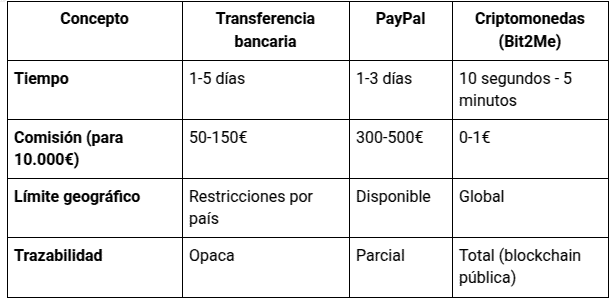
In addition to these points, it is important to highlight that:
- La speed of crypto transactions allows for more efficient liquidity management and agile response in the overall operation.
- low commissions and the absence of intermediaries significantly reduces operating costs, optimizing the company's resources.
- La full traceability Blockchain offers a level of transparency that facilitates auditing and risk control, which is very attractive for companies looking to improve efficiency and security in their operations.
How to do it in Bit2Me
Bit2Me It offers a comprehensive platform with a 360-degree service that facilitates the integration of cryptocurrencies into business operations. Some of the tools and services it offers include:
- Bit2Me Pro: Ideal for operating in the cryptocurrency market, this platform offers very competitive commissions, allowing companies to make conversions and transfers with a minimum cost. It is an essential tool for those companies that handle large transaction volumes and seek to maximize operational efficiency. For stablecoins, fees are practically negligible:

- Bit2Me Trade: Designed for receiving payments from customers, this solution allows for easy integration of the “pay with crypto” option into e-commerce. Using APIs, automatic conversion to fiat (e.g. ETH to euros) or holding of funds in crypto is possible, depending on the company’s preferences.
- Bit2Me Tax: This tool is designed to simplify and optimize the tax management of cryptocurrency transactions. Bit2Me Tax companies can:
-
- Automate the calculation and recording of crypto transactions to facilitate accounting and tax reporting.
- Obtain detailed reports that comply with current regulations, reducing the risk of non-compliance and possible sanctions.
- Take advantage of tax benefits specific to each jurisdiction, such as non-taxation of appreciation gains in certain cases, optimizing the company's overall tax burden.
- Support and advice: In addition to technological solutions, Bit2Me It offers expert support for the integration and optimization of these processes, which is especially useful for companies in transition to innovative payment methods.
The combination of these tools allows the three use cases (payments to international suppliers, payrolls to employees and receipt of payments from clients) to be implemented in an agile, secure and cost-effective manner, positioning the company at the forefront of financial innovation.

 Author