Essential Points
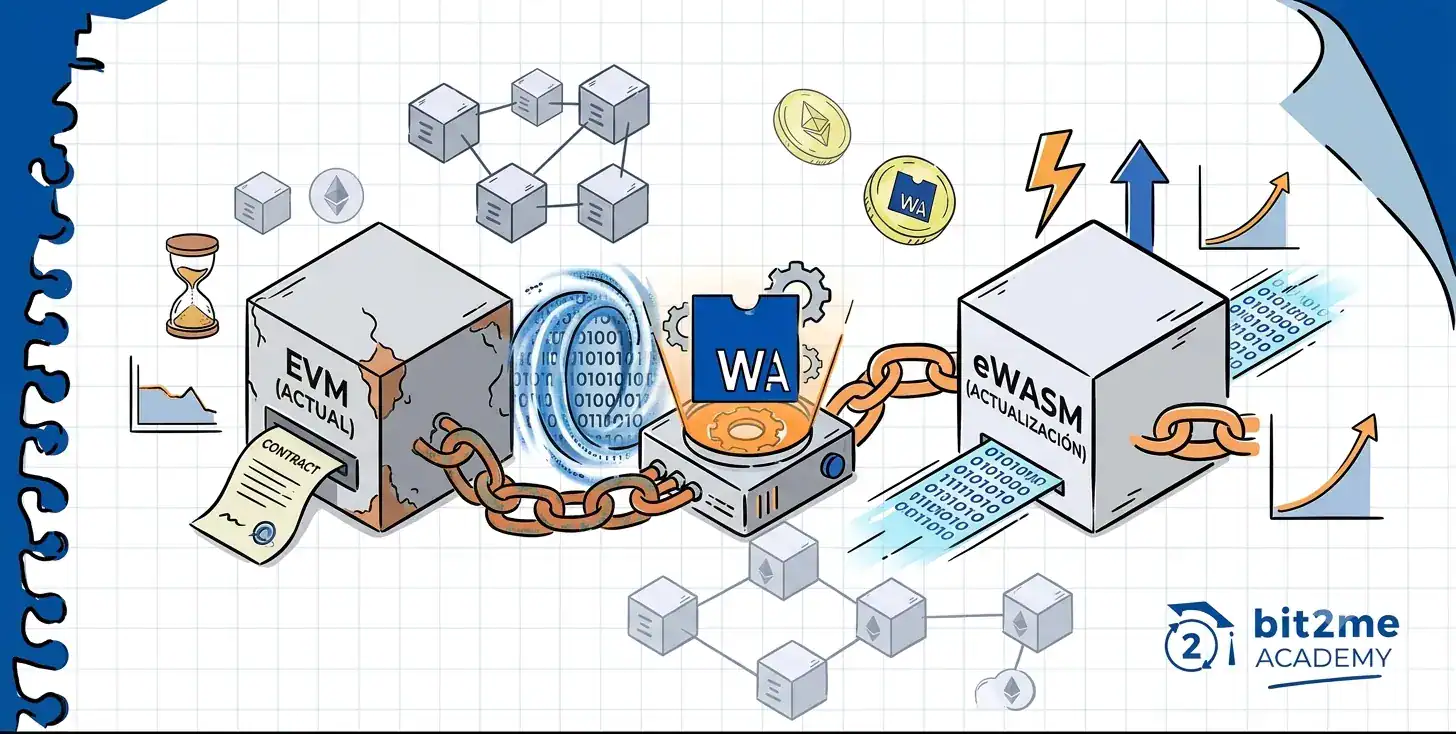
- WebAssembly (WASM) is a binary execution format that allows high-efficiency code to be run directly on the Ethereum Virtual Machine, as an alternative to the traditional EVM.
- Ethereum has been developing eWASM for years as an evolution of its runtime environment; meanwhile, Solana already runs native programs on WASM/BPF with full production support.
- With tools like Solang, Wabt, and Hardhat, you can compile Solidity or Rust code to WASM and deploy it to test networks today, without waiting for eWASM to reach mainnet.
- The main advantage of WASM over EVM is performance and language portability: the same contract can be written in Rust, C++ or Go, reducing the barrier to entry for system developers.
The Ethereum Virtual Machine (EVM) has been the heart of decentralized computing for years. Millions of smart contracts run on it, from the protocols DeFi (Decentralized Finance) From the most complex to the simplest NFTs. However, the EVM has limitations in performance, language portability, and computational efficiency that the ecosystem has long sought to overcome. WebAssembly (WASM) It emerges as the most promising technical response to that challenge.
This guide is aimed at developers with programming experience who want to understand how WASM works in the blockchain context, what tools exist today, how support in Ethereum compares to Solana, and how to install a complete development environment to deploy your first WASM compiled contract on a test network.
 Certificate

What is WebAssembly and why does it matter in blockchain?
WebAssembly is a binary instruction format designed as a portable compilation target for high-level languages such as C, C++, Rust, or Go. It was defined by the W3C in 2019 as a web standard and allows code to run at near-native hardware speeds within secure sandbox environments, such as a browser or, in this context, a blockchain.
The relevance of WASM in blockchain is direct: the EVM was designed with its own set of instructions (opcodes) that only Solidity Vyper and Rust compile natively. WASM, on the other hand, is the compilation target for dozens of languages. This means that a Rust developer with systems experience can write a smart contract without learning Solidity from scratch, with all the expressiveness and security guarantees of their usual language.
Furthermore, WASM implementations are optimized for Just-In-Time (JIT) compilation, which can result in a significant reduction of gas consumed by computationally intensive operations: iterations, custom cryptography, and in-memory data manipulation.

The eWASM project on Ethereum: where we are
The eWASM (Ethereum WebAssembly) initiative originated as a proposal from the Ethereum Foundation to gradually replace the EVM with a WebAssembly-based execution environment. The idea was that Ethereum nodes could execute contracts in pure WASM, leveraging the speed and portability of the format.
As of June 2026, eWASM has not yet reached the Ethereum mainnet. Ethereum's current roadmap prioritizes the transition to Proof of Stake (PoS) through The Merge, Danksharding scalability improvements, and user experience enhancements. eWASM remains an active research project, but without a specific mainnet activation date. You can follow its status on the official ewamsm repository on GitHub.
This does not mean that WASM is unusable on Ethereum today. There are two viable paths:
- Test networks with eWASM support: Some experimental clients (such as the eWASM branch of go-ethereum) allow WASM contracts to be deployed in isolated development environments.
- Compilers that translate WASM to EVM bytecodeTools like Solang compile Solidity or Rust code into bytecode compatible with the standard EVM, using WASM as an intermediate format. The final contract runs on regular Ethereum nodes without modification.
This second approach is the most practical today and the one we will cover in the installation and practical example section.
Solana and WASM: Native support in production
While Ethereum is working on eWASM, Solana offers de facto support for WebAssembly through its eBPF (Extended Berkeley Packet Filter)-based runtime environment, which shares many principles with WASM in terms of portability and efficiency.
Solana programs are written in Rust (primarily), C, or C++, compiled to BPF bytecode, and run on the Solana BPF VM. From a developer's perspective, the workflow is functionally equivalent to that of WASM: you write in a systems language, compile to an optimized binary format, and deploy to the network.
Solana's ecosystem of tools is mature and well-documented. The Solana CLI and Anchor Framework (the development framework equivalent to Hardhat on Ethereum) allow you to create, test, and deploy programs in minutes. For a developer looking to explore WASM on blockchain today with full mainnet support, Solana is the most straightforward option.
The most relevant architectural difference between both platforms for WASM development purposes:
- Ethereum remains focused on Solidity and the EVM; WASM is an experimental/future path.
- Solana uses Rust + BPF as its first-class solution, with all the ergonomics that implies for system developers.

Essential tools for developing with WASM on Ethereum
Before installing anything, it's helpful to understand what each tool does in the pipeline:
- SolangA Solidity and Rust compiler for WASM and EVM bytecode. It is the central component of the WASM workflow on Ethereum today. Actively maintained; its official documentation It is the main reference.
- Wabt (WebAssembly Binary Toolkit)A set of command-line utilities for inspecting, validating, converting, and optimizing .wasm files. Includes wat2wasm (converts WAT text to WASM binary) and wasm-objdump (inspects WASM modules).
- Node.js + npm: required for Hardhat and Ethereum interaction libraries.
- HardhatA development and testing environment for Ethereum. It allows you to deploy contracts on local networks, run migration scripts, and execute automated tests.
- ethers.js: JavaScript library for interacting with the Ethereum blockchain from deployment and test scripts.
- Rust toolchain (Optional, for contracts in Rust): If you prefer to write the contract in Rust instead of Solidity, you will need rustup and the target wasm32-unknown-unknown.
Installing the development environment
Previous requirements
You need a Linux or macOS system (on Windows, use WSL2). Before you begin, make sure you have the following installed:
node --version # >= 18.0.0 npm --version # >= 9.0.0
Step 1: Install Solang
Solang distributes pre-compiled binaries for major platforms. On Linux/macOS:
Download the latest version from the official repository
curl -L https://github.com/hyperledger/solang/releases/latest/download/solang-linux-x86-64 -o /usr/local/bin/solang chmod +x /usr/local/bin/solang
Check the installation
solang --version
On macOS with Apple Silicon (M-series), use the solang-mac-arm binary:
curl -L https://github.com/hyperledger/solang/releases/latest/download/solang-mac-arm -o /usr/local/bin/solang
chmod +x /usr/local/bin/solang
Step 2: Install Wabt
On macOS with Homebrew
brew install wabt
On Ubuntu/Debian
sudo apt-get install wabt
Verifica
wat2wasm --version
Step 3: Create the Hardhat project
mkdir wasm-ethereum-demo && cd wasm-ethereum-demo npm init -y npm install --save-dev hardhat @nomicfoundation/hardhat-toolbox npx hardhat init
Select "Create a JavaScript project" when prompted
The resulting project structure:
wasm-ethereum-demo/
├── contracts/ ← our contract will go here
├── scripts/ ← deployment scripts
├── test/ ← automated tests
└── hardhat.config.js
Your first contract compiled with WASM: a practical example
We're going to build a simple Counter contract — the "Hello World" of smart contract development — and compile it with Solang targeting WASM, then deploy it on Hardhat's local network.
The contract: Counter.sol
Create the file contracts/Counter.sol:
// SPDX-License-Identifier: MIT
pragma solidity ^0.8.20;
Contract Counter
It's a standard Solidity contract. The difference lies in how we're going to compile it.
Compile to WASM with Solang
Compile pointing to the ewasm target (Ethereum WebAssembly)
solang compile --target ewasm contracts/Counter.sol
Solang generates two files: the binary .wasm module and the standard Ethereum JSON ABI. You can inspect the WASM module with Wabt:
Deploy on the Hardhat local network
Create the script scripts/deploy.js:
const = require("hardhat"); const fs = require("fs"); const path = require("path");
async function main()
main().catch((error) => );
Launch the Hardhat local network and deploy:
npx hardhat node
We deployed the contract
npx hardhat run scripts/deploy.js --network localhost
The expected output:
Desplegando desde: 0xf39Fd6e51aad88F6F4ce6aB8827279cffFb92266
Counter desplegado en: 0x5FbDB2315678afecb367f032d93F642f64180aa3
Conteo tras increment(): 1
Current state of WASM on Ethereum as of June 2026
The ecosystem is still in transition. The most relevant points for a developer today:
Solang v0.3.x (The most recent branch as of this writing) supports compilation to the ewasm, solana, and substrate targets, making it the most versatile tool for writing portable cross-chain contracts. The official documentation at solang.readthedocs.io It is the canonical reference; any information here about versions should be verified against that source before use in production.
Hyperledger Fabric vs Substrate (The Polkadot framework) already uses WASM as its native runtime environment in production, demonstrating the viability of the approach. Ethereum is the most complex case due to its installed base of EVM contracts, which makes any runtime migration more expensive.
The EVM will remain the de facto standard on the Ethereum mainnet on the 2026-2027 horizon. The practical path for developers who want to prepare for a future with more WASM is: master Solang, write contracts that can be compiled to multiple targets, and keep business logic separate from the runtime environment.
Security considerations when compiling with WASM
Introducing an additional compiler into the pipeline (Solang on top of Solc) adds an attack surface that should be considered. Before deploying any Solang-compiled contract to the mainnet, verify the following:
- Audit the compiler outputUse wasm-objdump and tools like Binaryen To inspect the generated WASM module, verify that the exports exactly match the functions you expect.
- Compare the generated ABIThe ABI generated by Solang should be identical to the one generated by solc for the same Solidity code. A discrepancy indicates a compiler bug or a different interpretation of the standard.
- Use fixed versions of the toolsIn your package.json and CI scripts, specify the exact versions of Solang, Wabt, and Hardhat. An unplanned update can change the build output.
- Invariant testsIn addition to functional tests, write invariant tests that verify properties that must always be true (e.g., the counter can never be decremented if there is no decrement function).
Important noticeThis article is for educational and informational purposes only. The content does not constitute financial, legal, or tax advice. Cryptocurrencies are high-risk assets and their value can fluctuate significantly. Consult a qualified professional before making any acquisition or participation decisions.
The future is multi-runtime: WASM as infrastructure
WebAssembly isn't going to replace the EVM overnight on Ethereum; the burden of backward compatibility is too great. What is happening, however, is the emergence of a multi-runtime ecosystem where different blockchains choose their runtime environments more freely, and WASM is emerging as the common denominator that allows code reuse across them.
For a blockchain developer in 2026, learning the WASM pipeline—writing in Rust or Solidity, compiling with Solang, inspecting with Wabt, deploying with Hardhat—isn't betting against the EVM: it's building the abstraction layer that makes your code portable. The Counter contract you just deployed on Hardhat's local network can be compiled, with the appropriate Solang tweaks, to run on Solana, Substrate, or any WASM runtime that emerges in the coming years.
The next concrete step: explore the Solang documentation For the Solana target, deploy the same contract on Solana DevNet. A direct comparison between the two environments will give you practical insight into what WASM unifies and what remains specific to each chain.


 Author