Meet bulletproofs a very special type of cryptographic test specially designed to be fast, secure and provide enormous privacy and anonymity. This without assuming high computational consumption and impractical in blockchain technology.
Unot the most recent privacy protocols that exist in the crypto ecosystem are the Bulletproofs. A protocol implemented primarily in cryptocurrency Monero in order to improve your level of privacy, and which was launched at the end of 2017.
Although this protocol is based on two privacy systems: the zero knowledge tests (the ZK-snarks precisely) and confidential transactions (Confidential Transactions - CT). In other words, the Bulletproofs protocol makes a rather smart combination of both systems. In a more technical concept, Bulletproofs protocols are a much more efficient method than zk-SNARKs tests. This therefore allows the verification of certain parameters in a confidential and secure way. And they can also be used without the need for a trusted configuration by the creator.
Origin and implementation of Bulletproofs
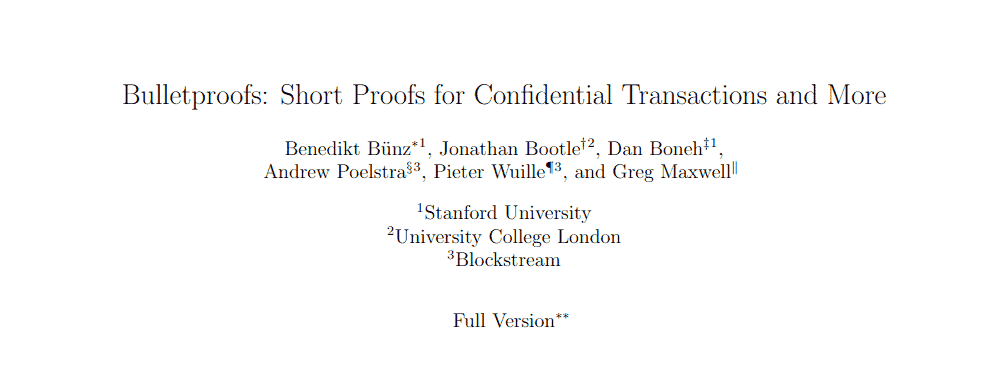
The Bulletproofs protocol was developed and was made public in late 2017. Its main developers are Jonathan Bootle from University College London, England, and by Benedict Bunz from Stanford University, United States. But Dan Boneh, Andrew Poelstra, Pieter Wuille and Greg Maxwell. The protocol designed by these two developers quickly caught the attention of the cryptographic community, who showed a genuine interest in knowing how this new protocol worked and how they could implement it within their blockchains. The protocol whitepaper can be accessed through this link.
Although the Bulletproofs protocol, known as “bulletproof” was originally designed to be implemented in the Bitcoin blockchain, they have been those of Monero and the network MimbleWimble Those who have really started to use this protocol to improve their level of privacy. Likewise, the CEO of Litecoin It is also evaluating the possibility of starting to implement this protocol within the blockchain of its cryptocurrency.
Likewise, although the Bulletproofs protocol does not offer users complete privacy or anonymity, its implementation does hide the amounts associated with the transfers made. Showing only the origin and destination of the transaction, but without disclosing the amounts transferred at any time.
Therefore, the design of this new protocol was driven by the growing need of users and the community to enjoy a higher level of privacy than that offered by public blockchains, at the time they carry out their financial transactions and operations.
It is well known that one of the greatest advantages that blockchain technology offers is its immutability and its level of transparency when recording transactions made. But for certain applications, these blockchain properties are not the most appropriate. When it comes to companies that require a level of privacy and confidentiality, or simple users who want to enjoy these benefits, the transparency of public blockchain technology is not the best option.
How do Bulletproofs work?
The crypto behind the Bullteproofs is truly complex, so complex that only a few cryptographers understand it in depth. To get an idea of their complexity, let's look at some of the mathematical functions that make them possible:
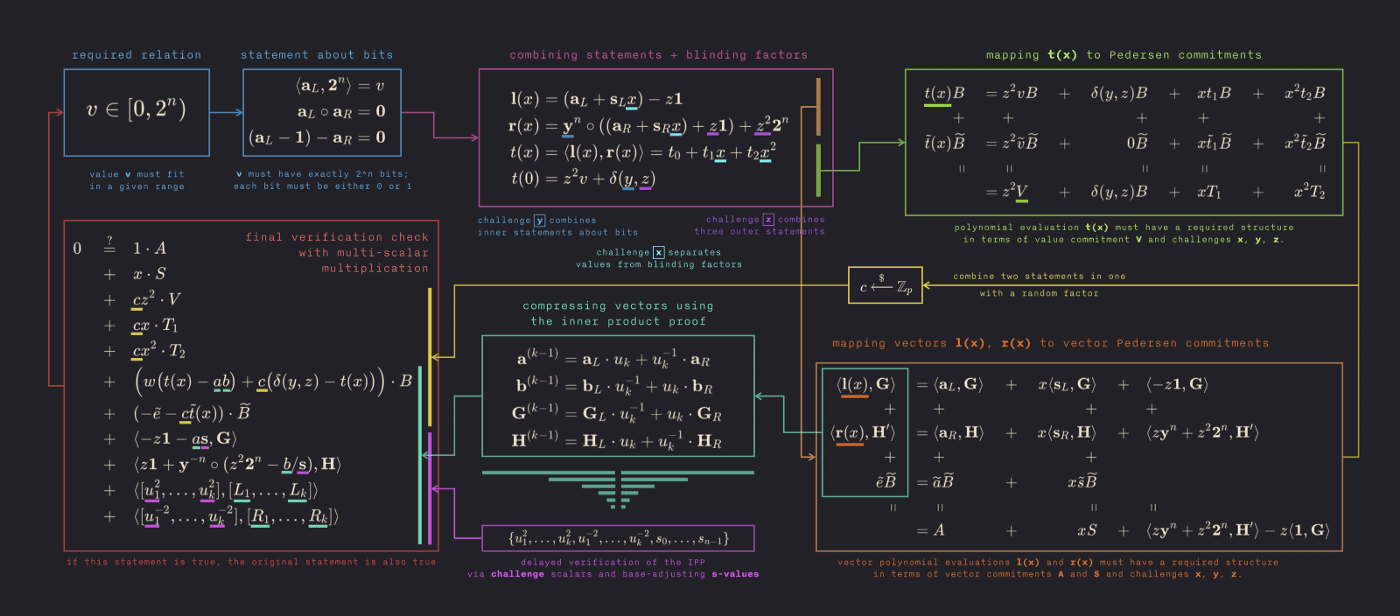
This image shows how the Test Ranges of the Bulletproof work mathematically and relationally. All this is a single function within the set of functions that make Bullteproof possible. Given this complexity, we will explain in a very simple way how these tests work.
First of all, the objective of Bulletproofs is to hide the values involved in a transaction. Without diminishing the ability to verify its authenticity by the network. To achieve this, Bulletproofs protocols are based on the Pedersen Commitments. These are a special type of cryptography, which is called homomorphic cryptography.
The operation of Pedersen Commitment allows values to be validated without the need to reveal them publicly at any time. To achieve this, they use a little mathematical trick, which shows that the sum of the inputs is greater than the sum of the outputs. So you are not generating coins out of thin air, you are not using already spent coins, or using a negative balance that you do not own. You are simply sending an encrypted message, in which the rest can verify that you are really using your balance, but no one knows how much balance it is.
Likewise, these protocols are based on the assumption of a discrete logarithm (discrete logarithm): This makes them extremely versatile and compatible with any elliptic curve algorithm. Also, Bulletproofs protocols make use of cryptographic techniques Fiat-Shamir heuristics. Which allows them to gain a non-interactive character and create short tests of zero knowledge. The purpose of this is to create very short cryptographic signature systems, which can be verified quickly and without using much computing power.
In short, the union of all these parts allows the creation of a fast, efficient and secure cryptographic evidence system.
How much do you know, cryptonuta?
Are Bulletproofs susceptible to quantum computing?FALSE!
One of the great advantages of Bulletproofs (and ZKPs in general) is their ability to resist the emergence of quantum computing, resisting that their security can be broken by this type of technology and their enormous computational capacity.
Bulletproofs protocol capabilities
- With Bulletproofs protocols users can enjoy a higher level of privacy than with the Bitcoin or Ethereum blockchain. For example, if you are dealing with companies and companies, you will not have to worry because your competition may be how much money you transfer to your suppliers. In the case of users in general, they will not have to worry that other people can see how much money they manage in their accounts or how much money they earn in a month.
- Transactions made through these protocols can have a much lower commission rate. This is because Bulletproofs protocols minimize computational excesses by reducing the size of cryptographic tests significantly.
- Bulletproofs protocols are can implement in conjunction with the coinjo. Thus, they can provide a higher level of privacy to users who so wish.
- Although these protocols offer a much slower solution to confirm and validate than zero-knowledge tests (zk-SNARKs) or confidential transactions (confidential transactions), They are much more efficient and secure to implement in cryptocurrency blockchains.
- Bulletproofs protocols provide a high level of confidence to the users of blockchains that implement this protocol. This because of do not require a trusted configuration as it happens with zero knowledge tests (zk-SNARKs). This means that when configuring Bulletproofs protocols, the parameters do not have to be configured with a secret value.
- Bulletproofs protocols are open source. So any user with knowledge of cryptography can contribute to the improvement and development of this protocol.
Bulletproofs protocols use cases
Bulletproofs protocols are very versatile and have a wide variety of applications that vary from blockchain networks and cryptographic protocols to implementations in smart contracts or smart contracts. Although in the latter, the use of these protocols is quite complex. Despite its complexity, and because this innovation is so novel, it is already being used in some cryptocurrencies.
On the one hand, the network Monero It has been a pioneer in the implementation of this protocol within its blockchain. Something that has brought great benefits to your community. For example, you have seen a significant reduction in the size of the data generated by transactions. This has been projected towards a reduction in transaction commission rates.
We can also highlight the network MimbleWimble, where the implementation of the Bulletproofs protocols as a replacement for range tests in confidential transactions has also contributed to a considerable reduction in the size of UTXOs.

 Author