Essential Points
- A security token is a negotiable security, such as a bond or a stake in a company's capital, issued or recorded on a blockchain.
- If it meets the financial instrument criteria of MiFID II, it falls outside the MiCA Regulation and is governed by securities market regulations.
- In Spain, it is issued by an issuer with an entity responsible for registration and is traded on authorized infrastructures or outside the market.
- Being regulated does not eliminate risk: there is issuer risk, liquidity risk, technology risk, and country-specific interpretation risk.
A security token is a negotiable security, such as a bond, a company share, or a fund share, that is issued, registered, or transferred on a blockchain rather than a traditional ledger. The medium changes, but not the legal nature: ESMA, the European securities markets regulator, establishes in its Guidelines on the classification of crypto assets as financial instruments, whose final report is dated December 17, 2024, that tokenized financial instruments remain financial instruments for all regulatory purposes.
Therefore, a tokenized security is not the same as the crypto-assets regulated by the MiCA Regulation: Article 2 excludes crypto-assets that are financial instruments, so MiFID II and the rest of the market regulations apply to them. In Spain, Law 6/2023 (LMVSI) has recognized, since April 7, 2023, the representation of securities through distributed ledger systems, under the supervision of the CNMV (National Securities Market Commission).
Understanding this prevents you from making two common mistakes: believing that any token with a project behind it is valuable, and assuming that a tokenized asset works like Bitcoin. According to the CNMVThe only thing that bitcoin and a financial instrument based on this technology share is the support, not the regulatory framework, and in the second case the control and governance fall to supervised entities.
 Certificate
What is a security token and how does it differ from other tokens?
A security token is the tokenized version of a security that already exists in financial law. The CNMV (Spanish National Securities Market Commission) defines financial instruments based on distributed ledger technology (DLT) as those that are issued, registered, transferred, or stored using this technology, and emphasizes that the difference from a traditional security lies solely in the medium: the same type of instrument confers the same rights. Depending on the security, these rights are economic, such as receiving periodic payments or participating in profit sharing, or political, such as voting on corporate decisions.
It's a market label, not a legal category. European law refers to negotiable securities and financial instruments, and the classification of a specific token depends on the rights it grants, not the name under which it is traded. equity tokens This is the best-known example: a security token that represents a stake in a company's capital. utility token It gives access to a product or service and, as a general rule, is not a value, although the boundary between the two requires a case-by-case analysis.
The most frequently cited classification outside the EU is that of the Swiss regulator FINMA, which in its ICO guidelines dated February 16, 2018 It distinguishes three groups of tokens according to their economic function, a useful reference even though it is not applied in the EU:
- Payment tokens: designed as a means of payment or transfer of value.
- Utility tokens: provide digital access to an application or service.
- Asset tokens: represent a debt or an equity stake, and FINMA treats them as securities.
Within the EU, the MiCA Regulation creates other categories for crypto assets that are not securities: according to the CNMV glossary, these include asset-linked crypto assets, electronic money tokens, and other crypto assets. If you want to review the general framework, you can find it here. Academy guide on MiCA.
Technically, it is a crypto asset issued through a Smart contractA program that runs on the blockchain when predetermined conditions are met. What distinguishes it from Bitcoin is who controls that code, something you'll see below.
When does a token become a security and fall outside of MiCA?
Article 2(4)(a) of Regulation (EU) 2023/1114 excludes crypto-assets that are financial instruments from MiCA, and paragraph 5 tasked ESMA with publishing guidelines on the conditions and criteria for that classification by 30 December 2024, as stated in the Text of Article 2 in the ESMA's single rulebookThese guidelines adopt a substance-over-form approach: if the token grants rights equivalent to those of shares, bonds or other negotiable securities, it is treated as such, with the same rules as a traditional financial instrument.
ESMA considers a crypto asset to be a negotiable security when it meets three conditions: it is not a payment instrument, it belongs to a class of securities, and it is tradable on the capital markets. It also distinguishes between tokens that confer voting rights on company decisions, such as electing directors or approving mergers, which are equivalent to shareholder rights, and tokens with purely technical governance, such as protocol or fee changes, which do not confer such rights. The table summarizes the regulator's criteria.
| ESMA criteria | Signal of negotiable value | Signal of another type of crypto asset |
|---|---|---|
| Payment | It is not a payment instrument | It functions as a means of payment |
| Class | It is issued in interchangeable units that form a class of securities | It is not part of a value class |
| Negotiability | It can be traded on the capital markets | It is not negotiable in that market |
| economic rights | Interest, profit sharing, or the right to acquire securities | Access to future services or discounts |
| Governance | Voting on corporate decisions | Vote on technical changes to the protocol |
A token that grants access to a service, such as one offering commission discounts, is not considered a security unless it provides returns comparable to those of a financial instrument or is part of a security class. ESMA adds that this conclusion holds even if someone buys it expecting it to appreciate in value. In practice, this distinction requires a case-by-case analysis, and the CNMV indicates that the rating of a specific token can be obtained through its Fintech portal.
How is a tokenized security issued and registered in Spain?
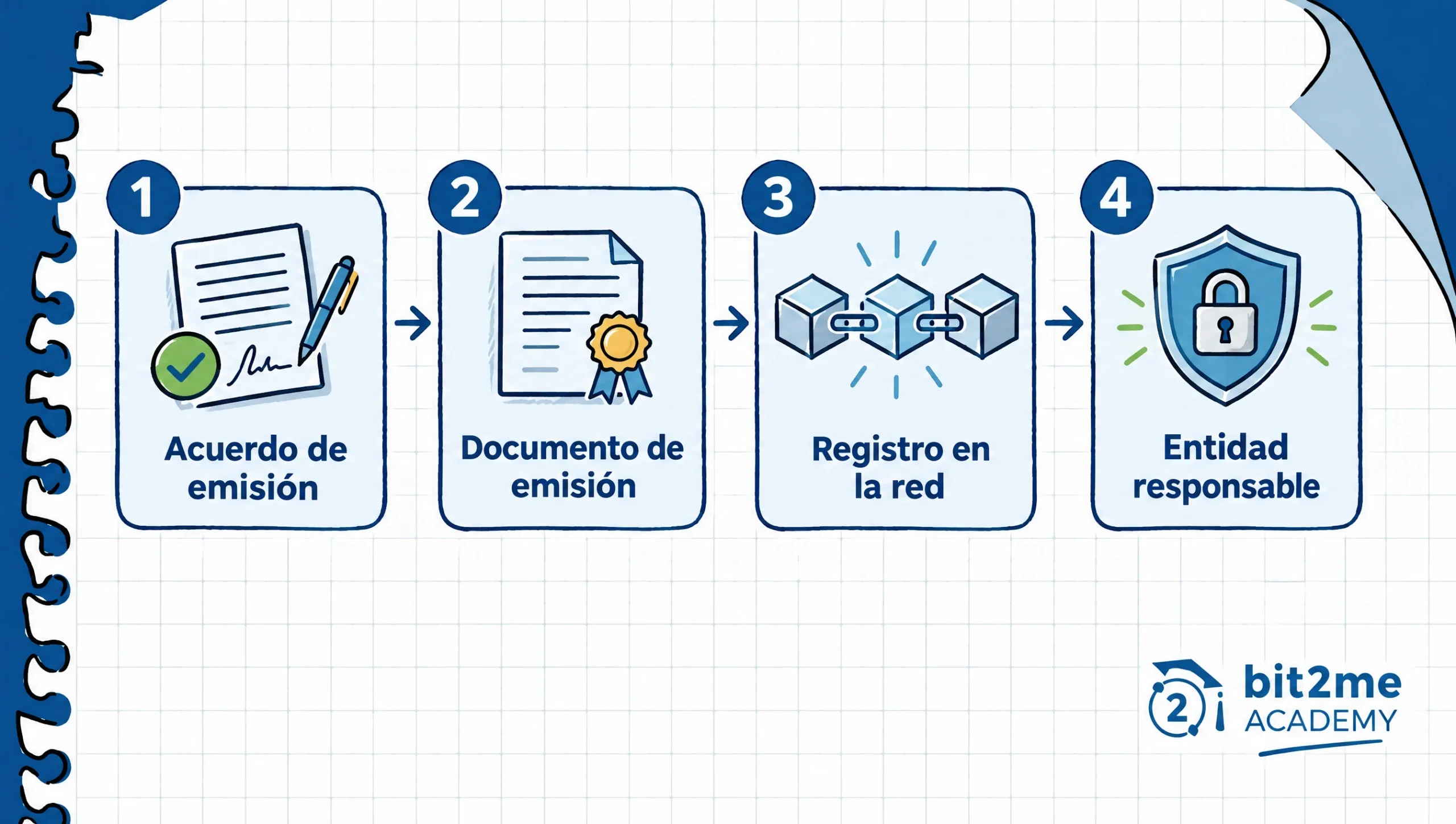
Law 6/2023 (LMVSI), in force since April 7, 2023, adds a third way of representing negotiable securities to paper-based representation and book-entry systems: DLT-based systems. Articles 6 to 15 regulate how securities are created and transferred, how real rights are established over them, and which entity maintains the register. Article 6.1 requires that the chosen form of representation be applied to all securities of the same issue, without the possibility of tokenizing only a portion.
The issuer designates the entity responsible for the administration of the registration and the registry (ERIR) and identifies it in the issuance document, along with the characteristics of the securities, the registration systems and the mechanisms to prove ownership.
That document is given to the ERIR and, if the securities are admitted to trading, also to the manager of the trading venue, and both the issuer and the ERIR must keep it available to the holders and to the public.
The ERIR is a regulated entity, not a role that just anyone can assume. If the securities are not traded on a DLT market infrastructure, it needs authorization to provide the ancillary securities custody service under Article 126(a) of the LMVSI (Spanish Securities and Exchange Commission Law), and if they are traded, those functions fall to the infrastructure that clears the securities. Its tasks include:
- to ensure the integrity of the record and identify the holders;
- issue ownership certificates;
- manage the collection of interest and other economic rights;
- Maintain a contingency plan, which Royal Decree 814/2023 requires in case the network fails or ceases to be viable.
The technical architecture reflects this control. According to the CNMV (Spanish National Securities Market Commission), the issuance agreement typically includes a whitelist of addresses between which securities can be transferred, as well as functions accessible only to the ERIR (European Revenue and Investment Registry) that allow tokens to be created or deleted at one address, locked, or moved to another. These functions mitigate the risk of cyberattacks or key loss, and explain why a tokenized security, unlike Bitcoin, has centralized control within supervised entities.
Where are tokenized securities traded in the European Union?
A tokenized security does not necessarily have to be listed. The CNMV (Spanish National Securities Market Commission) points out that unlisted security is transferred privately between two parties, always with an ERIR (Real Estate Investment Trust) responsible for each issue, and that those that are traded can do so on the usual trading venues or on the DLT (Distributed Ledger Technology) market infrastructures authorized by Regulation (EU) 2022/858, known as the pilot scheme, applicable since March 23, 2023, according to ESMA (European Securities and Markets Authority).
The pilot program envisions three types of infrastructure: a multilateral DLT trading system, a DLT settlement system, and a system that combines trading and settlement. Those who obtain authorization can request exemptions from traditional trading and post-trade rules, provided they offer compensatory measures acceptable to the supervisor. In return, they only accept instruments that comply with these limits.
| Instrument admitted under the pilot program | Limit |
|---|---|
| Shares of issuers | Market capitalization less than 500 million euros |
| Bonds and other forms of securitized debt | Issue of less than 1.000 billion euros |
| Unstructured UCITS fund shares | Assets under management less than 500 million euros |
| Aggregate market value of supported DLT instruments | 6.000 millones de euros |
The limits come from the CNMV and the ESMA report on the pilot scheme from June 2025, which adds that as of May 31, 2025, there were only three authorized infrastructures: CSD Prague, since October 11, 2024, 21X AG, since December 3, 2024, and 360X AG, since April 29, 2025. According to ESMA, this small number reflects the novelty of the framework and the legal and technical complexity it requires, and the report itself notes that the market perceives the thresholds as too restrictive.
What real-world examples of tokenized securities exist?
The most cited case in Europe is that of the European Investment Bank (EIB), the EU's financial institution, which on April 27, 2021, launched a €100 million, two-year digital bond on a public blockchain, with Goldman Sachs, Santander, and Société Générale as underwriters. Société Générale-FORGE acted as the registration and settlement agent, and, in collaboration with the Banque de France, the underwriters' payment to the EIB was represented on the blockchain in the form of central bank digital currency, according to the statement from the EIB itself.
In Spain, the CNMV published its regulations in December 2025. conclusions document about the project tests Bit2Me Security Token Exchange (STX) in the controlled testing environment of Law 7/2020. Between October 22, 2024 and March 6, 2025, a bond was issued in a controlled real environment, with settlement delivery versus payment at T+0 and 38 subscribed users, and the CNMV describes the tests as having been carried out without relevant technical or operational incidents.
| Date | EIB Bond (2021) | Sandbox trial bonus (2024-2025) |
|---|---|---|
| Amount | 100 millones de euros | 145.000 Euros |
| Term | 2 years in the Making | 3 months |
| Issuance date | April 27th 2021 | November 19th 2024 |
| Register | Public blockchain | Permissioned public blockchain |
| Source | EIBs | CNMV |
It's important to clarify the scope of the second case: only one bond was tested, not shares, and the promoter acknowledges in the document itself that it couldn't assess other risks inherent in trading other instruments. The cost and speed advantages it mentions come from the promoter, not from an independent measurement, so they are a hypothesis to be confirmed with further issuances, not a proven result.
How has regulation evolved and what role does the Howey test play?
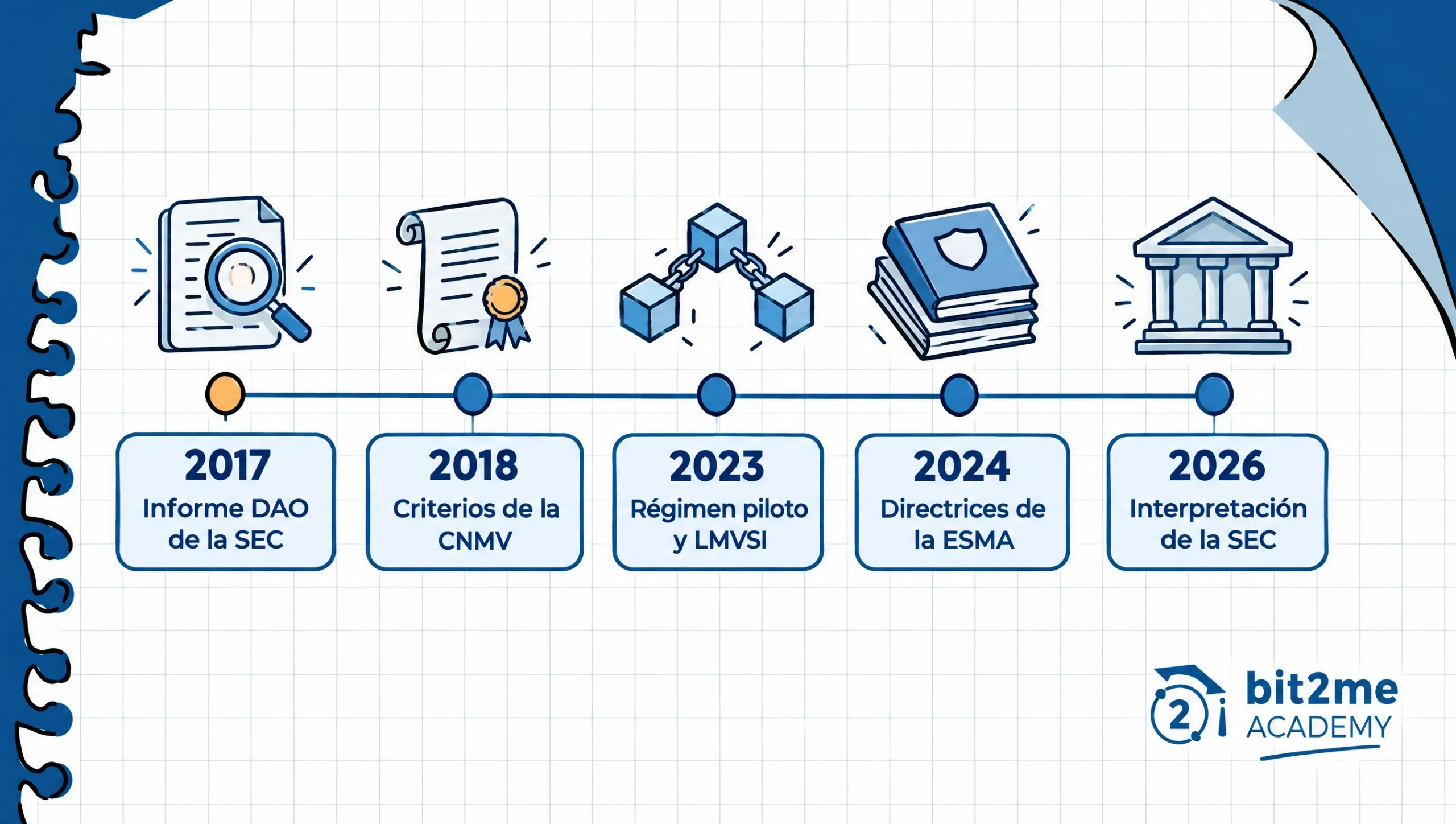
The Howey test originated from a ruling by the United States Supreme Court on May 27, 1946. SEC v. WJ Howey Co.Regarding the sale of orange groves in Florida with a service contract to cultivate and market the harvest, the court defined the investment contract It's like a scheme where an individual contributes money to a joint venture and expects a return that depends on the efforts of others. It's a US regulation and only describes how the SEC reasons, not how the CNMV or ESMA classify tokens.
In July 2017, the SEC's report on The DAO applied that test to the tokens issued by that organization and concluded that they were investment contracts and, therefore, values. In Europe, the CNMV statement of February 8, 2018, indicated that a large part of the ICOs should be treated as issues or public offerings of negotiable securities, and established factors for deciding this, including:
- that the tokens confer rights or expectations of participating in the appreciation or performance of a business;
- that grant rights equivalent or similar to those of shares, bonds or other financial instruments;
- that, although they provide access to services or products, are offered with reference to a benefit from revaluation or to their trading in markets similar to securities markets.
With the LMVSI and the pilot regime of 2023, and with the ESMA guidelines and the implementation of MiCA at the end of 2024, those provisional criteria were replaced by EU rules.
In the United States, the SEC published on March 17, 2026, with guidance from the CFTC, a interpretation on the application of federal securities laws to crypto assets, effective since March 23, 2026. It classifies crypto assets into five categories, including digital securities, which are tokenized securities, and makes it clear that it does not replace the Howey test and that a security is a security whether it is issued off-chain or on-chain.
What are the risks and limitations of a tokenized asset?
Being regulated reduces legal uncertainty, but it doesn't eliminate the inherent risks of the instrument or the technology. An applicable framework and a supervisor are not a guarantee of outcome, and no regulation makes a tokenized security a risk-free product. These are the risks that should be distinguished:
- Issuer: A tokenized bond depends on the issuer paying, just like a traditional one, because the blockchain does not change its solvency.
- Liquidity: not all tokenized securities are listed, and the pilot program had only three authorized infrastructures as of May 31, 2025.
- Technology: an error in the smart contract, the loss of keys or a network that ceases to be viable due to costs or latency forces the ERIR to have a contingency plan.
- Jurisdiction: The same token may be classified differently in the EU and the United States, and buying it online does not place you outside the rules of your country.
- Rights: According to the SEC, some tokenized securities do not grant the same legal rights as the underlying security, but only the right to collect distributions from a central entity.
The taxation of these assets depends on your residency, the type of security, and your personal circumstances; there is no one-size-fits-all rule. Consult a tax advisor or the tax authorities before participating in an issuance.
Current status of tokenized securities in November 2026
As of 1 November 2026, the limits in the table above remain those of Regulation (EU) 2022/858, but are under review. The European Commission proposed on 4 December 2025 to reform the pilot scheme in its market integration package, arguing that its restrictive design had limited its use. Council working document The data from September 11, 2026 still shows figures in brackets, meaning there is no final agreement.
The MiCA Regulation applies from December 30, 2024 and, according to the CNMVThe transition period in Spain ended on July 1, 2026, which affects crypto assets that are not financial instruments. In the United States, the SEC's interpretation has been in effect since March 23, 2026. Always check the status of each regulation and issuance with official sources, as these figures and deadlines change frequently.
What changes and what doesn't when a value becomes a security token
Tokenizing a security changes how it is issued, registered, and transferred, but not who the issuer is accountable to or what regulations apply. As a security token, it remains subject to MiFID II and market regulations, a supervisor, and, in Spain, an entity responsible for its registration. This continuity is what distinguishes it from an open-source cryptocurrency and also what makes it essential to read the issuance document before participating.
If you want to explore further, Academy's guide on What is tokenization? expands the idea to other assets, and the one of real world assets Review which assets from the physical world are being brought to the blockchain.

Frequently asked questions about security tokens


 Author