Essential Points
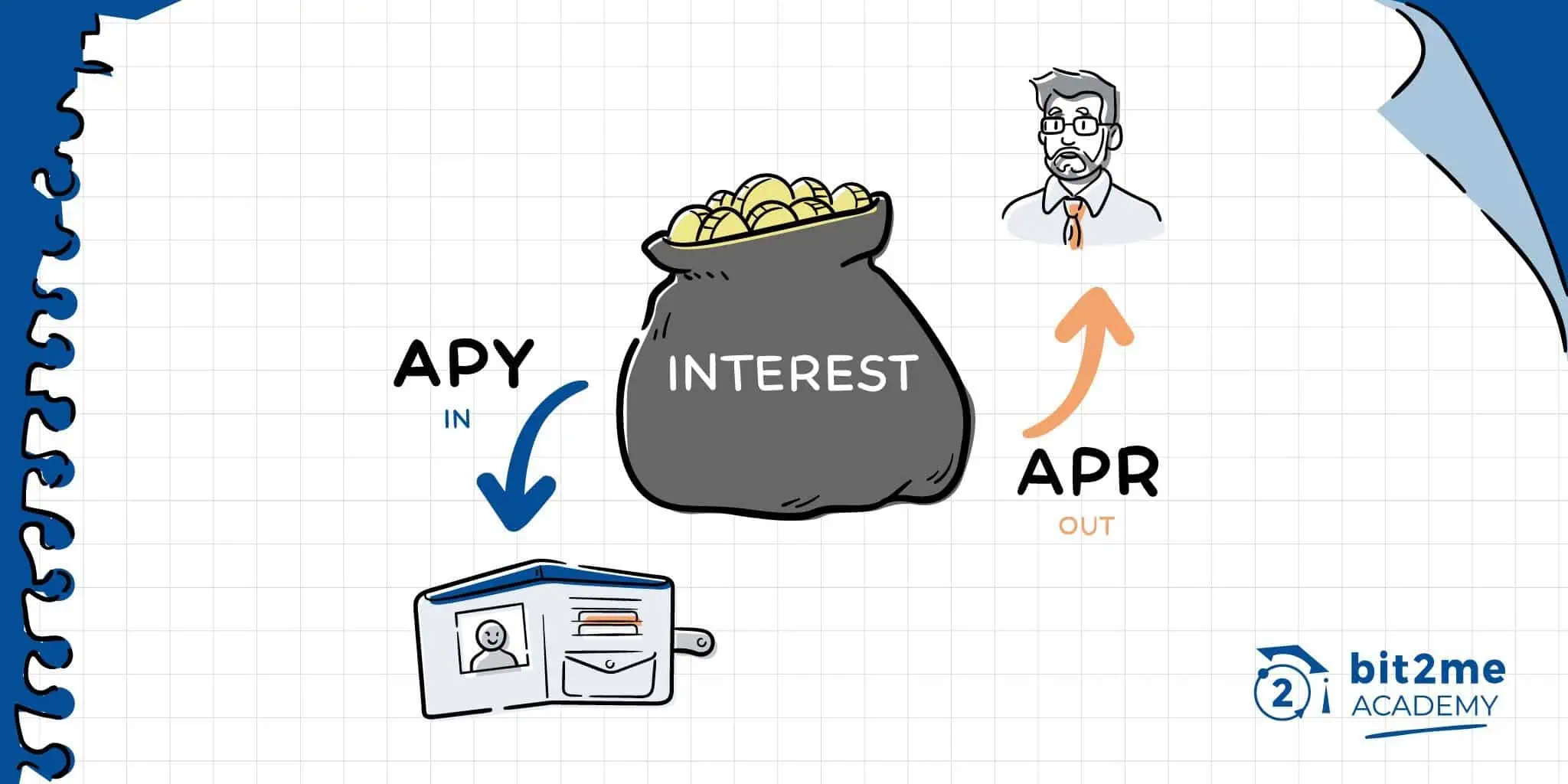
- The APR is a simple annual rate, always calculated on the initial balance, without adding rewards or costs to the balance.
- The APY is the effective annual rate: it includes compounding, so with the same nominal rate it is never less than the APR.
- With a nominal rate of 12% and monthly compounding, the APR is 12% and the APY is 12,68%; more compounding per year increases the APY.
- Before comparing rates, look at the label, the compounding frequency, and whether the figure is variable, because none guarantee a future reward.
The APR is a simple annual rate, while the APY is an effective annual rate that already includes compounding, meaning the effect of adding the rewards generated to your balance. With a nominal rate of 12%, the APR remains 12%, and the APY with monthly compounding rises to 12,68%. It may seem like a small difference, but it changes the figure you see on the screen and how you compare one offer to another. That's why understanding APR and APY is the first thing you should do before reading any advertised cryptocurrency rates.
The two labels coexist without a common criterion. Aave v4 documentation It refers to "supply APY" and "borrow APY" for the balance you contribute and the balance you borrow, while the Compound III documentation It calculates an APR that multiplies the rate per second by the seconds in a year, according to both pages consulted in October 2026. They are two loan protocols that present their rate with different names, and neither of them is wrong: each platform decides how to display it.
Using the formula and a frequency table, you can convert an APR to an APY, or vice versa, and identify when two figures are not comparable. There is also a warning that accompanies any advertised percentage: the rate of a cryptocurrency product is variable, it is not guaranteed, and there is a risk of losing some or all of the invested funds.
 Certificate

What do APR and APY mean in cryptocurrencies?
APR and APY are two ways of expressing, as an annual percentage, the rate applied to a balance, whether it's the reward you receive for maintaining it in a protocol or the cost you pay for borrowing it. Both acronyms come from English and describe the same underlying concept, but the resulting figure differs because one account is compounded and the other is not.
Meaning of APR
The APR, or Annual Percentage Rate, is a simple rate that is always calculated on the initial balance and does not include rewards or costs generated during the year. If a protocol advertises an APR of 12% on 1.000 units of a token, the reference value after twelve months is 120 units, because the calculation basis does not change at any time.
Meaning of APY
The APY, or Annual Percentage Yield, is the effective annual rate: it reflects the effect of compounding, which involves adding each reward received to the balance so that it also generates a reward in the following period. With the same nominal rate of 12% and monthly compounding, those 1.000 units end the year at 1.126,83, which is equivalent to an APY of 12,68%.
The two terms describe the same nominal rate viewed in two different ways, so the APY is never less than the APR if both start from the same rate. If you want to see the mechanism from scratch, the guide on how capitalization works He explains it with another example, and we will use it here only to understand how crypto rates are advertised.
What is the difference between APR and APY?
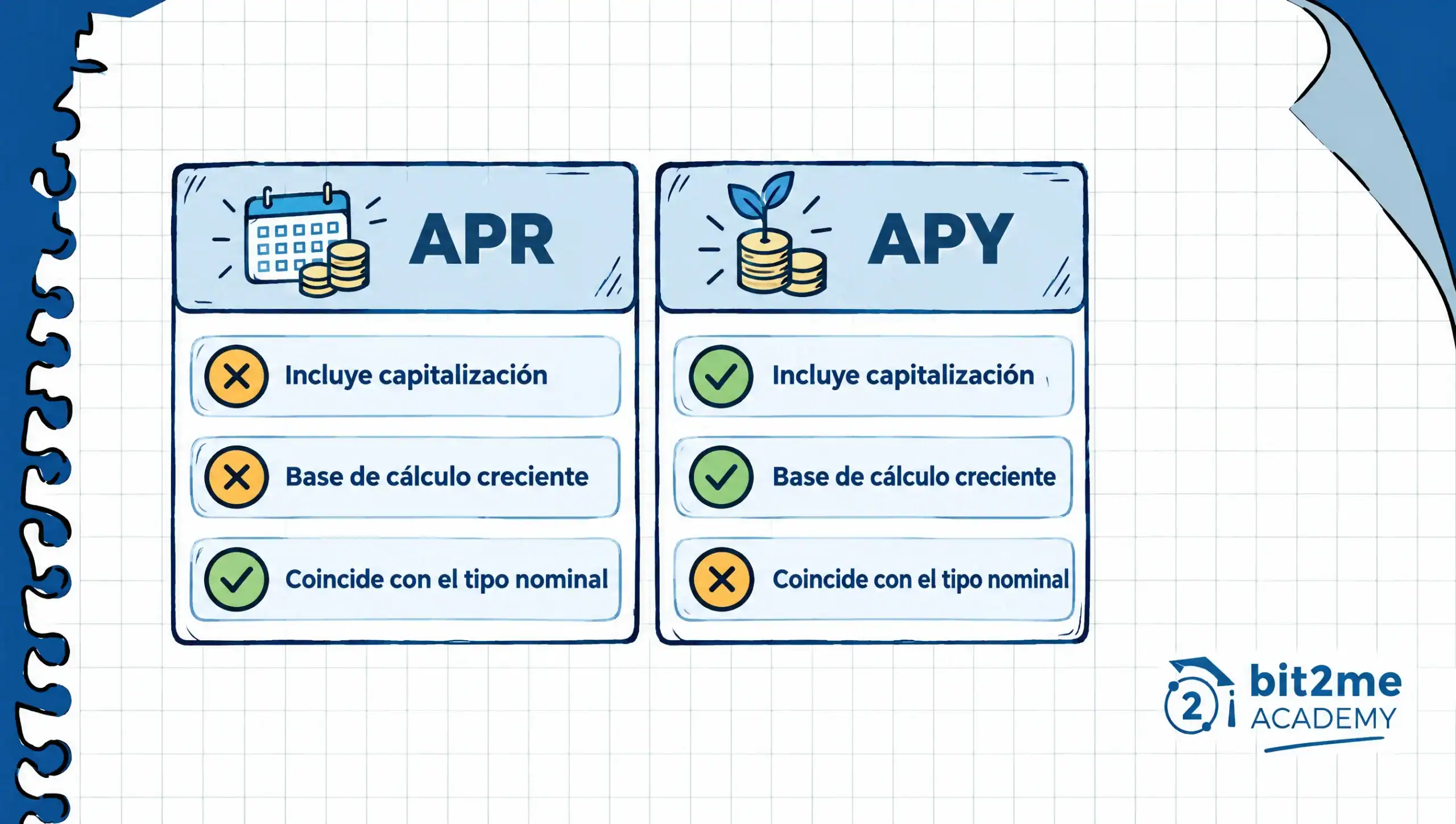
The practical difference is just one: the compounding rate. However, this has other implications that are worth keeping in mind when comparing two products. The table summarizes the most important criteria and uses the same example of 12% nominal interest with monthly compounding to ensure comparability.
| Criterion | APR | API |
|---|---|---|
| What is | Simple annual percentage rate | Annual effective rate with compounding |
| Capitalization | Rewards and costs are not added to the balance | Add each reward to your balance at the end of each period |
| Relationship with the nominal rate | He agrees with him | He is equal to or greater than him |
| Figure with a nominal rate of 12% and monthly capitalization | 12% | 12,68% |
| Label they use, according to their documentation from October 2026 | Compound III | ave v4 |
| What to check | The formula should not include capitalization. | How often is it capitalized |
The gap between the two figures depends on two factors: it increases with the higher the nominal interest rate and the more frequently the interest is compounded, although beyond a certain frequency the increase becomes very small. With a low nominal interest rate, such as 1%, the APY with monthly compounding barely exceeds 1,0046%, and with a high rate the difference is readily apparent.
This leads to the rule that avoids the most errors: a rate labeled APY and another labeled APR cannot be directly compared, because the former already includes an effect that the latter omits. To compare them, convert one to the form of the other using the formula in the next section and also check how often it is compounded.
How are APR and APY calculated?
The APR calculation is a multiplication: the rate for each period multiplied by the number of periods in a year. In the formula, APR = rate per period × periods per year. If a balance receives a 1% reward each month, the APR is 1% × 12 = 12%, and this result does not change even if the rewards accumulate month after month.
The APY adds the effect of compounding and is calculated with this formula: APY = (1 + r / n)^n – 1. To apply it, keep in mind how each variable is defined:
- r is the nominal annual rate written in decimal, for example 0,12 for 12%.
- n is the number of capitalization periods per year, for example 12 if it is monthly or 365 if it is daily.
- The symbol ^ means "raised to the power of", so ^n indicates repeating the multiplication n times.
Using the example from the previous section, r = 0,12 and n = 12, so each month a rate of 0,12 / 12 = 0,01 is applied. The calculation becomes APY = (1 + 0,01)^12 – 1 = 0,126825, which is equivalent to an APY of 12,68%. Over 1.000 units, that's 126,83 units of accumulated reward after one year, compared to the 120 units resulting from applying the simple APR.
If you need the reverse calculation, the APR is calculated using the formula APR = n × ((1 + APY)^(1/n) – 1). With an APY of 12,68% and monthly compounding, this gives 12%, which is the initial nominal rate. This calculation helps you determine whether a platform is displaying the rate with or without compounding.
A word of caution about the formula: it assumes the nominal rate remains constant throughout the year and that each reward is added to the balance on its due date. In crypto, almost no rate is fixed, so the calculated APY is an estimate based on current conditions and not a guaranteed result.
How much does the capitalization frequency weigh?
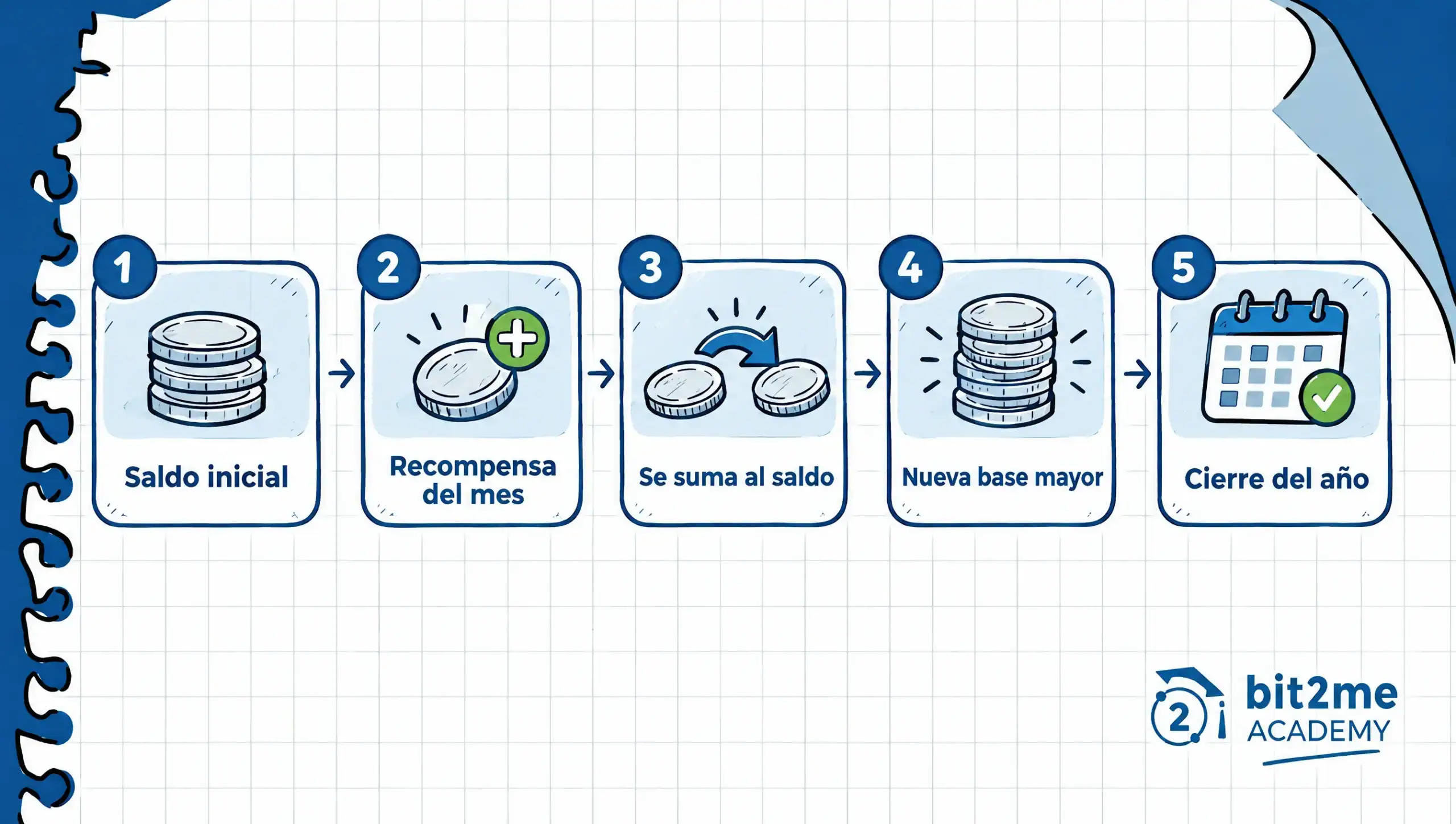
The same nominal rate yields a different APY depending on how often the reward is added to the balance. To see the effect clearly, it's best to first follow a full year using the example of 1.000 units and 1% monthly interest, and then compare different frequencies with the same 12% nominal rate.
Month after month with a nominal 12%
The table shows the balance at the beginning and end of several months with monthly compounding of 1%. The amounts are rounded to two decimal places and can be reproduced in a spreadsheet by multiplying each balance by 1,01.
| Month | Initial balance | Reward of the month (1%) | Final balance |
|---|---|---|---|
| 1 | 1.000,00 | 10,00 | 1.010,00 |
| 2 | 1.010,00 | 10,10 | 1.020,10 |
| 3 | 1.020,10 | 10,20 | 1.030,30 |
| 6 | 1.051,01 | 10,51 | 1.061,52 |
| 12 | 1.115,67 | 11,16 | 1.126,83 |
The monthly reward increases from 10,00 to 11,16 units without changing the rate, simply because the base grows each month. With simple APR, the monthly reward would always be 10,00, and that is the key difference between the two calculation methods.
Same rate, different frequency
The second table applies the APY formula at a nominal rate of 12% with different compounding frequencies. Each figure is derived from (1 + 0,12 / n)^n – 1, where n equals the number of periods per year, and the final balance corresponds to 1.000 units after one year.
| Frequency | Periods per year (n) | APY with 12% nominal | Final balance of 1.000 units |
|---|---|---|---|
| Annual | 1 | 12,00% | 1.120,00 |
| Quarterly | 4 | 12,55% | 1.125,51 |
| Monthly | 12 | 12,68% | 1.126,83 |
| Weekly | 52 | 12,73% | 1.127,34 |
| daily | 365 | 12,75% | 1.127,47 |
Switching from annual to monthly compounding increases the APY by 0,68 percentage points, while switching from monthly to daily only adds about 0,07. This means the biggest difference lies in compounding more than once a year, and the difference between daily and weekly compounding is almost negligible. These calculations are my own, based on the formula in the previous section.
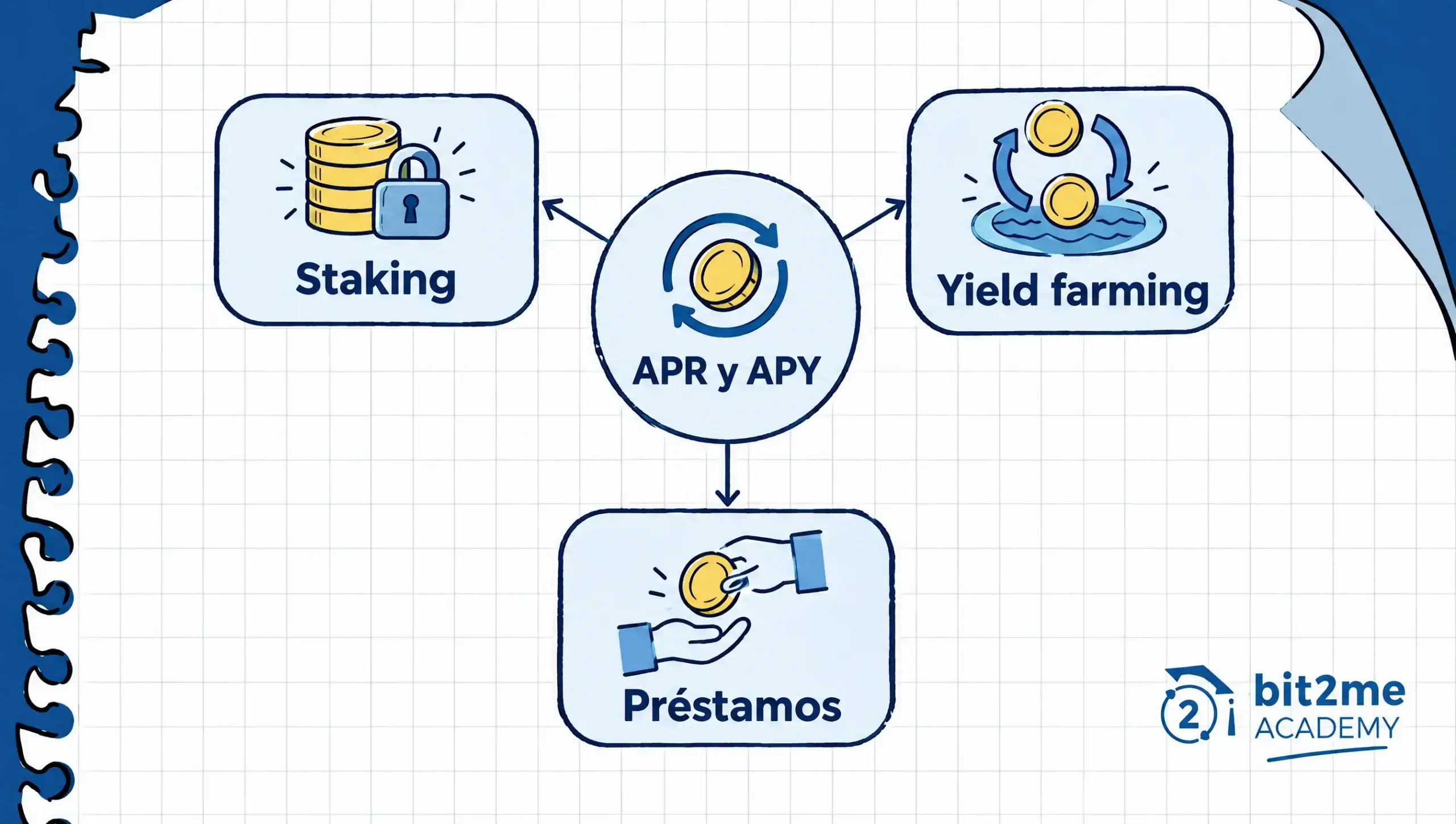
Where will you see the APR and APY in staking, farming, and lending?
You'll see both labels on all crypto products that advertise an annual rate, but each category has its own conventions and each platform its own criteria. Therefore, it's a good idea to check what each platform uses and not assume that the same name means the same thing everywhere.
Staking
Locking tokens to participate in the validation of a proof-of-stake network generates rewards that fluctuate based on the total locked and the protocol's issuance rules. Many platforms display this reward as APY when they automatically reinvest rewards, but this figure is an estimate, not a guaranteed amount.
The guide on What is staking? It explains the mechanism, and the article on APY in staking and how to calculate rewards It focuses on where network rewards come from, while this guide deals with the formula and how to compare labels.
Yield farming and decentralized finance
In the decentralized finance The protocols operate using smart contracts, and each one chooses how to present its rate. In the yield farming You contribute crypto assets to a liquidity pool in exchange for rewards, and the advertised amount can be APR or APY depending on the protocol. If the reward comes in a different token than the one you contribute, the advertised percentage doesn't tell you what that token will be worth when you receive it, so the number is only a reference.
Loans with crypto assets
In a loan, the rate is the cost paid by the borrower and the reward for the lender, and here the label matters more because it defines how much is owed at the end. According to its documentation from October 2026, Aave v4 uses APY for both the lender's and borrowed balances, and Compound III publishes an APR formula for both. To understand what taking out a loan with crypto collateral entails, you can consult the guide on Cryptocurrency loans.
What are the advantages and limitations of each rate?
Neither rate is better, because each answers a different question. The APR tells you what the nominal rate is without compounding, and the APY tells you what the effective annual rate would be if rewards were added to the balance regularly. The table summarizes how each one helps and where it falls short.
| Appearance | APR | API |
|---|---|---|
| Main advantage | It is easy to read and calculate because it does not depend on the capitalization frequency. | It shows the effect of capitalization and gives an annual figure closer to what happens to the balance |
| Second advantage | It allows you to compare nominal types between products that use the same label | It allows you to compare products that capitalize at different frequencies, if they all show APY. |
| Main boundary | It excludes compounding, so it may fall short if rewards are added to the balance. | It is more difficult to calculate and understand because it depends on the capitalization frequency. |
| What can confuse | It appears lower than an APY even though the nominal rate is the same | It seems larger than an APR even though the nominal rate is the same |
| What happens if the rate changes? | It is a reference point: the actual rate may vary at any time. | It is calculated using the current rate and becomes invalid as soon as the rate changes. |
Whether a number seems higher or lower says nothing about the product's quality, so you shouldn't choose based on the highest number. Proper comparison requires first matching the label, then the compounding frequency, and finally understanding the source of the reward or what costs are involved.
How to read an advertised rate before using it?
Read any advertised percentage along with a short checklist before contributing a single cryptocurrency to a product. None of these checklists guarantee a specific outcome, but together they help you avoid common comparison errors and make it clear what you're agreeing to:
- Check if the label is APR or APY and what the platform documents about how it calculates it.
- Look up the compounding frequency, because without it an APY cannot be converted or compared.
- Check if the rate is fixed or variable and how often it is updated, because in crypto it is almost always variable.
- Find out where the reward comes from, whether it's from the network, usage fees, or another token whose value changes.
- Review the deadlines, fees, and product withdrawal conditions, which reduce the actual result.
A significantly higher APY than comparable options forces you to ask where that reward comes from and what risks the provider assumes. A high rate could be temporary, depend on a token whose value is falling, or reflect a protocol design that's difficult to sustain, and none of those possibilities are reflected in the percentage.
The same nominal rate, two ways of calculating it
The APR and APY are like two clocks showing the same time in different time zones: the nominal rate is the same, but each label expresses it differently. If you recall the 12% from the example, you know that the APR remains at 12%, the APY with monthly compounding reaches 12,68%, and that additional compounding periods only increase it by a few tenths of a percent.
The usefulness of knowing this lies in the question it allows you to ask any platform: what label it uses, how often it capitalizes, and where the reward comes from. With those three answers, you can truly compare two products and, with the formula in hand, convert one figure into the other without depending on how each interface presents it.

Frequently Asked Questions about APR and APY



 Author