Essential Points
- The mempool is the waiting room of each node: it stores valid transactions that are not yet in any block.
- There is no single mempool: each node has its own, with its own limits, so two explorers can show different numbers.
- Miners choose first the transactions that pay the highest fee per unit of space, so raising the rate usually speeds up confirmation.
- A transaction in the mempool is not yet a final payment: it can be replaced or ejected, and with 0 confirmations, caution is advised.
The Bitcoin mempool is the memory where each node stores the valid transactions it has received that are not yet in a block. There isn't a single mempool shared by the entire network: each node maintains its own, with the transactions it has received and its own admission rules. You can think of it as a waiting room where each transaction waits its turn until a miner selects it and includes it in a block.
That room has a capacity limit. In Bitcoin Core, one of the Bitcoin node programs, the default limit is 300 MB of memory, according to the Version 0.12 notesAnd when it's full, the transactions that pay the lowest fees are ejected first. Since Bitcoin was designed to produce a block every 10 minutes on average, according to the payment processing guideAnd since each block has a limited space, transactions compete to get in, and the fee you offer decides who gets in first.
This explains why the same transaction might take minutes one day and hours another, and why a payment that appears unconfirmed is not yet final. With this understanding, deciding how much commission to pay and how long to wait is no longer a matter of guesswork.
 Certificate

How does a mempool work step by step?
It all starts in your wallet, which creates the transaction and signs it with your private key. It then sends it to a node, and that node acts as a receptionist in the waiting room: it checks that the transaction complies with the rules and, if it's valid, records it and notifies other nodes.
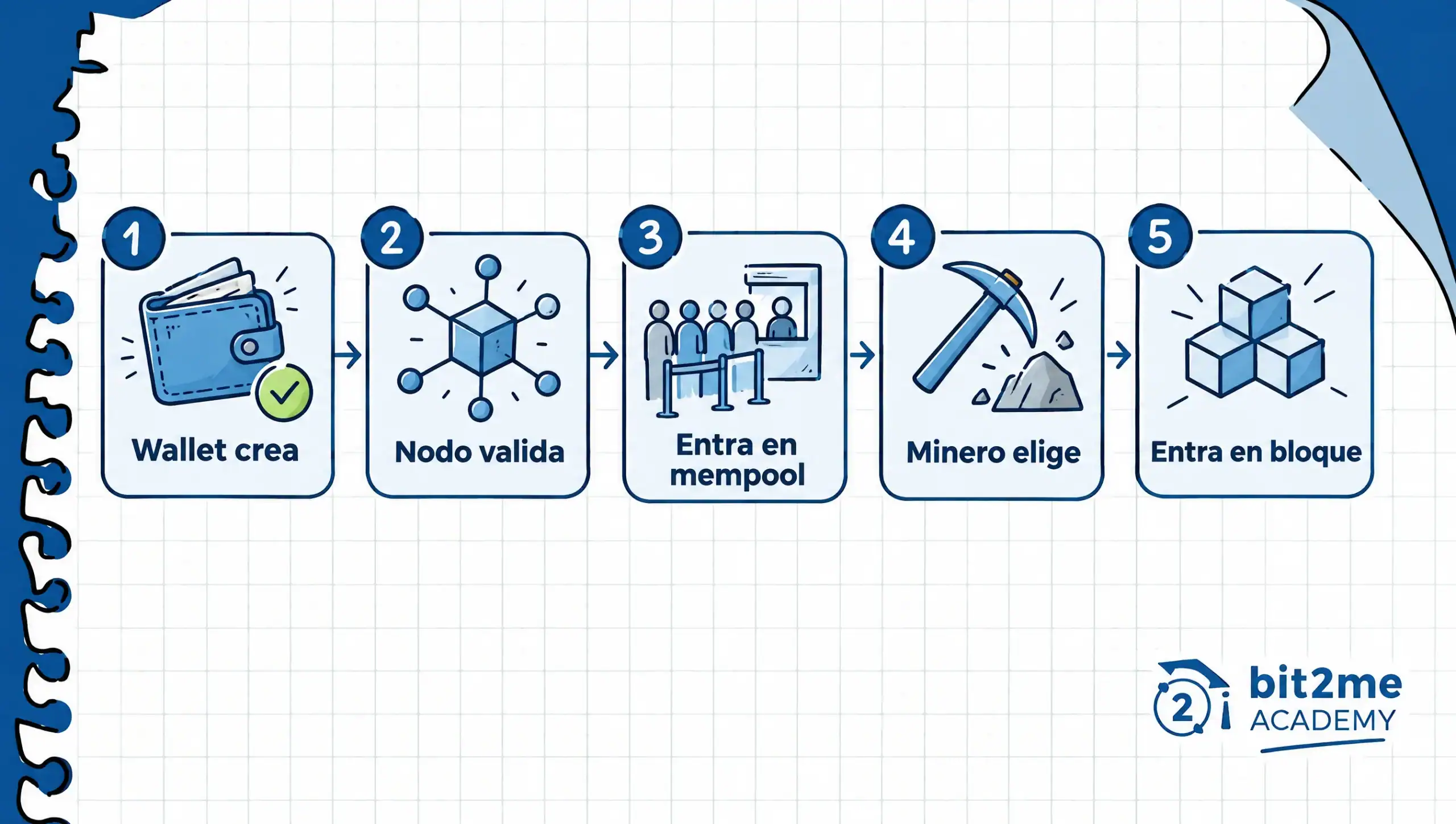
The complete journey of a transaction, from when you create it until it is recorded on the blockchain, is summarized in five consecutive steps that are repeated with each shipment, whether you move a small amount or a large amount.
- Your wallet creates the transaction and signs it with your private key, without revealing it to anyone.
- A node receives it and checks that it is valid: correct signatures, unspent coins, and compliance with its minimum commission.
- If it passes the checks, the node saves it in its mempool and forwards it to the nodes it is connected to.
- A miner chooses transactions from their own mempool to build a candidate block, starting with those that pay the highest fee per unit of space.
- When someone mines a block that includes it, the nodes remove it from their mempool and the transaction gets its first confirmation.
If an everyday image helps, think of a waiting room with a queue management system where each node manages its own queue. The analogy isn't perfect, because in Bitcoin the order depends on the fee, not arrival, but it effectively summarizes the idea of a priority queue.
Bitcoin is designed to produce a block every 10 minutes on average, and according to the payment processing guide, a transaction with a sufficient fee needs that average time to receive its first confirmation. An average is not a fixed timeframe: if your fee is low, your transaction may take several blocks to be processed before it's included.
Why does each node have its own mempool?
Bitcoin does not have a central server that stores the official list of pending transactions. Each nodeThat is, each computer running the Bitcoin software and checking the rules receives transactions from its neighbors and decides on its own which ones to keep.
La Bitcoin developer guide He explains that full nodes can keep track of unconfirmed transactions, and that is why it is convenient to talk about the mempool of a node and not the mempool of the network.
El BIP-35which in 2012 added a network message called "mempool" with which one node requests another for the list of unconfirmed transactions it has. BIP It is a document that describes a Bitcoin standard or change, and it only allows you to query another node's mempool, without regulating how it works.
La Bitcoin network reference It clarifies that the response is, at most, a view from one node and not a complete list of unconfirmed transactions on the network. This difference is normal and expected, because each node only knows what it has received.
The differences between mempools arise from two causes. The first is time: a transaction needs a few moments to propagate and does not reach all nodes at the same time, so for a few seconds some nodes know about it and others do not yet.
The second factor is policy: each operator can change parameters such as the maximum size or minimum fee, so two nodes can accept or reject the same transaction. That's why two block explorers can show you slightly different figures at the same minute.
This is not a feature unique to Bitcoin. Other networks, such as Ethereum, also maintain a set of pending transactions, which ethereum.org It's called a "transaction pool," with its own rules that don't match those of Bitcoin.
Who decides which transaction goes through first?
No one decides alone: each miner builds their own candidate block, as the guide explains. Bitcoin mining and block creationAnd since it charges fees on what it includes, it tends to fill it with the transactions that pay the most for the space they occupy. Bitcoin transaction guide It explains that the commission is calculated according to the size of the signed transaction and that the fee per byte increases when the demand for space in the blocks increases.
This rate is expressed in satoshis per virtual byte, or sat/vB. A satoshi is one hundred millionth of a bitcoin, and the virtual byte measures the size of a transaction within a block, the limit of which was set by the BIP-141 in 4.000.000 units of weight.
That's why a transaction with many entries takes up more space and costs more, even if you're moving a small amount of money. If you want to calculate it in detail, you have the guide for to know the fee of a Bitcoin transaction.
| Factor | What is | Who decides? |
|---|---|---|
| Rate in sat/vB | The commission you offer divided by the virtual size of the transaction | You, with the help of your wallet |
| Transaction size | The space it occupies in the block, measured in virtual bytes | Its structure, that is, how many inputs and outputs it has |
| Block space | A maximum of 4.000.000 weight units per block | Bitcoin's consensus rules |
| Block rhythm | One block every 10 minutes on average | The protocol design, which adjusts the difficulty every 2.016 blocks |
| Mempool limit | 300 MB by default in Bitcoin Core | Each node operator |
An example with made-up numbers helps you see the logic. Imagine two 200 vB transactions: transaction A offers 2.000 satoshis (10 sat/vB) and transaction B offers 400 satoshis (2 sat/vB). If the next block only has room for one, the miner will take transaction A, and transaction B will wait in the mempool for a block with less competition.
To find out how much those satoshis are worth in euros, you need the Bitcoin price todayBecause the value of a commission changes with the market even if the SAT/VB rate is the same. Converting it before sending avoids surprises with commissions that seemed small.
What happens when the mempool fills up?
When the memory limit is reached, the node has to make room. In Bitcoin Core, the default maximum is 300 MB and can be changed with `-maxmempool`, according to the Version 0.12 notesand the same value appears in the source codeIt is a policy of each node and not a rule of the protocol.
When a new transaction would cause that limit to be exceeded, the node ejects the transaction with the lowest total rate, along with its descendants in the mempool. Descendants are pending transactions that consume the outputs of another transaction.
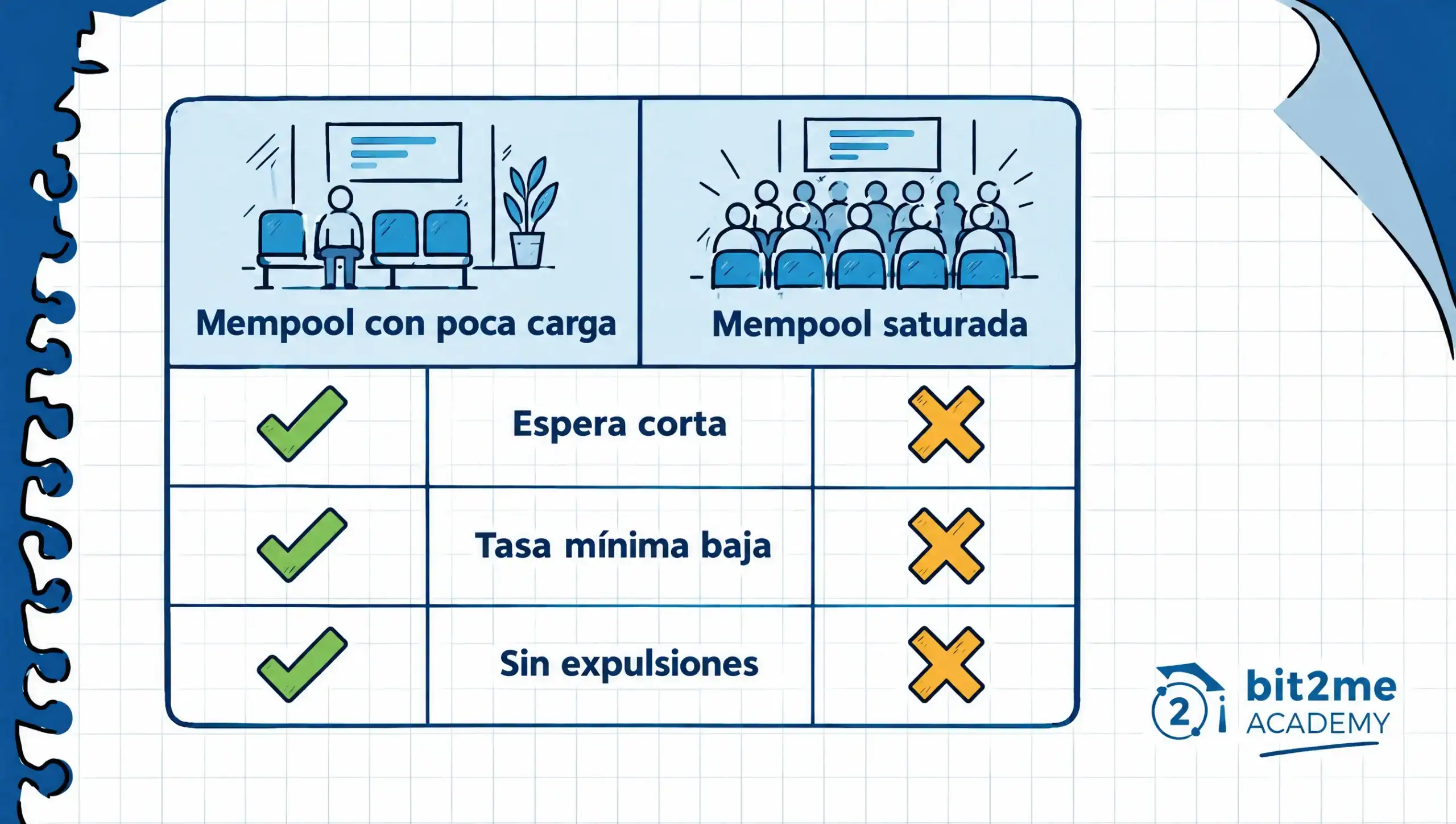
Furthermore, the node raises its minimum effective rate: from that point on, it only accepts transactions that pay more than the expelled rate. To use the room analogy, the person who paid the least is kicked out, and the door only opens to those who offer more.
As a user, you'll notice that the recommended fees increase while there's a queue and decrease when the mempool empties. A transaction with a low fee can wait many hours and even be discarded: in Bitcoin Core, the default is 336 hours, or 14 days, before the node removes it.
If all nodes end up discarding it, your funds remain where they were, although other nodes might retain it and confirm it later, so it's advisable to check its status before resending.
The minimum entry fee has also changed. As of October 31, 2026, since Bitcoin Core 28.3, released on October 17, 2025, the minimum relay and incremental fees have decreased from 1 sat/vB to 0,1 sat/vB, according to the notes from that version.
The notes themselves warn that, until these lower values are widely adopted, there is no guarantee that a transaction with a lower rate will propagate or be confirmed, so these values reflect a trend and not a promise for each shipment.
Is it safe to accept an unconfirmed transaction?
A transaction that appears in the mempool is not yet a completed payment. You only know that a node considers it valid and is waiting for it, and that doesn't prevent another version of that spend from reaching a block first. Bitcoin's payment processing guidelines advise against accepting transactions with zero confirmations without a risk analysis.
The risk has a name: double-spendingTwo separate transactions spend the same number of coins, but only one can end up on the blockchain. A malicious actor can send you a transaction with a low fee and prepare another, with a higher fee, that spends those coins in a different direction, so that the miners prefer the second transaction and yours is invalidated.
The mechanism that makes this possible is called commission replacement or RBFThis allows you to replace a pending transaction with another that uses the same amount of coins but pays more. It's a legitimate option when your transaction is stuck, but it also explains why a pending transaction can change before confirmation.
El BIP-125 It defined its optional version, and since Bitcoin Core 28.0, released on October 2, 2024, full replacement is enabled by default with mempoolfullrbf=1, according to the notes from that versionIt's a policy of the nodes and not proof that the attack is easy, but it encourages waiting for confirmations.
This isn't a protocol flaw, but rather a consequence of Bitcoin confirming transactions in blocks: until a block includes it, no transaction is final, hence why services ask users to wait for confirmations. irreversibility of transactions The opposite happens: once confirmed and with blocks on top, there is no button to undo it.
How many confirmations do you need to trust a payment?
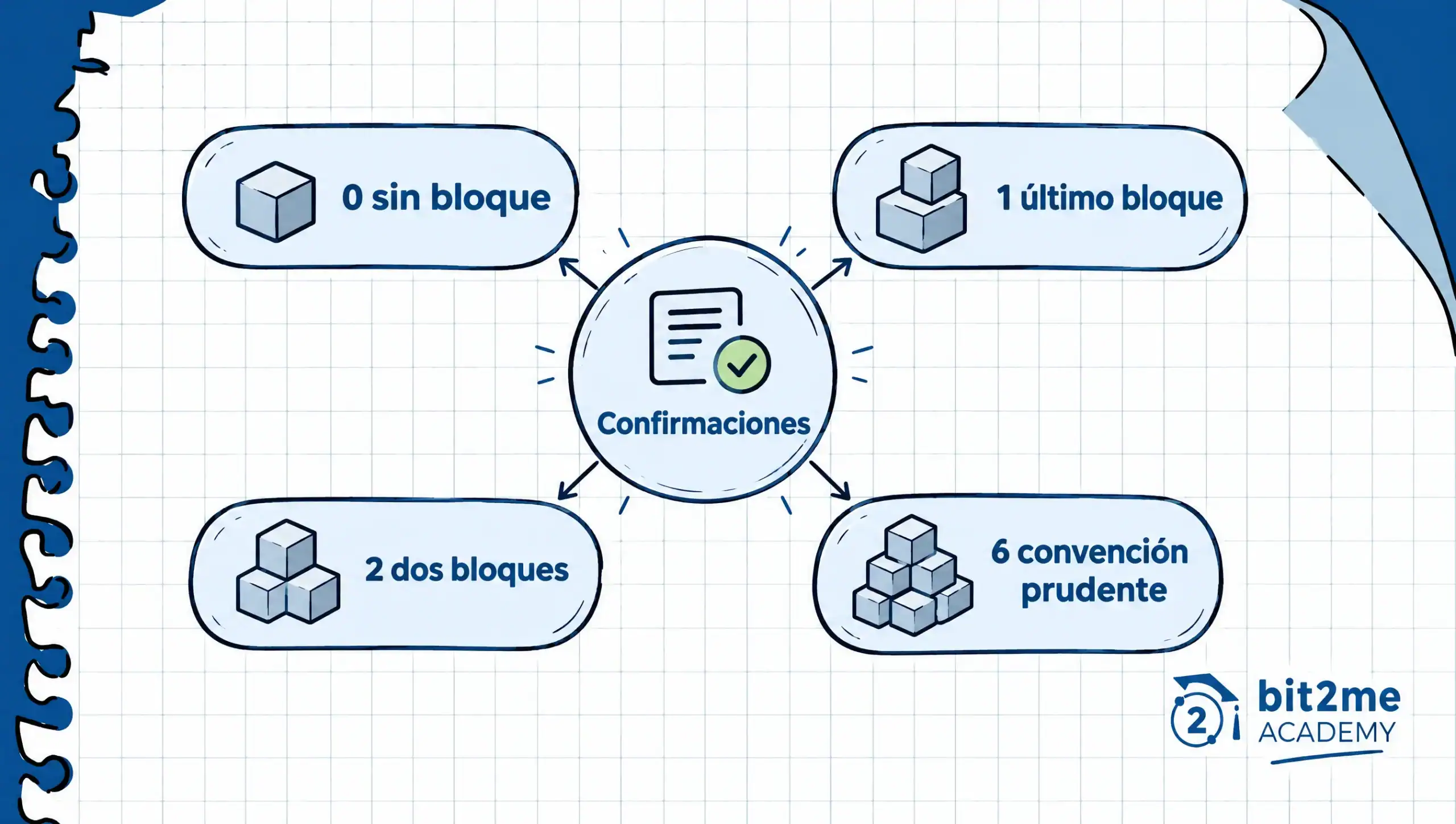
Each block added on top of the one containing your transaction adds a confirmation and makes it harder to overrule. The Bitcoin Developers Guide describes a scale you can use as a reference, although there isn't an official number that everyone is required to confirm.
| Confirmations | What does it mean | As the guide describes it |
|---|---|---|
| 0 | The transaction has been publicized, but it's not on any block. | It should not be accepted without a risk analysis |
| 1 | It's in the last block | The risk of double spending is much lower, but the last block is replaced fairly often by accident. |
| 2 | A subsequent block has been chained to the one that includes it. | In March 2014, a two-block replacement was exceptionally rare and required expensive mining equipment. |
| 6 | The network has been protecting her for about an hour. | A somewhat arbitrary figure that the guide proposes as a minimum for high-value paid software |
Note the nuance: six is a prudent convention, not a protocol rule, and each exchange or service sets its own number based on the risk it assumes. Therefore, there isn't a single number that applies to everyone, and the sensible thing to do is check how many confirmations the service that pays or charges you requires.
Ethereum poses the question differently in The Merge on September 15, 2022, and addresses finality. A block is justified and finalized in the following epoch, approximately 13 minutes later, and undoing it would require obtaining and burning more than a third of the staked ETH, according to [source missing]. ethereum.org.
How to view the mempool before sending Bitcoin?
The most direct way is to ask your own node. If you're running Bitcoin Core, the command getmempoolinfo It returns the number of transactions, their size in virtual bytes, the memory in use, the maximum limit and the minimum rate to enter, according to the RPC API reference.
If you're not running a node, you can use a block explorer that displays the mempool, with the queue of pending transactions and the recommended rates for each term—a very useful aid for estimating how long to wait before hitting send.
Remember what we discussed earlier: since each node has its own view, the figures from two explorers may not match exactly, and what matters is the trend. If the queue is long, you'll need a higher rate, and if it's empty, a low rate is usually sufficient.
If you've already sent a low-fee transaction and it's stuck, some wallets allow you to replace it with a higher-fee one using RBF, while others let you wait for the mempool to empty. Checking the queue before sending takes a minute and avoids most long waits.
Current state of the Bitcoin mempool
The default Bitcoin Core policies that most affect the mempool, as of October 31, 2026, are those listed in the release notes for each version. These are default values for that program, and other nodes can configure their own, so they describe a trend and not a network-wide rule.
| Version | Publication date | Mempool change |
|---|---|---|
| 28.0 | 2th October 2024 | Full replacement by commission enabled by default (mempoolfullrbf=1) |
| 28.3 | 17th October 2025 | Minimum retransmission rate and incremental from 1 sat/vB to 0,1 sat/vB |
| 31.0 | April 19th 2026 | New clustered mempool design, with limits of 64 transactions and 101 kB virtual space per connected transaction group |
With the version 31.0 The mempool stopped enforcing parent and child limits and replaced them with cluster limits. You won't find the current mempool size or the average daily fee here, as they change every few minutes: to see them, use your node's command or a block explorer.
Read the Bitcoin mempool before each send
The Bitcoin mempool isn't a physical location or a common file, but rather the sum of thousands of local lists that are similar enough to allow the network to function. Viewing it this way gives you two useful habits: checking the queue before deciding on the fee and waiting for the confirmations requested by the service that pays you.
If you don't already have Bitcoin, you can buy Bitcoin at Bit2Me and make a small initial shipment to see how your transaction behaves while you wait. When you're ready to send, the guide for send Bitcoin from the Bit2Me Wallet It guides you step by step. Remember that the value of cryptocurrencies can change rapidly and that a confirmed transfer cannot be reversed.

Frequently Asked Questions about the Bitcoin Mempool



 Author