Essential Points
- Cryptographic Immutability: The architecture of blocks chained by hashes ensures that any attempt at alteration is detected instantly, eliminating fraud.
- Decentralization of Trust: By distributing the database across thousands of global nodes, the "single point of failure" and the need for central institutions are eliminated.
- Operating efficiency: Technology enables the automatic liquidation of assets and execution of contracts, reducing intermediation costs by up to 80% in certain sectors.
- Auditable Transparency: Every transaction is public and verifiable in real time, redefining accountability in finance, logistics, and governance.
Blockchain is a distributed ledger technology that allows the creation of a public and secure registry of transactions and data. Instead of having a centralized database, the blockchain uses a decentralized network of nodes to store and verify information. Each block of data in the chain is cryptographically linked to the previous block, creating an immutable blockchain.
The Parable of the Flying Meerkat
So that you quickly understand what blockchain is, imagine that you are walking down the street and, suddenly, a flying meerkat of gargantuan proportions lands in a crowded square, eats the ice cream of all the children in it, drops two huge shrieks and it goes just as it came.
Without a second to waste, a lie detector is attached to the 1.000 people who have witnessed it and records exactly what they saw. They all tell the same story with identical details. Would there be any doubt about the landing of the flying meerkat?
 Certificate

Introduction to Blockchain Games Course
Basic levelDiscover the exciting world of blockchain games. The future has already arrived and gamers can now make a profit doing what they love the most.
The end of blind trust: How is blockchain redefining ownership?
Blockchain technology is not just an efficient database; it represents the first system for exchanging value that doesn't require you to trust the face of the person you're interacting with. It's a paradigm shift in how we interact with the digital world.
Imagine a simple file with two columns: one with an identifier and the other with a balance. Now, picture that same file replicated on thousands of computers around the world. If someone tries to tamper with the data on their machine, the rest of the system detects it and blocks them. The network synchronizes in seconds, maintaining a single, accurate version of reality. What happens if a node goes offline? Absolutely nothing. The network keeps functioning.
This structure is what defines a robust crypto asset. Although the internal workings include complex layers of cryptography, the goal is simple: to create a distributed ledger that synchronizes without the participants needing to know each other. Satoshi Nakamoto He solved a mathematical and social problem that had been stuck for decades, and he did it by launching Bitcoin into the world.
As he rightly pointed out Marc andreessen, co-founder of Netscape and a key figure in technology venture capital:
A blockchain is a digital ledger of events shared among various parties. It is only updated through majority consensus, and once recorded, the information is immutable. Bitcoin's ledger offers complete and verifiable traceability of every financial transaction since its inception.
Moving away from a central server controlled by a large corporation isn't a whim; it's a technical necessity. If the system is distributed, so is the power. Ultimately, the token usage The data you store in your wallet is only valuable if the underlying record is tamper-proof. Are we ready to manage our own digital sovereignty without intermediaries? The data suggests we are.

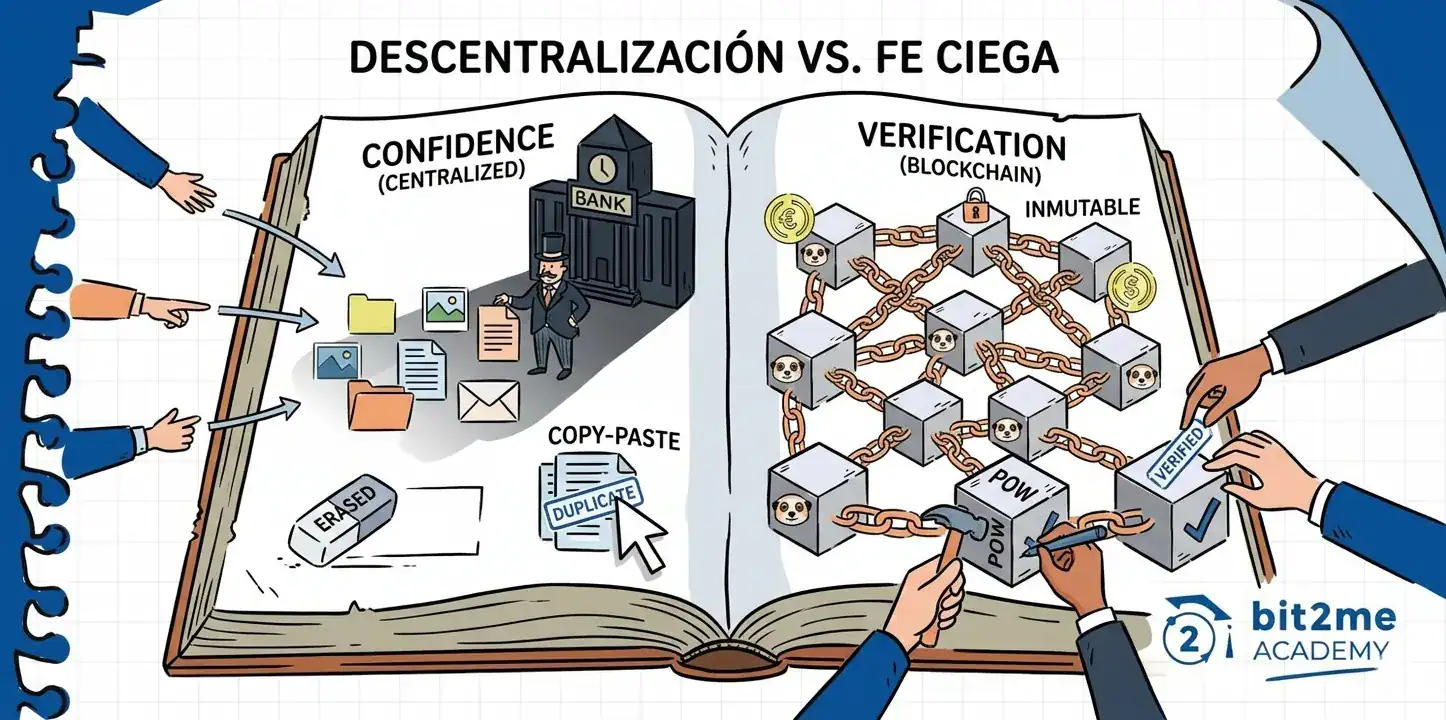
The Parable of the Meerkat: Decentralization versus Blind Faith
In this comparison, those individuals who agree on their version of the story represent the nodes. We are talking about geographically and computationally isolated connection points that, without knowing each other, maintain the integrity of the system.
To validate the story, the system requires a Proof of WorkIt's not magic; it's a cryptographic process that proves a specific chip has consumed resources to solve a complex puzzle. It's physical evidence that the data is legitimate.
Is it possible to cheat the system?
Falsifying an entry in this log would require more than half of the participants to decide to lie about the details of the meerkat's landing. They would have to do so identically, simultaneously, and without prior coordination. Coordinating an attack of this magnitude is, in practice, unfeasible.
Once the data is stamped onto the chain, it becomes immutable. This is a "write-only" database: what goes in, stays. There are no erasers or editors with special permissions. Everything is governed by consensus.
The end of intermediaries of "truth"
If you stop to think about it, almost all of your current digital activity depends on a central authority. You trust that the bank won't manipulate your balance, that the messaging server will deliver your texts, or that the antivirus won't hide a security breach.
The problem is that trust is an attack vector. If the provider makes a mistake or lies, your security collapses.
The internet has become a fragile ecosystem where almost any service is susceptible to manipulation. Faced with this chaos, blockchain technology proposes an alternative: verification instead of trust.
The accounting book that doesn't allow "copy and paste"
We often associate digital technology with the ease of duplicating files. You can copy a photo or a song a thousand times, but you can't do the same with a cryptocurrency.
In reality, tokens don't exist as files stored in a folder on your computer. What exists is a global ledger (the blockchain) that records every transaction with pinpoint accuracy. For the first time, humanity is collaboratively writing its financial history, without information dictators deciding what is true and what is false.
Can you imagine the impact of a world where transparency doesn't depend on the goodwill of a politician or a banker, but on the laws of mathematics? That's what we're building in the blockchain ecosystem.
What does the blockchain or blockchain have to say about it?
It sounds incredible but thanks to the concept of distributed consensus an incorruptible record of past and present events of the digital world can be created. Also, it would do this without compromising your privacy.
It can be recorded that the event in question has taken place and that it has succeeded without specifying specific details about the type of event or the parties involved.
This explains why bitcoin has been used to carry out illegal transactions since, despite public and free access to the “ledger”, the privacy of its users is guaranteed if required.
Typical misunderstandings about blockchain
Bitcoin is a decentralized network
This is simply not true.
The blockchain is a P2P network in which all the nodes are equal to each other resulting in a distributed system resistant to computer attacks, failures or falsifications. In this way, even if a node failed, it would be possible to reach those to which it was connected by alternative routes. This would not be possible in a decentralized system.
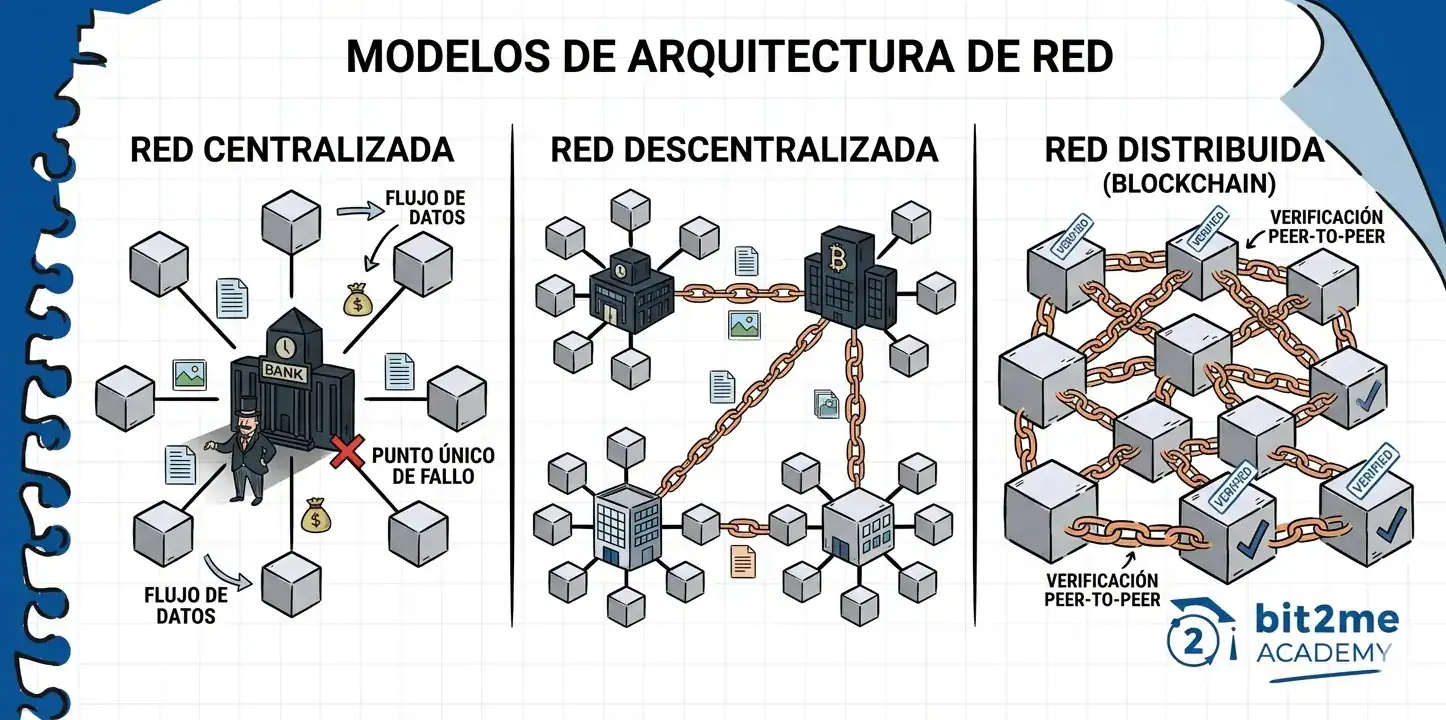
The horizon of distributed architecture: Beyond data logging
If you've followed this thread so far, it's clear that we're not dealing with a simple software upgrade. We're facing a structural change. Experts in the financial sector compare the impact of this technology to the rise of the personal computer in the 70s or the explosion of the internet in the 90s. But, honestly, those comparisons fall short when we analyze the autonomous execution capabilities we have today.
The leap to programmed execution: Smart Contracts
One of the most powerful branches of this ecosystem is the deployment of the smart contracts or smart contractsThey are not contracts in the traditional legal sense, but code that executes itself when certain pre-established conditions are met.
What is the real advantage? The ability to delegate the verification of an agreement to a network of nodes without the need for a third party to interfere in the process.
- Logistics and services: Imagine that payment to an external collaborator is automatically released the moment the deliverable passes the protocol's quality tests. No invoices pending approval, no bank waits.
- Internet of Things (IoT): A device can manage its own maintenance, acquiring supplies or hiring technical services when a fault is detected, using its own balance of crypto assets.
Where are we headed?
The implications in terms of efficiency are massive. By eliminating human friction and administrative errors, transparency ceases to be a marketing promise and becomes a system requirement.
The deployment of these programmable tokens allows value to move at the same speed as information. It's no longer just about recording who has what, but about programming how money should behave based on reality. Will we really continue to rely on manual processes and slow bureaucracy when code can guarantee compliance with an agreement with mathematical precision? The answer seems clear: automating trust is the only logical path.
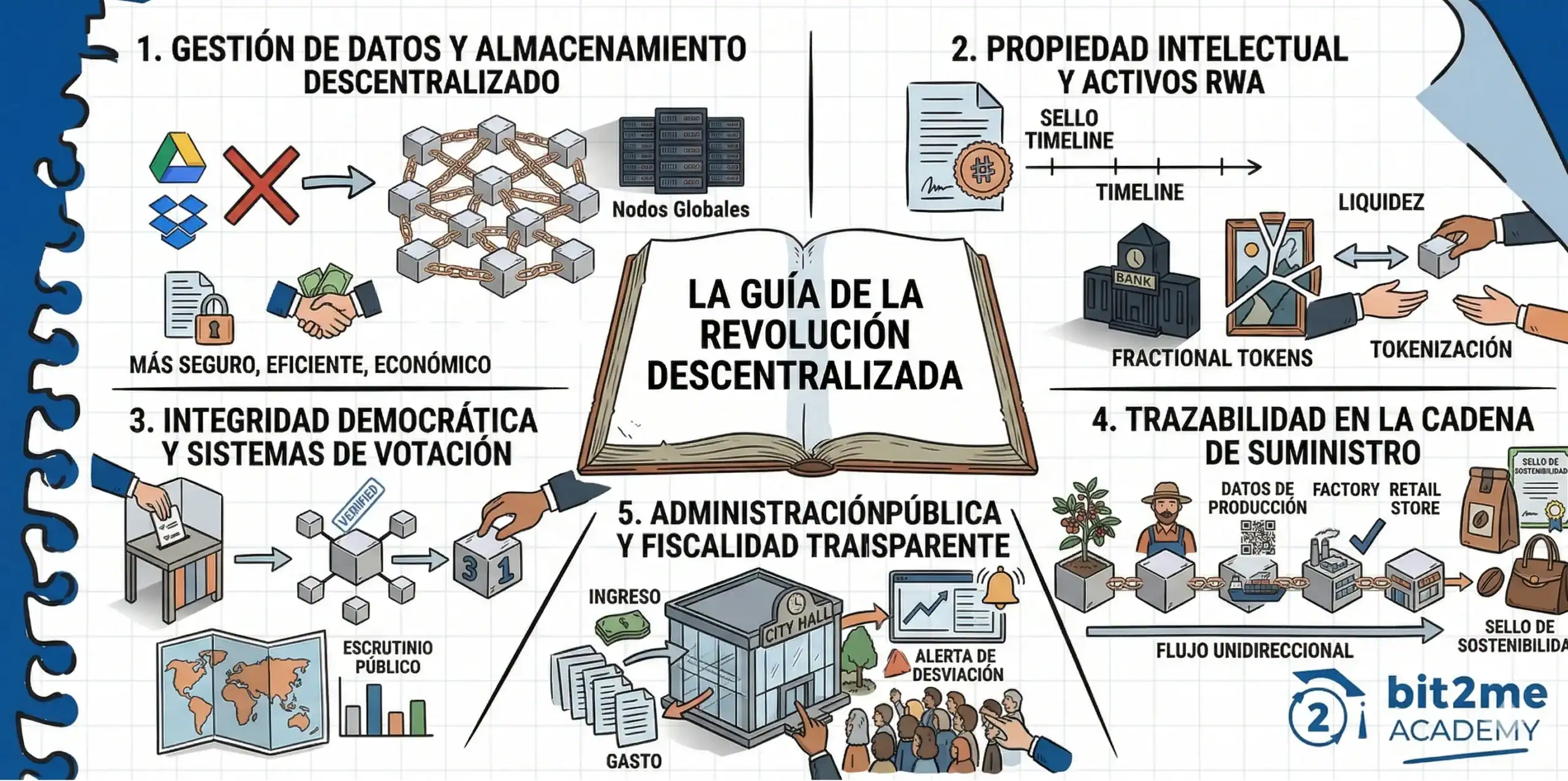
Sectors that blockchain is revolutionizing
In theory, all this looks very good, but is there a company that has already started to work to unleash the power of Blockchain?
Of course, the financial sector, which is what it was designed for, but it's not the only one. Here are some examples:
Data management and decentralized storage
Traditional services like Dropbox or Google Drive operate on a model of blind trust in a single provider. If their servers go down or they decide to block your access, you lose your data.
Projects that were once pioneers, such as Storj and Filecoin, have solidified a model where data is fragmented, encrypted, and distributed across a global network of nodes. This is not only more secure against targeted attacks, but it also allows any user with free space on their computer to rent it out, creating an efficient market that is far more economical than centralized server farms.
Intellectual Property and RWA (Real World Assets)
The ability to generate a unique hash linked to an external document has transformed patent registration. No longer is it necessary to wait years for a bureaucratic office to validate an idea; simply registering proof of existence on the blockchain provides an immutable, time-stamped record.
Furthermore, we are witnessing the tokenization of real assets. From real estate to works of art, ownership is being fragmented into tokens that can be exchanged in seconds. This brings liquidity to sectors that have historically been slow and cumbersome.
Democratic integrity and voting systems
Traditional electronic voting has always suffered from the same weakness: vulnerability to hacking and a lack of transparency in the counting process. Implementing voting on a blockchain network guarantees that each vote is a unique, unforgeable, and publicly verifiable transaction without compromising voter anonymity.
Can we eliminate suspicions of electoral fraud? Technically, yes. The cost of manipulating a distributed network with current power is prohibitive for any attacker, providing a layer of legitimacy that many modern democracies desperately need.
Traceability in the supply chain and sustainability
How do you know that "sustainable" coffee really is? Sectors like food and luxury fashion are now using blockchain to track every step of the product, from cultivation to the shop window.
Every time a batch of merchandise changes hands, a movement is recorded in the network. This not only prevents fraud and counterfeiting, but also allows for targeted recalls of defective products, pinpointing the source of the problem in seconds instead of weeks.
Public administration and transparent taxation
This is where technology clashes with political will. A city council or government could upload its cash flows to a public network like Ethereum, allowing any citizen to audit spending in real time.
- Clear accounts: If a payment goes to an address that does not have an associated invoice, the alert is immediate.
- Impossibility of alteration: Books from previous years cannot be "cooked," because the chain is a permanent historical record.
The technology to eradicate administrative corruption is ready and available. However, its actual implementation depends on those who manage institutions agreeing to submit to oversight that allows for no interpretations or favoritism. Will we ever see it on a massive scale? The tool exists; all that's missing is the courage to activate it.
What are banks doing about it with the blockchain?
The financial sector has finally detected the potential disruptor that this technology will have in your industry. In fact, almost daily there are new investments in this sector. In just one month this section could be out of date in terms of references.
In fact, BBVA with Coinbase, Bankinter with Coinffeine y Santander These are some examples of Spanish banking giants, who have bet in the form of investments to better understand Bitcoin and the role it is playing in the present and, above all, the one who will play in the future.
We also see how one of the main Estonian banks is developing a wallet that uses Bitcoin to allow free and instant money transfers.
We can think even further by putting medical records, voting, property records, marriage records, or blockchain-managed litigation on the table.
Eventually, any dataset and digital transaction could leave its "fingerprint." Creating an easily auditable trail of every digital event that takes place in history without compromising anyone's privacy.
Conclusion
It seems evident that if the blockchain as a concept survives the enormous expectation it is causing, it could introduce a level of democracy and objectivity in the digital world hitherto unheard of and unattainable in the "physical world".
The promise he makes to us carries with it a future in which no one has absolute power online and no one can lie about past or present events.
In addition, remembering the initial example of a text document with two columns, where "abc" corresponds to "34"; You should note that it has not been indicated at any time what those "34" are. This is because Blockchain is actually agnostic, it serves to keep track of things. Then, depending on the case, the "surname" or connotation that is desired or that each ecosystem deems appropriate will be associated with it. In this line, in the Bitcoin ecosystem the blockchain transports bitcoins, which are priced based on a quote that people give it. But this accounting could be used for countless things: company shares, local currencies, home ownership, diamond tags, identities… The potential is only limited by the imagination. After all, Blockchain is a distributed ledger that allows value to be transported.
Today there are hundreds of projects that, inspired by the idea of decentralization, are investigating how to extrapolate this principle to other things. Many times using even Bitcoin's open and free source code, the first ecosystem to put the pieces together in a functional way on that ideal.
Don't forget that Bitcoin is constantly evolving and at the same time Blockchain technology. It is such a dynamic sector that new solutions, integrations and innovations appear every week that continue to take this technology to new levels.
Do you think it will be able to fulfill the mission of taking us to a more transparent and fair world?
FAQ – What is Blockchain?


 Author